
The belief that “any research is good research” for the Match is wrong. The data shows that what kind of research you have—abstracts vs full publications vs nothing at all—correlates strongly with where you end up, how competitive your specialty can be, and even how program directors read your file in the first 30 seconds.
You are not competing in a vacuum. You are competing against distributions. Score distributions, publication distributions, and specialty-specific norms. Once you see the numbers, the path becomes less mysterious and more like a probability problem you can actually influence.
Let’s walk through this systematically: abstracts vs publications vs none, using real data patterns from NRMP, specialty surveys, and what I keep seeing year after year in applicant spreadsheets and match lists.
1. The Baseline: How Much “Research” Do Applicants Actually Have?
The conversation usually starts with vibes: “Everyone has tons of research.” That is false. But the average for matched applicants in competitive specialties is higher than most people realize.
Recent NRMP Program Director Surveys (and specialty-specific applicant reports) consistently show three rough tiers of research productivity by Match outcome:
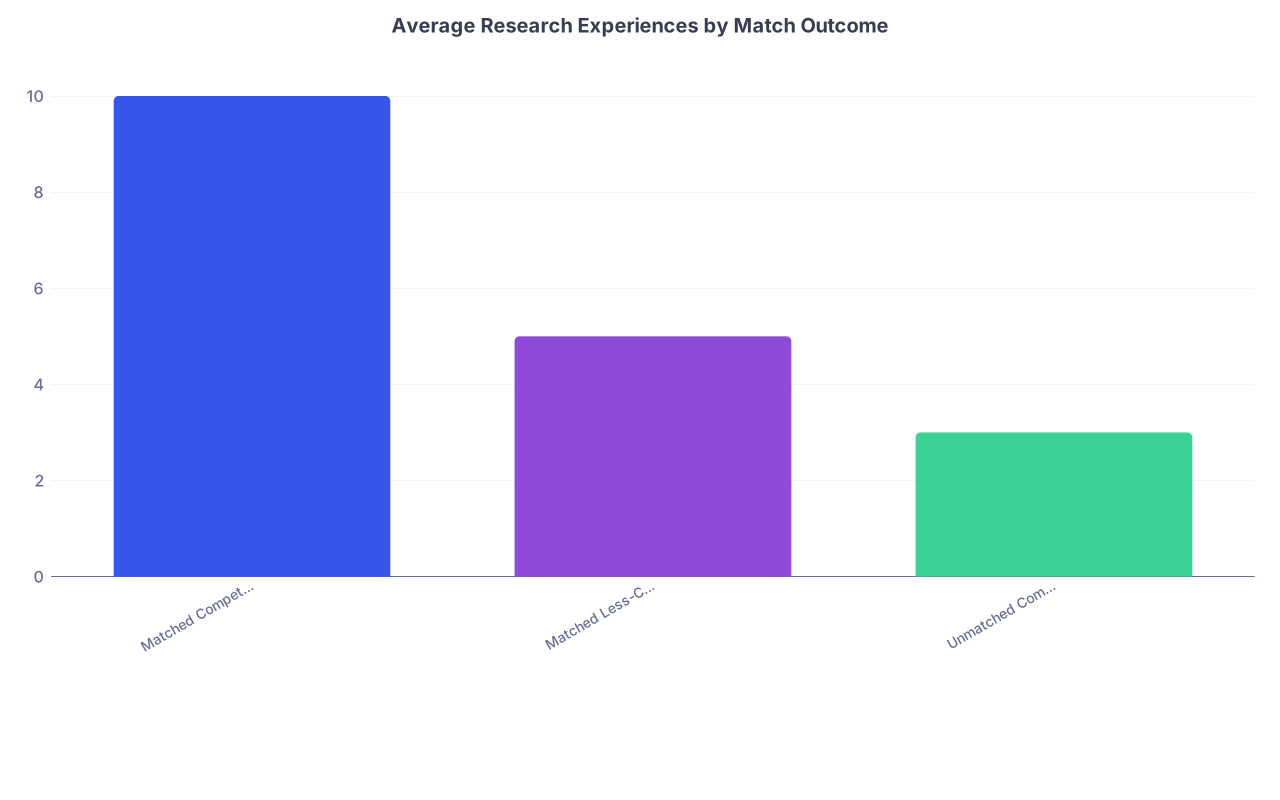
| Category | Value |
|---|---|
| Matched Competitive | 10 |
| Matched Less-Competitive | 5 |
| Unmatched Competitive | 3 |
Those “research experiences” blend everything: abstracts, posters, presentations, publications, even some QI and case reports. Not all items are equal. A single first-author paper in a mid-tier journal is simply not equivalent to four poster abstracts from the same low-impact project presented at regional meetings.
But before we split hairs, you need to see the rough research environment by specialty.
Specialty-Level Research Expectations (Approximate)
This is not precise to the decimal, but it matches what I have seen in real applicant data and NRMP outcome reports.
| Specialty Type | Typical Matched Applicant Research Items | Publications Common? |
|---|---|---|
| Ultra-competitive (Derm, PRS, Ortho, ENT) | 12–20+ | Yes, often multiple |
| Competitive (Radiology, Anesthesia, EM, Neuro) | 6–12 | Mixed; at least some |
| Mid-range (IM, Gen Surg, OB/GYN) | 4–10 | Helpful but not universal |
| Less-competitive (FM, Psych, Peds) | 2–6 | Variable, often few |
So the median derm applicant is not choosing between “one abstract vs one publication.” They are stacking many entries, often with several tangible outputs.
If you are applying IM or FM, the bar is much lower. But it is not zero. And “none” is almost always a disadvantage at competitive academic programs.
2. Abstracts vs Publications: How Program Directors Actually Rank Them
Program directors do not weigh an abstract the same as a peer-reviewed publication. They never have. They never will.
From PD survey data and many off-the-record conversations, a rough perceived value scale looks like this:
- Full, peer-reviewed original research article (especially PubMed-indexed, mid-tier or better journal)
- First- or second-author review article or meta-analysis
- Case report / short communication in a recognized journal
- National meeting oral presentation
- National meeting poster / abstract
- Local/regional meeting abstract/poster
- “Unpublished project,” QI, or “manuscript in preparation” with no clear output
You can map that qualitatively into “impact units.” It is crude, but it reflects how the file is read.
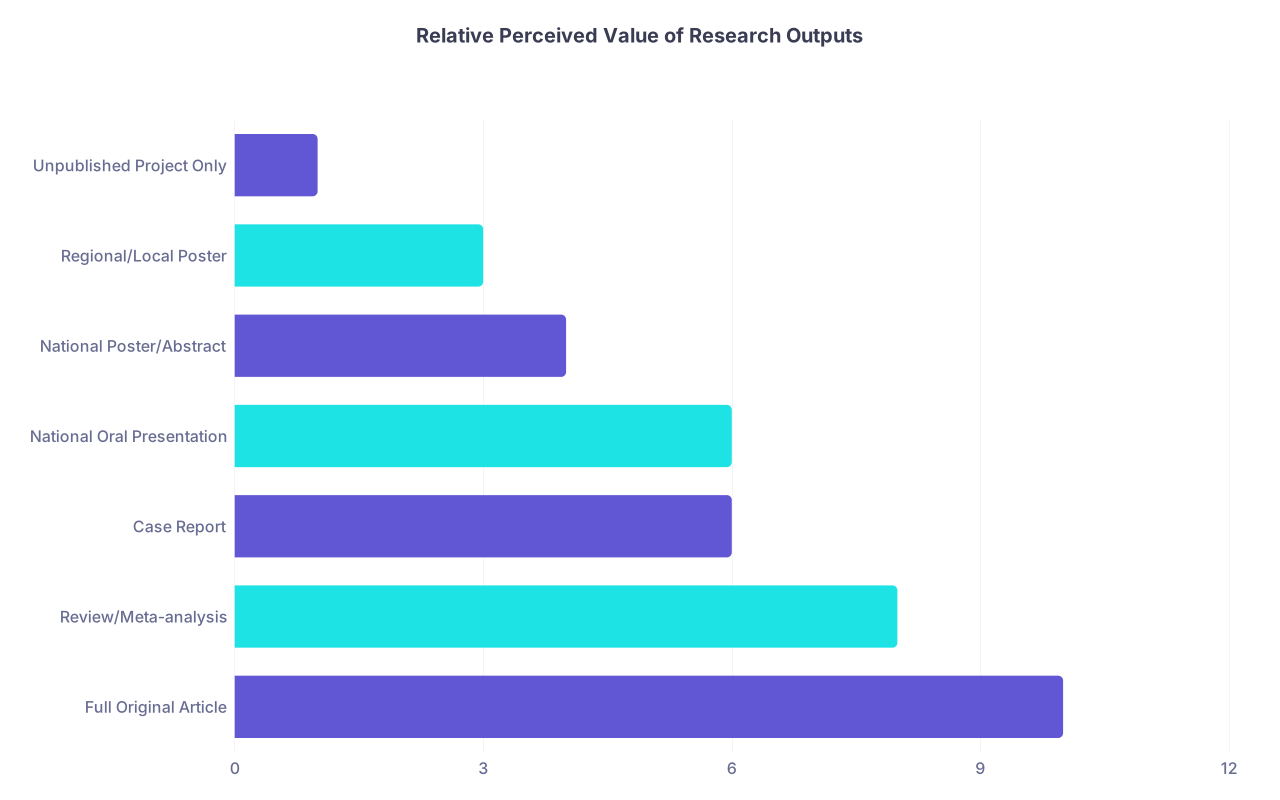
| Category | Value |
|---|---|
| Full Original Article | 10 |
| Review/Meta-analysis | 8 |
| Case Report | 6 |
| National Oral Presentation | 6 |
| National Poster/Abstract | 4 |
| Regional/Local Poster | 3 |
| Unpublished Project Only | 1 |
This is not a formal scoring system. But it explains why one strong publication can move the needle more than five posters from the same underpowered, never-published project.
So, abstracts vs publications:
- One publication usually outweighs several abstracts.
- Abstracts + ongoing work that plausibly leads to a publication can approach that value.
- A CV full of abstracts with no publication anywhere looks weaker than the raw count suggests.
3. Quantifying Match Advantage: None vs Abstracts vs Publications
Let me make this concrete with a realistic scenario, because this is where applicants get misled.
Imagine three internal medicine applicants with similar Step 2 scores (let us say 245), solid clinical grades, and okay LORs:
- Applicant A: 0 research items
- Applicant B: 4 abstracts/posters, no publications
- Applicant C: 1 first-author publication + 2 abstracts
At a community IM program, the difference may be marginal. At a mid-to-high tier academic IM program, it is not marginal. It is structural.
Most academic IM programs screen with something like:
- Step 2 threshold
- Home program / geographic ties
- Research engagement, especially for “research track” or university-heavy programs
If a program receives 3,000+ applications for 30–40 spots, they are doing some sort of filter. Research is one of the few dimensions beyond Step scores that has banded variation (0 vs 5 vs 15+ items) and is easy to eyeball fast.
A Simple Probability Model
No program director will publish this, but based on past cycles and match lists, we can approximate “relative odds” of getting serious consideration at a strong academic IM program:
- No research: baseline odds = 1.0
- Some abstracts/posters (3–5): odds multiplier ~1.5–2.0
- At least one publication (plus a few abstracts): odds multiplier ~2.0–3.0
This is conditional on having adequate scores and no red flags. It is not an absolute guarantee of anything, but it shows directionality.
So if Applicant A has maybe a 5–10% chance of getting an interview at a top 20 IM program, Applicant C might sit closer to 15–25%, all else equal. That difference compounds over 20–40 programs.
4. Competitive Specialties: Abstracts Alone Rarely Cut It
Now look at the brutal end of the spectrum: dermatology, plastic surgery, orthopedic surgery, ENT. Here the difference between abstracts and publications becomes much sharper.
A Realistic Data Snapshot
When you dig through derm and plastics applicant spreadsheets and NRMP Charting Outcomes data, you see a few consistent patterns:
- Matched derm applicants frequently list:
- 12–25 “research items”
- Often 2–5+ PubMed-indexed publications
- Unmatched derm applicants may still have:
- 8–15 “research items”
- 0–1 real publication, many abstracts/posters
Here is a simplified, stylized comparison:
| Profile Type | Total Research Items | Publications | Abstracts/Posters |
|---|---|---|---|
| Strong Matched | 18 | 4 | 10–12 |
| Median Matched | 14 | 2 | 8–10 |
| Median Unmatched | 10 | 0–1 | 8–9 |
The difference is not how many raw lines exist on the CV. It is how many of those lines ended up in actual publications, preferably in the specialty or close to it.
Program directors in these specialties know the game. They have been on the other side as applicants. Four posters from the same weak project with no submitted manuscript? They discount it.
5. The “None” Category: How Bad Is Zero Research Really?
Let’s be precise. “None” is a heterogeneous group:
- Zero research experiences of any kind
- Minimal QI or chart review work that never left the department
- Shadowing or scribing mis-labeled as “research” (yes, people do this; no, it does not fool anyone)
The data trend is consistent:
- In highly academic programs (university hospitals, big-name institutions), “no research” is a significant negative predictor of interview offers.
- In community or less academic programs, especially in FM, psych, peds, or some IM programs, “no research” is tolerated if clinical performance and fit are strong.
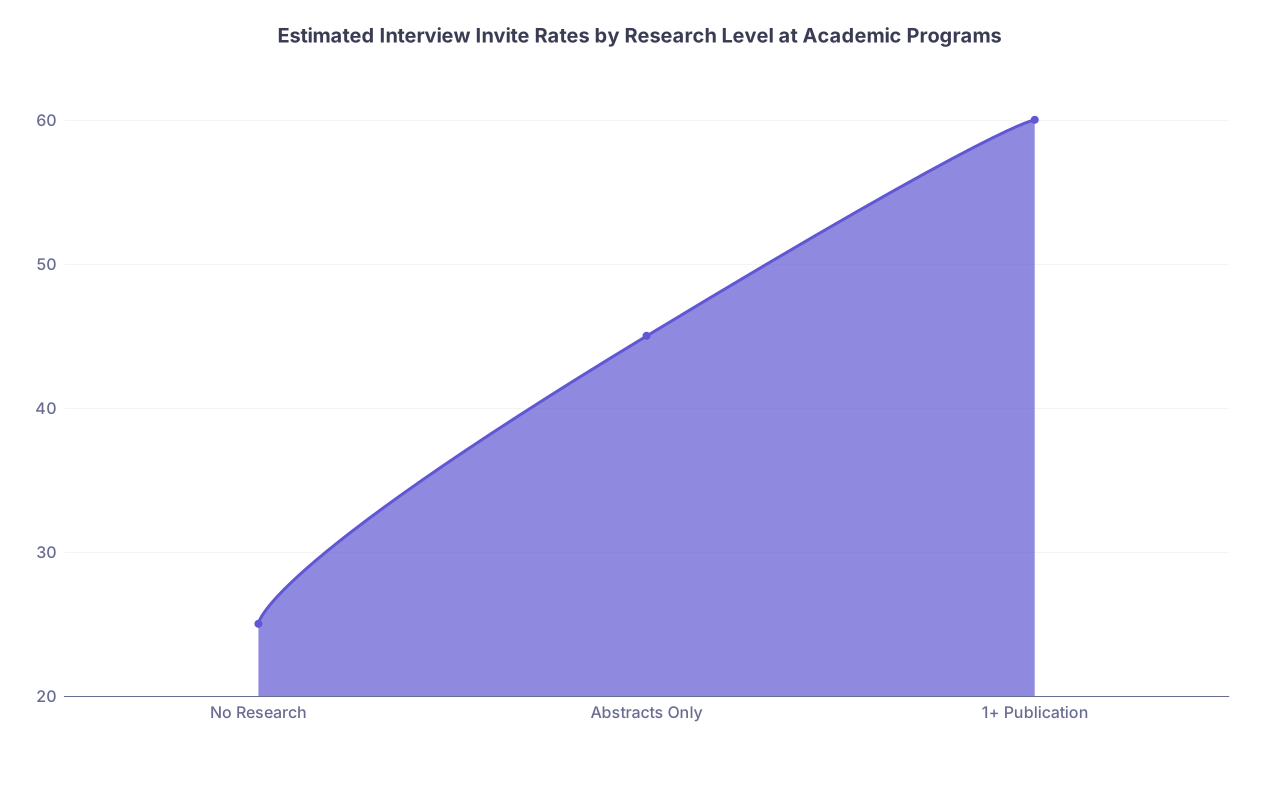
| Category | Value |
|---|---|
| No Research | 25 |
| Abstracts Only | 45 |
| 1+ Publication | 60 |
These are illustrative percentages, not official NRMP data. But they match what you would see if you sampled spreadsheets of 4th years tracking invites.
Zero research does not kill an application everywhere. But you are voluntarily putting yourself into the lowest quartile on a key screening dimension, especially for academic programs.
6. Time ROI: Is It Rational to Chase Publications vs Abstracts?
Now the question that actually matters for you: given limited time, where should you put effort? Abstracts? Publications? A bit of both?
Think of this as a return-on-investment problem.
Rough Time Costs
These are ballpark, and yes, they vary wildly. But the order of magnitude is instructive.
- Single poster/abstract from an existing dataset: 10–40 hours
- On-and-off contribution to a larger study (co-author, non-first): 50–150+ hours
- First-author original research project from scratch to publication: 150–400+ hours, often across a year or more
If you have 6–9 months before ERAS submission, the probability of moving a fresh, original project from zero to accepted publication is quite low unless the data already exist and the mentor is extremely efficient. Abstracts and case reports are simply faster to produce.
So the rational strategy, based on the data and timelines, often looks like this:
- If you have nothing:
- Prioritize 1–3 concrete, finishable outputs (case report, retrospective chart review, national or regional poster) that will 99% show up on your ERAS.
- If you already have ongoing work:
- Push the highest-yield projects toward actual submission. One accepted paper on PubMed before applications is worth a surprising amount.
For many applicants, the dominant strategy is:
- Short term: maximize “guaranteed” outputs (abstracts, small papers, case reports).
- Medium term: contribute to at least one project likely to reach publication, even if the acceptance hits after you submit—because updated CVs for interviews and fellowship still benefit.
7. How Abstracts vs Publications Play Out on Interview Day
The Match decision is not just about checkboxes. It is about the story your spreadsheet tells when a human skims it for 60–90 seconds.
Here is how different profiles feel in the room, which matters more than applicants want to admit.
Profile 1: Abstract-Heavy, No Publications
You: “I have 8 posters and abstracts across multiple conferences.”
Interviewer flips through ERAS, sees many entries that end with “Abstract presented at XYZ meeting. Manuscript in preparation” and nothing in the publications section.
Silent thought process:
“This student is enthusiastic and willing to help. But do they finish projects? Do they know how to get something across the line?”
Your risk: looking like an “eternal helper” rather than someone who can own and complete a paper.
Profile 2: Moderate Abstracts, One Good Publication
You: “I worked on a QI project and a chart review; one of them ended up as a first-author paper in [recognizable journal]. I presented parts of it at a national conference.”
Interviewer flips to publications, sees the PubMed entry, recognizes the journal or the topic.
Silent thought process:
“OK, they understand the full pipeline. They can likely handle scholarly work during residency. Their productivity is real, not just padded.”
You have evidence of follow-through. That is the part that matters.
8. Strategic Recommendations by Applicant Type
Let me be blunt. You have to think in cohorts, not in isolation.
If You Have Zero Research and Are 12–18 Months from Applying
Data-driven play:
- Aim for 2–4 concrete outputs:
- At least 1 case report or brief article that has a real shot at publication.
- 1–2 abstracts/posters (regional or national).
- Find a mentor with a track record of actually publishing (you can check their PubMed profile).
- Avoid sprawling projects with huge datasets unless the analysis is already underway.
Your goal: move from “none” to “some + at least one likely-publication-quality project” before ERAS.
If You Have Several Abstracts but No Publications and 6–9 Months Left
You are at risk of looking like the “helped-but-never-finished” person.
Data-backed plan:
- Identify your most mature project and push it hard toward submission.
- If it is realistically impossible to get accepted before ERAS, at least get it submitted and be able to say:
- “Manuscript submitted to [Journal], under review.”
That line is stronger than “manuscript in preparation” for the third year in a row.
- “Manuscript submitted to [Journal], under review.”
- Do not add endless low-impact posters just to bump your count from 7 to 10. The marginal value is small; the opportunity cost is real.
If You Already Have One or More Publications
You are now in signaling territory.
Use your existing work strategically:
- Highlight the strongest, most relevant paper in your personal statement and interviews.
- If the publication aligns with your target specialty, that is a significant plus (e.g., cardiology-focused IM applicant with first-author cardiology paper).
- You can stop chasing raw quantity unless you are targeting the ultra-competitive top of derm/plastics/ortho.
At that point, your time is usually better spent:
- Improving Step 2 / shelf performance.
- Securing strong letters from big-name faculty who know your work.
9. Abstracts vs Publications vs None: A Simple Framework
Strip away the noise. You can think of your research profile as a 3-level categorical variable:
- Level 0: None / negligible
- Level 1: Abstracts / posters only
- Level 2: At least one real publication
The effect of moving between levels depends heavily on specialty and program type:
| Target Program Type | 0 → 1 (None → Abstracts) | 1 → 2 (Abstracts → Publication) |
|---|---|---|
| Community FM / Psych / Peds | Small to moderate | Small |
| Mid-tier IM / Gen Surg / OB/GYN | Moderate | Moderate |
| Academic IM / Surgery / Neuro | Moderate to large | Large |
| Ultra-competitive (Derm, PRS, Ortho) | Large | Very large |
If you are chasing a derm spot at a top-10 program, going from 0 to 4 abstracts is a huge upgrade. Going from 4 abstracts to 1–2 solid publications is an even bigger one.
If you are applying family medicine at a solid community program, the incremental jump from abstracts to publication is smaller. It still helps for academic tracks, but Step scores, clinical performance, and fit will dominate.
FAQ (Exactly 5 Questions)
1. Does an abstract “count” as research, or do program directors mostly ignore it?
Abstracts absolutely count as research experience, especially if they demonstrate that you engaged in a real project and presented at a credible meeting. However, their “weight” is clearly lower than publications. A portfolio of only abstracts without a single publication somewhere on your CV often looks like incomplete follow-through rather than high productivity. As a starting point, abstracts are good. As an endpoint, they are suboptimal, especially for academic or highly competitive specialties.
2. If I only have time for one output, is a case report publication better than a big abstract at a national meeting?
In most cases, yes. A PubMed-indexed case report in a real journal is typically valued more than one more abstract, even at a big national meeting. That is because the publication signals that you completed peer review and navigated the full pipeline. An abstract at a major national meeting still looks good, especially for name recognition, but if forced to choose and the time cost is similar, a small but real publication usually has better long-term ROI.
3. Are “manuscripts in preparation” or “under review” worth listing on ERAS?
“Under review” has some real value; it signals the project reached the submission stage. Program directors know many will be rejected or need re-submission, but they will still see that as stronger than “in preparation.” “Manuscript in preparation” is heavily discounted. If half your CV is “in preparation” items with no actual publications, it weakens the overall impression. Use that label sparingly and only for genuinely near-submission projects.
4. Can I match a competitive specialty with no publications if I have many abstracts and strong scores?
Yes, it is possible, but you will be swimming upstream against the data. For specialties like derm, plastics, and ortho, most matched applicants at strong programs have at least one publication, often more. If you have stellar Step scores (top decile), outstanding letters, a strong home program, and 10+ abstracts, you still have a shot. But you are competing against many candidates with similar scores and multiple publications. It is not impossible, but it is statistically less favorable than having at least one solid paper.
5. If my research is not in the specialty I am applying for, does it still help?
Yes. Program directors care first about whether you can complete and disseminate scholarly work, not only about the niche topic. A first-author paper in basic science or another clinical field still shows discipline, analytic ability, and persistence. That said, specialty-aligned research is a bonus, especially in competitive fields; it signals “true interest” and future academic potential in that area. Non-aligned research moves you from “none” to “some” or from “abstracts” to “publication” in the same way. Aligned research adds an additional narrative advantage on top.
Key points, without fluff:
- The data show that moving from no research to some abstracts, and then from abstracts to at least one real publication, materially improves your odds at academic and competitive programs.
- One strong publication almost always outweighs several low-impact abstracts, because it signals completion and real scholarly ability, not just participation.