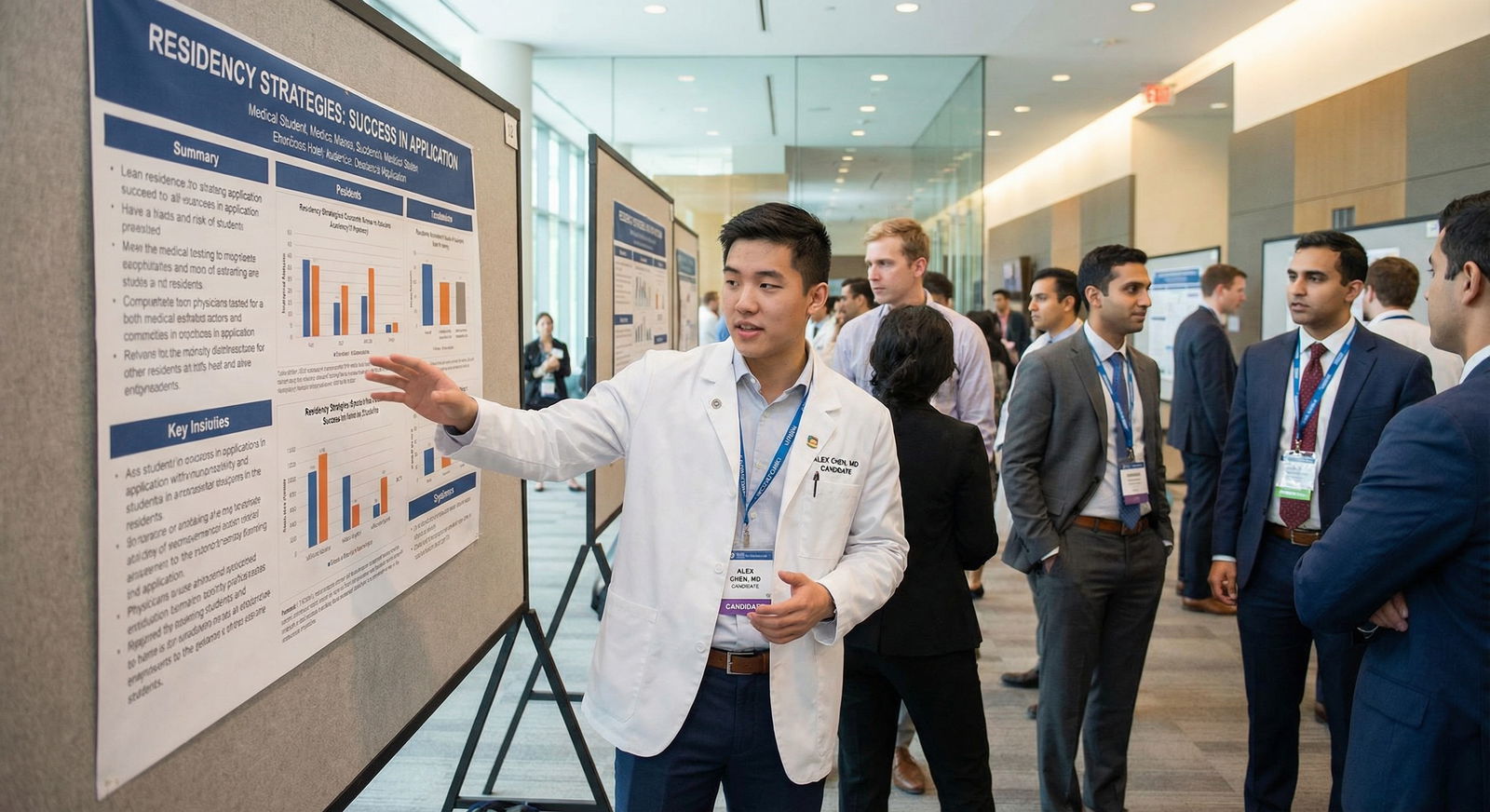
The panic about not having research is wildly overblown—but the way most applicants try to “fix” it is wrong.
If you have minimal research background, you do not need to fabricate a fake academic persona. You need to signal scholarship. That is a different problem. And a much more solvable one.
Here is the core idea:
Residency programs want evidence that you can think critically, handle data, improve systems, and contribute to the academic life of a department. Traditional research is just one way to show that. Not the only way.
You are going to build a scholarship signal using what you already have (plus some targeted work in the next 3–12 months). Step by step.
Step 1: Get Honest About Your Starting Point
Before you try to solve the “no research” problem, you need a brutally clear inventory. Not vibes. Facts.
Make a quick grid. Fill it in without sugar-coating.
| Domain | Status Example |
|---|---|
| PubMed-indexed pubs | 0 |
| Posters / abstracts | 1 local poster, no national |
| QI / education work | Helped with small QI, not listed |
| Presentations | 2 case presentations, internal |
| Teaching / tutoring | Peer tutor MS2 |
If you want to be systematic, score yourself 0–3 in each:
- 0 – Nothing / truly minimal
- 1 – Informal or local, not structured or documented
- 2 – Concrete activity, but limited reach (local, regional)
- 3 – Strong activity with clear academic output (pub, national talk, award)
You are likely staring at a lot of 0–1s. Fine. That just tells us where to build.
Now classify yourself into one of these buckets:
Absolute minimal
- No publications
- No posters
- No QI projects with your name on them
- Maybe a case presentation or two on rounds
Light but unstructured scholarship
- One or two local posters or talks
- Helped with someone else’s project but not on paper
- Did QI in a clerkship but never wrote it up
Some real activity, poor packaging
- A project that never got submitted
- A near-complete chart review sitting in limbo
- A conference abstract you never built into a paper
- Teaching or curriculum stuff no one ever called “scholarship”
This classification matters. It determines how urgent and how aggressive you need to be before ERAS opens or before you apply again.
Step 2: Understand What Programs Actually Mean by “Research”
A lot of students hear “they value research” and translate that into “they only want R01-level bench scientists with 10 first-author papers.” That is nonsense for most specialties and most programs.
What PDs actually want to see is some combination of:
- Can you ask a clear question?
- Can you work systematically to answer it?
- Can you analyze and present data without embarrassing the department?
- Do you have the discipline to finish something that takes months?
Here is what “scholarship” can legitimately include:
- Clinical research
- Quality improvement (QI) projects
- Educational projects (curriculum, teaching innovations, assessment tools)
- Case reports and case series
- System redesign, workflow optimization, informatics projects
- Serious audit / chart review work
- National committee or guideline contributions (rare, but it counts heavily)
Residency applications are full of people who touched research; far fewer own finished projects.
You are not trying to become “research heavy” overnight. You are trying to look like someone who understands and can participate in scholarship.
Step 3: Choose the Right Strategy for Your Timeline
You cannot do everything. Pick the play that matches your calendar and specialty.
Scenario A: You are 12+ Months from Applying
This is the best-case scenario. You have time to create real output.
Your priorities:
- Get on one project that can realistically result in a poster and/or paper in 6–12 months.
- Build one visible QI or education project that you can finish before ERAS.
- Learn basic research language so you sound like you know what you are doing in interviews.
Practical move set:
Email 3–5 faculty with active projects in your target specialty.
Subject line like:
“MS3 interested in [specialty]: Available to help with ongoing projects”In the email:
- 3 sentences about your interest
- 2 concrete skills (Excel, chart review, basic stats, data cleaning, organizing literature)
- Offer specific hours per week (e.g., 3–5 hours / week, evenings and weekends)
Tell them directly:
“My goal is to help move an existing project forward to abstract or manuscript stage, not start something from scratch that will never finish.”
That sentence alone separates you from the 50% of students who say “I want to do research” and then disappear.
Scenario B: You are 6–9 Months from ERAS Opening
You are not creating a full portfolio from scratch. You are going for high-visibility, lower-barrier wins.
Targets:
- A case report or case series
- A small but real QI project with measurable outcomes
- At least one poster or abstract submission
Case report strategy:
Tell residents and fellows on your rotations:
“If you have an interesting case that might be publishable and you need help with the write-up, I am very motivated and can take lead on drafting.”When a case appears, you:
- Offer to do the literature review that night
- Draft the intro / case description within 48–72 hours
- Ask your attending where they usually submit (journal vs meeting)
QI strategy:
Find pain points that already bother your team:
- Discharge summaries always late
- Vaccination rates low on your service
- Poor follow-up for abnormal lab results
- Readmission documentation a mess
Propose something simple, measurable, and time-bound:
- “Track baseline for 2–4 weeks → implement one intervention → re-measure for 2–4 weeks → present as short QI project.”
This is enough to count as structured scholarship if you document it and present it somewhere.
Scenario C: You are 0–4 Months from Applying (or Reapplying)
You are not going to fix the underlying deficit completely. Stop pretending you will whip out a first-author NEJM paper.
Your job now:
- Reframe what you already have into scholarship language.
- Add one or two quick but real signals that you care about academic work.
- Avoid looking like you just realized research exists last week.
Fast-track moves:
- Submit a case report to a reasonable journal or a poster to a regional meeting. Acceptance pending is still better than nothing.
- Turn any old project attempt into a “work in progress” with a clear plan and your role described.
- Get someone (preferably faculty) to mention your analytical / scholarship abilities in a letter.
You are playing defense, not offense. But you can still show direction and intent.
Step 4: Turn What You Already Did into Scholarship
The biggest mistake I see: students say “I have no research” when they actually have unframed scholarship.
Examples of things you may be undervaluing:
- A tough case you presented at morning report
- A student-led teaching session you designed
- A shadow-QI project you did with a resident (but never wrote up)
- Work on clinic workflow or template optimization
- Data collection you did for someone else’s project
Your job is to:
- Name it as a project.
- Define your role.
- Attach an outcome (even if small).
Example transformation:
Old story:
“We noticed follow-up on abnormal TSH was inconsistent, so I made a checklist, and people kind of used it.”Scholarship version:
“TSH Abnormal Result Follow-up QI Initiative, Community Clinic X
– Identified inconsistent documentation and follow-up on abnormal TSH results.
– Designed and implemented a standardized follow-up checklist integrated into clinic workflow.
– Collected pre- and post-intervention data over 6 weeks; preliminary review showed increased documentation completeness from ~55% to ~80%.
– Presented findings at clinic staff meeting; checklist incorporated into standard operating procedure.”
This is now a QI project. Not big. But very real.
Do this systematically:
- List every “improvement” or “extra work” you did in med school.
- For each, ask:
- What was the question or problem?
- What did we do?
- What changed?
- Did I present it anywhere (even locally)?
Turn anything that fits into an ERAS “Research” or “Leadership / QI / Education” entry.
Step 5: Build One High-Yield QI Project From Scratch
If you truly have nothing, QI is your fastest route to signaling scholarship. You do not need IRB for most basic hospital QI (check with your institution). It can be:
- Small
- Simple
- Practical
- Done in weeks to months
Framework I have seen work repeatedly:
Pick a narrow, measurable problem.
- Missed VTE prophylaxis on admissions
- Incomplete med rec on discharge
- Missing vaccination documentation
- Poor pain reassessment documentation after opioids
Define one clear metric.
- Example: “Percentage of admitted patients who had VTE prophylaxis ordered within 24 hours.”
Measure your baseline for 2–4 weeks.
- 20–50 patients is often enough for a basic QI snapshot.
- Track numerator and denominator in a simple spreadsheet.
Implement one intervention. Only one.
- Checklist on admission
- Template prompt in the note
- Brief teaching at morning huddle
- Laminated card on workstation
Re-measure for another 2–4 weeks.
- Same metric. Same process.
Present it somewhere.
- Department QI meeting
- Clerkship conference
- Local teaching day
- Posters for internal “research day”
For ERAS, you now have:
- A clear project title
- Defined role (ideally you are the main driver)
- Outcome measure and result
- Presentation line (“Presented at Department QI Meeting, Month Year”)
That is scholarship.
To make this even cleaner, outline it in PDSA (Plan-Do-Study-Act) terms. Programs love that language for QI.
Step 6: Use Case Reports Strategically (Without Getting Scammed)
Case reports are the go-to for students scrambling to show academic interest. They can be good. They can also turn into time-sinks and predatory-journal traps.
Use them with discipline:
What works well:
- Rare disease or unusual presentation
- Novel complication or drug effect
- Clear “teaching point” that is actually useful
Basic path to execution:
Identify a case where an attending says something like:
“I have never seen this before.” or “This would make a decent case report.”Say out loud:
“I would be happy to take lead on a case report with you if you are interested.”Within 48 hours:
- Draft the timeline and key data
- Start a basic literature search
- Outline intro, case description, and discussion sections
Ask your attending where they usually submit cases. Acceptable targets:
- Specialty-specific case report journals
- Lower-impact but PubMed-indexed clinical journals
- National meeting abstract→poster formats
Avoid:
- Journals that email you directly pushing for fees
- Outlets with clearly spammy names unrelated to your specialty
- Long delays with no responsiveness
Even “submitted, decision pending” is fine to list if accurate.
One strong case report with your name as first or second author is infinitely better than “I was planning to do research but it never worked out.”
Step 7: Frame Teaching and Education as Scholarship
If you have minimal classic research but strong teaching experience, use that. Many programs care deeply about residents who will help teach students.
Convert teaching into “education scholarship” by:
Structuring your role.
- Were you just informally explaining things? Fine, but that is weak on ERAS.
- Or did you design:
- A workshop
- A recurring teaching session
- A peer-tutoring program
- A study guide or curriculum?
Adding evaluation.
- Pre/post surveys (even simple, like 1–5 rating scales)
- Qualitative feedback quotes
- Attendance tracking and repeat invites
Presenting your work.
- Local education day
- Medical education conference
- Clerkship or course meeting
You can now write this up as:
- “Developed and implemented a structured peer-teaching curriculum for MS2 renal physiology review; administered pre/post surveys showing improved self-reported confidence scores from 2.3 to 4.1 / 5 (n=28); presented results at institutional education symposium.”
That is very clearly scholarship.
Step 8: Make Your ERAS Application Scream “I Can Do Scholarship”
You can have decent projects and still look weak if you list them poorly. The way you write entries matters.
For each research / QI / education entry:
Title it like a paper or project.
Bad: “Research with Dr. X”
Better: “Retrospective Analysis of [X] in [Y] Population”Specify your role.
- “Designed data collection tool; performed chart review on 120 patients; cleaned dataset; drafted methods section.”
Include concrete outcomes.
- “Abstract accepted to [Conference], presented poster, Month Year.”
- “Manuscript in revision for [Journal].”
- “Submitted to [Journal], decision pending.”
Use numbers.
- Sample size
- Time frame
- Improvement percentages
- Attendance counts
Example ERAS-style entry:
- Title: “Improving Discharge Summary Timeliness on General Medicine Service”
- Role: Medical Student, Quality Improvement Lead
- Description:
“Led QI project targeting late completion of discharge summaries. Conducted baseline audit of 80 consecutive discharges (45% completed within 24 hours). Implemented standardized discharge checklist and brief resident education session. Re-audited 75 discharges; on-time completion improved to 76%. Presented findings at department QI meeting (May 2025). Checklist incorporated into resident orientation materials.”
That reads like serious, structured work, even if the project was small.
Step 9: Signal Scholarship Verbally – How You Talk About It
You will almost certainly be asked about research or academic interests during interviews.
If your research is light, the worst thing you can do is:
- Apologize repeatedly
- Overcompensate with grand future promises
- Act defensive (“I did not have opportunity”) without showing initiative
You want a calm, direct narrative:
Acknowledge the reality without drama.
“I do not have a heavy research background compared with many applicants, especially in [specialty].”Highlight what you did do, with specifics.
“During third year, I focused on a QI project improving VTE prophylaxis orders, and a case report on [X] that is currently under review. I enjoyed the process of defining a question, collecting data, and presenting our findings to the team.”Show upward trajectory.
“Over the last year I learned how scholarship works in practice—how to move a project from an idea to actual data and a presentation. I plan to build on that in residency with more formal mentorship.”Connect to their program specifically.
“What excites me about your program is the resident-friendly QI infrastructure and your [X] research group; I would like to be the type of resident who contributes both clinically and academically, even if I am not planning a purely research career.”
This is how you own a light research record instead of looking like you are running from it.
Step 10: Avoid the Common, Time-Wasting Traps
A few patterns I see repeatedly that hurt more than they help:
Joining huge, unfocused “big data” projects late.
- You become “Person #14 who helped with data extraction.”
- Very low chance of meaningful authorship before ERAS.
- You learn almost nothing.
Starting three different projects and finishing none.
Programs would rather see one finished, small project than five “initiated” monsters.Falling for predatory journals to stack publications.
- Review committees recognize these names.
- It makes you look unserious or poorly advised.
- One or two solid, modest publications beat ten sketchy ones.
Overstating your role.
- Saying you “designed the study” when you checked 30 charts is a fast way to lose credibility if someone probes.
- Better: “Contributed to data collection and preliminary analysis for a retrospective study designed by Dr. X.”
Waiting for perfection.
- QI does not have to be perfect.
- Posters do not need to be groundbreaking.
- Being “done and presented” beats “almost ready” every time.
Quick Comparison: What Actually Moves the Needle
To keep this grounded, here is how I would rank common activities for signaling scholarship, roughly from strongest to weakest, assuming similar effort:
| Activity Type | Signal Strength |
|---|---|
| First/second author paper | Very High |
| National poster / abstract | High |
| Solid QI project with results | High |
| Case report (reputable) | Moderate |
| Local poster / talk | Moderate |
| Unfinished project ideas | Low |
Your goal with minimal research background:
Move yourself up one or two rows from where you are now, not jump from “nothing” to “KOL-level researcher.”
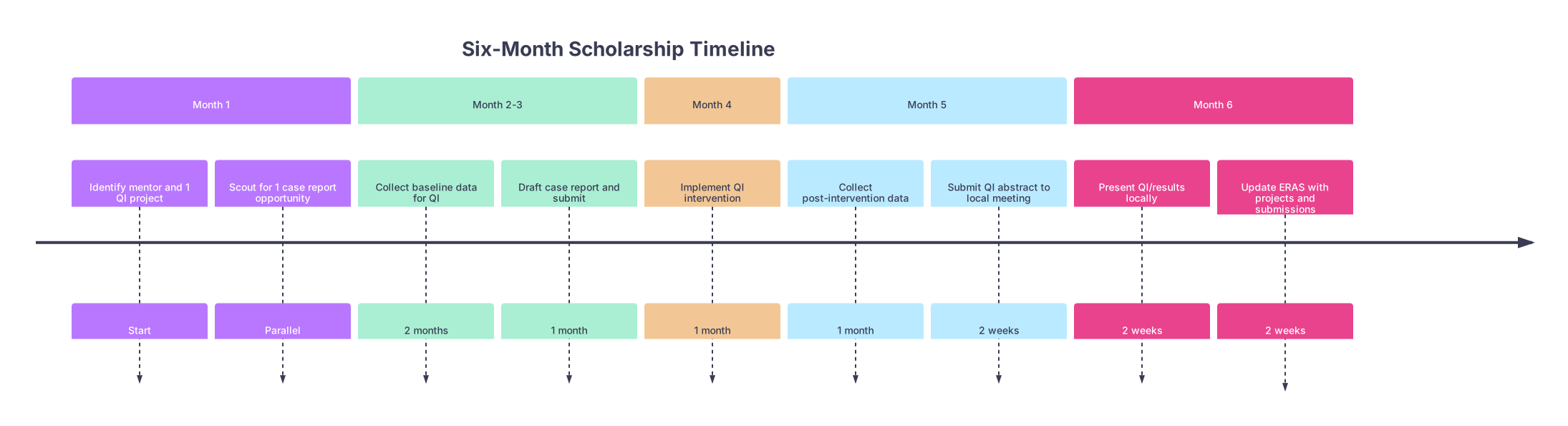
Visual: Simple 6-Month Plan to Add Scholarship
| Period | Event |
|---|---|
| Month 1 - Identify mentor and 1 QI project | Start |
| Month 1 - Scout for 1 case report opportunity | Parallel |
| Month 2-3 - Collect baseline data for QI | 2 months |
| Month 2-3 - Draft case report and submit | 1 month |
| Month 4 - Implement QI intervention | 1 month |
| Month 5 - Collect post-intervention data | 1 month |
| Month 5 - Submit QI abstract to local meeting | 2 weeks |
| Month 6 - Present QI/results locally | 2 weeks |
| Month 6 - Update ERAS with projects and submissions | 2 weeks |
Data Snapshot: Where to Put Your Effort
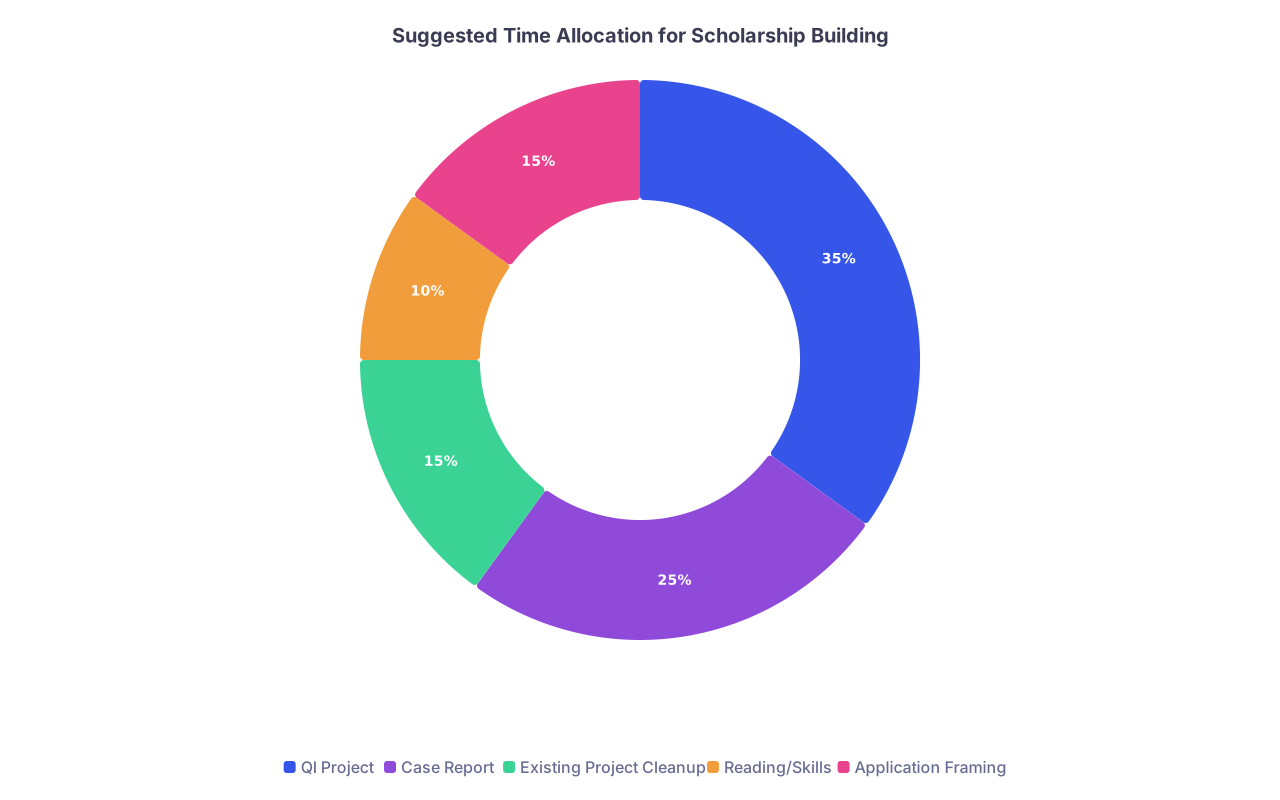
If you have limited time, you must prioritize. This rough breakdown works well for many students with minimal research:
| Category | Value |
|---|---|
| QI Project | 35 |
| Case Report | 25 |
| Existing Project Cleanup | 15 |
| Reading/Skills | 10 |
| Application Framing | 15 |
- ~35% on one decent QI project
- ~25% trying to get 1 case report done
- ~15% salvaging old / existing projects into presentable form
- ~10% learning basics (study design, statistics language)
- ~15% writing strong ERAS entries and prepping how to talk about this work
How Letters of Recommendation Can Back Up Your Scholarship Signal
Even with minimal formal research, your letters can quietly tell programs, “This person can handle scholarly work.”
You want at least one letter to say things like:
- “She approached me about getting involved in QI and saw a small project through from planning to data collection and presentation.”
- “He demonstrated strong analytical thinking on the wards, often reviewing primary literature and applying it to our patients.”
- “Although she has limited formal research experience, she clearly has the curiosity and discipline necessary for academic work.”
Your role:
- When you request a letter, state explicitly:
“I am working to strengthen the academic side of my application. If your experience with me supports it, I would appreciate if you could comment on my ability to think analytically, engage with literature, and contribute to projects like QI or teaching.”
You cannot script the letter. But you can prime your writer.
A Quick Word on Specialty Differences
Not all specialties care about research equally. But none of them dislike scholarship.
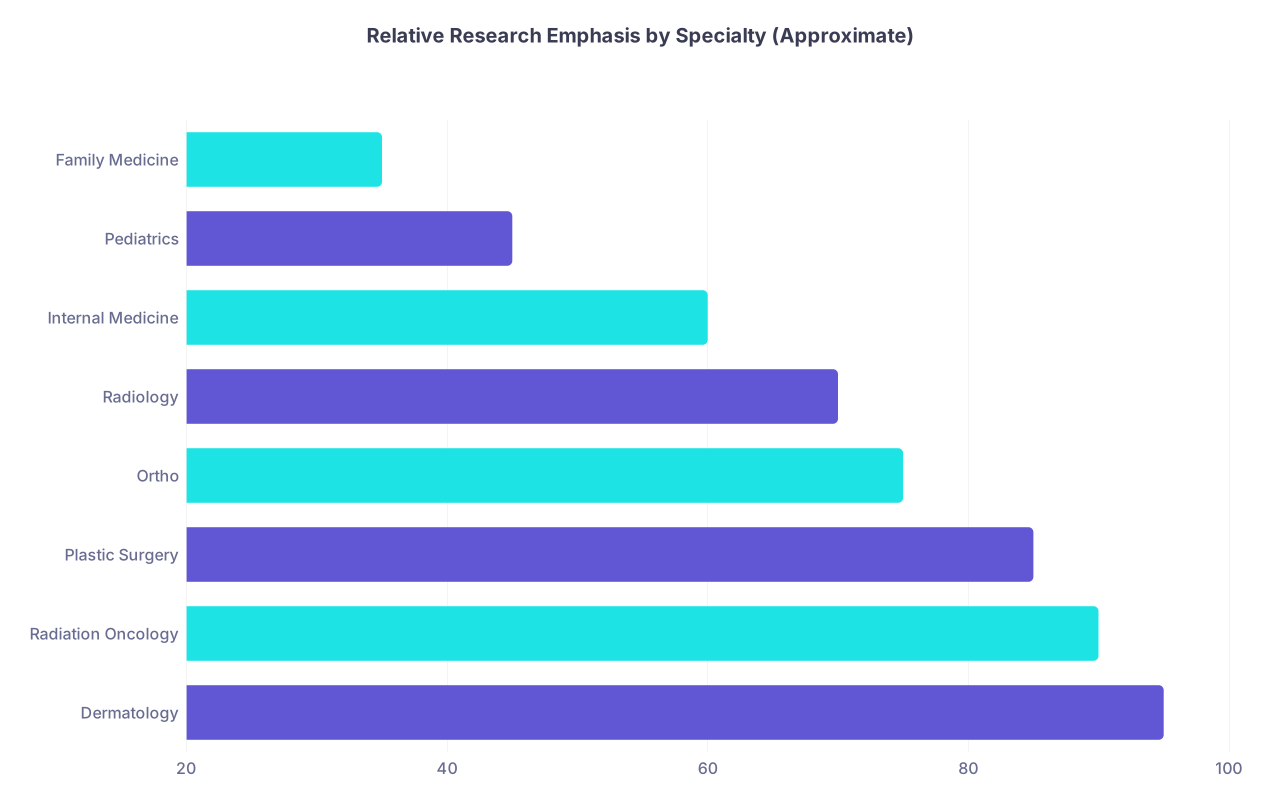
Rough, honest guidance:
| Category | Value |
|---|---|
| Dermatology | 95 |
| Radiation Oncology | 90 |
| Plastic Surgery | 85 |
| Ortho | 75 |
| Radiology | 70 |
| Internal Medicine | 60 |
| Pediatrics | 45 |
| Family Medicine | 35 |
Higher scores = more emphasis on research at competitive programs.
If you are applying to very research-heavy fields (derm, rad onc, plastics), minimal research is a serious liability at top academic centers. You may need:
- Dedicated research time or a research year
- Multiple strong projects
- Intentional targeting of more community-oriented or less research-intensive programs
For IM, peds, FM, psych, EM: signaling that you can do scholarship—via QI, a couple posters, and good framing—is often sufficient, especially outside the very top academic places.
Final Check: Are You Actually Signaling Scholarship Now?
By the time you hit submit on ERAS, you should be able to answer yes to most of these:
Do I have at least one clearly described project (research/QI/education) with:
- A defined question
- A concrete role
- A measurable outcome or clear next step?
Do at least two of my ERAS entries show:
- Data, numbers, or clear process changes?
- Presentation or submission to a meeting/journal?
Can I explain my academic interests in 2–3 sentences without sounding defensive or lost?
Does at least one letter writer know enough about my academic side to comment credibly on it?
If not, you know exactly what to work on.
Key Takeaways
- You do not fix a thin research record by panicking. You fix it by creating and clearly framing small, real scholarly projects—especially QI, case reports, and structured teaching.
- Programs care less about the label “research” and more about whether you can ask questions, work systematically, and finish what you start.
- One or two well-executed, well-described projects plus thoughtful framing in ERAS and interviews will signal scholarship far more convincingly than five half-finished ideas and vague “interest in research.”