
Your application does not fail because of the gap. It fails because the gap looks unexplained, unplanned, or out of your control.
Let me be blunt: residency selection committees have seen every version of a “nonlinear” path. Extra years. LOAs. Failed exams. Visa delays. Family crises. They do not reject you for having a story. They reject you for telling it badly—or not telling it at all.
You need a profile that looks intentional, stable, and forward‑moving, even if your path has been anything but. That is fixable.
This is how you fix it.
1. How Programs Actually Look at Gaps (Not the Fantasy Version)
Before you start patching holes, you must understand how your file is read. Committees do not read your ERAS in a vacuum; they skim in a predictable way.
The real review sequence
Most programs follow some version of this order:
- USMLE/COMLEX scores and attempts
- Medical school and year of graduation
- Transcript / MSPE (with any LOAs, withdrawals, “concerns”)
- Clinical experience recency and type (esp. US clinical for IMGs)
- Work/activities chronology
- Personal statement and any “gap” explanations
- Letters of recommendation
Gaps become a problem when they trigger one of these red flags in the reviewer’s mind:
- “Is this person clinically rusty?” (recency)
- “Is this person unreliable?” (professionalism / behavior)
- “Is this person safe?” (health, impairment, legal issues)
- “Is this person going to leave or fail out?” (retention risk)
Your job: structure your profile so that the answer to all four questions looks like a confident “No.”
2. Map Your Timeline Before You Touch ERAS
You cannot build a coherent profile from memory and vibes. You need a visual map of your entire training and work history.
Step 1: Build a month‑by‑month timeline
Open a spreadsheet. Across the top, list months and years from the start of medical school to the start of the upcoming residency year. Down the side, list categories:
- Medical school / training
- Exams (USMLE, COMLEX, others)
- Clinical work (paid / unpaid)
- Research
- Non‑clinical work
- Personal / family / health leave
- Immigration / licensing / other administrative
Now fill every month. Every single one.
If you have truly empty months, highlight them. Those are your “high‑risk” gaps. Anything you cannot explain in one clean sentence needs a plan.
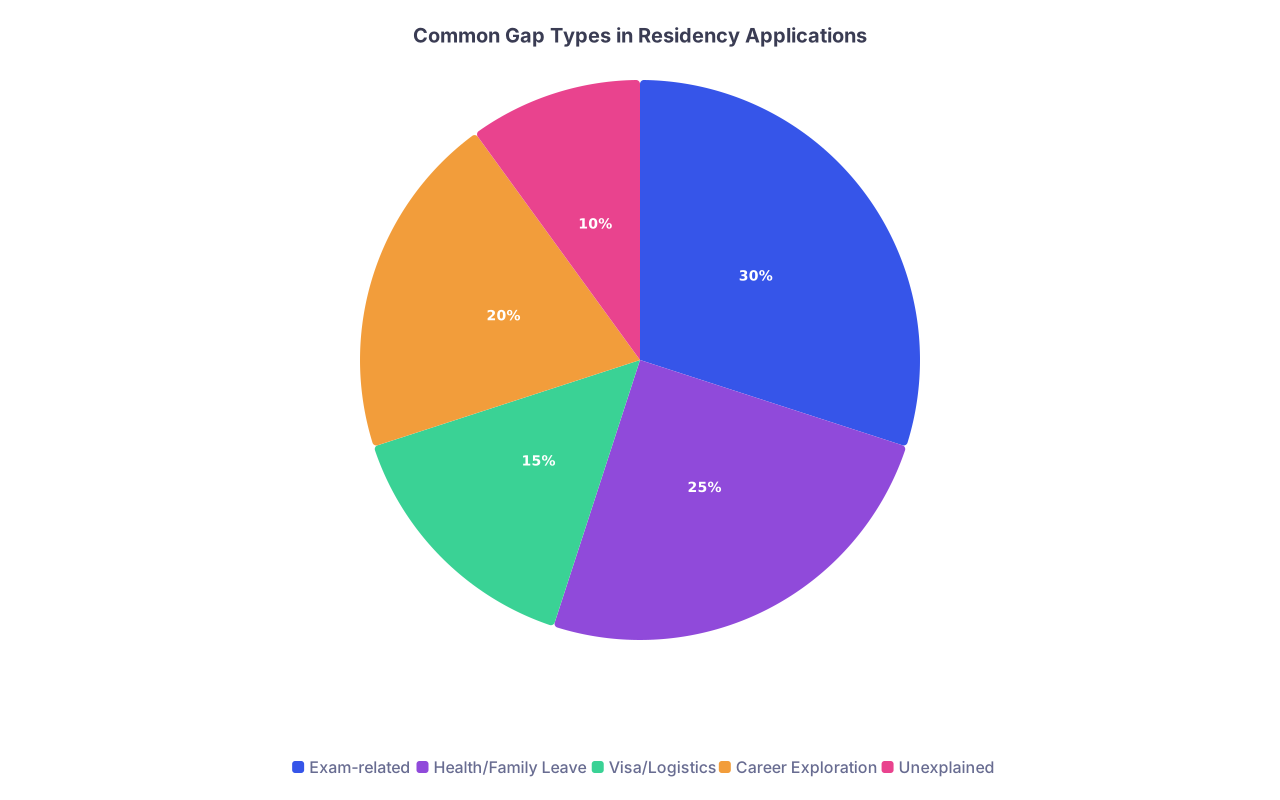
| Category | Value |
|---|---|
| Exam-related | 30 |
| Health/Family Leave | 25 |
| Visa/Logistics | 15 |
| Career Exploration | 20 |
| Unexplained | 10 |
Step 2: Identify your gap type, not your excuse
Most gaps fall into one of these buckets:
| Gap Type | Core Concern for Programs | Risk Level* |
|---|---|---|
| Exam failure / delay | Knowledge, resilience | High |
| Health or family leave | Stability, recurrence | Medium |
| Visa / administrative | Logistics, reliability | Medium |
| Career change / research | Commitment, direction | Medium |
| Post‑grad unemployment | Motivation, clinical rust | High |
*“Risk” here means how much explanation and active mitigation you need. Not moral judgment.
You are not trying to justify. You are trying to label the category so you can:
- Address the specific concern that category creates
- Choose the right place(s) in the application to address it
3. The Three Pillars of a Coherent Profile
A “coherent” profile is not “perfect” or “straight through in four years.” It is:
- Chronologically complete
- Clinically current
- Forward‑focused
If you structure your application around those three, you can carry some surprisingly ugly history.
3.1 Chronologically complete: close every hole
Programs hate unexplained blanks. Even more than they hate failures.
Your rule: no month left for the committee to guess about.
You do this using three main tools:
- ERAS “Experience” entries
- The “Education” and “Training Interruptions” sections
- Personal statement (only when needed)
How to record “ugly” time as legitimate experience
Any legitimate, structured activity can—and usually should—be entered:
- Caring for a sick parent → “Family Caregiver” (non‑clinical job)
- Recovering from a major surgery → “Medical Leave and Rehabilitation”
- Waiting on visa processing while doing online CME → “Independent Medical Study and Licensure Preparation”
Each entry should include:
- A clear title: do not hide behind vague labels
- Brief description: 2–4 lines, specific, factual
- Hours per week: realistic, even if low
- Supervisor / contact if appropriate (for formal roles)
Bad description:
“Personal time for various responsibilities and reflection.”
Good description:
“Full‑time caregiver for first‑degree relative with advanced heart failure. Coordinated appointments, managed complex medication regimen, and liaised with multidisciplinary team. Concurrently completed accredited online CME in internal medicine (approx. 20 hours/month).”
That second one answers: “What were you actually doing?” and “Were you still engaged with medicine at all?”
3.2 Clinically current: prove you are not rusty
If you graduated years ago, failed an exam, or had prolonged non‑clinical work, this is your biggest vulnerability: recency.
Programs are asking: “Will this person be safe and functional on Day 1?”
You counter that with visible, structured, recent clinical engagement.
For most applicants with gaps, I recommend aiming for at least one of:
- 3+ months of recent, hands‑on clinical experience (ideally in the target system—e.g., U.S. for IMGs)
- A recent exam success (Step 2, OET, etc.) with strong performance
- Documented, supervised work that clearly uses clinical judgment
Concrete options:
- Observerships that are structured and full‑time (not two weeks of shadowing and Starbucks)
- Research positions embedded in clinical units where you attend rounds or clinics
- Telemedicine triage roles (in some systems) under supervision
- Nursing, scribe, or physician assistant roles (depending on your background and country)
If you are more than 3 years post‑grad and have no recent clinical contact, that is a critical problem. Do not sugarcoat it. Fix it before you hit submit.

| Step | Description |
|---|---|
| Step 1 | Graduate with Gap |
| Step 2 | Secure 3-6 months supervised clinical role |
| Step 3 | Add 1-2 recent observerships |
| Step 4 | Obtain strong letters |
| Step 5 | Highlight recency in PS and ERAS |
| Step 6 | >2 years since regular clinical work? |
3.3 Forward‑focused: stop re‑litigating the past
Your story cannot be “I had this problem, then this problem, then this problem.” Programs are choosing who they want to spend 3–7 years with. They want momentum.
In every explanation—personal statement, interviews, even email—you must:
- Acknowledge briefly what happened
- Emphasize what you did to address it
- Pivot to what you are doing now and planning next
Formula:
“In [year], [concise description of issue] led to [brief consequence—LOA, delay, etc.]. Since then, I have [concrete actions: clinical work, study, therapy, new habits], and over the last [time period], I have [evidence of stability: passed exams, finished rotations, strong evaluations]. I am now focused on [training goal and how residency fits].”
You are not telling a sob story. You are giving a stability report.
4. Where to Explain Gaps—and Where to Shut Up
A coherent profile is not an over‑explained profile. Dumping every life event into your personal statement is a mistake.
You have four main channels for explanation. Use each for a specific job.
4.1 ERAS Education / Training Interruptions
Use this for:
- Official leaves of absence
- Extended delays in graduation
- Dismissals / remediations that altered your training timeline
Keep it extremely factual:
- “Took a personal leave of absence from [Month/Year] to [Month/Year] for medical reasons. Fully cleared by treating physicians to return without restrictions.”
- “Repeated third‑year clerkships from [Year–Year] after academic difficulty. Successfully completed with improved performance and professionalism evaluations.”
Do not:
- Argue with your dean’s language in the MSPE here
- Provide medical details beyond what is professionally relevant
4.2 ERAS Experience Section
Use this to:
- Close chronological gaps
- Show productive activities during “dead” time
- Build a picture of maturity and responsibility
If an experience covers a gap, lead with what a PD cares about:
- Structure (organized, not chaotic)
- Responsibility (you were accountable for something)
- Duration and consistency
4.3 Personal Statement
The personal statement is for your trajectory, not a confessional.
Address gaps here only when:
- The event is central to why you chose your specialty, or
- The issue is so large or visible (e.g., dismissal, long LOA, major fail) that ignoring it looks evasive
When you do mention it:
- One to three sentences max on the actual event.
- More time on what changed in your behavior, skills, or priorities.
- A clear pivot to your current readiness and goals.
Bad approach: half the PS about your depression or visa battles.
Better approach: one paragraph acknowledging the period, then demonstrating maturity and current function.
4.4 Supplemental Questions / Program‑specific forms
Some programs now directly ask about gaps, leaves, or “any additional information.” This is where you can be slightly more explicit than in the PS.
Use a structured response:
- Context – 1–2 lines: when, what category (health, family, exam, etc.)
- Action – 3–4 lines: what you did to address it, support you used
- Outcome – 2–3 lines: exam passed, rotations completed, letters praising reliability
- Current state – 1–2 lines: stability, no restrictions, ongoing care if appropriate
You are trying to sound like a colleague giving a brief, honest handoff. Not like someone pleading their case in front of a judge.
5. Fixing Specific Gap Scenarios
Let us get concrete. Here is how I would structure profiles in some of the most common pain points.
5.1 Multiple exam failures / long Step gap
Core concern: knowledge base, test‑taking ability, resilience.
Your strategy:
- Show a clear turning point with a different prep strategy
- Back it with one or more solid scores (even if not stellar)
- Demonstrate consistent clinical functioning alongside
In ERAS:
- Experiences: “Dedicated USMLE Study and Clinical Review” for the prep period, with details: Qbank volume, UWorld % improvements, NBME practice scores trending up.
- If you failed while doing full‑time clinical, show you changed the conditions (reduced work hours, used tutor, formal prep course).
In PS / explanations:
“After failing Step 1 twice while attempting to self‑study during full‑time rotations, I changed approach. I took protected time, enrolled in a commercial course, and worked with a learning specialist to restructure how I study. My subsequent Step 2 score of [###] and strong shelf exam performance reflect that change in method, not just more time.”
Notice: you are not describing yourself as “bad at tests.” You are describing a process problem that you solved.
5.2 Medical or mental health leave
Core concern: stability, recurrence, ability to handle residency stress.
Your strategy:
- Show that the condition was evaluated and treated
- Give clear evidence of sustained normal functioning after recovery
- Avoid gory medical detail; focus on capacity
In ERAS Training Interruption:
“From 08/2020 to 02/2021, I took a medical leave of absence to address a health condition. I completed recommended treatment and was fully cleared to return to training without restrictions. Since returning, I have successfully completed all remaining clerkships and have had no further interruptions.”
If asked in detail (e.g., interview question):
- One sentence on the category (physical vs mental)
- One sentence on treatment and resolution / chronic management
- Emphasis on 1–2 years of stable performance, including call, nights, etc.
If it is mental health (for example, depression), you can acknowledge that directly if you are comfortable, but you do not owe specific diagnosis codes.
5.3 Family care responsibilities or parenting gaps
Core concern: time availability, long‑term competing obligations.
Your strategy:
- Frame caregiving as structured and time‑limited or now better supported
- Emphasize that you have a sustainable plan for residency years
In Experiences:
“Primary caregiver for first‑degree relative with stroke‑related disability (20–30 hours/week). Coordinated home health, therapy visits, and adaptive equipment. During this period, I also maintained part‑time clinical work (see [position]) and completed focused CME in neurology and rehabilitation medicine.”
In interviews, be explicit about your future support system:
- “My [relative] is now in a long‑term facility / other family has taken over primary care.”
- “We have full‑time childcare arranged, with backup from [partner / local family].”
Programs do not hate parents or caregivers. They hate surprises and chronic scheduling disasters.
5.4 Years of non‑clinical research or industry work
Core concern: commitment to clinical medicine, bedside skills erosion.
Your strategy:
- Show that you remained clinically adjacent, not in a completely different world
- Demonstrate active steps to refresh clinical skills before residency
In Experiences:
- Detail anything that touched patients: data collection in clinics, participation in tumor boards, etc.
- Add recent observerships or PRN clinical jobs before applying if you are several years out.
In PS:
- Explain why you stepped into research or industry (genuine interest, not “running from clinical”).
- Show why you are choosing to return to the bedside now—specific to the specialty you are applying to.
5.5 Unemployment or “nothing” periods post‑graduation
Core concern: motivation, professionalism, possibly match rejections.
If you truly did very little for a stretch (it happens), you cannot rewrite history. You can, however, avoid making it look worse.
Your strategy:
- Identify anything structured and relevant you did—online CME, volunteering, long‑term study, even language courses for patient care.
- Bundle very low‑density periods into one honest entry instead of pretending you did 40 hours/week of “self‑improvement” with no proof.
Example:
“Independent Medical Study and Transition Planning (05/2021–11/2021). After not matching in 2021, I reassessed my application with mentors, completed over 60 hours of online CME in internal medicine, and began regularly volunteering with [community clinic / health outreach]. This period helped me clarify my commitment to internal medicine and led to [subsequent structured role].”
You are owning the stall, then showing how you turned it into a pivot.
6. Aligning Your Story Across All Parts of the Application
This is where many applicants with gaps blow it. They fix one part (personal statement) and forget the rest.
Your test for a coherent profile:
- Timeline audit: Can a stranger reconstruct your last 8–10 years with no unexplained months longer than ~3 months?
- Consistency check: Does the way you describe your gap in ERAS match the tone and facts in your PS and any dean’s letter comments?
- Recency evidence: Is there obvious, recent clinical and/or exam activity within the last 12–18 months?
- Forward story: If someone reads your PS last, do they feel like your main story is about the future, not the gap?
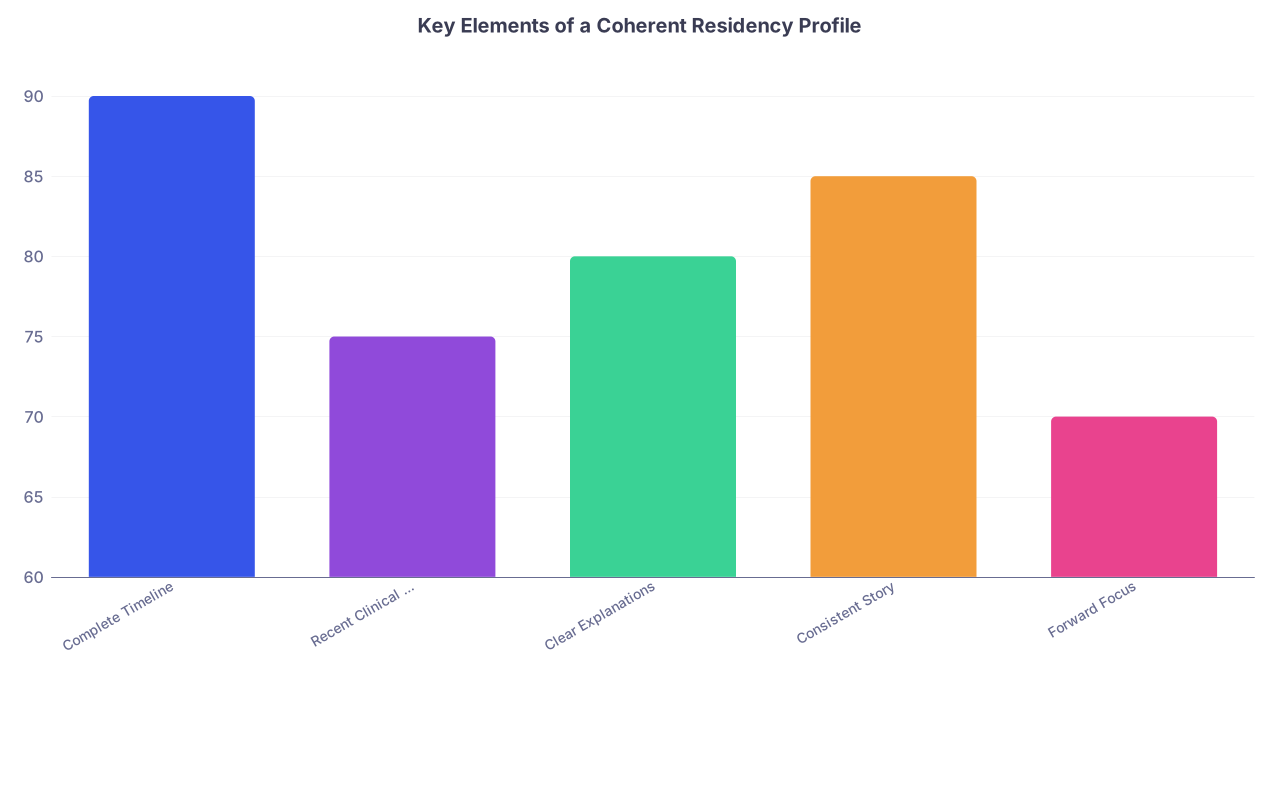
| Category | Value |
|---|---|
| Complete Timeline | 90 |
| Recent Clinical Work | 75 |
| Clear Explanations | 80 |
| Consistent Story | 85 |
| Forward Focus | 70 |
If you are not sure, have someone outside your close circle read your application and answer two questions:
- “Where do you stumble or get confused about what I did when?”
- “If you were a PD, what would you worry about?”
Then fix those exact points.
7. Specialty‑Specific Risk Tolerance for Gaps
Not all specialties react to gaps the same way. Some care more about research continuity; others care more about physical/mental resilience.
| Specialty | Clinical Recency Priority | Exam History Sensitivity | Gap Flexibility |
|---|---|---|---|
| Internal Med | High | Moderate | Moderate |
| Family Med | High | Lower | Higher |
| Psych | Moderate | Moderate | Moderate |
| Surgery | Very High | Very High | Low |
| Pathology | Moderate | High | Moderate |
Surgical and procedure‑heavy fields are notoriously unforgiving about:
- Physical/mental health leaves (they will probe durability)
- Long gaps without hands‑on clinical work
- Exam failures
Primary care fields are often more flexible but still want:
- Clear clinical recency
- Evidence that you can handle volume and documentation
Psych will look sharply at mental health‑related leaves—less from stigma, more from concern about relapse in a high‑stress field. How you frame ongoing treatment (if any) matters.
Match your narrative to the culture of the field you are entering.
8. Build a Simple “Coherent Profile” Checklist
You are trying to solve a practical problem, not write a memoir. Use a checklist.
Before you submit, you should be able to say “Yes” to all of these:
- Every month from the start of med school to now is accounted for somewhere
- Any formal leaves or interruptions are clearly but briefly documented
- I have at least one recent, structured clinical experience (or I am actively getting one before the next cycle)
- My major challenges (exam failures, health, family leave) are acknowledged, not hidden
- I clearly show what I did to address those challenges
- My personal statement spends more words on my current readiness and future goals than on past problems
- The story in my PS matches the facts in my MSPE, transcript, and ERAS entries
- If someone read only my experiences and PS, they would see progression, not random flailing

| Step | Description |
|---|---|
| Step 1 | Map Full Timeline |
| Step 2 | Classify Gaps by Type |
| Step 3 | Add/Refine ERAS Experiences |
| Step 4 | Document Official Interruptions |
| Step 5 | Update Personal Statement |
| Step 6 | Secure Recent Clinical Work |
| Step 7 | External Review and Revise |
FAQ (Exactly 3 Questions)
1. Should I ever completely omit mentioning a gap or leave?
Yes, if it was short, informal, and not documented anywhere else. For example, two months between finishing med school and starting a research job does not need its own sob story. You just cover that time with the start/end dates of adjacent experiences. However, if your school issued an official leave of absence, or if your transcript/MSPE mentions it, you must align your explanation with that reality. Hiding documented interruptions looks dishonest and is worse than the interruption itself.
2. What if my gap reason is something I really do not want to disclose (e.g., sensitive mental health or family issues)?
You can protect details and still be transparent. You are allowed to use higher‑level language like “medical leave” or “family circumstances” without specifying diagnoses or intimate family situations. Focus on function: that you sought appropriate help, followed treatment, and have demonstrated stable performance since. If pressed in an interview, you can calmly set a boundary: “I am comfortable sharing that it was a health issue that is now well managed, and I have had no restrictions in training since.”
3. Is it better to apply now with gaps or wait a year to strengthen my profile?
If your gaps are recent and you have no substantial clinical recency or clear remediation of past problems, waiting a year to build a stronger, more coherent profile is usually smarter. Use that year to secure supervised clinical work, pass any remaining exams on the first next try, and build 1–2 strong letters that comment directly on your reliability and readiness. If, on the other hand, your gaps are several years in the past and you already have solid recent work and letters, waiting just to “feel better” about your story rarely changes anything.
Open your timeline right now—spreadsheet, notebook, whatever you use—and fill in every month from the start of medical school to today. If you cannot explain a block of 3+ months in one clean, professional sentence, that is your first fix.