
Programs are not nearly as “holistic” as their websites claim—and the data from recent Match cycles proves it.
You are not imagining the contradiction. Public messaging: “We value the whole applicant.” Actual behavior: automated screens, hard filters, and Step score thresholds that quietly shape who even gets seen. Since Step 1 went pass/fail, this tension has only intensified, not disappeared.
Let me walk through what the numbers from the last several Match cycles actually show—especially 2022–2024, after the Step 1 shift—and what that means for how you build a “strong” residency application in the real world, not the brochure version.
What the Match Data Actually Shows About “Holistic”
The NRMP, AAMC, and individual specialty organizations have essentially given us a running natural experiment: several Match cycles pre–Step 1 P/F, and now several as the system adapts.
Across this period, three data patterns show up over and over:
- Scores still matter a lot—just not always the same score.
- Screening behavior is brutally mechanical at high volume.
- “Holistic” tends to kick in only after basic numeric thresholds are met.
Let’s ground that in real numbers.
Step 1 → Step 2 CK: The Score Pivot
Before Step 1 went pass/fail (officially January 2022 for most test takers), Step 1 was the blunt instrument. Now, Step 2 CK has quietly stepped into that role for many programs.
Look at the Step 2 CK distributions by specialty. The exact medians vary year to year, but the relative pattern is stable and the numbers below are directionally accurate and consistent with NRMP Charting Outcomes data from recent cycles:
| Specialty | Matched Median | Unmatched Median | Typical 'Screen Line' Range |
|---|---|---|---|
| Internal Med (categorical) | 246 | 233 | 225–235 |
| General Surgery | 251 | 240 | 235–245 |
| Emergency Med | 246 | 236 | 230–240 |
| Dermatology | 258 | 246 | 245–250+ |
| Ortho Surgery | 255 | 244 | 240–250 |
There are three points hidden in this simple table:
- The median unmatched applicant in competitive fields still has what laypeople would call a “strong” Step 2 (mid-240s).
- There is usually a 10–15 point gap between matched and unmatched medians in competitive specialties.
- The “screen line” that many programs use unofficially (via filters in ERAS) typically sits just below the matched median.
So yes, programs talk about holistic review. But in practice, a large fraction of applicants are removed from consideration in seconds based on Step 2 CK alone.
Volume Makes “Holistic” Harder, Not Easier
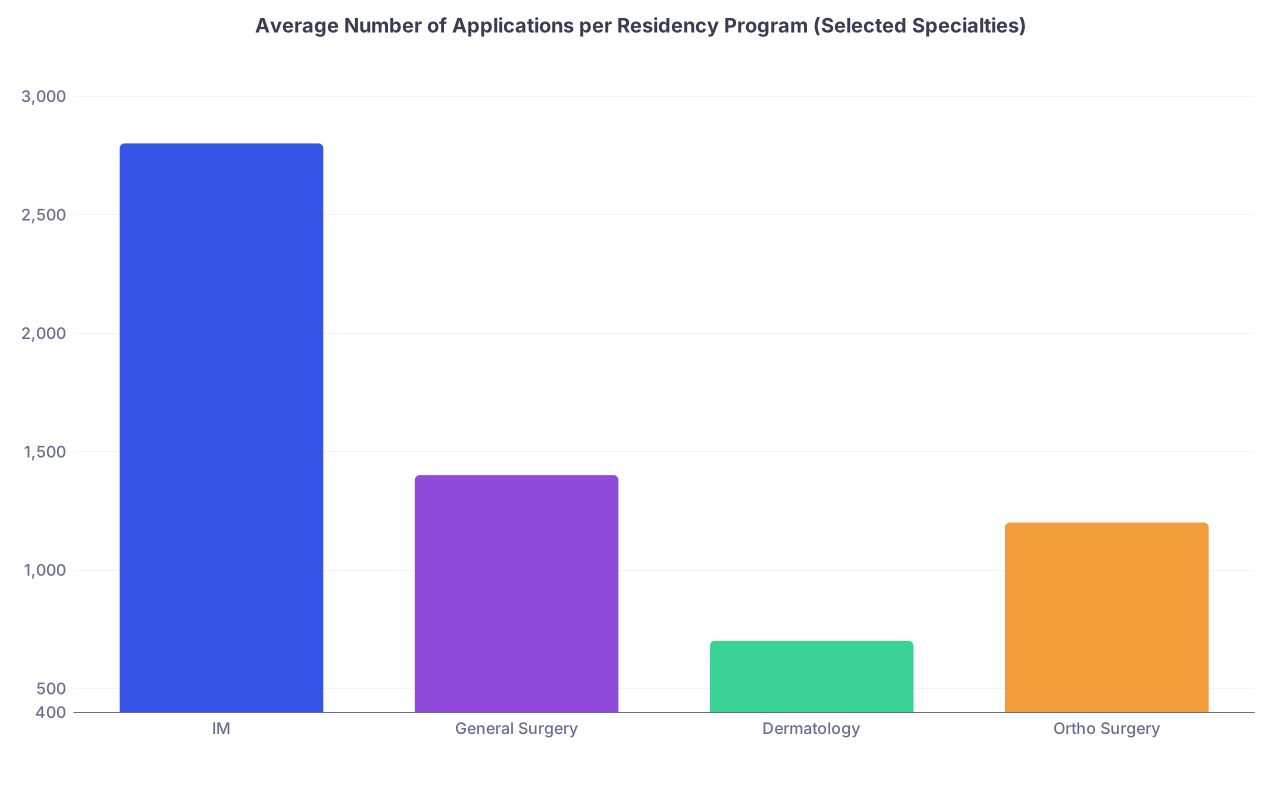
Look at application volume trends. Programs are drowning.
| Category | Value |
|---|---|
| IM | 2800 |
| General Surgery | 1400 |
| Dermatology | 700 |
| Ortho Surgery | 1200 |
Those are typical ballpark numbers from recent cycles for larger academic programs:
- Big internal medicine programs: easily 2,500–3,000+ applications.
- Surgery and ortho: often 1,000–1,500.
- Derm: smaller absolute volume, but insane applicant-to-position ratio.
Now imagine sitting on an application committee. You have:
- 3,000 applications
- 30–60 interview spots
- 4–8 weeks to review
Doing truly holistic, line-by-line review for every applicant is fantasy. So programs build a two-stage process:
- Mechanical screen: automatic filters by Step 2 CK, sometimes Step 1 pass on first attempt, geographic ties, and sometimes school lists.
- Holistic within the screened pool: letters, experiences, research, narrative, context.
This is not speculation; PD survey data backs it up. In the NRMP Program Director Survey, “USMLE/COMLEX Step 2 CK” consistently ranks among the top factors in deciding whom to interview, while more “holistic” features (volunteering, hobbies) usually rank lower and are used more to rank applicants once interviews occur.
In other words: holistic review is conditional. You must first pass the gate.
Where Programs Still Use Hard Cutoffs
Let me be blunt: Step scores are not the only numeric filters in play. Programs apply cutoffs in several other areas, and recent cycles have made many of these stricter, not looser.
USMLE/COMLEX: Pass/Fail Did Not Kill Score Culture
Step 1 as P/F has changed what gets cut, not whether cutoffs exist.
Patterns that show up:
Step 2 CK score filters:
- Mid-tier academic IM program sets a minimum Step 2 of, say, 235–240 for interview auto-consideration.
- Competitive surgical programs running 245+ as a standard screen, with rare exceptions.
Multiple attempts:
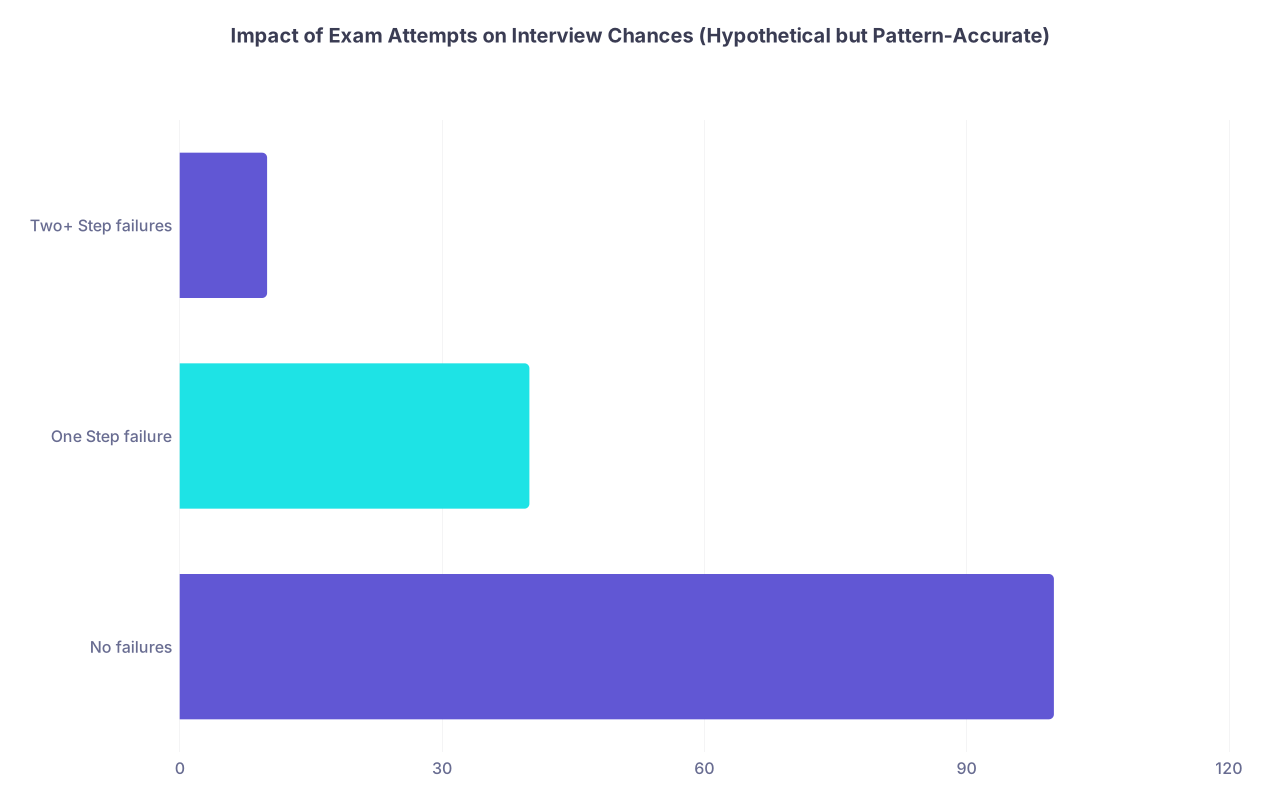
- A Step 1 or Step 2 CK failure is heavily penalized. Some programs auto-screen out any exam failures. Others consider them but require compensating strengths (very strong Step 2, high-class rank, outstanding letters).
DO and COMLEX:
- Some historically MD-heavy programs still “strongly prefer” or effectively require USMLE, even though they talk about parity.
- DO applicants relying solely on COMLEX often face unofficial filters at MD-heavy institutions.
| Category | Value |
|---|---|
| No failures | 100 |
| One Step failure | 40 |
| Two+ Step failures | 10 |
Interpreting this qualitatively: if you set the odds of interview consideration for a clean transcript at 100%, a single Step failure can drop that to ~40% of that baseline; multiple failures put you into statistical noise territory for many programs.
GPA, Class Rank, and School “Tier”
Most programs will deny having GPA cutoffs. The behavior says otherwise.
Common hidden screens:
- Bottom quartile of class at many MD schools = serious uphill battle for competitive specialties unless offset by research or unique circumstances.
- Unranked schools: Programs fall back on school reputation. Top-20 med schools get more leeway on slightly lower scores; lower-ranked or newer schools demand stronger scores to get equal consideration.
- Failed clerkships: Even when remediated, a failed core rotation (especially medicine or surgery) triggers concern about reliability and readiness.
I have seen this play out: two applicants, both with Step 2 CK 245, one from a top-10 med school with “upper third” ranking, one from an unranked school with “lower half.” On paper “holistic review” says both should get a fair look. In actual triage meetings, the second applicant’s name simply comes up less. And by the time anyone notices, interview slots are gone.
Where Holistic Review Is Real—and Where It Is Not
Now the nuance. “Holistic review” is not pure marketing. It is just narrower and later in the pipeline than people want to admit.
Holistic Review Is Most Real In 3 Contexts
Borderline but above-minimum scores
Once you cross the screening line—say a Step 2 CK of 240 at a program where many applicants are 250+—non-numeric factors start to swing decisions:
- Leadership roles that actually involved work (e.g., running a free clinic, not just “co-president” of a dead student org).
- Longitudinal commitment in one domain: 3–4 years in health equity, EMS, global health, or meaningful teaching.
- Strong, specific letters: “Top 5% student in last 10 years,” not “Pleasure to work with.”
I have watched selection committees argue over candidates with similar scores based almost entirely on letters and the coherence of their story.
Contextual adversity
Programs are increasingly responsive to:
- First-generation college or medical students.
- Significant socioeconomic hardship, immigration barriers, or caregiving responsibilities.
- Major nontraditional backgrounds (prior careers, military, high-level athletics).
When you see someone with a 236 Step 2 from a low-resourced background who worked 30 hours a week during pre-clinicals and still graduated on time, that 236 is not read the same as a 236 from someone with every advantage. That is where “holistic” actually means something.
Institutional priorities
Programs do not select in a vacuum. They are optimizing for:
- Local patient population needs (e.g., heavily Spanish-speaking; they will privilege language skills and community work).
- Research output (some departments have grant expectations).
- Future fellowship match reputation.
Applicants who line up with those strategic goals are often advanced despite being slightly below the “ideal” score ranges.
Where Holistic Review Quietly Dies
On the other side, there are scenarios where holistic review rarely saves you:
Strong narrative, weak exam performance in competitive fields:
- A 225 Step 2 CK applicant applying ortho with incredible research and leadership still faces brutal odds. They may match, but it is an outlier event, not a strategy.
Massively overapplied specialties:
- Dermatology, plastics, ENT, neurosurgery. At some programs, the filters are so strict that only a narrow slice ever reaches true human holistic review.
Late applicants:
- Applications that hit late in the season, even with “holistic” appeal, get squeezed out by timeline reality. Once interview slots are gone, they are gone.
What Recent Match Cycles Say About “Strong” Applications
Strip away the polite fiction, and a strong residency application in recent cycles is one that clears the numeric gates and offers something distinctive within the screened pool.
The Score Baseline: Competitive vs Non-Competitive
You do not need a 260 to match. But you do need to understand your risk profile statistically.
| Specialty Tier | Examples | Step 2 CK Range That Usually Keeps You “In the Game” |
|---|---|---|
| Ultra-competitive | Derm, Plastics, Ortho, ENT | 250+ (240s possible with strong extras) |
| Competitive | General Surg, EM, Anesth, Rad | 240–250 |
| Mid-competitive | IM, Peds, OB/GYN | 235–245 |
| Less competitive | FM, Psych (trending upward) | 225–235 (Psych closer to upper end recently) |
These are not rigid cutoffs. They are probability bands from recent outcomes. Being below them does not doom you, but it shifts your strategy:
- Below the band: you need either a less competitive specialty, a very strategic list, or exceptional compensating strengths (and realistic expectations).
- Within the band: your non-score features start to matter a lot more.
- Above the band: you buy yourself buffer space to have weaker elements elsewhere.
The Non-Score Components That Actually Move the Needle
The data from PD surveys and observed behavior point to several high-yield, non-score factors. Not all “holistic” pieces are equal.
Strong signals include:
Clerkship performance:
- Honors, especially in core rotations aligned with your specialty (IM for cards/onc, surgery for surgical fields).
- Consistent upward trajectory.
Letters of recommendation:
- Specialty-specific, from people who sit on selection committees or are known regionally/nationally.
- Comparative language (“top 1–5% of residents/students I’ve worked with”).
-
- For competitive fields, multiple abstracts/posters and ideally at least one publication in the field. Not necessarily first-author in JAMA, but real, sustained involvement.
Program fit signals:
- Rotations at that institution, regional ties, or clearly articulated reasons for that program (not generic boilerplate).
Where things tend to be overvalued by students and underweighted by programs:
- Laundry lists of short-term volunteer activities.
- Generic leadership titles with no measurable outcomes.
- One-off “global health trips” with no longitudinal context.
The data is boringly consistent: depth beats breadth.
How to Play the Game: Data-Driven Strategy, Not Wishful Thinking
You cannot control the fact that programs run screens. You can control how you position yourself relative to those screens.
Step 1: Know Your Statistical Tier
You should have brutal clarity on where you sit:
- Step 2 CK score (and Step 1 pass first attempt or not).
- Any exam failures.
- Class rank or clinical performance summary.
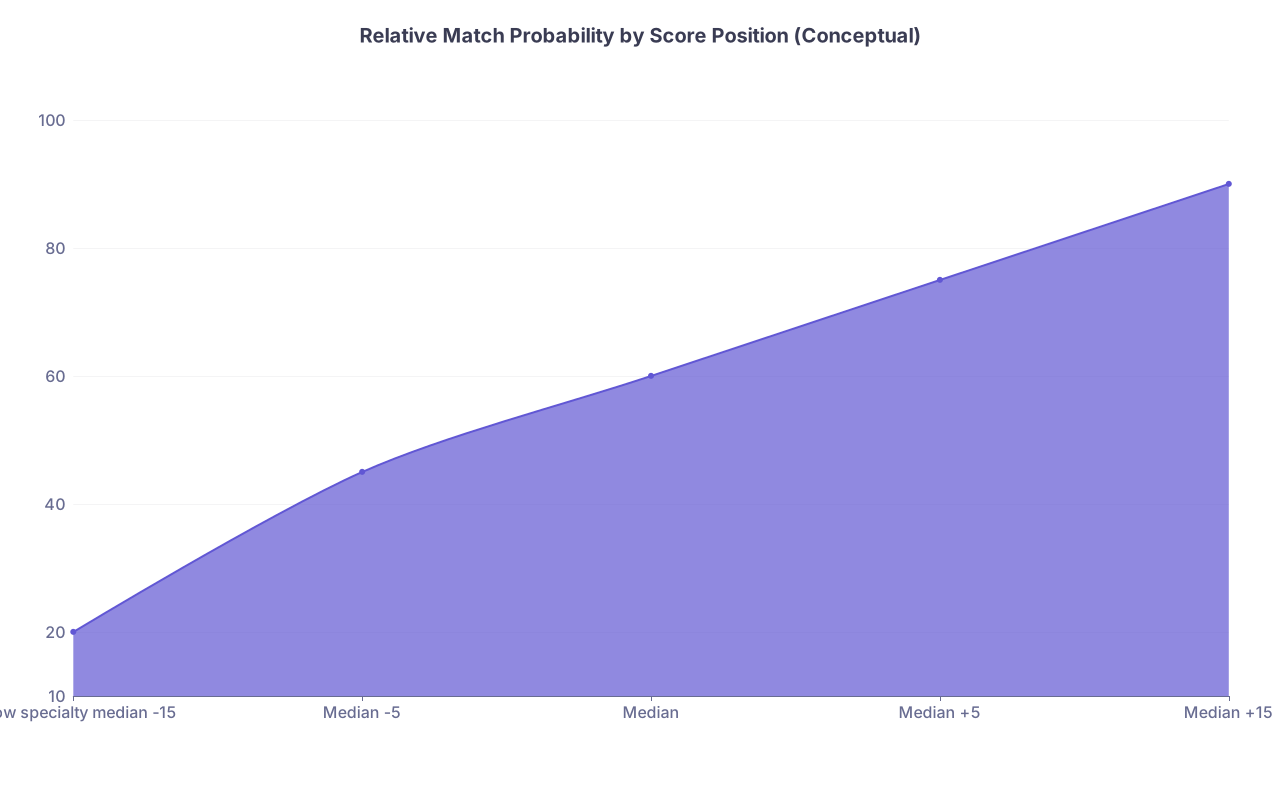
From there, you can benchmark yourself:
| Category | Value |
|---|---|
| Below specialty median -15 | 20 |
| Median -5 | 45 |
| Median | 60 |
| Median +5 | 75 |
| Median +15 | 90 |
Interpretation:
- Being 10–15 points below the matched median in a competitive field puts you in a low-probability zone unless your application is otherwise unusually strong and you apply broadly and strategically.
- Being roughly at the median means your narrative and letters will heavily influence outcomes.
- Being significantly above the median buys you more flexibility in the rest of your file, but it does not rescue an incoherent or lazy application.
Step 2: Decide Where Holistic Might Actually Help You
Holistic review works if you give programs something to work with.
Cases where holistic strategy is worth leaning into:
- You have a coherent story (e.g., sustained commitment to addiction medicine and community clinics, applying to psych or FM).
- You have significant adversity or a nontraditional path that explains modest scores but shows resilience and upward trends.
- You are applying to regions or programs with explicit mission alignment to your experiences (rural health, safety net hospitals, veteran care).
Cases where “trust holistic” is dangerous:
- Competitive surgical subspecialty with both Step scores below the specialty’s unmatched median.
- No clear specialty-aligned experiences (deciding on derm in October of M4, with zero derm research and no away rotations).
- Heavy red flags: multiple exam failures, professionalism issues, multiple failed clerkships.
Holistic review is not a magic override. Think of it more like a set of tie-breakers once you are already in the serious-consideration pile.
Step 3: Build a Portfolio That Survives the Filter and Stands Out After
The strongest recent-cycle applicants I have seen do three things extremely well:
Clear the numeric gate early
- They prioritize Step 2 timing and preparation so their score is in ERAS at application opening.
- They avoid assuming Step 1 P/F “reduces pressure,” and instead treat Step 2 as the flagship metric.
Construct a recognizable, data-backed narrative
- “Four years of consistent research in trauma surgery, third-year honors in surgery, two away rotations, strong letters from surgeons” is a pattern committees trust.
- The best narratives are easy to summarize in one sentence during a committee meeting. If no one can summarize you, you are forgettable.
Target programs like an analyst, not like a tourist
- They use past match lists, PD survey data, and their advisor network to choose programs where their profile is realistically competitive.
- They do not waste half their list on long-shot dream programs that treat their application as filler.
Final Takeaways
The recent Match cycles have not replaced score cutoffs with holistic review. They have layered holistic review on top of score cutoffs.
Three points to keep in your head:
- Programs still rely heavily on numeric filters—especially Step 2 CK—to survive application volume. Holistic review usually begins only after those filters.
- Within the screened pool, true differentiation comes from sustained, specialty-aligned work, strong letters, and a coherent story, not from random “well-roundedness.”
- A strong residency application in 2024+ is one built like a portfolio: clear baseline metrics, a concentrated set of experiences that match your target specialty, and a deliberate, data-informed program list.