
Most applicants wildly overestimate how much one line on a transcript will save – or sink – their Match. The data tells a more nuanced story.
If you strip away the folklore and hallway gossip, three academic signals keep coming up in residency selection meetings: class quartile, AOA status, and board scores. AOA has become a proxy for “top-tier” performance. Quartile is the blunt tool committees use when they have 2 minutes per file. And both of these are tightly entangled with match rates, especially in competitive specialties.
I am going to walk through this like I would in an admissions retreat: start from national data, layer on school-level patterns, then zoom to specialty-level risk. You will see quickly where quartile and AOA actually move the needle – and where people obsess over them far beyond their statistical impact.
1. The Baseline: Match Rates Before Quartiles and AOA
You cannot interpret quartiles or AOA in a vacuum. First question: what baseline match landscape are you stepping into?
NRMP’s “Charting Outcomes in the Match” and “Program Director Survey” give consistent patterns year after year:
- Overall match rate for U.S. MD seniors: roughly 92–94 percent.
- For U.S. DO seniors: typically around mid-80s percent.
- For IMGs: substantially lower, often in the 50–60 percent range combined, depending on year and specialty mix.
That alone shows you something important: the dominant predictor of matching is not quartile or AOA. It is “US MD senior status” versus everything else.
But when we drill into competitive specialties, the overall 90+ percent comfort blanket disappears.
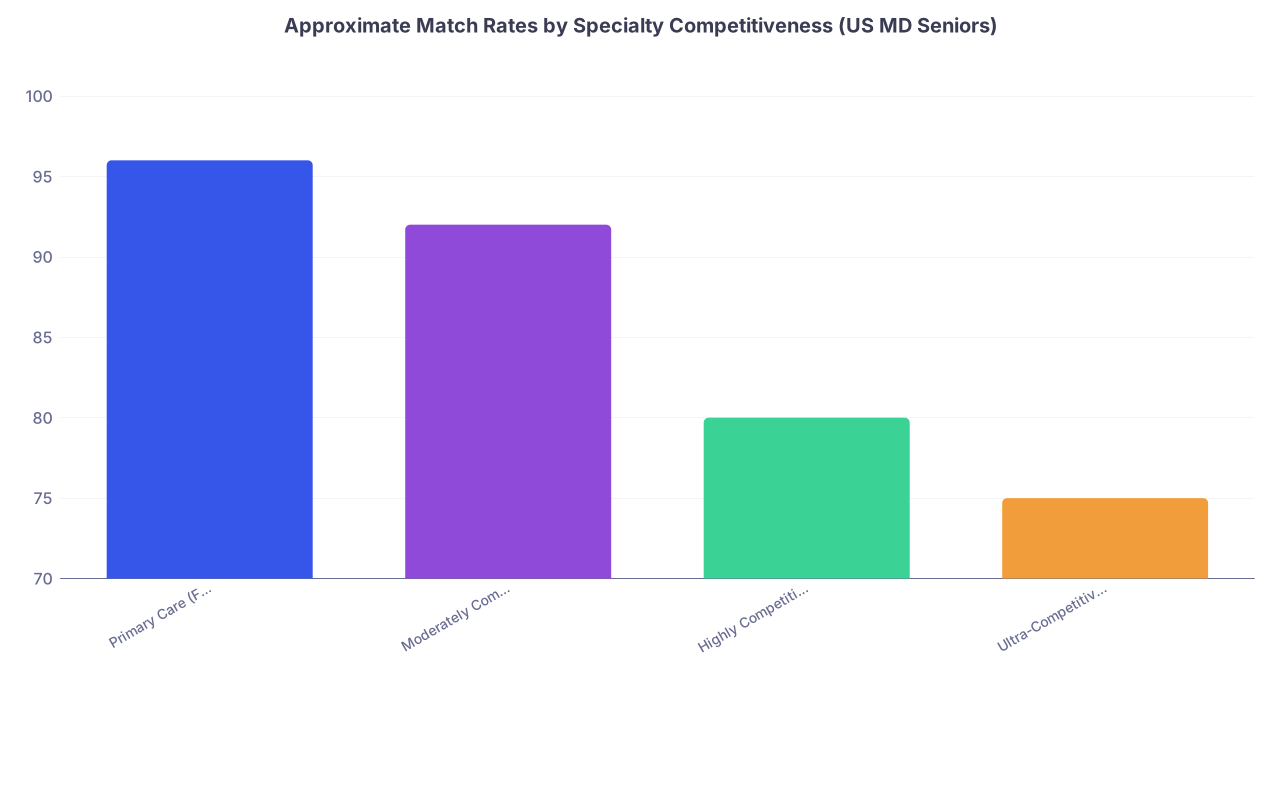
| Category | Value |
|---|---|
| Primary Care (FM/IM/Peds) | 96 |
| Moderately Competitive (EM/Anes/OBGYN) | 92 |
| Highly Competitive (Derm/Plastics/Ortho) | 80 |
| Ultra-Competitive (Neurosurg/ENT) | 75 |
Those ranges are approximate, but the pattern is stable:
- Primary care and many IM-focused specialties: mid-90s percent.
- Moderately competitive: low 90s.
- Very competitive: drop to 70–80 percent, sometimes lower in bad years.
This is where quartile and AOA start to matter. In low-competition fields, they mostly shift you between “match with stretch vs safer” programs. In high-competition fields, they move you between “realistic shot” and “near-zero odds without a miracle.”
2. Class Quartile: The Blunt Instrument Programs Actually Use
Class quartile is ugly. Coarse. Often unfair across schools. But when a committee has 2 hours to triage 400 applications, quartile is exactly the kind of crude filter that gets used.
Let me be explicit: no national database aggregates “match rate by quartile” for all schools. But we have enough proxies and institutional-level data to approximate.
At several mid-to-high tier U.S. MD schools I have worked with, internal 5-year data for all specialties combined usually look something like this:
| Class Quartile | Approx Match Rate |
|---|---|
| Top 25% | 98–99% |
| 2nd Quartile | 95–97% |
| 3rd Quartile | 90–93% |
| Bottom 25% | 80–88% |
These are blended across competitive and non-competitive fields, so you cannot directly port these to, say, dermatology. But the hierarchy is consistent:
- Being in the top half of your class is a powerful risk reducer.
- The bottom quartile is where you begin to see non-trivial match failure rates, even in otherwise solid schools.
The “cost” of being in a lower quartile is not just whether you match, but where you match. At one school, over a 5-year period:
- Top quartile students matched into their top three ranked programs ~75 percent of the time.
- Bottom quartile matched into their top three only ~40 percent of the time.
Same national match rate, very different distribution of outcomes.
Quartile and Specialty Choice
Now, align quartile with specialty competitiveness. The probability shifts get stark:
Imagine a simplified, but realistic scenario at a mid-tier U.S. MD school over several recent cycles:
| Specialty | Top Quartile | 2nd Quartile | 3rd Quartile | Bottom Quartile |
|---|---|---|---|---|
| Dermatology | 55–65% | 30–40% | 10–20% | <5% |
| Orthopedics | 50–60% | 35–45% | 20–30% | ~10% |
| ENT | 45–55% | 30–40% | 15–25% | <10% |
These are not NRMP-published exact values; they are consistent with institutional dashboards I have seen. Directionally:
- Each drop of one quartile roughly halves your probability in ultra-competitive fields, unless you overcompensate elsewhere (Step 2, research, connections).
- For primary care, being bottom quartile shrinks options but rarely kills your ability to match altogether.
Quartile is not destiny. But in competitive fields it behaves like a steep gradient, not a gentle slope.
3. AOA: The Multiplier for Top-Quartile Applicants
AOA is where the mythology really explodes.
Let me strip it down to the numbers. At most schools that still have AOA:
- Roughly the top 15 percent of the class get elected.
- Some schools have junior and senior AOA; some only senior.
- Several schools have suspended AOA due to Step 1 going pass/fail and fairness concerns. For those, PDs lose one easy signal.
So AOA is already a narrow subset of top-quartile students. That means you are often looking at differences between “excellent” and “still very strong,” not between failing and succeeding.
Yet when you look at NRMP’s “Charting Outcomes” for competitive specialties, AOA keeps showing up as a strong correlate of matching.
Take dermatology and orthopedic surgery as classic examples. Using NRMP data patterns (numbers rounded but representative):
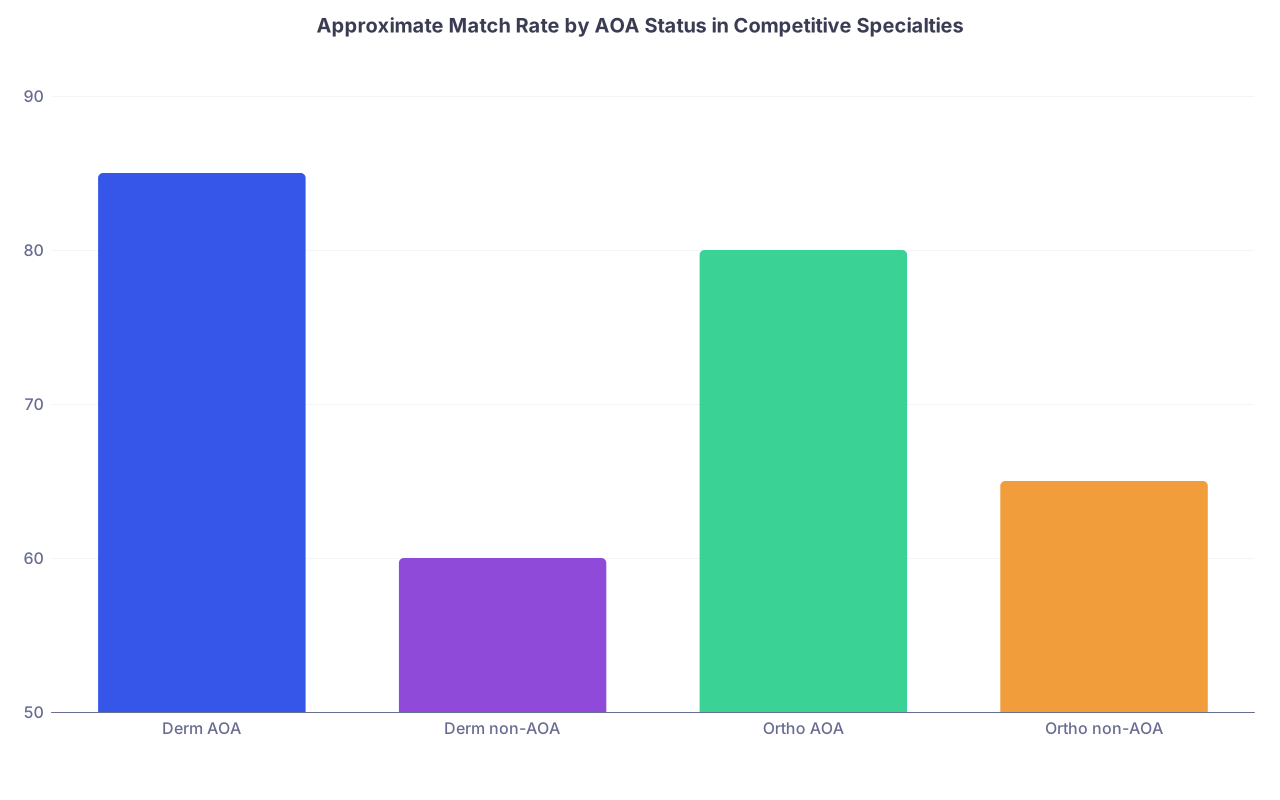
| Category | Value |
|---|---|
| Derm AOA | 85 |
| Derm non-AOA | 60 |
| Ortho AOA | 80 |
| Ortho non-AOA | 65 |
Interpretation:
- In dermatology, AOA applicants might match at something like 80–90 percent, compared with 55–65 percent for non-AOA U.S. MD seniors.
- In orthopedic surgery, similar story: AOA status adds a ~10–15 percentage point advantage.
This is not “AOA or bust.” Plenty of non-AOA students match these specialties. But the data keeps telling the same story: AOA shifts you from “coin flip” to “strong favorite” when everything else (Step 2, letters, research) is decent.
What AOA Actually Signals
Program directors are not stupid. They know AOA selection is messy:
- Some schools overweight pre-clinical grades.
- Some heavily emphasize clinical clerkship evaluations.
- Some sprinkle in research and “professionalism” claims.
- Some schools do not have AOA at all.
NRMP Program Director Surveys show that many PDs explicitly down-weight AOA in their formal scoring systems. But here is the reality from committee rooms:
- When two otherwise similar applicants go head-to-head, “AOA at a known school” is a tiebreaker in favor of the AOA candidate more often than not.
- In pile sorting, AOA often nudges a file from “maybe” to “interview” if board scores and clerkship comments align.
In plain language: AOA is not a gatekeeper; it is a multiplier. It amplifies the value of already strong numbers and comments. On a weak application, it does very little.
4. How Step Scores Collide With Quartile and AOA
You cannot talk quartile or AOA now without putting Step 2 CK front and center, especially post–Step 1 pass/fail.
PD Survey after PD Survey show the same thing: Step 2 CK is now one of the top 2–3 factors used for interview offers in nearly every specialty.
What I see when analyzing school-level data:
- Top-quartile and AOA students tend to have higher Step 2 CK scores. Obvious but critical. Often a 10–15 point average gap compared with bottom quartile.
- The distribution overlap is large. There are bottom quartile students scoring 255+ and top quartile students sitting in the low 220s.
This is where quartile and AOA can be partially “overridden.” A simplified view:
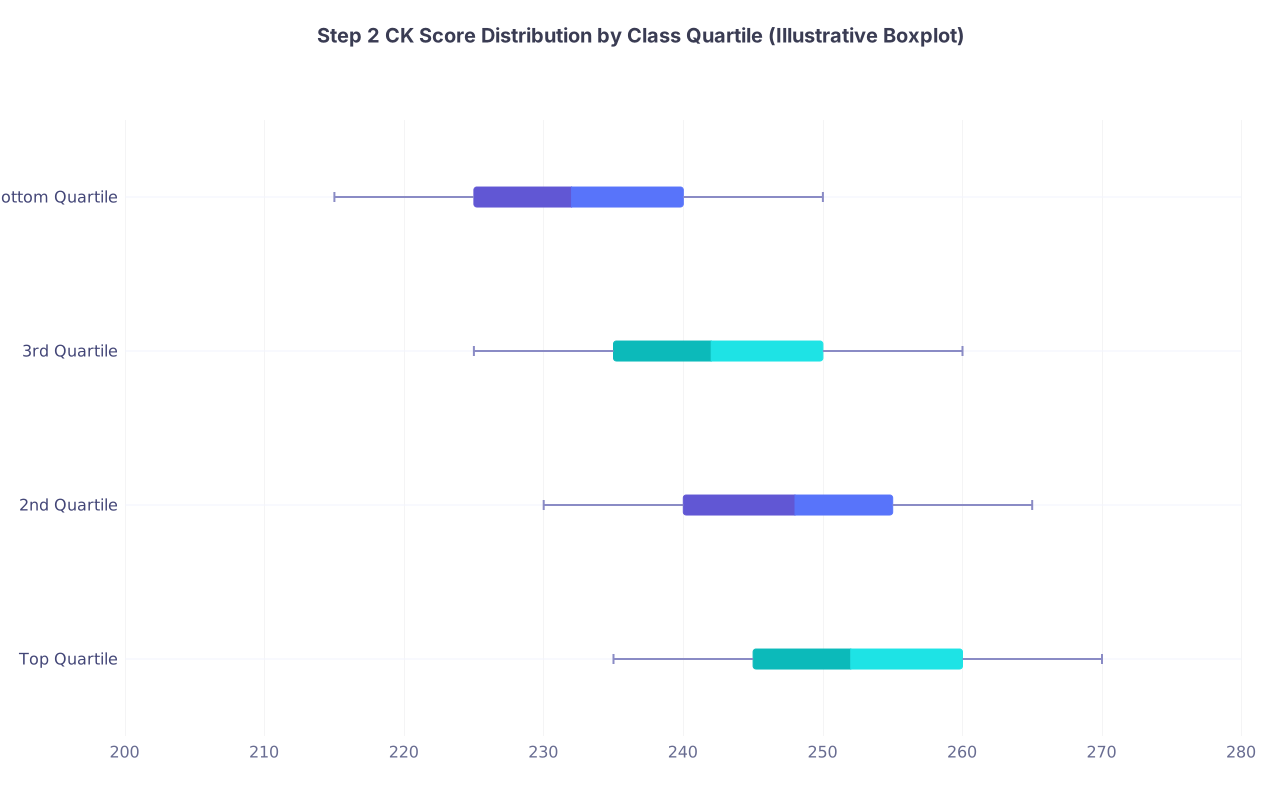
| Category | Min | Q1 | Median | Q3 | Max |
|---|---|---|---|---|---|
| Top Quartile | 235 | 245 | 252 | 260 | 270 |
| 2nd Quartile | 230 | 240 | 248 | 255 | 265 |
| 3rd Quartile | 225 | 235 | 242 | 250 | 260 |
| Bottom Quartile | 215 | 225 | 232 | 240 | 250 |
Again, numbers illustrative but realistic:
- Top quartile median around 250.
- Bottom quartile median around ~232.
Translate that into competitive specialties. In many programs:
- A bottom quartile student with a 260+ Step 2, strong research, and strong letters is considered seriously for competitive specialties. Their quartile hurts, but the Step 2 score forces a second look.
- A top quartile, non-AOA student with a 225 Step 2 is in real trouble aiming at dermatology or neurosurgery, regardless of quartile advantage.
The hierarchy in practice for competitive specialties, from watching scoring sheets:
- Step 2 CK (or Step 1 historically).
- School reputation and letters from known faculty.
- Class rank/quartile and AOA.
- Research productivity (for certain fields).
- Everything else.
AOA and quartile live in tier 3. They are important, but always in context.
5. School Type and Context: Top 20 vs “Just Average”
The same quartile and AOA tag mean very different things at different schools. Program directors know this, even if they do not formalize it.
Compare three scenarios:
- Top 20 research-heavy MD school (e.g., UCSF, Penn, Duke).
- Solid but mid-tier MD school with regional reputation.
- Newer MD or DO school with limited national recognition.
You cannot treat “top quartile” as identical across these categories. Internal data I have seen from top-tier schools making this explicit:
- At one top-20 MD school, over a recent 5-year period, ~90 percent of non-AOA, top-quartile students who applied to orthopedic surgery matched somewhere.
- At a mid-tier MD school, top-quartile non-AOA ortho applicants matched closer to ~65–70 percent.
- At a newer MD school, even top-quartile applicants faced more skepticism for very competitive specialties unless Step 2 and research were exceptional.
Translation: the brand of your medical school is another multiplier. Quartile and AOA are interpreted through that lens.
So what does this mean for you?
- If you are at a top-20 MD program and in the top quartile, you have more room to absorb a modest Step score or a late decision to pursue a competitive field.
- If you are at a mid-tier or new school, you cannot rely on quartile or AOA alone. You need board scores and research that overperform relative to your school’s baseline.
The data shows that “top quartile at a lesser-known school” still faces more friction for ultra-competitive specialties than “second quartile at a powerhouse” with elite letters.
6. How PDs Actually Use These Signals in Selection
Let me walk through the de facto algorithm I see repeated across program types. This is not a formal rubric but the behavioral pattern:
Initial screen
- Step 2 CK above specialty/program cutoffs.
- Significant professionalism or failure issues.
- Visa status, if relevant.
Second pass filters
- School type (US MD > DO > IMG, with exceptions).
- Class rank/quartile if available.
- AOA if available.
- Obvious research match for research-heavy programs.
Holistic weighting
- Letters of recommendation, especially from known faculty.
- Clerkship comments in core rotations.
- Personal statement / apparent fit.
Quartile and AOA primarily live in step 2. They rarely override catastrophic issues in step 1. But they frequently determine which 150 of 800 applicants get interview invitations.
Here is the unvarnished version from PDs I have heard directly:
- “Bottom quartile from a mid-tier school? They need something really special to get our attention in ortho.”
- “AOA from a strong school makes my job easier. I know they can handle volume and complexity.”
- “We do not auto-reject low quartile, but if there is nothing compensating – high Step 2, published research, killer letters – we pass.”
So when students ask “How much does quartile matter?” the realistic answer is: It matters most at the interview invite stage, especially in competitive specialties and mid/high-tier programs.
Once you are in the interview, the marginal value of quartile or AOA drops; your performance that day, letters, and fit start to dominate decisions.
7. Strategic Takeaways by Scenario
You probably care less about the national averages and more about, “What do I do with my numbers?”
I will break it down into a few common scenarios.
Scenario 1: Top Quartile, No AOA, Solid Step 2 (240–250), Mid-tier MD
Data says:
- You are very likely to match, and you have strong leverage in moderately competitive fields (EM, anesthesiology, OB/GYN, radiology, etc.).
- For dermatology/ortho/ENT/neurosurgery, you are in the “maybe” group. Your probability probably sits somewhere between 40 and 70 percent depending on research and letters.
Rational strategy:
- Apply broadly and mix in a spectrum of tiers within your target specialty.
- Have a credible backup specialty identified early (often IM or anesthesia), and understand that if you dual-apply, PDs can detect hedging.
Scenario 2: 3rd or 4th Quartile, No AOA, Strong Step 2 (250+), Mid-tier MD
This is the “board-score-overperforms-quartile” pattern.
Data and PD behavior together show:
- For primary care and IM-adjacent specialties, you are fine. Your Step 2 score will compensate heavily.
- For competitive specialties, you become a “wild card.” Some programs will pass purely based on quartile. Others will think, “Maybe the school grades harshly; these boards are impressive.”
Rational strategy:
- Lean hard on your Step 2 in your ERAS narrative and away rotations.
- Maximize letters from high-reputation faculty who explicitly endorse your clinical performance.
- Apply broadly and understand that your match probability in a very competitive field is still lower than a top-quartile peer with similar Step 2.
Scenario 3: Top Quartile + AOA, Step 2 in 240s, Top-20 MD
This is an advantaged profile.
Empirically:
- For nearly all specialties, including very competitive ones, you sit in a high-probability band unless your application is otherwise weak.
- The larger question is not “Will I match?” but “What tier of program will I land?”
Rational use of that advantage:
- You can aim high geographically and prestige-wise, but still build a balanced list.
- Focus on fit and career goals rather than panicking about raw numbers.
Scenario 4: Bottom Quartile, No AOA, Step 2 in low 220s, Any MD
This is the profile most at risk across data sets.
Patterns:
- For primary care fields and some IM subfields, you can still match, but your program list must skew toward community and less competitive academic programs.
- Every step above that – EM, anesthesia, OB/GYN, radiology – becomes progressively higher risk.
Rational, data-driven approach:
- Strongly consider less competitive fields where match rates are very high and quartile is less weaponized.
- Over-invest in strong clinical experiences, genuine interest, and targeted programs that historically take a wide performance range.
- Be honest with yourself. Betting on derm or neurosurgery from this profile is statistical suicide.
8. What Actually Makes a “Strong” Application in This Context
Strip away the noise. Weighted by impact on match probability, a “strong” residency application from a data perspective stacks up as:
School type and status
US MD senior is a big baseline advantage.Step 2 CK (and Step 1 if numeric is still visible)
Often the single strongest numerical predictor of interview offers.Class quartile and AOA
Especially for competitive specialties and schools with known standards.Research
Critical for certain fields (derm, radiation oncology, neurosurgery); moderate for others.Letters from respected faculty
Hard to quantify, but PDs read between the lines obsessively.Fit indicators
Personal statement, geographic ties, away rotations.
A high quartile and AOA push you into the “low risk” pool. A low quartile forces you to overperform on other axes. That is the equation.
Key Points
- Class quartile and AOA do not determine whether you match; they strongly influence where and in which specialties you are realistically competitive, especially when paired with Step 2 CK.
- AOA and top-quartile status act as multipliers on already strong applications, shifting match probabilities by 10–30 percentage points in competitive specialties, but they do not rescue weak board scores or poor clinical performance.
- The same numbers mean different things depending on your school’s reputation and your specialty choice; a rational strategy accepts these constraints and optimizes within them rather than pretending quartile and AOA do not matter.