This article is for educational purposes only. It is not financial advice, not legal advice, and not tax advice. Figures vary by individual circumstances, so consult a qualified professional before acting.
The Hybrid Reality Check: Why You Feel Like You're Failing
Let's get one thing straight right out of the gate. The hybrid rotation model is a logistical nightmare disguised as a "flexible" perk. If you are currently on a hybrid rotation and feel like you are drowning, failing, or losing your mind, take a breath. You aren't failing. The system is just actively working against you.
Medical school trains you for the 80-hour work week. It prepares you for the physical exhaustion of being on your feet for 24 hours. It does absolutely nothing to prepare you for the specific, soul-crushing fatigue of the hybrid "double-shift."
Here is what the double-shift actually looks like. You spend eight to ten hours in the hospital running around, managing acute patients, and absorbing high-adrenaline clinical environments. Then, instead of going home to sleep, you commute to a hotel or your apartment, open your laptop, and stare at a screen for another four to six hours to finish charting, attend virtual didactics, or complete remote research.
You are doing two completely different jobs in one day. The cognitive whiplash is brutal. You feel like you're failing because your brain is trying to process high-acuity clinical decisions and low-acuity administrative data in the same 16-hour window.
Stop beating yourself up. Acknowledge the unfairness of the model. Validate your own frustration. Now that we've established the system is flawed, we need to stop treating this like an emotional crisis and start treating it like a tactical problem. You need a survival strategy. Here is exactly how you handle it.
The In-Person Protocol: Be Seen, Be Heard, Be Present
When you are physically in the hospital, you need to be in the hospital.
I see this mistake constantly. Residents show up for their in-person hybrid days, grab a coffee, and immediately retreat to a windowless workroom to stare at their screens. They become the "Zoom doctor" even when they are physically present. This is a massive wasted opportunity. If you are just going to sit in a room and chart, you could be doing that at home.
Your physical presence is your biggest asset. The in-person hours are your currency. Spend them wisely.

First, nail the physical presence rules. Wear clean scrubs. Be punctual. Do not shuffle into the morning huddle looking like you just rolled out of a hotel bed. Look sharp, look awake, and look like you want to be there. Perception matters immensely in residency evaluations.
Second, maximize mentorship. The attendings and senior residents are physically right in front of you. Use this time for things you cannot do over a screen. Shadow the attending during procedures. Ask them about their career path, their fellowship choices, and how they handle complex family discussions. Introduce yourself to the charge nurses and the case managers. Build your social capital.
Third, practice active participation. Do not just stand in the back of the room during rounds holding a tablet. Speak up. Present your patients with confidence. Ask clarifying questions. When you are in the building, you need to be the most engaged person in the room. Make them remember you were there. When you log off for the remote shift, your in-person reputation should already be cemented for the day.
The Remote Protocol: Surviving the Second Shift
The remote shift is where residents go to die. Not literally, but professionally and mentally.
You check into a mediocre hotel after a long day, throw your bag on the bed, and start charting from the mattress. Stop doing this immediately. Working from bed destroys your sleep hygiene. Your brain quickly associates your bed with stress, glowing screens, and unfinished notes. When you finally try to sleep, your brain is still in work mode.
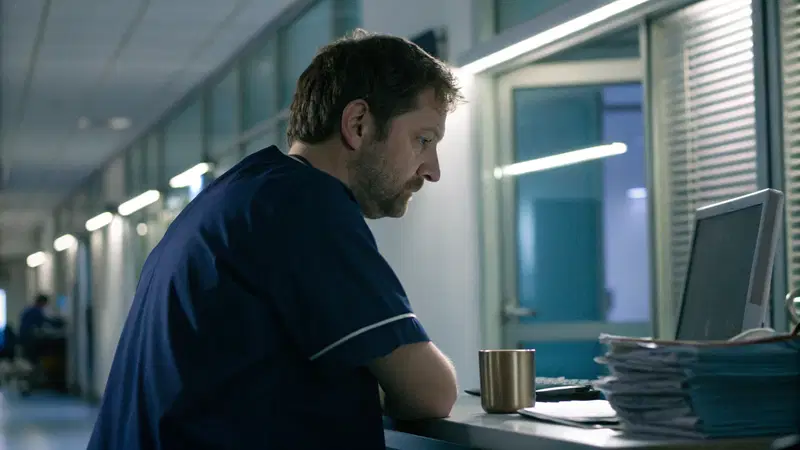
You need to treat the remote shift like an actual shift. It requires a dedicated workspace. If the hotel room desk is a flimsy piece of plywood that hurts your back, go down to the hotel business center or the lobby lounge. Find a proper chair. Set up your laptop at eye level.
Managing documentation and virtual rounds without losing your mind requires strict compartmentalization. When you are doing virtual rounds, keep your camera on. Yes, you are tired. Yes, you want to hide. Keep the camera on, look at the lens, and nod. It forces you to stay engaged and prevents you from doom-scrolling on your phone under the desk.
Most importantly, you must set boundaries. The remote shift has a nasty habit of bleeding into the night. "I'll just finish these three notes" turns into "I'm still charting at 2:00 AM." Set a hard stop time. When the clock hits your designated end time, close the laptop. Physically put it away in your bag. Do not leave it open on the desk where it can stare at you while you try to wind down. The work will be there tomorrow. Your sanity might not be.
The Logistics & Tech Stack: Your Survival Kit
You cannot survive a hybrid rotation on willpower and stale hospital coffee alone. You need gear. Logistics are your enemy in this model, and you need to invest in your setup immediately.
Hardware Essentials Noise-canceling headphones are non-negotiable. Whether you are trying to focus in a noisy hospital workroom or a bustling hotel lobby, you need to control your auditory environment. Get a good pair of over-ear headphones. Next, invest in a portable dual-monitor setup or a high-quality laptop stand with a wireless keyboard and mouse. Hunching over a 13-inch screen for six hours after a 10-hour physical shift is a fast track to cervical radiculopathy.
Software Essentials Make sure your VPN is working before you leave the hospital. There is nothing worse than getting to your hotel, logging in, and realizing your remote access token expired. Keep your secure messaging apps updated on your phone, but turn off non-urgent notifications during your remote shift. Use cloud-based note templates and dot-phrases aggressively. If you are typing out the same paragraph more than twice, make it a macro.
The Physical Commute Do not underestimate the commute between your in-person and remote shifts. This is your psychological airlock. Use this travel time to decompress. Listen to a podcast that has absolutely nothing to do with medicine. Call a friend. Sit in silence. Do not use the commute to mentally rehearse your notes. Let your brain shift gears from high-acuity clinical care to low-acuity administrative work.
Mental Resilience: Managing the Cognitive Load
Context switching is a brain killer. Going from managing a crashing patient in the ICU to answering mundane emails in a silent hotel room causes severe cognitive whiplash. Your brain doesn't just snap from high-adrenaline to low-adrenaline. It needs a buffer, and the hybrid model rarely gives you one.
The psychological toll of this constant switching is heavy. You feel "always-on." Even when you aren't actively working, the laptop sitting on the desk reminds you that you could be working. This low-grade, persistent anxiety drains your mental reserves faster than actual clinical work.
You have to actively fight the "always-on" culture. Disconnecting is a skill you must practice. When your remote shift is over, change your physical state. Go for a walk. Take a hot shower. Do a 20-minute workout in the hotel gym. You need a physical ritual that signals to your nervous system that the workday is definitively over.
Learn to recognize the burnout signs specific to hybrid schedules. Traditional burnout looks like apathy and exhaustion. Hybrid burnout looks like irritability, insomnia, and a creeping resentment toward your laptop. If you find yourself staring at a blank screen for twenty minutes, unable to type a single sentence of a discharge summary, you are hitting the wall. Step away. Take a 15-minute break. Staring at the screen harder will not make the words appear.
Your Action Plan: Surviving the Next Hybrid Rotation
Talk is cheap. Here is your exact execution plan for your next hybrid block.
Pre-Rotation Checklist
- Test your VPN and remote EHR access 48 hours before the rotation starts.
- Pack your tech bag: noise-canceling headphones, laptop stand, wireless mouse, and all necessary chargers.
- Book a hotel with a confirmed, usable desk in the room or a 24-hour business center.
Daily Routine
- Morning: Treat the in-person shift like a traditional rotation. Be visible, be loud, be engaged.
- Transition: Use the commute as a hard mental break. No medical podcasts.
- Evening: Set up a dedicated remote workspace. Do not work from the bed. Execute your administrative tasks, then close the laptop at a hard stop time.
Post-Rotation Review When the rotation ends, do not just collapse and forget about it. Translate this grueling experience into a residency interview talking point. You didn't just "do a hybrid rotation." You managed complex logistics, maintained high clinical acuity across dual environments, and demonstrated exceptional time management and adaptability. Frame the struggle as a masterclass in operational efficiency.
The hybrid model is flawed, exhausting, and unfair. But it is the reality you are dealing with right now. Control your environment, protect your sleep, and attack the day in two distinct shifts. You've got this. Now get to work.