
Only 20–30% of residents believe that current duty hours are “about right.” Most think they’re either too long or paradoxically too short for learning. That tells you something: the people actually living this system do not buy the myth that more hours automatically means better doctors.
Let me be blunt: the belief that longer residency hours create better physicians is mostly cultural, not scientific. It’s tradition, ego, and sunk-cost fallacy dressed up as “professionalism” and “grit.”
When you actually look at the data—ACGME trials, randomized duty-hour studies, patient outcome metrics, exam performance—the picture is a lot more uncomfortable for the old-school hardliners.
The Origin Myth: Suffering = Skill
The core myth goes like this: “I worked 100+ hours a week, slept on stretchers, and I turned out fine. Shorter hours will create a generation of weak, incompetent physicians.”
I have heard that almost verbatim from attendings in surgery, internal medicine, even psychiatry. You’ve probably heard it too.
There are three problems with this logic:
Survivorship bias – You’re only hearing from the people who survived the system and stayed in academia or leadership. You are not hearing from the ones who left medicine entirely, burned out, or quietly became mediocre and bitter.
Confounding variables – The people who made it through 120‑hour weeks and then also became outstanding clinicians were probably exceptional to begin with. They didn’t become great because of exhaustion; they became great despite it.
Zero actual control group – The “I turned out fine” argument ignores the counterfactual. We have no idea how much better those same physicians could have been with sane hours and structured rest.
So let’s stop pretending that “I survived misery” is evidence of educational value. It is not.
What the Major Duty Hour Trials Actually Show
If you want to understand this debate, you need to know the big trials. Not the anecdotes. Not the hallway rants.
| Study | Specialty | Design Type | Main Focus |
|---|---|---|---|
| FIRST | General Surgery | Cluster RCT | Flexible vs standard |
| iCOMPARE | Internal Med | Cluster RCT | Flexible vs standard |
| Flexibility | Multiple IM | Cluster RCT | 80-hr flexible rules |
FIRST Trial (Surgery)
The FIRST trial (Flexibility In duty hour Requirements for Surgical Trainees) randomized general surgery programs to:
- Standard ACGME rules: 16‑hr intern cap (at that time), strict maximums, required time off
vs. - Flexible rules: 80‑hr weekly average still in place, but fewer restrictions on shift length and time between shifts (yes, longer continuous hours).
Findings?
- Patient outcomes: No difference in 30‑day mortality, serious complications, readmissions.
- Resident exam performance: No difference in ABSITE scores.
- Resident perceptions: Flexible programs reported worse satisfaction with overall well-being and work–life balance.
Translation: longer, more “traditional” hours did not create better surgical outcomes or smarter residents. They just made people more exhausted and less happy.
iCOMPARE (Internal Medicine)
iCOMPARE did the same thing for internal medicine: standard ACGME duty hours vs. more flexible, longer shifts allowed.
Results were almost comically consistent:
- Mortality and patient safety: No significant difference.
- Board exam performance: No significant difference in in‑training exam scores.
- Resident sleep and alertness: Interns in flexible programs slept less, showed more attentional failures.
- Well‑being: Slightly worse measures of well‑being and job satisfaction in the flexible, longer-shift group.
So again: more hours did not make better doctors by any objective measure. They just made more tired doctors.
The Punchline From These Big Trials
When you keep total hours around 80 per week, making the shifts longer and more brutal does not measurably improve:
- Patient outcomes
- Resident test scores
- Perceived quality of education
But it does erode sleep, attention, and well-being.
That’s not “soft.” That’s physiology.
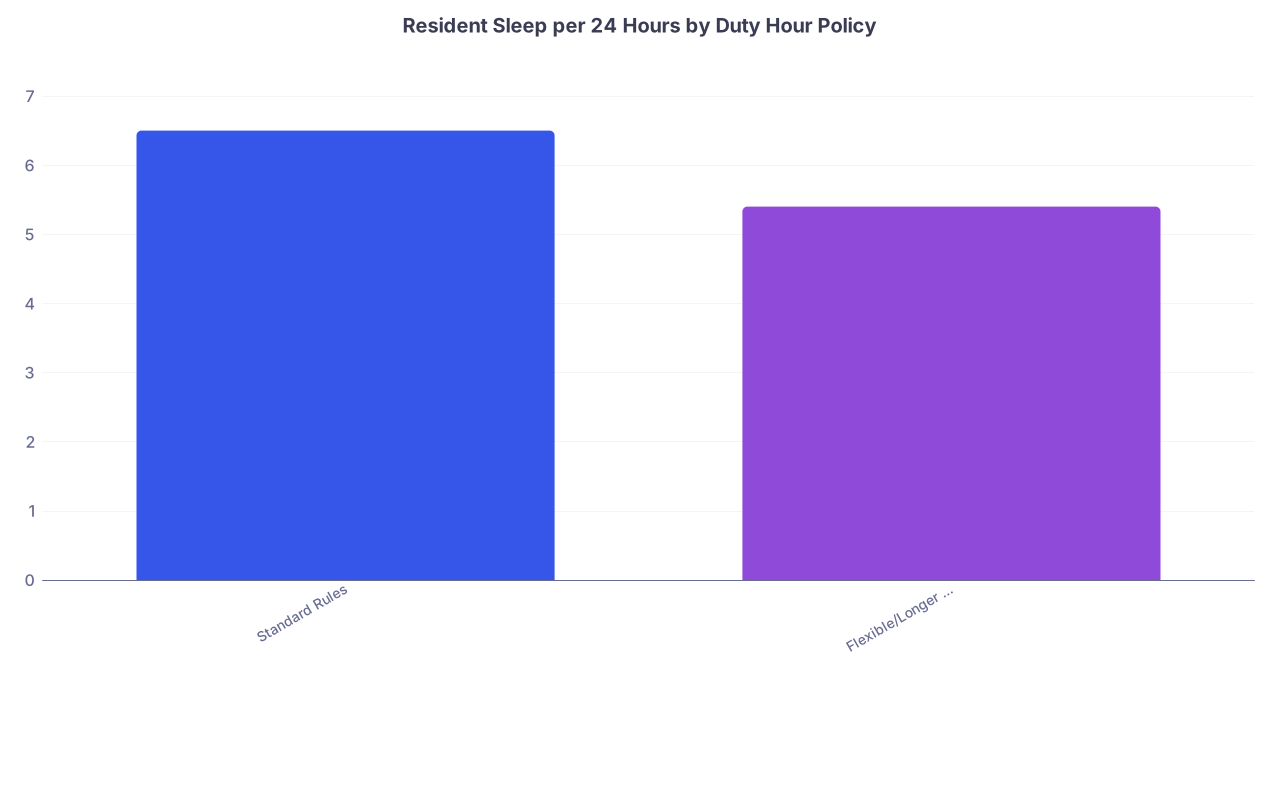
| Category | Value |
|---|---|
| Standard Rules | 6.5 |
| Flexible/Longer Shifts | 5.4 |
The Cognitive Science: Your Brain on 28‑Hour Call
There’s another entire body of literature that old-school defenders of 36‑hour calls try very hard not to talk about: sleep science.
Sleep deprivation has been studied in:
- Pilots
- Truck drivers
- Medical residents
- Control-room operators
And the conclusion is pretty devastating to the “more hours = better training” story.
You see the same patterns:
- After ~16–18 hours awake, reaction times, vigilance, and decision-making drop significantly.
- Being awake for 24 hours straight can impair performance as much as a blood alcohol content of 0.10%—legally drunk in most jurisdictions.
- Errors of omission (not noticing a change, missing a lab, overlooking a subtle sign) skyrocket with fatigue.
Now combine that with the reality of residency: high-stakes decisions, complex multitasking, constant interruptions, and minimal supervision at night in many programs. Then tell me, with a straight face, that a 28‑hour call is “enhancing learning.”
No. It’s enhancing risk.
The “More Exposure” Fallacy
Here’s the usual counterargument from the long-hours crowd: “If you’re there more, you see more. More pathology. More procedures. More everything. That’s how you become good.”
This sounds logical, but it breaks when you look closely.
Not all exposure turns into learning. After 20 hours awake, your ability to form durable memories and integrate new patterns tanks. You may see a lot, but you don’t retain or synthesize it well.
The marginal benefit of extra hours drops fast. The 40th hour in a week likely adds real learning. The 90th hour? You’re largely running checklists and trying not to miss disasters. That’s not deep learning. That’s survival mode.
Repetition isn’t everything. Skill growth comes from:
- Deliberate practice
- Feedback
- Reflection
- Time to read and tie cases to theory
You barely have the cognitive bandwidth for that when you’re sleep-deprived and chugging bad coffee at 3 a.m.
So yes, more hours can increase raw exposure. But exposure without sleep, feedback, or reflection is cheap experience. Not expertise.
Do Shorter Hours Make Worse Doctors? The Scare Tactic vs. Data
The scare story goes like this: reduce hours and you get:
- More handoffs
- Less continuity of care
- No one “owns” the patient
- Green residents who “haven’t seen enough”
Let’s see how much of that holds up.
Patient Outcomes After Duty Hour Reforms
Multiple observational studies looked at US residency programs before and after duty-hour reforms (2003 and 2011 reforms).
The consistent finding:
- No significant worsening of mortality, length of stay, or major complication rates.
- In some subgroups, outcomes improved slightly, but not enough to hang your hat on.
So the predicted disaster—“Patients will die if we cap work hours”—simply never manifested at the population level.
Board Scores and Competency
Look at internal medicine, surgery, pediatrics: board pass rates and in‑training exam scores have been basically stable through multiple rounds of duty-hour reform.
If anything, some specialties have seen higher pass rates over time, despite reduced hours. Why? Because exam performance is driven far more by:
- The quality of teaching
- Access to resources
- Protected time to study
- Program culture around learning
…than by whether you’re on hour 78 or hour 102 this week.
I’ve seen residents in more humane programs score higher and function better clinically than residents in “we eat our young” programs that fetishize 100‑hour weeks.
Continuity and Handoffs
Handoffs are a real risk point. More shift-based systems mean more handoffs. But that does not automatically mean worse care. It depends how you do them.
You can either:
- Keep hours long, rely on “continuity by exhaustion,” and pretend your post‑call brain is sharp
or - Shorten hours, accept more handoffs, and design handoffs to be structured and safe
Programs that adopt protected, standardized handoff systems (I-PASS, for example) show reduced communication errors—even with more handoffs.
The villain is not “shorter hours.” It’s sloppy transitions.
The Hidden Costs of Long Hours: Burnout, Attrition, Mediocrity
Here’s the part attendings often gloss over: what long hours do to the supply and quality of physicians over time.
Chronic overwork increases:
- Burnout
- Depression
- Suicidal ideation
- Desire to leave clinical practice or choose “lifestyle” specialties purely out of self-preservation
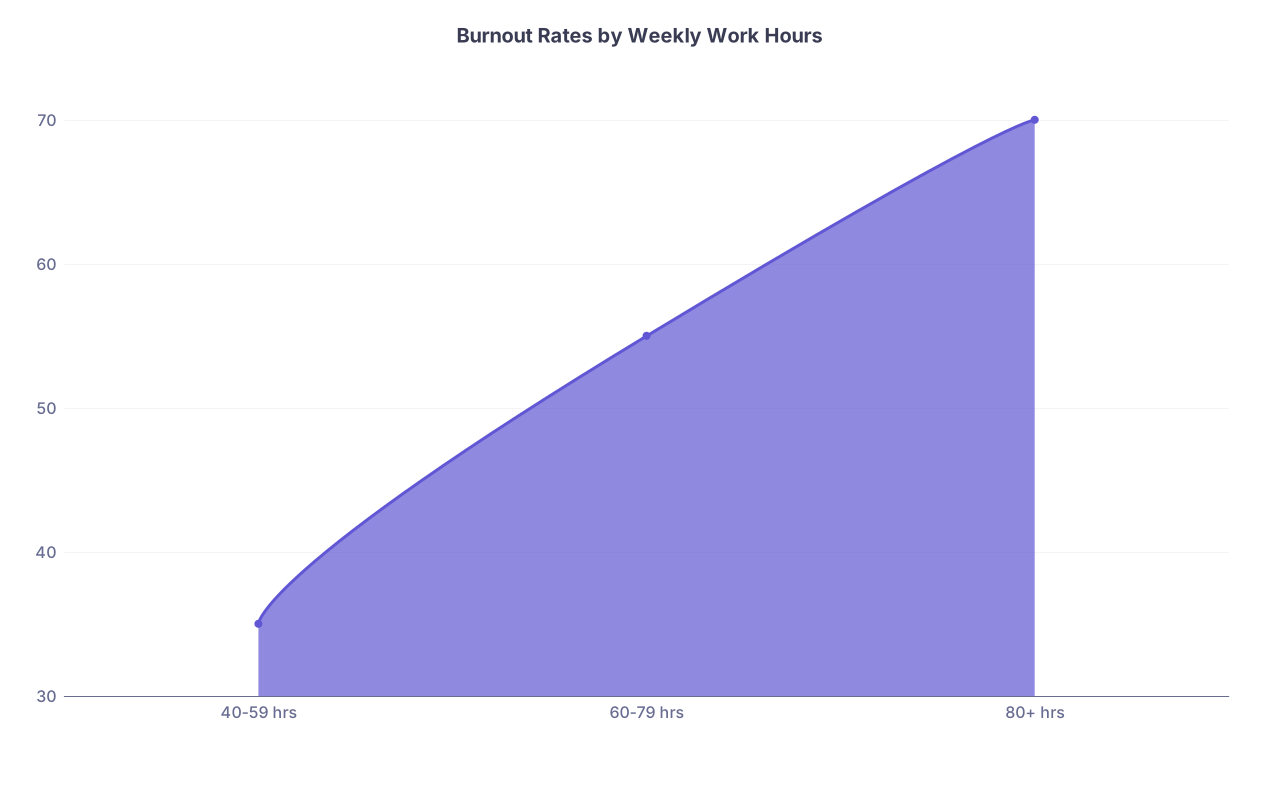
| Category | Value |
|---|---|
| 40-59 hrs | 35 |
| 60-79 hrs | 55 |
| 80+ hrs | 70 |
Those 80+ hour training weeks don’t just make residency miserable. They shape the rest of a physician’s career:
- Some leave medicine entirely or shift to non-clinical roles.
- Some settle into “bare minimum” practice: enough to get through the day, not enough to push themselves to excellence.
- Some reduce FTE as soon as they can.
So even if you could make a tortured argument that brutal hours produce marginally better skills during residency (and the data says they don’t), you still have to answer this: What good is a “better trained” physician who leaves practice early or practices at 60% of their potential for the next 25 years?
That long-tail cost never shows up in 30-day mortality studies. But patients feel it.
What Actually Makes Better Physicians (Spoiler: Not Just Hours)
Let me flip the question for a second. Instead of arguing about whether 80 hours vs. 100 hours is optimal, ask: what actually separates excellent clinicians from the rest?
From what I’ve seen and what the literature supports, it’s more about:
- Deliberate practice with feedback – Attending who actually watches you do the LP, corrects your hand position, not just signs your note at 1 a.m.
- Case variety across settings – ICU, clinic, wards, ED, procedures, continuity care. Not just endless scut at 3 a.m.
- Protected learning time – Conferences that are respected, not constantly interrupted by “Can you just quickly discharge 3 more patients?”
- Time to read and reflect – The resident who goes home, sleeps, then reads up on that weird vasculitis will be far better in a year than the one still stuck in the hospital pushing paperwork.
- Mentorship and psychological safety – A place where you can admit “I don’t know” and get taught, rather than hide ignorance and fake competence.
None of these require 100‑hour weeks. Many are actively sabotaged by them.
If you want better physicians, focus less on raw time-in-building and more on the density and quality of actual learning within that time.
The Real Trade-Off: Hours vs. How You Use Them
Here’s the uncomfortable truth: there probably is a lower limit of exposure below which training suffers. A 40‑hour/week surgical residency would almost certainly under-train people. Same with complex ICU medicine.
But that doesn’t automatically sanctify 80‑100 hour weeks.
The question isn’t “long or short.” It’s:
- How many hours do you actually need for adequate exposure?
- Beyond that point, are you getting more learning or just more fatigue?
- Within those hours, how much time is genuine clinical reasoning and skill-building vs. mindless bureaucracy?
Most programs massively waste resident time on:
- Poorly designed workflows
- Redundant documentation
- Inefficient rounding practices
- Antiquated paging systems and constant interruptions
Fix that, and you can compress the same or more learning into fewer total hours, with less burnout and probably fewer errors.
So if you’re defending 100‑hour weeks, be honest: you’re defending a lazy system design that uses resident time as a bottomless resource instead of optimizing it.
Where the Myth Still Hangs On
So why does the “longer hours = better doctor” myth refuse to die, despite weak supporting evidence?
Three reasons.
Ego and identity
People who suffered intensely often tie their identity to that suffering. Admitting it was unnecessary—or even harmful—threatens the story they tell about themselves. So they defend the system, not because it’s effective, but because it validates their past.Cheap labor
Residents are relatively inexpensive, highly skilled workers. Longer hours mean more service coverage without hiring more staff or NPs/PAs. There’s a financial incentive baked into this.Romanticized hardship
There’s a certain mythology in medicine about the heroic, sleepless physician who “never leaves the bedside.” It looks good in movies. It feels noble. It doesn’t survive contact with sleep science or objective safety data.
Where This Leaves You as a Resident (or Future One)
If you’re in residency or heading there, here’s the practical takeaway:
- Don’t confuse brutal hours with superior training. They are not the same thing.
- When you evaluate programs, ask:
- How much real supervision and feedback do residents get at night?
- Is there protected time for didactics that’s actually protected?
- How is handoff structured?
- What’s the culture around rest and calling for help?
Look less at whether the program brags about being “hardcore” and more at whether graduates are competent, sane, and satisfied five years out.
And if you’re faculty, stop hiding behind “I did it, so you should too.” Ask a better question: What structure produces the best clinicians with the least unnecessary harm?
We have enough evidence now to say this clearly:
- Longer continuous hours do not reliably improve patient outcomes or exam performance once you’re around the 80‑hour/week mark.
- Sleep deprivation degrades performance and learning; “exposure” when you’re exhausted is a lot less educational than you think.
- The real drivers of better physicians are quality of supervision, feedback, case mix, and time to study and reflect—not how many nights you spent half-awake on a call-room mattress.