The mantra that “more hours equals more learning” in residency is wrong. Not just a little wrong—backwards in several key ways.
If sheer time in the hospital automatically turned you into a better doctor, the pre–duty hour restriction era would’ve produced an army of flawless clinicians. It did not. It produced variability, burnout, and a lot of mythology disguised as tradition.
Let me be blunt: cutting work hours does not always cut learning. Sometimes it does. Sometimes it doesn’t. And in some scenarios, trimming hours actually improves what residents retain and how safely they practice. The data are messy, but they’re not ambiguous in the way people like to pretend.
Let’s walk through what the studies actually show—and where attendings, residents, and regulators are each getting it wrong.
The Core Myth: “Fewer Hours = Worse Training”
The standard argument you hear in workrooms goes something like this:
“Back when we were here 120 hours a week, we learned real medicine. If you cap people at 80 hours, or worse at 16-hour shifts like the old ACGME rules, you’re robbing them of cases and making softer, less competent graduates.”
I’ve heard almost that exact sentence in ICUs, surgical lounges, and pre-round huddles. The nostalgia is thick. The evidence behind it is thin.
What actually changed with modern duty hour limits?
- Pre-2003 in the U.S.: Residents routinely worked 100+ hours per week, 30–40 hour continuous shifts were common, and “post‑call day off” was often theoretical.
- 2003 ACGME rules: 80-hour weekly average, 24+6 continuous duty cap, some protections.
- 2011: Stricter intern rules (16‑hour limit), more handoff requirements.
- 2017: iCOMPARE and FIRST-style flexibility trials where some programs were allowed to relax shift limits while staying under 80 hours/week.
If slashing hours truly gutted training, you’d expect across-the-board collapse of exam scores, clinical performance, and patient outcomes after 2003. That’s not what happened.
What Happened to Knowledge and Exam Scores?
Here’s where the romantic “we were better trained” story runs into a wall.
Multiple studies looked at in-training exam scores and board pass rates before and after duty hour reforms. The results? Pretty boring. And that’s exactly the point.
- Internal medicine in‑training exam scores did not fall after the 2003 reforms. Some cohorts even trended slightly upward.
- ABIM board pass rates stayed relatively stable over time, with no big cliff after 2003 or 2011 that you’d expect if training quality had collapsed.
- In surgery, exam performance and board certification rates have fluctuated with curriculum changes and candidate pools, but there’s no clean pattern showing “more hours = better test performance.”
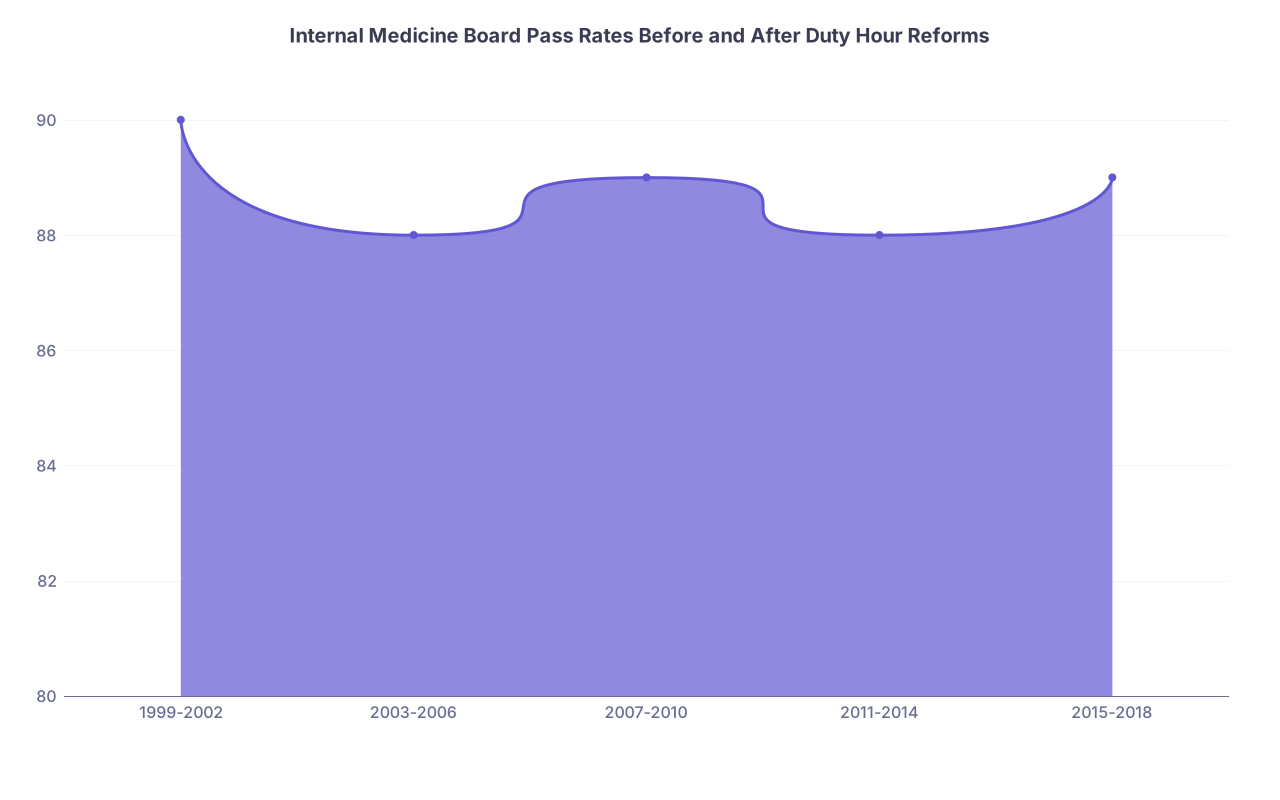
| Category | Value |
|---|---|
| 1999-2002 | 90 |
| 2003-2006 | 88 |
| 2007-2010 | 89 |
| 2011-2014 | 88 |
| 2015-2018 | 89 |
Look at that kind of data long enough and you realize something uncomfortable for the “hours = learning” crowd: exam performance is much more sensitive to the quality of teaching, structure of curriculum, and resident selection than to whether someone worked 75 vs 95 hours per week.
If cutting hours always cut learning, you’d see it in the most easily measured output—test scores. You largely don’t.
Does that mean hours never matter? No. But the relationship is not linear. There’s a saturation point where extra time stops adding knowledge and just adds fatigue.
Think of it this way: the 60th hour in a week might still be high-yield. The 104th? That’s where you’re rereading the same CT report three times and forgetting what you just ordered.
Patient Outcomes: Did Care Get Worse When Hours Dropped?
This is where the conversations usually get heated.
Attending physicians love to say: “The patients are the ones who will suffer if we let residents leave ‘early’.” It sounds noble. But when health services researchers actually looked at mortality, complications, and readmissions before and after duty hour changes, the findings were… underwhelming.
Large studies using Medicare and VA data around the 2003 reforms showed:
- No consistent increase in mortality for common medical and surgical conditions after duty hour limits.
- No systematic worsening in key patient safety indicators directly attributable to the reforms.
- Some hints that teaching hospitals became slightly more comparable to non-teaching hospitals on certain quality metrics over time.
Was there a massive safety improvement? No. But the apocalyptic predictions (“patients will die because residents go home”) never materialized.
Then came the big “flexible vs standard hours” trials:
- iCOMPARE (internal medicine): Randomized programs to standard ACGME rules vs more flexible rules (longer shifts, fewer constraints) while staying under 80 hours.
- FIRST (general surgery): Similar idea in surgery.
The punchlines:
- Patient outcomes (30‑day mortality, serious complications) were not significantly different between flexible and standard programs.
- In other words: whether interns worked 16‑hour max shifts or longer wasn’t the main driver of patient survival.
So no, more hours did not clearly make patients safer. Nor did cutting hours clearly endanger them—assuming the systems were adjusted (handoffs, supervision) with some competence.
Resident Learning vs Resident Experience: Not the Same Thing
Here’s the subtlety people often miss: learning is not the same as “feeling like you are learning.”
When shifts got shorter and handoffs increased, residents started reporting:
- Less continuity with “their” patients.
- More frustration from repeated signouts and fragmented care.
- Subjective sense of “I’m not seeing whole hospitalizations start-to-finish.”
Those feelings are real. I’ve heard PGY‑2s say, “I never see what happens after my patient goes to the ICU” or “I admit them and someone else discharges them; it feels incomplete.”
Subjective continuity dropped. That can absolutely affect perceived ownership and identity as “the doctor” for a patient.
But when you look at objective learning outcomes—exam scores, milestone progression, observed performance—they don’t track 1:1 with those frustrations. You can feel less in control and still be learning a lot. You can also feel “hardcore” and learn almost nothing because your 2 a.m. brain is mush.
Where does work-hours reduction clearly hurt learning? Two places consistently show up:
Procedural exposure in certain surgical subspecialties
Surgical residents and fellows, especially in high-complexity fields, sometimes do end up seeing fewer index cases if hours are rigidly capped and OR time is poorly protected. When you’re post‑call and barred from staying for the big case you helped work up, that’s a lost opportunity.Continuity in longitudinal clinics
For ambulatory-heavy specialties, more night float and more strict hour rules can disrupt clinic follow‑up and continuity, which does matter for learning chronic disease management.
So yes, there are scenarios where cutting hours without redesigning rotations cuts meaningful learning. The problem is that people then generalize these niche failures to all of residency.
The Real Enemies of Learning (Hint: Not Just the Clock)
If you want to know what destroys learning far more reliably than a 16‑hour cap, here’s the short list:
- Garbage supervision – Attending who barely teaches, only shows up to sign notes, or provides feedback that’s either absent or useless. You can work 100 hours with that person and come away with nothing but resentment.
- Administrative bloat – EMR clicks, prior auths, chasing beds, doing secretary work because the system is cheap. Those tasks expand to fill whatever time you give them.
- Unstructured nights – Being “crushed on cross-cover” without a single moment of protected, focused teaching turns overnight shifts into survival exercises, not learning experiences.
- Randomized exposure – If your education depends on what just randomly shows up in the ED, hours help but design matters more. Slightly fewer, better-curated experiences can beat endless chaos.
| Commonly Blamed | Actually Higher Impact |
|---|---|
| Duty hour caps | Quality of supervision |
| 16-hour shifts | Structure of teaching |
| Night float | EMR & admin burden |
| ACGME rules | Feedback culture |
You can keep hours long and still completely tank resident growth by doing those four things poorly. You can also cut hours and preserve or even enhance learning if you aggressively attack those real enemies.
This is what the better programs quietly do: they build actual curricula, protect OR time, use simulation, enforce bedside teaching, and scrutinize their handoffs. They’re not worshipping raw face-time.
Fatigue: The Thing Everyone Mentions but Few Quantify
“Being tired is part of the job.” Sure. So is being competent.
Sleep deprivation research—actual controlled studies, not war stories—consistently shows:
- Cognitive performance, reaction time, and decision-making degrade with prolonged wakefulness.
- After about 16–18 hours awake, your performance looks a lot like being mildly intoxicated.
- Complex tasks requiring synthesis, like managing septic shock or subtle EKG interpretation, are particularly sensitive to fatigue.
Residents are not superhuman. A 28‑hour call does not magically spare the prefrontal cortex.
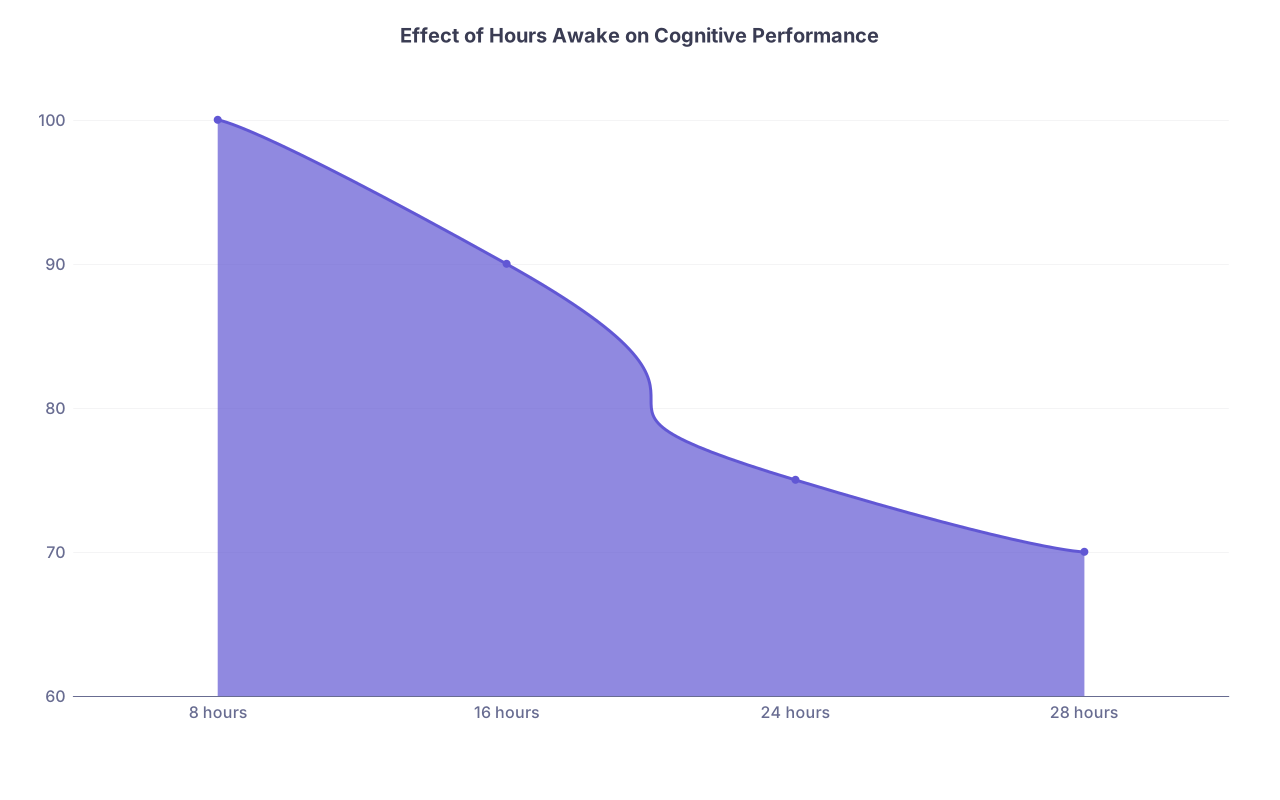
| Category | Value |
|---|---|
| 8 hours | 100 |
| 16 hours | 90 |
| 24 hours | 75 |
| 28 hours | 70 |
There’s an ugly truth here: some of what people call “learning under pressure” is really “surviving despite impaired cognition.” You remember the drama, the intensity, the feeling of sacrifice. That does not mean your clinical reasoning was high quality.
The better controlled comparisons (like iCOMPARE’s cognitive assessments) suggest:
- Moderate reductions in continuous duty improve alertness and some aspects of performance.
- They don’t necessarily produce massive leaps in measured clinical outcomes, largely because medicine is a team sport and systems compensate.
So does cutting hours always cut learning? No. It often trades a little raw exposure for better cognitive function. That’s a trade you want for things that actually matter: dosing chemo, interpreting troponins in complex patients, recognizing early deterioration.
Where Hour Cuts Do Backfire
Let me not sugar-coat this. There are contexts where duty-hour changes were implemented in the dumbest possible way and residents paid the price academically.
Patterns I’ve seen and that show up in survey data:
- More but worse handoffs – Programs added night float and shorter shifts but never taught structured handoffs properly. Residents feel like they’re “managing signouts,” not patients. Learning naturally suffers.
- Loss of longitudinal cases – Interns do the initial workup, then senior night float residents “own” the evolving course and ICU management. Juniors miss the arc of disease.
- Rigid clock-watching that kills teaching moments – “It’s 6:59 p.m., you’re out, we’ll staff this interesting case tomorrow without you.” That’s just laziness disguised as compliance.
These are not inevitable consequences of shorter hours; they’re consequences of lazy program design.
Programs that took reforms seriously did things differently: better signout scripts, co-follow models, structured night teaching, clear protection for critical learning experiences even if it means tweaking schedules.
The lesson is not “never cut hours.” It’s “don’t amputate learning while you’re cutting fatigue.”
So What Actually Works? The Nuanced Answer
If you put the data and lived experience together, the picture looks like this:
- The total weekly hours matter less for learning than everyone pretends, once you’re above a certain baseline (say 55–60 hours).
- The distribution and structure of those hours matter a lot. Long stretches of cognitively dead time or pure scut aren’t redeemed by being “present.”
- Fatigue management is a real educational tool. A resident who can think clearly for 70 structured hours will probably learn more than one who’s half-awake for 95 unstructured ones.
- Specialties differ. Procedural fields may need smarter, maybe even slightly higher, peak exposure to cases—but that’s an argument for targeted design, not 120-hour weeks.
And the key heresy: you can absolutely cut hours and increase learning if you aggressively redesign the work to prioritize:
- Time with supervisors who teach.
- Protected participation in high-yield cases.
- Real feedback.
- Less time on tasks that a robot or clerk should be doing.

| Step | Description |
|---|---|
| Step 1 | Duty Hours |
| Step 2 | Learning driven by structure |
| Step 3 | Too little exposure |
| Step 4 | Supervision quality |
| Step 5 | Case mix |
| Step 6 | Fatigue level |
| Step 7 | Learning impaired |
| Step 8 | Learning optimized |
| Step 9 | Above baseline |
| Step 10 | Excess fatigue |
That’s the real model. Hours are just one node in a much more complex network.
What You Should Take Away as a Resident (or Program Director)
If you’re the one on the schedule, here’s the uncomfortable truth: arguing over 70 vs 80 hours per week is missing the bigger fight. You should be far more aggressive about:
- Demanding real teaching on rounds and at the bedside.
- Pushing your program to protect core clinics, OR blocks, and critical case exposure from being cannibalized by service.
- Calling out nonsense scut tasks that add no learning and could be offloaded.
- Advocating for structured, efficient handoffs instead of chaotic signout marathons.
If you’re designing programs, stop hiding behind the phrase “duty hours” as if the clock is the main variable. Your residents are not undertrained because they’re capped at 80 hours. They’re undertrained if their hours—however many there are—are wasted.
The Short Version
- Cutting hours does not automatically cut learning; big studies show minimal impact on exams and patient outcomes when work hours were reduced, provided you stay above a reasonable exposure threshold.
- Beyond that threshold, how hours are used—supervision, structure, case mix, and fatigue management—drives learning far more than simply how many hours are worked.
- When hour cuts hurt, the culprit is almost always bad implementation: poor handoffs, loss of continuity, and lazy curriculum design—not the basic idea that residents shouldn’t live in the hospital to become competent.