
It’s 2:37 a.m. You’re on night float, halfway through another “quiet” shift that somehow hasn’t let you sit down in three hours. You’ve just admitted your sixth patient, you still have five notes to finish, and your senior casually says, “We’re fine on hours this week.”
You look at your duty hour log and think:
What actually counts as work?
Does this teaching conference? That pre-rounding? The 40 minutes waiting for the elevator because transport is backed up?
Here’s the answer you’re looking for: if it feels like work, it probably counts. But let’s be precise.
The Core Rule: If You’re Required To Be There, It Counts
ACGME’s 80-hour rule isn’t based on your feelings, it’s based on one simple concept:
If an activity is required by your program and related to your clinical role, it counts toward your 80 hours per week.
Doesn’t matter whether you’re touching patients, staring at Epic, or sitting in a lecture hall. If you have to be there as part of your clinical training, it’s work.
Here’s the mental litmus test I use:
- If I didn’t show up, would someone notice and care?
- Could I get in trouble for not being there?
- Was it listed on the schedule/rotation expectations?
If yes to any of those, it’s duty hours.
Now let’s break it down by category, because this is where programs and residents start to disagree.
What Clearly Counts as Clinical Work
These are the slam dunks. If anyone tells you these don’t count, they’re wrong.
1. Time in the hospital (or clinic) on duty
Everything from walking in the door at the start of your shift to walking out at the end counts:
- Pre-rounding
- Rounds (family-centered, table rounds, teaching rounds – all of it)
- Admissions, transfers, discharges
- Cross-cover
- Procedures
- Consults
- “Just finish your notes then you can go” time
- “Can you help with this code before you leave?” time
If your badge says you’re in the building and you’re “on,” it counts. Even if you’re just waiting for something to happen.
2. Conferences and didactics
If you’re on a clinical rotation and:
- You’re required to attend morning report, noon conference, morbidity & mortality, grand rounds, journal club, etc.
- And they’re during your usual duty schedule (or specifically required outside it)
Then that time is work. It’s part of your clinical training.
This includes:
- Mandatory simulation sessions
- Mandatory skills labs
- Mandatory online modules that substitute for in-person teaching (“You must complete this by Friday”)
If it’s required and tied to the rotation? Count it.
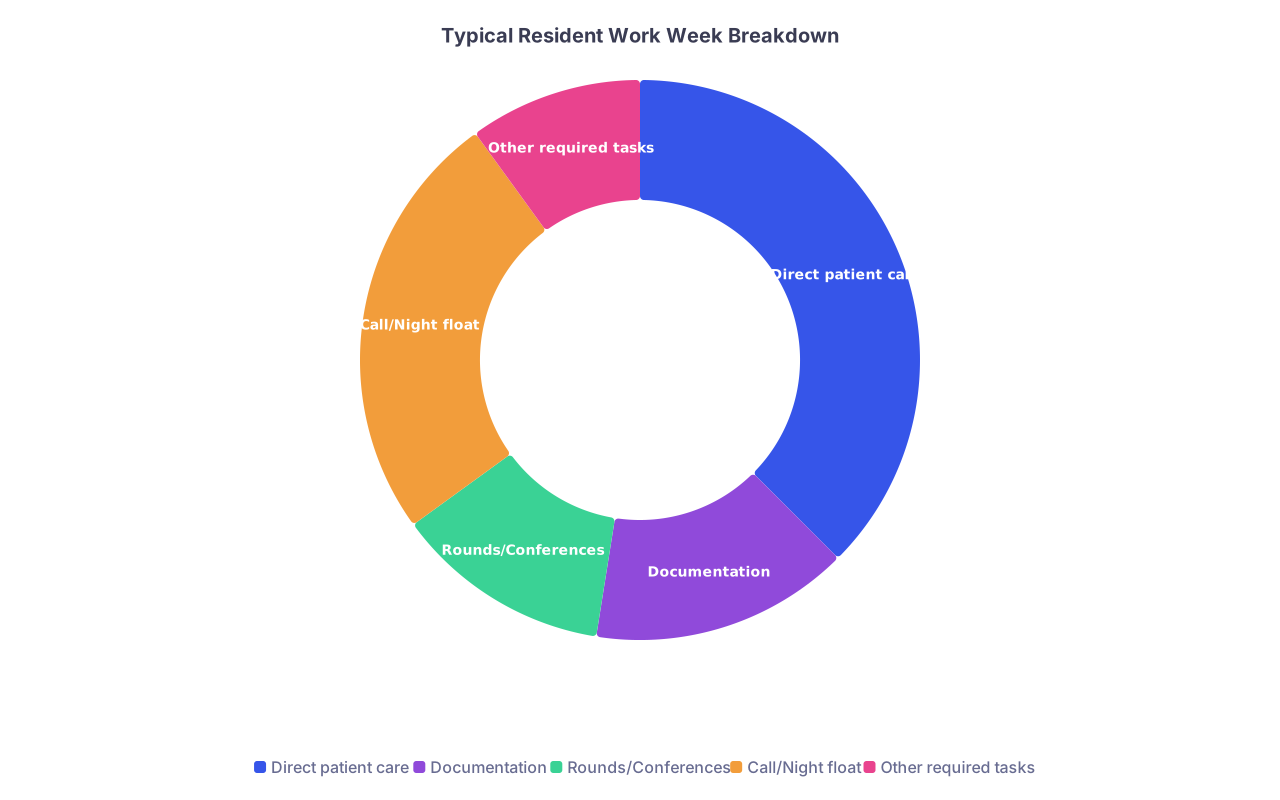
| Category | Value |
|---|---|
| Direct patient care | 30 |
| Documentation | 12 |
| Rounds/Conferences | 10 |
| Call/Night float | 20 |
| Other required tasks | 8 |
3. In-house call and night float
All of this counts, every minute:
- The whole 24 hours of a 24-hour call
- The “post-call” work you do until you actually walk out
- Night float shifts, including downtime between pages
- Staying late “to help” if your senior or attending expects it
If they can page you, you’re on duty.
4. Post-call wrap-up
This is always a point of confusion, so let’s be blunt:
If you’re post-call and still:
- Following up labs
- Answering pages
- Finishing notes
- Giving sign-out
- Helping move the list forward
You’re working. That time counts toward both:
- The 80-hour limit, and
- The 24+4 continuous duty cap (for most specialties)
Once you truly hand off your patients and are free to leave, your duty day stops. If culture says “You should stay for noon conference because optics,” but you’re not required and truly free to leave? That’s the gray zone. More on that in a minute.
What Also Counts (People Try to Ignore These)
Programs sometimes conveniently “forget” these count. Don’t.
1. At-home call (pager call)
If you’re on home call and:
- You’re required to be available
- You’re answering calls
- You’re logging into the EMR from home
- You’re driving into the hospital to see patients or do procedures
That’s work.
How ACGME treats it:
- Time you spend on the phone, in the EMR, and in the hospital counts as duty hours
- The entire period of home call does not automatically count
- But frequent, intense home call that approaches in-house work must be monitored and scheduled with the same care
In reality: If you’re getting hammered with calls all night, log the hours honestly. You’re not “resting.”
2. Required documentation and charting from home
This one’s massive and often abused.
If your attending says, “You can go home but make sure your notes are done tonight,” and you spend:
- 1.5 hours finishing progress notes
- Another 30 minutes messaging consultants
- Another 30 minutes calling families
That 2.5 hours absolutely counts as duty hours.
Does your EMR track access times? Yes. Is it auditable? Also yes. You’re not imagining this.
3. Required quality projects and committees
If your program says:
- “Everyone on MICU must participate in an ICU QI project this month”
- “Each PGY-2 must attend the patient safety meeting”
- “You need to present your QI project at M&M”
That work – meetings, data pulls, prep – counts as duty hours, not “free time passion project.”
If it’s explicitly framed as scholarly but required for the rotation? Still counts.
4. Mandatory online modules and trainings
Things like:
- Annual hospital compliance modules
- EMR training
- Required sedation, central line, or safety modules tied to your clinical role
If they’re mandatory and you do them on your own time? You log that time. It’s still work, even if you’re in sweatpants on your couch, half-watching Netflix.
What Usually Does Not Count
Now let’s talk about what probably doesn’t count, even if it feels like work-adjacent.
1. Purely voluntary research
Key word: voluntary.
If you:
- Chose to do a research project
- Work on it during off hours
- It’s not required for graduation or a specific rotation
That time is not duty hours. That’s academic activity you opted into.
Caveat: If the program or PD heavily “strongly suggests” research to be competitive for fellowship, that’s more of a cultural pressure issue than a duty hour one. But ACGME won’t count it as work unless it’s formally required.
2. Optional conferences and events
If something is:
- Clearly labeled optional
- Not tied to evaluation or rotation completion
- Truly something you can skip without raised eyebrows
Then it doesn’t need to be logged as duty hours.
The reality: Many “optional” things are socially mandatory. If your chief “recommends” everyone comes to some dinner with the chair, that’s pressure. But for duty hour rules, it’s not technically required work.
3. Studying for boards on your own time
Your USMLE Step 3 prep. In-training exam prep. Board review courses you choose and pay for.
Unless the program:
- Requires attendance at a specific board review course
- Schedules it during clinical hours as part of training
Your self-study doesn’t count. That’s called being an adult in a demanding career.
Gray Zone Situations (And How to Log Them)
This is the messy part. Let’s talk through scenarios and what I’d do.
Scenario 1: “You can leave… once you’re done”
You’re on wards. Official sign-out is at 5 p.m.
At 4:45, your senior says, “Try to leave on time, just make sure your notes are done.”
You stay until 6:30 finishing notes and calling a consultant who never called back.
That 1 hour 45 min? Count it. You were still working. You were not free to leave. Patients were still your responsibility.
Scenario 2: “You’re post-call, but… stick around”
You’ve hit your 24 hours. It’s 10 a.m., you’ve signed out, but your attending says, “It’d be great if you went to noon conference. Good teaching case today.”
If:
- You’re genuinely allowed to say no and walk out, and
- Saying no has no evaluation or political consequence
Then that’s probably not duty hours.
If the culture is “everyone stays” and you’d be the only one leaving? I’d count it as duty hours. You’re not truly free.
Scenario 3: “Finish this at home tonight”
You leave physically at 6 p.m., do family stuff, then from 9–11 p.m. you:
- Finish your H&P
- Place orders in the EMR
- Reply to staff messages
That 2 hours? Duty hours. Log it.
If you’re just reading UpToDate or reviewing tomorrow’s cases voluntarily, that’s not duty hours.
Scenario 4: Home call vs just being nice
You’re “off,” but a co-resident texts: “Hey, can you help me interpret this EKG really fast?” You spend 3 minutes looking at it. That’s not duty hours. That’s being collegial.
But if you’re on the schedule with “home call 6 p.m.–6 a.m.” and you’re managing patients, taking calls, giving real medical input? That counts.
How to Protect Yourself Without Being “That Resident”
You don’t need to turn into a duty-hour vigilante. But you do need to be smart.
1. Log honestly, consistently
Don’t “help” your program by:
- Under-reporting hours
- Avoiding logging at-home documentation
- Rounding down your call days
ACGME can’t fix what it can’t see. And when problems get bad enough that someone blows the whistle, having accurate logs matters.
2. Know your limits
Quick review of the key ACGME caps (most programs):
| Rule | Typical Limit |
|---|---|
| Weekly hours (averaged over 4 weeks) | 80 hours (including moonlighting) |
| Maximum continuous duty (most residencies) | 24 hours + up to 4 for transitions/education |
| Days off | 1 day in 7, averaged over 4 weeks |
| In-house call frequency | No more than every 3rd night, averaged |
If you’re averaging 90+ and “no one else is complaining,” that doesn’t mean it’s fine. It means everyone’s scared.
3. Use the chain of command (strategically)
If you see systematic abuse:
- Start with a trusted chief
- Then go to your program director
- If that fails, there’s often a GME office contact and/or anonymous reporting
You’re not “hurting your program” by being honest. Programs that chronically violate duty hours are already hurting themselves and you.
A Simple Framework: Ask Yourself 3 Questions
When you’re unsure whether something counts as clinical work toward your 80 hours, run this:
- Was I scheduled or expected to be doing this as part of my role as a resident?
- Would there be consequences – formal or informal – if I didn’t do it?
- Did it involve patient care, clinical responsibilities, required education, or program-mandated tasks?
If you hit “yes” to #1 and #2, and it’s remotely connected to #3, count it.
If it’s voluntary, academic, or genuinely optional, it probably doesn’t go into your duty hours.

| Step | Description |
|---|---|
| Step 1 | Activity |
| Step 2 | Probably not duty hours |
| Step 3 | Counts as duty hours |
| Step 4 | Required by program or rotation |
| Step 5 | Related to clinical role or required education |
FAQs
1. Does travel time to and from the hospital count toward my 80 hours?
No. Your commute is not duty time. The clock starts when you begin required activity (pre-rounding, sign-out, etc.) and stops when you’re actually free to leave and have no ongoing required work. That said, if you’re commuting between hospital sites as part of your shift, that transfer time while on duty does count.
2. Do I have to log time spent finishing notes at home?
Yes. If the notes are required for your clinical work and you’re expected to complete them, that’s duty time, even if you’re sitting at your kitchen table. Estimate honestly. If you’re in and out of the EMR over two hours, don’t pretend it was 10 minutes.
3. Do mandatory journal clubs and M&M conferences count?
If they’re mandatory and tied to your rotation or program expectations, yes. Journal club, M&M, grand rounds, morning report, noon conference – all count as duty hours when required. If it’s a truly optional evening journal club at someone’s house you could skip without consequence, you don’t have to log it.
4. Does moonlighting count toward my 80 hours?
Yes, absolutely. All internal and external moonlighting hours count toward the 80-hour weekly limit. Programs are technically required to monitor and approve moonlighting so your total hours (residency + moonlighting) don’t exceed ACGME caps. If your PD “doesn’t want to know,” that’s a problem on their side, not a loophole for you.
5. What if my program pressures us to under-report hours?
It happens. I’ve heard “We don’t have a duty hour problem here” more times than I can count – usually in places that very much do. You still log honestly. If there’s explicit pressure to falsify hours, bring it to a chief you trust, then the PD, then the GME office if needed. ACGME takes that seriously, and programs can get hammered for it. You’re not the villain for telling the truth.
Today, do one simple thing:
Open your most recent duty hour log and your calendar for the past week. Add up the time you spent finishing notes from home or doing mandatory modules that you didn’t log. That’s your real work week. Use that number the next time you enter your hours.