

The fastest way to destroy your work-life in residency is to mishandle boundaries with attendings.
Not the hours on the schedule. The hours you silently add on top because you are scared to say no, over-explain, or over-please.
You’re not just tired because “residency is hard.” You’re tired because of specific, fixable boundary mistakes that quietly stretch your day by 1–3 hours. Every. Single. Day.
Let’s walk through the big ones before they grind you down.
1. Saying “Yes” to Everything Just to Look Keen
This is the classic intern mistake: confusing “being a team player” with “being endlessly available.”
You know the script:
- It’s 5:45 pm.
- You’ve signed out your patients.
- You’re halfway through your first bite of cold food.
- Attending: “Hey, can you stay and help with this admission? It’ll be good learning.”
- You: “Sure, no problem!”
You just went from leaving at 6 to leaving at 8:30.
Why this extends your day
- Attendings are used to residents “making it work.” If you never say no, they assume you’re fine.
- You train people to see you as the one who can always stay late.
- The more you stay late, the more they forget what your actual scheduled hours are.
I’ve watched residents who said “yes” to everything get systematically overloaded while their peers quietly protected their time and still got great evaluations.
How to stop making this mistake
You don’t need to be dramatic. You need to be specific and consistent.
Try:
- “I can help start that admission, but I need to leave at 6:30. What’s the highest-yield part for me to do?”
- “I’m at the end of my shift. I can hand it off to night float or the on-call resident.”
- “Today I can’t stay late, but I’m happy to take an extra admission first thing tomorrow.”
You’re not refusing work. You’re defining a boundary. A normal one.
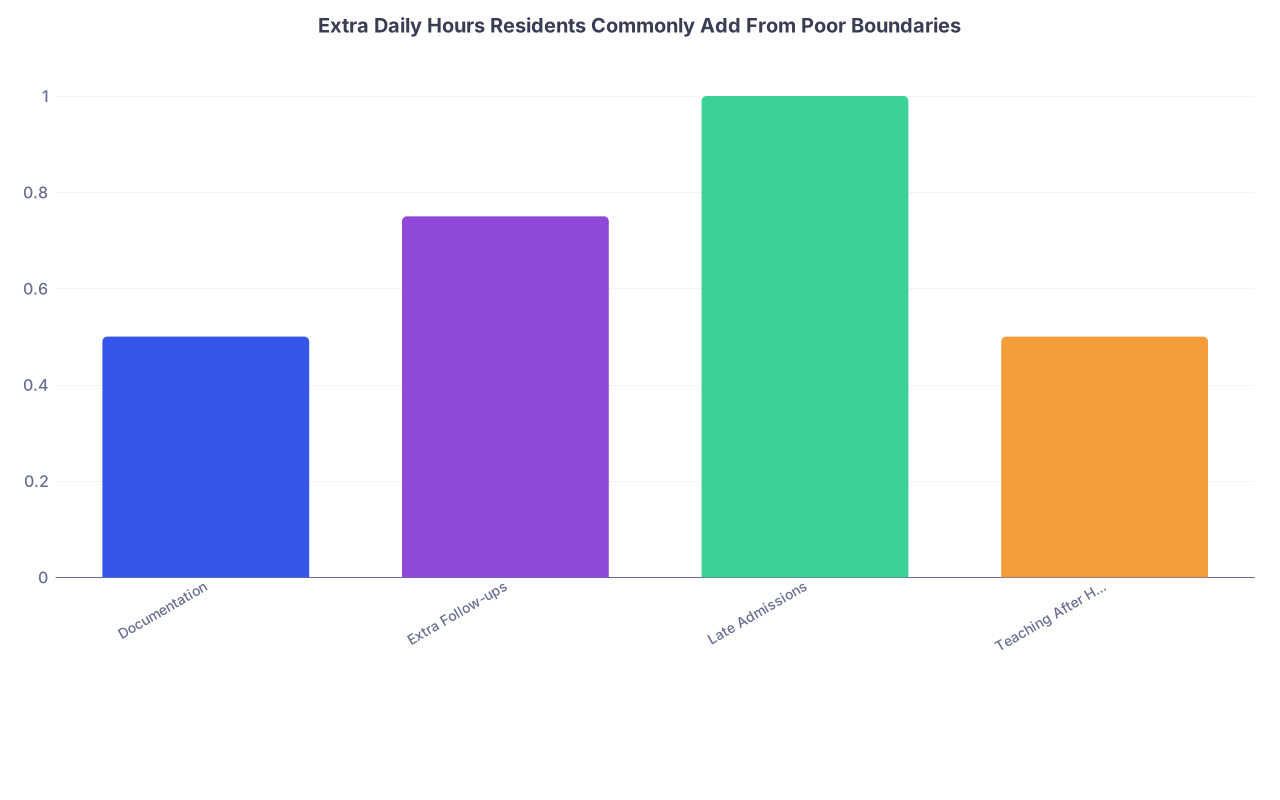
| Category | Value |
|---|---|
| Documentation | 0.5 |
| Extra Follow-ups | 0.75 |
| Late Admissions | 1 |
| Teaching After Hours | 0.5 |
2. Never Clarifying Expectations About Staying Late
A surprising amount of your misery is caused by assumptions. Yours and your attendings’.
Here’s what usually happens:
- No one says anything about what “reasonable” staying late looks like.
- You assume staying late equals being dedicated.
- Attending assumes silence means you’re fine.
- You burn out in slow motion.
Meanwhile, the PGY-3 pulled their attending aside on day one and had a 3-minute conversation that saved them dozens of hours over the month.
The silent trap
If your attending thinks:
- “Residents always stay until everything is silky smooth”
- “Notes should be perfectly polished before leaving”
- “All follow-ups should be done by day team even if it’s 7 pm”
…you will never leave on time.
What you should do instead
Ask direct, boring questions up front. This is not confrontational; it’s self-preservation.
On day 1 of a rotation, say:
- “What’s your expectation for when we should reasonably be out on non-call days?”
- “If we’re still charting after sign-out, are you okay with us finishing some of that from home, or do you prefer us to stay?”
- “For late admissions near the end of shift, how do you like to divide that between day team and night team?”
If they say, “I expect you here until the work is done, no matter what,” that’s a red flag. You log that. You adjust how much “extra” you sign yourself up for with them.

| Step | Description |
|---|---|
| Step 1 | Request from attending at end of shift |
| Step 2 | Say cannot due to work hour rules |
| Step 3 | Do task and document |
| Step 4 | Negotiate scope or hand off |
| Step 5 | Within duty hours? |
| Step 6 | Essential for patient safety? |
3. Letting Teaching Bleed Into Your Post-Shift
Teaching is good. But not all teaching is worth 90 extra minutes after a 12-hour day.
Common pattern:
- It’s 4:55 pm.
- Attending: “Let’s go over all of your patients in detail. It’ll be great teaching.”
- Two hours later, you’re still on patient #6, discussing every lab in the last month.
You wanted feedback. You got a hostage situation.
The subtle problem
You tell yourself: “This is high-yield, I should be grateful.”
Sometimes that’s true. Many times it’s not. Much of this could’ve happened earlier in the day, or in shorter focused blocks.
You don’t have to absorb every teaching moment at the cost of sleep, food, or a basic life.
How to protect your time without being “anti-teaching”
You set time constraints.
Earlier in the day:
- “I’d love to get some teaching on my notes, but I need to leave close to 6 today. Could we do a quick 20-minute session around noon?”
- “If we’re going to do feedback at the end of the day, could we cap it at 15 minutes? I’m on nights tomorrow and want to get some rest.”
If the attending starts a long session at 5:30 pm, you can say:
- “I have about 10 more minutes before I need to go. Can we focus on the top 1–2 things I can improve for tomorrow?”
You’re not rejecting teaching. You’re forcing it to be targeted and respectful of work hours.

4. Doing Attending-Level Work They Never Actually Asked For
Another huge boundary mistake: quietly taking on work that belongs to someone else because you’re afraid to “bother” the attending.
Things like:
- Rewriting entire plans by yourself because the original plan doesn’t make sense.
- Spending 40 minutes re-ordering tests you’re not sure are correct.
- Chasing multiple consults for an attending who would have gotten it done in one call.
You’re essentially doing unsupervised attending work… then still waiting for them to cosign it.
How this blows up your day
- You over-document and over-order to “cover all bases.”
- Then you have to walk your attending through all of it.
- Half of it gets changed anyway.
- You’ve doubled the work.
You’re not being “independent.” You’re burning time.
What to do instead
You must learn to escalate earlier and more efficiently.
Try:
- “I’m unsure between these two plans for this patient—can we quickly decide together so I don’t go down the wrong path for 30 minutes?”
- “Before I call three different services, can we agree on what question we’re actually asking?”
- “I can draft the note and basic plan, but I’d like your input before I order higher-risk tests or make big changes.”
You’re protecting both your time and patient care. That’s not weakness. That’s judgment.
| Mistake Type | Typical Time Lost/Day | How It Shows Up |
|---|---|---|
| Saying yes to all tasks | 0.5–2 hours | “Just one more admission” at 5:30 pm |
| Over-documenting | 0.5–1 hour | 3–4 paragraph assessments for everyone |
| Avoiding escalation | 0.5 hour | Spinning on uncertain plans or orders |
| Unbounded teaching | 0.5–1.5 hours | Long debriefs after sign-out |
5. Treating Duty Hours as Optional “Suggestions”
Let me be blunt: if you treat duty hours like they’re optional, attendings will too.
I’ve heard this from residents more times than I can count:
- “Well, I’m technically post-call, but I didn’t want to leave in the middle of…”
- “We’re supposed to leave by 11 am post-call, but our attending likes us to stay for teaching.”
- “We can’t report this. It’ll look bad.”
You know what looks worse? A PGY-2 falling asleep driving home. Or missing key details because they’re on hour 18.
Duty hours aren’t a cute suggestion. They’re there because people have died when they’re ignored.
Where residents go wrong
- Not tracking duty hours accurately “to be nice”
- Not telling attendings when they’re approaching a rule violation
- Quietly staying 2–3 hours late several times a week
- Bragging about how much they stayed late or “hustled”
You’re teaching the system that your time and safety are flexible.
How to enforce this without being “that resident”
Concrete language helps:
- “I’m close to my 80 hours for the week. If I stay late today, I’ll have to report a violation.”
- “I’m going to need to sign out by 6 to stay within duty hours, but I can prep as much as possible before night float gets here.”
- “I’ve tracked my hours this week and I’m at 14 for today already; I need to be out by 7.”
If an attending pushes back hard against duty hour compliance, that’s not on you. That’s a program-level problem. And you should not be paying for it with your health.
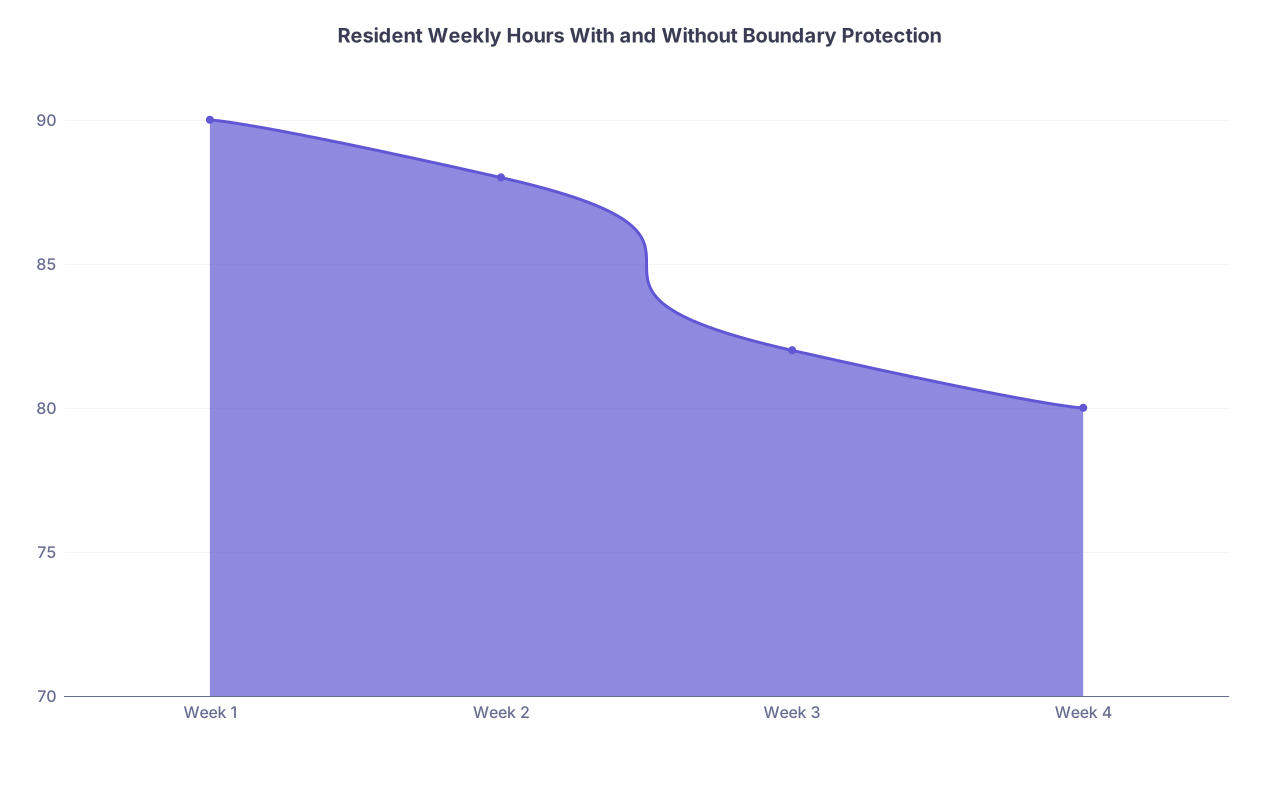
| Category | Value |
|---|---|
| Week 1 | 90 |
| Week 2 | 88 |
| Week 3 | 82 |
| Week 4 | 80 |
(Example: a resident slowly reclaiming hours by fixing boundary mistakes.)
6. Over-Explaining, Over-Documenting, Over-Proving
Another time killer: treating every note like a board essay and every question like an oral exam.
You know the vibe:
- SOAP note that reads like a textbook chapter.
- Paragraph-long justifications for 2 mg of Lasix.
- Repeating every normal value in the lab section.
You’re not doing “great documentation.” You’re panicking on paper.
Why this happens
- Fear of being questioned or “pimped” on your reasoning.
- Past experiences with hypercritical attendings.
- Insecurity about your knowledge level.
- Trying to impress someone through volume instead of clarity.
Result: you’re still typing at 8 pm while the resident who wrote tight, focused notes left at 6:10.
How to be safe without drowning in words
Shift from “prove everything” to “communicate clearly.”
Before writing, ask:
- What does the night team actually need to know?
- What decisions did we make today? Why?
- What changed? What’s the plan?
Then make yourself some personal rules:
- Cap most progress note assessments at 3–5 sentences per problem unless something truly complex occurred.
- Stop restating every single normal vital and lab in prose.
- Use problem-based lists focused on assessment and plan, not story-telling.
And if an attending wants ultra-detailed notes, clarify:
- “For your expectations, could you show me one or two examples that are the right level of detail? I want to match your style without over-writing every note.”
You may not even realize how much extra time your over-documentation is stealing.

7. Confusing “Being Nice” With “Being Available 24/7”
Here’s a quiet one: emotional boundary creep.
Some attendings blur roles. They:
- Text you after hours with non-urgent questions.
- Expect immediate responses to late-night emails.
- Treat every minor update as urgent.
- Give “just checking in” tasks at 6:05 pm that could’ve waited.
You want to be polite. You don’t want to be labeled “difficult.” So you respond to everything, instantly, at any time.
And your workday never really ends.
How to draw the line without drama
You don’t need a confrontation. You need patterns.
For example:
- Don’t respond instantly to non-urgent messages after hours. Wait until you’re back in.
- If they call or message after hours about something non-urgent, say, “I’m out of the hospital now; I’ll take care of this first thing in the morning.”
- During the day, say: “For non-urgent questions, is it okay if I batch them and check in with you once later in the afternoon? That way I can stay efficient with patient care.”
If your program doesn’t require personal phone contact with attendings, keep as much communication as possible on official channels (pager, secure messaging apps with logs).
You’re allowed to have off-time. You’re not a 24-hour call center.

| Step | Description |
|---|---|
| Step 1 | Start of shift |
| Step 2 | Unclear expectations |
| Step 3 | Over-documenting |
| Step 4 | Unbounded teaching |
| Step 5 | Extra late tasks |
| Step 6 | After-hours messages |
| Step 7 | End of day much later |
8. Never Looping in Your Chief or Program Leadership
One more mistake that keeps your days long: trying to privately “manage” attendings who are consistently boundary-violating.
Some situations are not fixable with personal scripts:
- Attendings who routinely ignore duty hours.
- Services where “everyone” stays 3 hours late as culture.
- Expectations to pre-round at 4 am “to impress attending X.”
- Post-call days where you’re “encouraged” to stay for afternoon rounds.
You’re not going to single-handedly reform that with one polite sentence.
What you must do instead
Use your support structure. That’s what it’s there for.
You:
- Track your actual hours for at least 1–2 weeks on that service.
- Write down specific examples:
- “Post-call on 10/2 stayed until 3 pm; expected to be out by 11 am.”
- “On 9/28 admitted a new patient at 6:45 pm despite sign-out at 6 pm; no night team involvement.”
- Bring this to your chief resident or program director:
- “I’m struggling on this service. Here are my logged hours and some specific examples. I’m trying to stay safe with duty hours and I’d like your advice.”
You’re not complaining. You’re reporting a structural problem affecting safety and education.
If you never escalate, leadership will assume everything is fine. And nothing changes.
Quick Self-Check: Are You Making These Boundary Mistakes?
If any of these feel familiar, you’re probably giving away hours you can’t afford:
- You regularly stay 1–3 hours after sign-out for “just a few more things.”
- You feel guilty any time you leave on time.
- You rewrite plans or notes multiple times to impress particular attendings.
- You’re scared to mention duty hours to your attending.
- You regularly answer non-urgent texts/messages from attendings off-hours.
You don’t need to fix everything at once. Start with one boundary:
- Choose one attending or one rotation.
- Pick one behavior you’re going to stop: e.g., staying past 7 pm on non-call days unless patient safety is at risk.
- Use one sentence you’ll say when pushed.
- Track your hours and how often you actually needed to stay late for real reasons.
You’ll be shocked how often the world doesn’t end when you quietly enforce basic limits.
FAQs
1. Won’t setting boundaries hurt my evaluations or reputation?
It can if you do it clumsily or with attitude. But clear, respectful boundaries are usually seen as professionalism, not laziness. The key is how you frame it:
- Focus on patient safety and duty hour compliance.
- Offer alternatives (“I can start this now and hand off to night team.”).
- Show that during your scheduled hours, you work hard and are engaged.
Most attendings respect residents who take both education and self-preservation seriously. The ones who don’t are usually already known to leadership.
2. How do I know when staying late is actually the right thing to do?
Use these filters:
- Is there an immediate patient safety issue that cannot safely be handed off?
- Is there no appropriate handoff person (night float, on-call resident) yet in place?
- Will staying late avoid real harm, not just mild inconvenience or “extra polish”?
If yes, you stay. You document why. You let someone (chief, coordinator) know if it becomes a recurring pattern. If not, you hand off.
3. What if my co-residents stay late and make me feel guilty for leaving on time?
This is common and dangerous. Some residents bond over mutual overwork and resent anyone who refuses to play that game. You’re not obligated to match their self-sacrifice.
You can be collaborative without participating in unhealthy norms. Be helpful during the day, offer fair coverage trades, and communicate clearly. Then walk out when your shift ends and patient care is safely handed off. You’re training for a career, not a martyrdom contest.
Key points to remember:
- Most of your extra hours come from preventable boundary mistakes, not just “hard rotations.”
- Duty hours and reasonable limits are not selfish; they’re safety requirements—for you and your patients.
- You protect your time by being clear, consistent, and specific with attendings, not by suffering in silence.


