
72% of residents report dozing off during routine clinical activities at least once a month. Not because they are lazy. Because their circadian biology is being systematically abused.
Let me be blunt: 24+ hour call is physiologically hostile. You can “get used to it” subjectively, but your neurobiology never does. The trick is not to pretend the schedule is fine; it is to learn how to exploit what we know about circadian biology to fail less catastrophically.
You are not going to “optimize” a 28‑hour call. You are going to damage‑control it. Very different mindset.
1. What Your Circadian System Actually Does (And Why Call Wrecks It)
Your brain is running two overlapping systems that determine alertness and performance:
- A circadian pacemaker (the clock)
- A homeostatic sleep drive (the pressure to sleep)
They are not the same thing, and call schedules crush both.
The circadian core: SCN, light, and the daily signal
Your main clock sits in the suprachiasmatic nucleus (SCN). It:
- Synchronizes to light entering the retina (especially blue‑enriched light)
- Sends timing signals to hormone systems (melatonin, cortisol), body temperature, and alertness centers
- Runs on a slightly longer than 24‑hour intrinsic period, so it needs daily light “time cues” (zeitgebers) to stay locked to the outside world
In a normal human:
- Core body temperature and cognitive performance peak late afternoon / early evening
- Sleepiness peaks in the mid‑afternoon and around 3–6 a.m.
- Melatonin secretion rises around 9–11 p.m., peaks 2–4 a.m.
- Cortisol peaks around wake time (6–8 a.m.), then slowly declines
Now stack a 28‑hour call on top of that. You are awake and trying to manage complex tasks precisely when your circadian system is engineered to be at minimum alertness and maximum sleep drive.
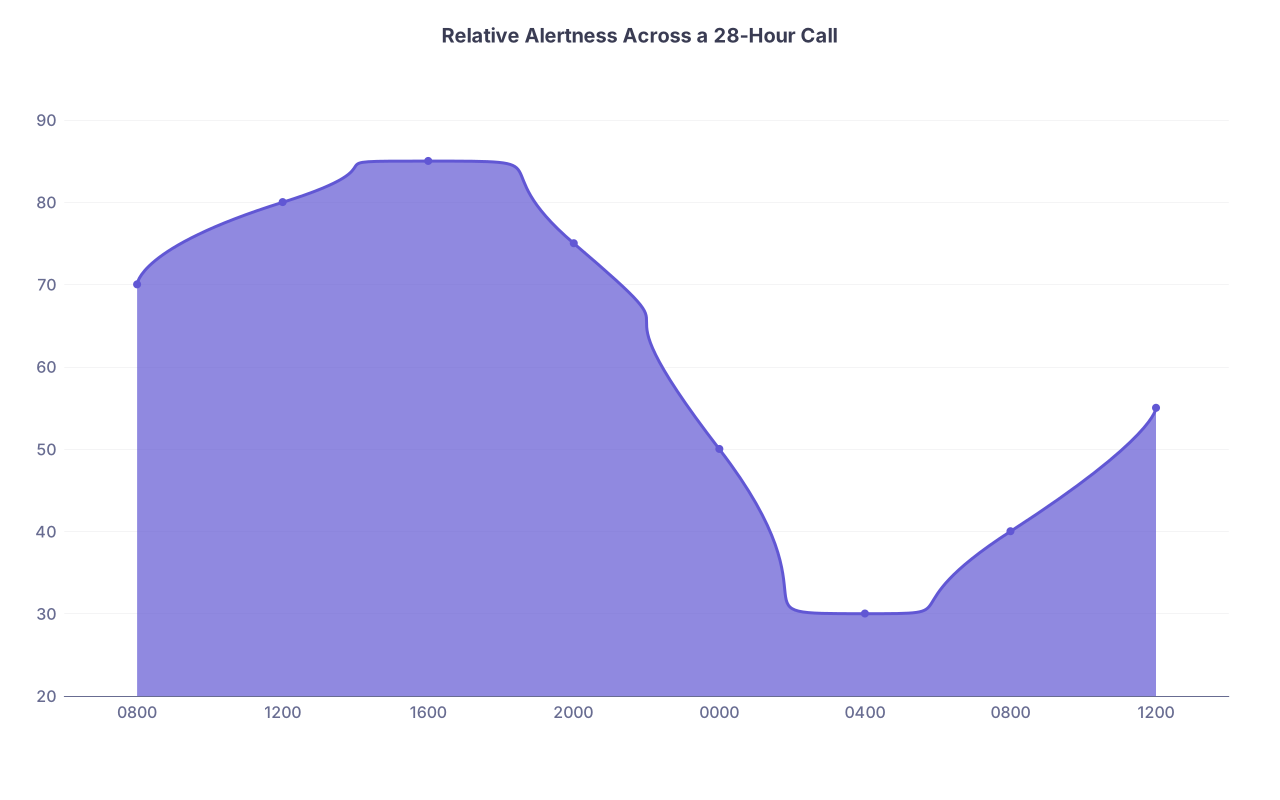
| Category | Value |
|---|---|
| 0800 | 70 |
| 1200 | 80 |
| 1600 | 85 |
| 2000 | 75 |
| 0000 | 50 |
| 0400 | 30 |
| 0800 | 40 |
| 1200 | 55 |
The second system: homeostatic sleep drive
Separately from the clock, your brain accumulates sleep pressure the longer you are awake. That pressure is driven in part by adenosine:
- Wake longer → adenosine builds up in the brain → sleepier
- Sleep → adenosine cleared → pressure drops
On a normal day: 16 hours awake, 8 hours asleep. That’s the rough balance your brain expects. On 24+ hour call, you are at 24–28 hours of wake with incomplete or fragmented recovery sleep on the back end. Your adenosine curve is so elevated by 3–6 a.m. that your cognitive performance is equivalent to moderate intoxication.
This is not metaphorical. Performance at 24 hours of sustained wakefulness is similar to a blood alcohol level of 0.10–0.12%. You would not let a drunk intern write TPN orders, but you routinely do the equivalent by schedule.
Why “getting used to call” is mostly an illusion
Residents always say, “It was horrible at first, but you get used to it.”
What actually happens:
- Subjective sleepiness: decreases somewhat because you adapt expectations and normalize suffering
- Objective performance: does not normalize. Psychomotor vigilance, reaction time, and error rates remain impaired during night hours even in long‑term shift workers
- Mood and empathy: gradually deteriorate; you get more irritable, less patient with families, and more likely to cut corners cognitively
So the goal is not to “toughen up.” The goal is to understand the predictable shape of your impairments and build habits and micro‑structures around that.
2. Circadian Anchors: What You MUST Protect On Q3–Q7 Call
The residents who survive call without unraveling do not necessarily sleep more. They sleep more strategically relative to their clock.
There are three non‑negotiable anchors:
- A mostly consistent wake time on non‑call days
- A protected “anchor sleep” block
- A realistic plan for post‑call recovery
1. Keep a consistent wake time (even if bedtime is variable)
Your SCN cares more about your morning light and wake time than about your exact bedtime. Constantly shifting wake times by 3–4 hours between days off and post‑call days is the fastest way to wreck circadian stability.
Rule I give interns:
- Pick a standard wake time on non‑call days that fits your earliest typical start (e.g., 5:30–6:00 a.m. on medicine)
- On post‑call days, allow 2–3 extra hours but not a 6–8 hour shift
- On days off, do not sleep until noon unless you are acutely sleep‑deprived from the previous night
Think “more sleep” by going to bed earlier, not by shifting your entire day later whenever you are off.
2. Anchor sleep: the 4–5 hour block you guard aggressively
Even in residents with terrible overall sleep time, performance is meaningfully better if they have a relatively stable block of sleep that hits at least part of the circadian “biological night.”
For a typical early‑start resident:
- Aim for an anchor sleep window like 11 p.m.–4 a.m. or 10 p.m.–3 a.m. on non‑call nights
- On late‑start rotations, you can slide this slightly later, but keep it consistent for that block of weeks
Why this matters: Your deepest slow‑wave sleep, which is most restorative for physical fatigue and adenosine clearance, clusters in the early part of the night. If you consistently sleep midnight–4 a.m., your brain at least knows when to deliver those stages.
Fragmented 2‑hour naps sprinkled randomly across 24 hours are much less effective than a continuous 4–5 hour period that overlaps your biological night.
3. Post‑call: controlled crash, not an all‑day coma
Most residents handle post‑call badly. Either:
- They stay up too long, “just to push through,” then are destroyed for two days
- Or they sleep from 10 a.m. to 6 p.m., cannot fall asleep at night, and shift their clock later and later
The physiology‑informed pattern that actually works:
- Get home. Shower, eat something simple.
- Sleep a controlled block: 3–5 hours maximum (e.g., 10 a.m.–2 p.m.)
- Wake up. Get light exposure, move your body, eat real food.
- Go to bed that night at your usual bedtime or 1 hour earlier.
You are trading some subjective sleepiness in the late afternoon/evening for better circadian alignment and less “jet lag” into the next several work days.

| Step | Description |
|---|---|
| Step 1 | Leave Hospital Post Call |
| Step 2 | Arrive Home |
| Step 3 | Shower and Light Snack |
| Step 4 | Sleep 3 to 5 hours |
| Step 5 | Wake by mid afternoon |
| Step 6 | Get bright light and light activity |
| Step 7 | Normal dinner |
| Step 8 | Bedtime at usual time or 1 hour earlier |
3. Strategic Napping During 24+ Hour Call (Done Like a Professional, Not a Martyr)
Here is where circadian science is actually useful on an hour‑to‑hour basis.
The reality: unplanned microsleeps will happen
By 3–6 a.m., whether you want to or not, your brain is going to have brief off‑line episodes. Microsleeps of 3–15 seconds where the lights are on and nobody is home. I have watched interns staring straight at an order entry screen, fingers on keyboard, with zero cortical activity.
You get to choose: controlled naps that you plan, or uncontrolled lapses that you deny until something serious happens.
Short vs long naps: pick based on where you are in the night
Two nap types:
- Ultra‑short “maintenance” nap: 10–20 minutes
- Full cycle nap: ~90 minutes
The key concept: sleep inertia – the groggy, impaired period after waking up from deeper sleep. Longer naps are more restorative but carry more inertia risk if timed badly.
Use them this way:
- Early in the night (e.g., 9 p.m.–1 a.m.): 90‑minute nap if you can get it, because inertia is less dangerous and you will have time to “climb out” before the circadian nadir
- After 2–3 a.m.: avoid 60–90 minute naps unless someone can protect you on wake‑up. Better to use 10–20 minute power naps which reduce sleep pressure without dropping you fully into slow‑wave sleep
If you have 30–40 minutes and no one is dying, I still usually advise: set 2 alarms at 20 minutes, use 5–10 minutes for wind‑down, accept 10–15 minutes of actual sleep. Residents consistently underestimate how much this helps at 4 a.m.
Where to place naps across a 28‑hour call
A practical pattern I give PGY‑1s on a Q4, 28‑hour schedule:
- Before call: 60–90 minute “prophylactic” nap late afternoon (4–6 p.m.) if you can. Yes, you will feel a bit groggy at first. That is the price of having reserve capacity at 3 a.m.
- On call:
- Target a 60–90 minute nap between 23:00 and 01:00 if the pager allows
- If things are too busy, take first lull after midnight for a 15–20 minute nap
- Around 4–5 a.m., if there is any gap, another 10–20 minute nap is gold
Not glamorous, but it cuts into your high‑risk window when both circadian low and maximal sleep pressure converge.
4. Light, Caffeine, Melatonin: Use Them Like Pharmacology, Not Vibes
Most residents use these three haphazardly. That is how you end up awake at 2 a.m. on your post‑call “day off,” doomscrolling, with a 5:30 a.m. wake time the next day.
Light: the most powerful circadian drug you have
Light is not just “helps you wake up.” It actively shifts your clock.
The simplified phase response:
- Bright light in the early biological morning → advances your rhythm (shifts it earlier)
- Bright light late biologic evening / early night → delays your rhythm (shifts it later)
You want different things in different contexts.
On a typical day shift block (with intermittent 24+ hour calls):
- Get outside or near a bright window as early as possible after waking (ideally 15–30 minutes of outdoor light)
- Minimize unnecessary bright light exposure between 11 p.m. and 4 a.m. on non‑call nights (screen dimming, blue‑light filters, overhead lights down)
On a single overnight call:
- Do not try to “flip” your clock completely. You are not a permanent night‑shift nurse. You just need to maintain alertness without totally shifting your rhythm.
- Use bright light strategically between ~22:00 and 02:00 in call rooms / workrooms to keep alertness up
- Between 03:00 and 06:00, favor task‑lighting: keep enough light for safety and function but avoid blasting yourself with ultra‑bright overhead LEDs if you can. You cannot fully avoid the nadir, but you do not need to hammer your clock in the process.
Caffeine: timing and stopping rules
Residents usually do caffeine in two bad ways:
- Constant low‑grade sipping all night
- A huge bolus at 3–4 a.m. to “get through the worst”
Here is the physiology‑informed version:
- Caffeine is an adenosine antagonist. It does not remove sleep pressure; it masks it.
- Half‑life averages 4–6 hours, longer in some people.
On a 24–28 hour call with a morning start (e.g., 7 a.m.):
- First dose: after initial rounding crunch, around 9–10 a.m., not immediately upon waking. Let your natural cortisol peak do some of the work.
- Second dose: early afternoon (13:00–15:00), especially on heavy admits days.
- After ~17:00–18:00: only small, deliberate doses if you know you are going to try for a short nap later. And stop entirely by midnight if you plan to sleep post‑call before afternoon.
A simple stopping rule that works for most: no caffeine within 8 hours of your intended major sleep block. On call, that might mean stopping by 1–2 a.m. if you expect to lie down after sign‑out at 9–10 a.m. and actually sleep.
Melatonin: for circadian correction, not as a knockout
Melatonin is more of a clock signal than a sedative. Residents abuse it like zolpidem, then complain that it “does not work.”
Use cases where it does have a role:
- Evening before the first early‑start rotation: low‑dose (0.5–1 mg) 3–4 hours before planned bedtime to help advance your rhythm slightly
- Post‑night‑float or after a string of late shifts: low‑dose in early evening to pull your bedtime earlier over several days
- Rarely, to reinforce sleep onset on a post‑call day when your circadian phase is drifting later
What not to do:
- Do not take high doses (5–10 mg) at random bedtimes. Higher doses do not proportionally improve sleep and increase morning grogginess.
- Do not rely on melatonin to “force” sleep at 2 p.m. right after call. Daytime post‑call sleep is fighting both circadian wake signals and light; melatonin can play a role, but blackout curtains and sleep hygiene matter more.

5. Task‑Level Strategy: Matching Work to Your Circadian Profile Across the Call
You cannot redesign the call schedule. You can control the order and nature of tasks under your control.
Mentally divide the call into bands and allocate tasks accordingly.
| Time Window | Physiology State | Best Tasks |
|---|---|---|
| 07:00–12:00 | High cortisol, rising alertness | Complex planning, ICU rounds |
| 12:00–18:00 | Peak performance | Procedures, family meetings |
| 18:00–23:00 | Gradual decline | Documentation, sign-outs |
| 23:00–03:00 | Falling alertness | Lower complexity admits, checklists |
| 03:00–07:00 | Nadir, max sleep drive | Only critical tasks, protocols, double-checks |
Morning (07:00–12:00): complex work, teaching, planning
You are still relatively fresh and aligned with your clock.
- Do the heaviest cognitive work here: diagnostic synthesis, major management plan changes, hard family meetings.
- Volunteer for procedures that require precision now rather than at 3 a.m. if you have any choice.
Afternoon (12:00–18:00): use your performance peak
Your reaction time and executive function are actually optimal in this band.
- Schedule procedures when possible
- Dictate or write the more nuanced consult notes
- Teach the med students complex concepts; you will do a better job now than at 10 p.m.
Evening (18:00–23:00): pre‑emptive organization
You are beginning to decline, but not in free fall.
- Front‑load:
- Orders that can be written early
- Anticipatory PRNs
- Clear handoffs between team members
- Work through documentation backlogs, but do not leave the highest‑stakes decisions for this window if you can avoid it.
Night (23:00–03:00): controlled attrition, planned nap
- Try to create a block (even 45–60 minutes) to lie down between admits.
- For new admissions:
- Rely more heavily on structured templates and systematic ROS/physical formats; less improvisation, more checklists.
- If you find yourself staring at the EMR, rereading the same line three times: you are already compromised. That is the time for a 10–20 minute nap.
Predawn (03:00–07:00): defense mode, not heroics
This is the dangerous zone. Your circadian nadir plus maximum sleep debt.
I tell residents:
- Avoid “creative” medicine now. Do not dramatically reinvent care plans unless something is clearly failing or unsafe.
- For new admits or decompensations:
- Use protocols and appropriate escalation to seniors and attendings.
- Double‑check insulin orders, anticoagulation, and high‑risk medications.
- If you are reviewing imaging or labs, say the findings out loud. It forces a second cognitive pass and keeps you from sleep‑reading.
This is not about pretending you cannot function. It is about recognizing that your error probability is highest and acting like that is real.
6. Rotation Patterns: How to Think Across Weeks, Not Just One Call
Circadian disruption compounds across weeks. You know this intuitively—by week 3 of wards on Q4 call, you are a different human than in week 1.
Continuous vs intermittent night work
Data are pretty clear:
- Permanent night shifts allow partial circadian adaptation (though never perfect)
- Intermittent single‑night calls create worse circadian stress because your clock never adjusts
In residency, you are usually stuck with intermittent nights. So you have two broad approaches between calls:
- Re‑anchor strongly to a day schedule between calls (what I recommend for most)
- Maintain a slight delay (later bedtimes and wake times) across a call block to make nights marginally easier
For traditional q4 overnight call on day‑shift rotations, option 1 wins. You simply do not have enough consecutive nights to justify clock‑shifting further.
For night float or 5–7 nights in a row, then yes, you treat yourself more like a permanent night worker and actually push your phase later using evening light and casual morning light avoidance (dark glasses on the way home, blackout curtains, etc.).
Days off: recovery vs social life vs circadian damage
Here is where people break themselves.
Residents will:
- Sleep until 1 p.m.
- Stay up until 2 a.m. with friends or Netflix
- Then expect to be sharp at 6 a.m. Monday
The human circadian system is not that flexible. A 4‑hour shift in 48 hours is basically flying a couple time zones and back.
Better pattern for a weekend off after calls:
- Saturday: allow 1–2 hours extra sleep in the morning, not 5–6. Get daylight, do something real outside the hospital.
- Saturday night: go out, fine. But aim to be home by the time you normally go to sleep on a non‑work day + 1–2 hours max.
- Sunday: wake at or near your workday wake time. Short nap in afternoon if needed. Get to bed earlier Sunday night.
You are protecting the upcoming week, not just extracting maximum social life from a single off‑day while torpedoing the rest.
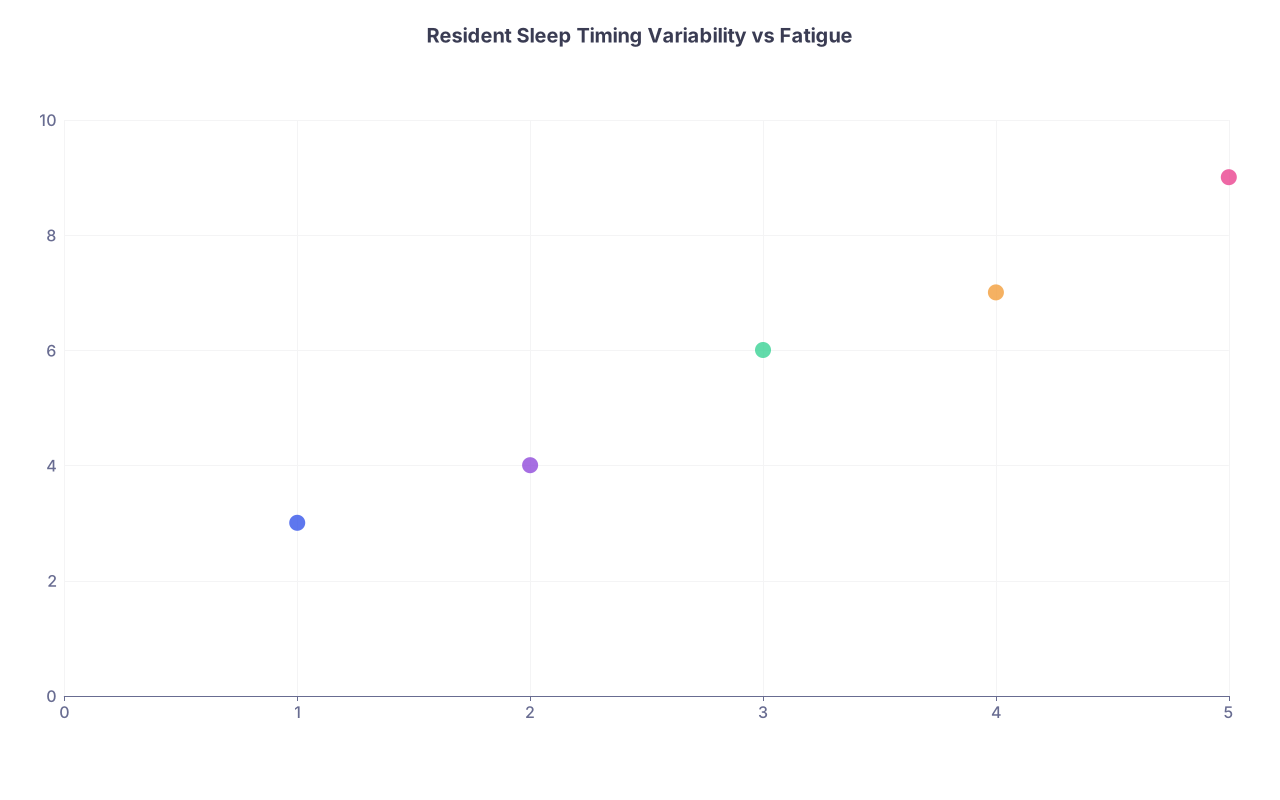
| Category | Value |
|---|---|
| Resident A | 1,3 |
| Resident B | 2,4 |
| Resident C | 3,6 |
| Resident D | 4,7 |
| Resident E | 5,9 |
(Here, x = average hours of weekend wake time shift; y = self‑reported fatigue scores. The pattern is real: bigger shifts → more fatigue.)
7. What To Do When the System Is Bad and You Have Limited Control
I will be honest: a lot of residency schedules are simply misaligned with what we know about circadian biology. There are structural fixes that would help (eliminating 28‑hour shifts, forward‑rotating schedules, protected nap periods), but you do not control those as a PGY‑2.
What you do control:
- Your pre‑call day: do not show up already sleep‑deprived
- Your caffeine, light, nap timing
- How rigidly you protect anchor sleep on non‑call days
- How you triage tasks by time of night
- Whether you treat post‑call as a temporary coma day or a controlled reset
I have watched smart residents destroy their functional capacity not because they had worse schedules, but because they absolutely refused to accept that their biology had limits. They treated 24+ hour call like a willpower contest instead of a logistics problem.
Let me be very clear: this is not about weakness or “self‑care” posters. This is about not making preventable mistakes on heparin drips, or blowing a central line, because you insisted on ignoring 70 years of circadian science.
You are operating heavy machinery: your own brain.
Key points to carry forward:
- You cannot out‑tough your circadian biology. Use anchor sleep, controlled post‑call naps, and consistent wake times to limit damage.
- Treat light, caffeine, melatonin, and naps as precise tools: what you use, when you use it, and when you stop matter more than the total amount.
- Match your highest‑risk tasks to your best circadian windows, and build checklists and redundancy into the 03:00–07:00 nadir, when you are most likely to make serious errors.