
Most residents break duty hour rules accidentally because nobody ever taught them how to maximize case exposure within the rules.
Let me be blunt. The ACGME duty hour standards are not your enemy. Poor planning, vague expectations, and “hero culture” are. If you want to get the most out of procedural rotations—surgery, anesthesia, IR, GI, cardiology, OB/GYN—without getting slapped in the face by a duty hour citation, you need a concrete strategy. Not wishful thinking. Not “I’ll just stay until it’s done.”
I am going to walk through how to optimize case exposure while staying squarely inside the rules: 80 hours, 1 day off in 7, 10 hours off between shifts (or equivalent), in-house call caps, and all the other fine print that program directors lose sleep over.
This is about working smarter inside a rigid legal box. And yes, that box matters—for you and for your program.
The Reality of Duty Hours in Procedural Rotations
Let me break down the core conflict: procedural training is inherently opportunistic, but duty hours are rigidly scheduled.
Cases do not distribute themselves neatly across your 60–70 hour workweek. They cluster.
- Big trauma nights.
- 8-case elective OR days.
- Marathon cath lab days.
- OB nights with 6 sections and 10 vaginal deliveries.
You either have a system for capturing that exposure legally, or you oscillate between two bad extremes:
- You obey the rules blindly and miss key cases because “it’s post-call, I have to leave.”
- You chase every interesting case, fudge your logging, and hope GME never audits it.
Both are weak strategies. The structure exists; use it.
What the ACGME Actually Cares About (Functionally)
Do not treat the rules as abstract. Translate them into operational constraints on procedural rotations:
- Average ≤80 hours per week over 4 weeks
- 1 day (24 hours) off in 7, averaged over 4 weeks
- 10 hours off between duty periods (with some flexibility in some specialties for continuity of care)
- In-house call no more frequent than every 3rd night
- No more than 24 hours of continuous in-house clinical duty (+ up to 4 for transitions/education)
On a procedural-heavy month, the key constraints that actually bite you:
- The 24+4 hour continuous duty cap
- The 10-hour rest window after late-running cases
- The 80-hour average over 4 weeks
Most residents get burned not by staying a bit late one night, but by repeated pattern violations: staying late three days in a row, or turning a 24-hour call into 28 hours “because the case was cool.”
You can absolutely be aggressive about case exposure and still stay legal—if you’re deliberate.
Know Your Rotation’s “Case Economy”
Every procedural rotation has a “case economy”—how cases are distributed, who controls assignments, and how often high-yield opportunities arise. You cannot optimize exposure if you do not understand that economy.
Map Out Where the Cases Actually Are
In the first 48 hours of a new procedural rotation, you should be able to answer:
- Where are the highest-yield cases?
- For surgery: complex oncology, vascular, hepatobiliary, major trauma.
- For OB: high-risk deliveries, operative vaginal, emergent C-sections.
- For anesthesia: cardiac, thoracic, peds, neuro, complex airways.
- For GI: ERCP, EUS, complex polypectomy.
- What time of day do these cases typically happen?
- Elective big cases often start 7–9 am.
- Add-on and emergent cases pile up late afternoon and night.
- Who controls case assignments?
- Chief resident? Charge nurse? Attending? OR board runner?
You are not “lucky” or “unlucky” with cases. You are either plugged into how your rotation allocates them, or you are floating blindly.
| Service | Peak High-Yield Time | Primary Decision Maker |
|---|---|---|
| General Surgery | 7–11 am (elective complex) | Chief resident |
| Trauma Surgery | 6 pm–2 am (emergent) | Trauma chief |
| OB/L&D | 11 pm–5 am (emergent C/S) | Senior resident |
| Anesthesia | 7–9 am (cardiac, complex) | Anesthesia scheduler |
| GI Endoscopy | 9 am–1 pm (advanced cases) | GI attending |
You want to position yourself at the right time, in the right place, with the right person, while still respecting your hours.
Duty Hour Rules as Tools, Not Handcuffs
Residents often treat duty hours as something to hide from or game. That is backwards. When you respect and use them, they actually protect your ability to be present for the best cases.
Let me break down the core rules into practical levers.
The 80-Hour Week: Average, Not Absolutes
80 hours is averaged over 4 weeks. That gives you flexibility.
You can have:
- Week 1: 74 hours
- Week 2: 82 hours
- Week 3: 85 hours
- Week 4: 75 hours
…as long as the 4-week average is ≤80.
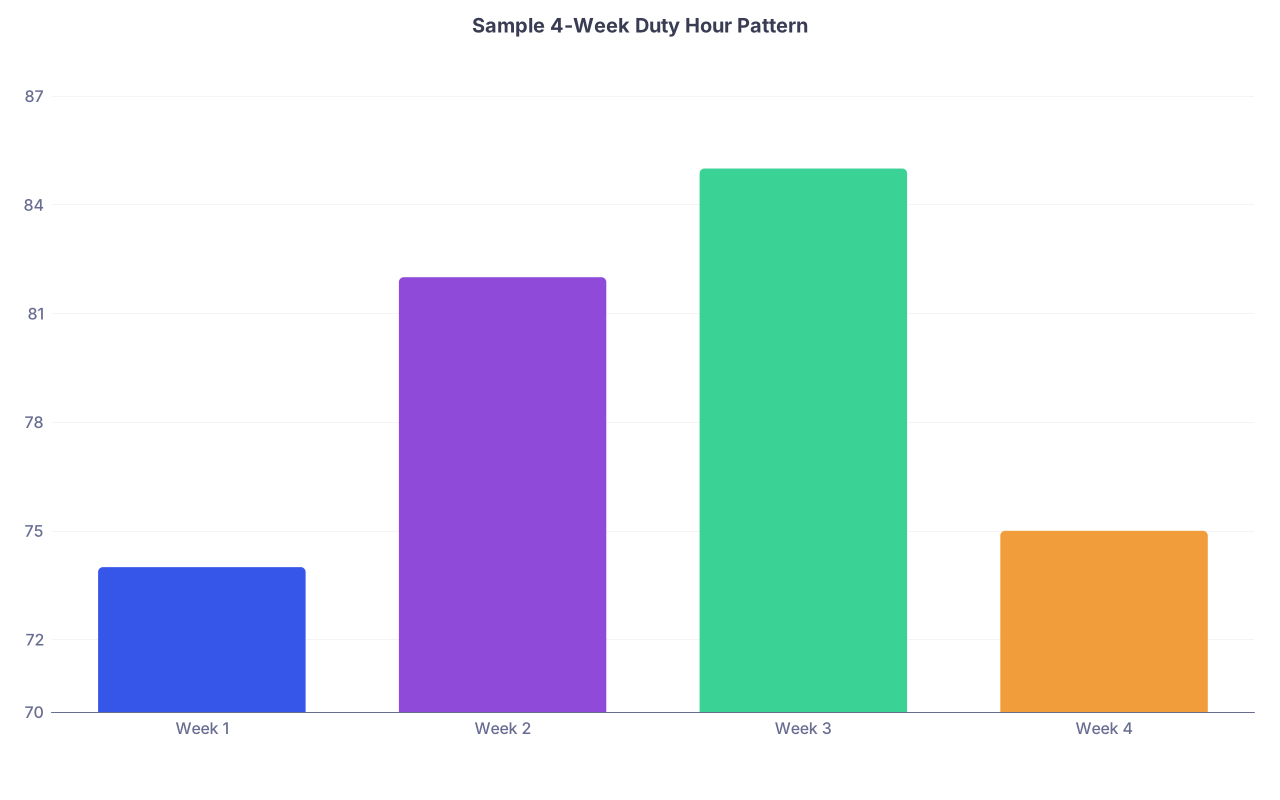
| Category | Value |
|---|---|
| Week 1 | 74 |
| Week 2 | 82 |
| Week 3 | 85 |
| Week 4 | 75 |
Strategic use:
- Front-load exposure on weeks when big elective blocks or call shifts are scheduled, then deliberately tighten hours on lighter weeks.
- If you are on call-heavy weeks 2 and 3, you ensure clean, early departures on weeks 1 and 4.
What you do not do is run 82–86 hours every single week and then lie. That burns you out, risks GME audit, and trains you to normalize unsafe fatigue.
The 24+4 Rule: How to Stay for a Big Case Without Violating Anything
Continuous duty: maximum 24 hours of patient care, plus up to 4 hours for:
- Transition of care
- Didactics
- Documentation
It is not 24+4 of “I kept operating because the case was interesting.”
If you have a 24-hour call ending at 7 am:
- You should not start an elective 3-hour case at 7:30 am and scrub out at 11:30. That is a violation.
- But you can:
- Stay until 9–10 am to wrap sign-out, complete notes, attend an 8 am teaching conference.
- Possibly stay for a short, urgent case that is clearly justified clinically, not educational tourism.
The trick: if you know a massive, complex case will start at 7 am, you make sure that is your start of the duty period, not the tail end of a 24-hour stretch.
That means:
- Say no to that extra add-on case at 3 am if it will push you beyond 24 hours and jeopardize you being fresh for the 7 am Whipple.
- Or, better, arrange the schedule so someone else covers the back half of the night, and you come in rested for the big elective case.
The 10-Hour Off Rule: Weaponize It
Residents see the 10-hour rule as an annoyance. You should see it as your legal tool to avoid being useless and unsafe the next day.
Example:
- You finish at 1:30 am on a heavy trauma night.
- You are required to have 10 hours off. That means you cannot be back before 11:30 am.
This is not something you apologize for. It is something you state clearly:
“I finished at 1:30 am, so I will be back at 11:30. I’ll check the board from home at 9–10 am and come in earlier only if there is a true need and we explicitly document it as an exception.”
The advanced move on procedural rotations:
- If a rare, career-relevant case is at 7 am and you know it in advance, protect that 10-hour window by leaving earlier the prior day. You do not stay until 9 pm on a day with trivial cases, then miss the 7 am aneurysm clipping because you are constrained by duty hours.
You decide which day gets the late stay. Before the fact, not after.
Building a Daily Case-Exposure Strategy That Respects Duty Hours
Let us zoom into the level that actually matters: your day-to-day decisions.
Start-of-Day: Board Review + Micro-Planning
If you show up, round, and just “see what happens,” you will waste potential.
At the start of your day—ideally 15–20 minutes before official start—you:
- Scan the OR / lab / delivery board.
- Identify:
- The 1–2 highest-yield cases where you can have a real role (primary operator portions, airway, line, key steps).
- Cases that are routine or repetitive for you at your current level (e.g., your 40th uncomplicated lap chole).
- Look at your projected duty hours:
- When did you leave yesterday?
- Are you approaching the 80-hour average this week?
- Do you have call tonight or tomorrow?
Then you explicitly map:
- “I will prioritize being primary on the 8 am sleeve gastrectomy and the 1 pm complex hernia. If the 5 pm appendectomy is still pending, I’ll likely hand off at 6:30 pm to stay within hours, unless the day has been light.”
That level of intentionality sounds fussy. It separates the residents who rack up meaningful case logs from those who passively drift.
Midday: Dynamic Rebalancing Without Violating Hours
By midday, the board has changed. Cases delayed, new add-ons, someone crashed into the ER.
Your mental checklist:
- What have I actually done so far today?
- How many of those cases gave me new skills or higher responsibility?
- How many hours am I realistically going to hit by end-of-week?
If you are already pushing 70+ hours by Thursday noon, and you have:
- One more high-yield case at 2 pm
- One low-yield, routine case at 6 pm
You do not “heroically” stay for both. You pick the high-yield case, then leave on time. That is not slacking. That is rational training.
Where residents get into trouble is trying to hoard every case and then retrofitting their hours. So they lie. They underreport. Programs get citations. Then everyone gets micromanaged.
End-of-Day: Controlled Exits, Not Ghosting
Here is where duty hours and culture clash.
The junior who vanishes at 4:59 pm every day without a word is useless. The junior who says at 4:15 pm:
“I’m at 72 hours already this week. I can safely stay for one more case or until about 6:30–7:00. Which case would you prefer I scrub, and who can I sign the floor to?”
…earns trust and stays within the rules.
You want three things at the end of the day:
- Clear, verbalized plan with the chief/senior.
- Transparent communication about your hours and constraints.
- A documented, safe handoff of patients and any pending duties.
You do not:
- Log out as “gone” in the duty hour software but hang around the OR “off the clock” to scrub big cases. That is both dishonest and, frankly, stupid if something goes wrong.
Leveraging Teams, Not Competing Against Them
You are not the only one trying to balance cases and hours. The smartest residents use the team structure to share both opportunity and constraints.
Case Trading: Legal and Smart
On a high-volume procedural service, trading cases is not just allowed, it is necessary if you want fair exposure.
Example, surgery:
- PGY-2 A is at 78 hours by Friday and on call Saturday.
- PGY-2 B is at 60 hours and off on Sunday.
There is a Saturday elective complex hepatectomy and a Sunday routine lap chole list.
Rational structure:
- PGY-2 B takes the Saturday hepatectomy (more rested, under hours).
- PGY-2 A covers more of the Sunday routine list post-call if hours and rest windows allow.
If your team is not already doing this, you can be the one to start:
“Let’s write out everyone’s estimated hours for the week and match higher-yield cases to the person who both needs them and can legally be there.”
Sounds like common sense. Almost nobody does it with that level of explicit planning.
Covering for Post-Call Residents Without Screwing Yourself
The biggest destroyer of duty hour compliance on procedural rotations is post-call creep.
You know what I mean:
- Post-call resident stays “just for this one case.”
- Then scrubbed into a second case because the attending asked.
- Now they are at 28 continuous hours “because the case was great.”
The senior or co-resident needs to be the one who says:
“They are post-call at 24 hours; I will cover this case or clinic so they can go home. I am at 50 hours this week and can absorb it safely.”
The attending may look annoyed for 5 seconds. Then move on. They know the rules; many simply default to asking whoever is in front of them.
Informal Deals with Attendings: How to Ask Without Sounding Entitled
On procedural rotations, attendings often function as gatekeepers of the “good” parts of the case. You need them on your side.
Duty hours can be your ally in these conversations.
Be Explicit About Your Goals and Constraints
Example conversation with a surgical attending:
“I am on trauma nights this week and already had three laparotomies. Tomorrow I am still under my hours, and I’d like to be primary on the next splenectomy or bowel resection that comes in. I do need to be out by about 7 pm to avoid pushing past 80 hours this week. If a case lands in that window, could I scrub with you and take more of the primary role?”
This does three things:
- Signals initiative and specific goals.
- Shows you actually understand and respect duty hour rules.
- Gives them a window to plan around.
Compare that with:
“Can I scrub everything tomorrow?”
…which just sounds naïve.
Use Duty Hours to Justify Strategic Absences
You will not scrub every case. Nor should you.
It is perfectly reasonable to say:
“I have already done three straightforward C-sections overnight and I am at 76 hours this week. I am going to hand off to [co-resident] for this fourth case so I can leave by 11 am and stay compliant. I want to be rested enough to be fully present for call tomorrow night where I’ll likely see more complicated cases.”
An attending with any sense will respect that. Or at least tolerate it. Either outcome is fine.
Documentation: Protect Yourself and Your Program
If you are going to be aggressive about case exposure, your documentation must be clean. That means duty hours and case logs.
Duty Hours: Log in Real Time, Not Retroactively
You cannot reconstruct a procedural week accurately three days later. Between add-ons, overnight emergencies, and board reshuffling, your memory is trash.
Residents who “fix” their duty hours at the end of the week always underreport. And eventually get caught.
You want:
- Same-day or next-morning logging.
- Honest reporting when you exceed:
- 80 hours
- 24+4 continuous duty
- Miss 1 day off in 7
Why be honest? Because occasional, justified violations with proper documentation are defensible. Systematic underreporting is not.
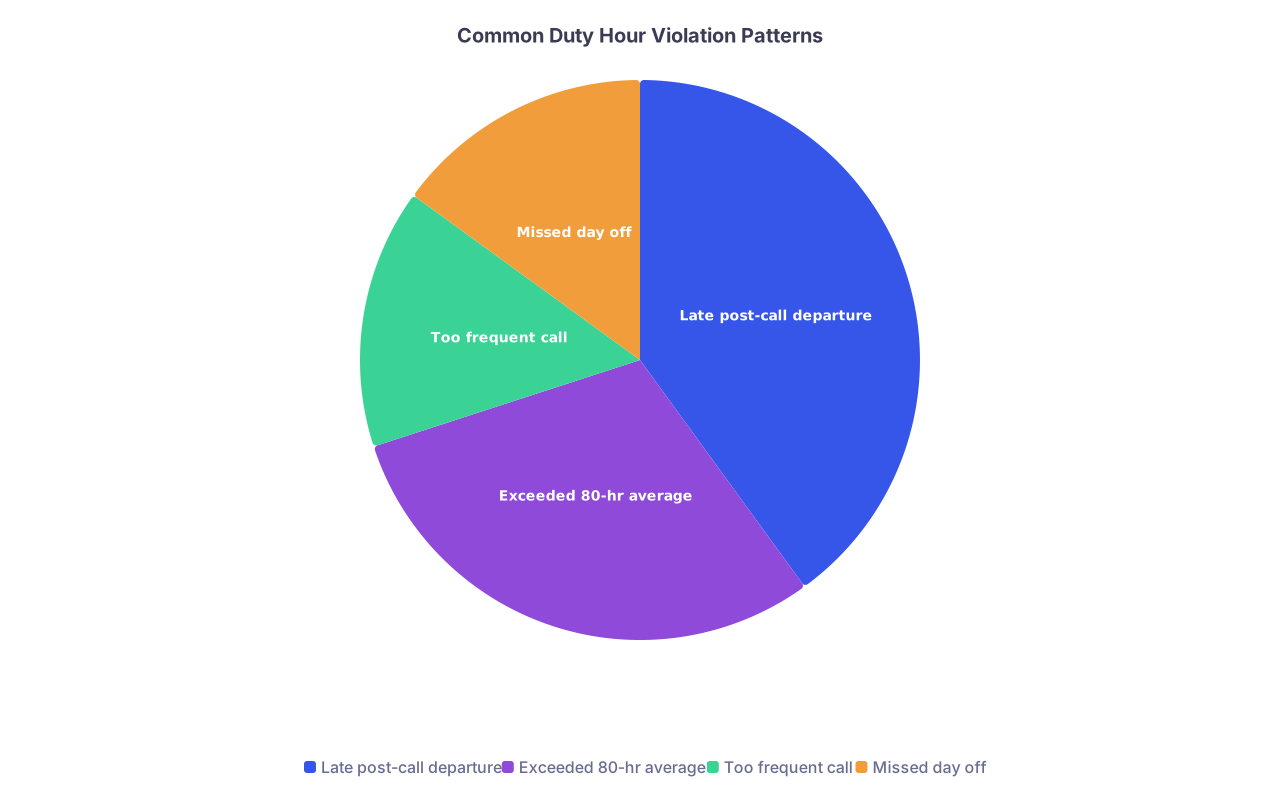
| Category | Value |
|---|---|
| Late post-call departure | 40 |
| Exceeded 80-hr average | 30 |
| Too frequent call | 15 |
| Missed day off | 15 |
If your program sees a cluster of “late post-call” violations on trauma nights, they can adjust staffing, call structure, or backup coverage. If you lie and mark them as 7 am departures when you actually left at noon, they cannot fix anything.
Case Logs: Quality Over Raw Numbers (But Numbers Still Matter)
Procedural specialties care about your case logs for board eligibility and promotion. The danger is residents chasing raw volume at the cost of:
- Sleep
- Safety
- Rule compliance
You want to capture:
- Progressive responsibility: from assisting to performing key steps to running portions of cases.
- Breadth of exposure: different procedures, pathologies, approaches.
- Enough volume to meet board and program requirements.
This is where targeted positioning on high-yield days gets you more than mindless scrambling for every small case. Being primary on one big Whipple is not equivalent to assisting on four incision-and-drainages.
Sample Schedules: How to Maximize Exposure Legally
Let me give you concrete patterns. This is how a surgical or procedural resident can live inside the rules and still build real skill.
Example 1: General Surgery Resident on Trauma / Acute Care
Monday: 24-hour trauma call (7 am–7 am).
- Three laparotomies overnight, one emergent thoracotomy.
- Leave by 9:30–10 am after sign-out and notes (well within 24+4).
Tuesday: Post-call, off from 10 am to next morning.
- No elective cases. You rest. You read.
Wednesday: Day on elective cases (7 am–5:30 pm).
- Scrub one complex ventral hernia, one lap colectomy. Skip low-yield cases after 4:30 pm to protect hours.
Thursday: 12-hour day (7 am–7 pm)
- Trauma consult service, one emergent case in afternoon.
Friday: Light day (7 am–3 pm)
- Leave early; you are approximating 70–72 hours at this point.
Saturday: 24-hour trauma call (7 am–7 am Sunday).
- Another 2–3 big cases overnight.
Sunday: Leave by 9–10 am, then off.
You hit around 76–78 hours. You got 6–7 major cases. All legal.
Example 2: OB/GYN Resident on L&D
- Nights every 3rd night, 12-hour shifts (7 pm–7 am).
- On non-call days:
- One or two long elective gyn cases.
- Strategic late stay for rare operative deliveries or repeat C-sections with complications.
- Proactively leave early on truly low-yield days.
The pattern:
- You protect your 10-hour windows between night shifts.
- You do not “volunteer” to stay past 9–10 am post-call for routine, repetitive cases.
- You do, however, come in earlier on some days (with appropriate offsets the day before) to catch specific high-yield operative cases.
Residents who approach it this way end up with plenty of C-sections, operative deliveries, and gyn surgeries. The ones who try to do “everything, every day” burn out and get flagged.
Using Institutional Structures to Your Advantage
Most programs have underused tools that can help you optimize procedural exposure within duty hours; residents either do not know about them or cannot be bothered to push.
Block Schedules and “Elective Heavy” Weeks
Pay attention to how your program schedules:
- Some services front-load high-yield elective cases in specific weeks of the block.
- Others cluster outpatient days or “lighter” clinics.
If you know week 2 of your GI month is ERCP/EUS-heavy and week 3 is mostly routine colonoscopies, you:
- Protect your hours to be fully present week 2 (be more disciplined about leaving on time week 1).
- Volunteer to cover more routine week 3 when under hours, knowing the yield is lower but needed for baseline competency.

| Step | Description |
|---|---|
| Step 1 | Review Rotation Schedule |
| Step 2 | Protect Hours Before |
| Step 3 | Cover More Routine Cases |
| Step 4 | Maximize Presence for Key Cases |
| Step 5 | High-Yield Week? |
Backup / Flex Residents
Some programs have a “jeopardy” / backup resident or float system.
On procedural rotations, a backup resident can:
- Relieve a post-call resident who is about to breach 24+4.
- Take over minor cases so a senior can stay for the rare complex case.
- Cover clinics or floor so a trainee can attend a specific OR day.
If your program has this structure, use it. If it does not, you can push your chiefs and PDs for small, targeted changes—especially if you can show that current practice is generating duty hour violations.
Red Lines: What You Do Not Do
Let me be absolutely clear about certain behaviors that are both common and unacceptable if you are serious about “optimizing case exposure legally.”
You do not:
- Scrub cases “off the clock” after logging out of duty hour systems.
- Ask co-residents to lie about your presence so your hours look cleaner.
- Stay for elective, non-urgent cases past your 24+4 window.
- Miss your guaranteed day off repeatedly “because it was a good list.”
- Treat every add-on after 8 pm as “must scrub” when you are already at 80+ hours for the week.
You will see seniors or attendings hint at some of these. “If you want to scrub, just don’t log it.” That is how programs walk into citations and how individual residents get destroyed after adverse events.
You are allowed to say:
“I would really like that case, but I am already at 80 hours this week and would be clearly in violation if I stay. Can we plan for me to be primary on the next similar case instead?”
That is what an adult professional sounds like.
Putting It All Together
Let me condense this into the core moves you control.

Know your case economy.
Who assigns cases, when high-yield cases happen, and how your service structures days and weeks. Guessing is lazy.Use duty hour rules as levers.
Plan your late nights and early mornings to align with high-yield cases. Protect your 10-hour rest when needed. Use the 4-week 80-hour average intelligently.Plan your day and week around specific targets.
Identify the 1–2 cases per day that truly matter for your development. Accept that you will skip lower-yield cases sometimes to stay legal and functional.Communicate transparently.
Tell your seniors and attendings your goals and constraints. Do not vanish; do not quietly violate. Acting like a ghost or a martyr helps no one.Document honestly and in real time.
Clean duty hour and case logs protect you, your program, and your future. You can be aggressive about exposure and still be completely honest.
If you treat duty hours as something to dodge, you will either lie or miss out. If you treat them as the legal framework inside which you must build a high-yield training experience, you will graduate competent, intact, and unafraid of an audit. That is the goal.