
The culture of “just stay until it’s done” is breaking residents. You do not fix unsafe work hours with more “resilience.” You fix it with scripts, boundaries, and documentation.
This is about that moment at 6:45 pm when the attending says, “Can you just admit two more? It should not take long,” and you have already blown past your work-hour limit for the week.
You need words. Prepared, professional, repeatable words. Not vague “I am feeling tired” comments that get steamrolled. Actual scripts that:
- Protect your license and your safety
- Show you are patient-centered, not lazy
- Document that you tried to address the problem
- Minimize retaliation risk
That is what this playbook is for.
Ground Rules Before You Push Back
You cannot improvise this stuff at 2:00 am on your 28th hour. You need a structure.
1. Know your numbers cold
You must know:
- Your program’s official duty hour policy (resident manual / GME handbook)
- ACGME duty hour limits for your specialty
- Your current week’s hours (at least approximate)
- How many in-house call or night float shifts you have done this month
If you say, “I think I am close to my hours,” it is weak. If you say, “I am at 77 hours documented this week, and this will put me over the 80-hour average,” that lands.
| Rule Type | Standard Limit |
|---|---|
| Weekly hours | ≤ 80 hours/week averaged over 4 weeks |
| Max continuous duty (in-house call) | 24 hours + 4 hours for transitions |
| Time off between shifts | 8–10 hours (goal 10) |
| Days off | 1 day off in 7, averaged over 4 weeks |
(Check your specialty and institution for exact language. But this is the baseline.)
2. Decide your “red line” in advance
You must pre-decide:
- What you will absolutely stay for (e.g., crashing patient, acute emergency)
- What you will not routinely stay for (elective add-ons, unnecessary scut, “learning opportunities” that violate hours)
If you try to draw the line in real time, you will cave. Because you are tired. Because you want to be “a team player.” Because they will guilt you.
So you set your rule ahead of time. For example:
- “I will not accept non-emergent new tasks once I have hit 24 hours in-house.”
- “I will not exceed 80 hours/week averaged over 4 weeks. If the service is unsafe, I will escalate.”
Write your rule down. Put it in your notes app. This is what keeps you from being manipulated.
Core Communication Framework: How to Say “No” Safely
Do not just say, “I cannot, that breaks duty hours.” That invites an argument.
Use a three-part framework:
- State commitment to patient care / team
- Cite the policy / duty hours / safety concern
- Offer a specific alternative or escalation path
Like this:
“I want to make sure patients are cared for safely, but I am at 78 hours this week and another admission will push me over the ACGME 80-hour limit. I can help stabilize any active emergencies now, but for routine admissions we should involve the night team or call the chief to problem-solve coverage.”
You sound:
- Patient-centered
- Policy-aligned
- Solution-focused
You are not just whining about being tired. You are protecting patients and the institution from a duty hour violation.
Scripts for Common Unsafe Extra-Hour Scenarios
Let’s get to the templates. I will give you:
- A short spoken script
- A slightly more formal version (e.g., for email/text to chiefs)
- A “when they push back” follow-up
You will need to tweak details (program name, your PGY year, specifics), but the structure holds.
Scenario 1: Attending asks you to stay late for more admissions (already at or near 80 hours)
Context: Day float, wards, or ICU. It is near sign-out. You are clearly overworked. Attending wants “just a few more things.”
Spoken Script – First Response
“I want to make sure patients get safe care, but I am already at about 78 hours this week, and taking on more admissions tonight will put me over the ACGME 80-hour limit.
I can finish wrapping up my current patients and do a thorough sign-out to night float, but new admissions past this point should go to the night team or be reassigned. If you would like, we can loop in the chief or GME to find a safe plan.”
If they push: “Everyone does this, this is how you learn”
“I am absolutely committed to learning and to the service, but exceeding duty hours repeatedly is not allowed by ACGME and is considered a patient safety issue.
I do not want to put you or the program at risk by knowingly staying over. Let us call the chief and get guidance on how they would like us to handle the volume tonight.”
You are doing two things:
- Reframing as their risk too
- Pulling in a third party (chief/GME) so it is not just you vs attending
Text/Email to Chief Afterward (if needed)
Subject: Duty hours approaching limit – coverage question for tonight
Hi [Chief Name],
I am currently at approximately [X] hours for this week and have [Y] more hours scheduled tomorrow. Tonight, we had additional admissions requested near sign-out that would likely push me over the 80-hour average.
I expressed my concern about duty hours and patient safety to the attending and suggested we involve the night team or explore alternative coverage. I wanted to make you aware in real time and ask how you would like us to handle future similar situations to stay within ACGME requirements.
Thank you,
[Your Name], PGY-[X]
Document. Calmly. No drama. Just facts.
Scenario 2: “Just finish your notes from home”
Context: You finished a brutal call day. Attending or senior says, “You can go home, just finish your notes tonight from home.” You are already over your hours; charting time still counts as duty hours.
Spoken Script – In the Moment
“I appreciate the flexibility, but time spent finishing notes at home still counts toward duty hours. I am already near my weekly limit, so I want to make sure I am compliant.
I can prioritize critical documentation now before I leave, and anything that is not medically urgent should be finished on my next scheduled shift so we stay within ACGME requirements.”
If they say “It is just documentation, not work”:
“ACGME specifically includes charting and clinical communication done from home as duty hours. If I log in and work on these notes tonight, they need to be counted. Given my current total, I am not comfortable doing more clinical work off the clock.
I am happy to flag the key issues in a brief addendum now so overnight providers have what they need, and complete the detailed notes when I am back on duty.”
Optional Email Documentation (to yourself / duty hour system)
Log it as duty hours if you are forced to do it anyway. If your platform allows comments:
“Completed [X] hours of documentation from home at attending request. This was after leaving physical hospital but still clinical work.”
You want a paper trail.
Scenario 3: Post-call and being asked to stay “a little longer”
Context: You are post-call. You have been in-house 24 hours. They want you to “just round quickly,” “do one more discharge,” or “help with this procedure.”
Spoken Script – Direct
“I have been in-house for 24 hours now, which is the ACGME limit for continuous clinical work. I can stay briefly for a safe handoff and make sure there are no unstable patients, but I cannot continue to provide direct care beyond that without violating duty hours.
I recommend we transition this to the day team or involve the chief so we can staff it safely.”
If they say, “It is just one patient, it will not take long”:
“Even if it is one patient, it still extends my continuous duty time beyond the allowed limit. That is a clear ACGME violation. I do not want to put you, the program, or the patient in that position.
I am happy to give a concise handoff right now, but I need to sign out and leave as required.”
If they insist anyway, you document and escalate later (I will give you those scripts below).
Scenario 4: Chronic “soft” violations – always 79–82 hours, every week
Context: Your service is always “technically” within 80 hours averaged over 4 weeks, but in reality you are past it or hovering right at the edge constantly. You are burning out, and it is not sustainable.
You need to address pattern, not just one night.
Approach the chief or PD, not in the middle of chaos.
Script for Meeting or Email with Chief/PD
“I wanted to bring up a pattern I have been tracking on [service name]. Over the last [X] weeks, my duty hours have consistently been in the 76–82 hour range, with very frequent late stays for add-on work that is not emergent.
I am concerned that this is becoming the baseline expectation rather than an occasional surge. From a patient safety and ACGME perspective, this feels risky.
Can we look at:
– Call schedule or census caps on this rotation
– Clear guidance on cutoff times for new admissions or consults
– When and how we should escalate to chiefs when the workload becomes unmanageable within duty hour rulesI want to do good work and learn as much as possible, but I also want to protect the program and patient safety by staying in compliance.”
You are offering solutions, not just complaining.
Scenario 5: Night float being asked to stay late into the day
Context: You are night float, supposed to leave at 7:00 am. Day team is delayed or short. They ask you to “just stay and help round” or do discharges. You are already fried.
Spoken Script
“I am at the end of my night float shift and have been in-house all night. For safety and duty hour compliance, I need to leave at my scheduled time once I have done a proper sign-out.
I can stay a few minutes to make sure any actively unstable patients are handed off safely, but I cannot continue routine work into the day without violating ACGME limits.”
If they say, “We are short, we really need you”:
“I understand the team is short, and I want to help, but extending night float into the day makes fatigue and safety worse for everyone. The safer approach is to adjust day coverage or call the chief to find backup, rather than stretch night float beyond hours.
Let us involve the chief now so they can help problem-solve.”
How to Escalate Without Torching Your Reputation
Sometimes you will meet a reasonable attending. They will adjust when you bring up duty hours.
Sometimes you will meet the “I trained before duty hours existed” dinosaur.
For those, you need an escalation ladder.

| Step | Description |
|---|---|
| Step 1 | Unsafe Extra Hours Request |
| Step 2 | Use Script With Attending |
| Step 3 | Document in Duty Hours |
| Step 4 | Contact Chief Resident |
| Step 5 | Inform PD or APD |
| Step 6 | File Anonymous or Formal Report with GME |
| Step 7 | Resolved? |
| Step 8 | Resolved by Chiefs? |
| Step 9 | Pattern or Serious Risk? |
Step 1: Use your script and document
Always start with the direct, professional script to the person making the request. Then log your hours accurately, with comments when relevant.
Step 2: Loop in chiefs
Text to Chief During or Right After the Event
“Hi [Chief], quick question on duty hours.
I am at about [X] hours this week. Tonight, [Attending/Senior] asked me to [stay for more admissions / continue work after 24 hours in-house]. I expressed concern about duty hours and patient safety but was asked to continue.
How would you like me to handle this going forward so we stay ACGME compliant?”
You are asking for guidance, not accusing. Chiefs usually care about this; they do not want citations.
Step 3: Program Director / APD
If chiefs are ineffective, or the problem is recurring:
“I wanted to get your guidance on a recurring duty hour issue on [rotation]. There have been multiple instances where I was asked to stay beyond [80 hours/week / 24+4 hours in-house / required day off], and attempts to address it at the attending and chief level have not led to consistent change.
I am concerned about the impact on patient safety, my own fatigue, and the program’s compliance record. I would appreciate your help in setting clearer expectations for attendings and residents on:
– When to cut off new admissions
– Handling post-call or night float shift transitions
– How residents should escalate when they are near or over duty hour limits.”
Be factual. Specific dates, not vague “it is always bad.”
Scripts for Documentation and Self-Protection
You are not just talking; you are building a record.
1. Comment in duty hour logging system
If your system allows comments, use short, neutral language:
“Stayed 2 hours beyond scheduled end at attending request for non-emergent admissions; voiced duty hour concern at the time.”
“Completed 1.5 hours of charting from home on [date] at attending request; logged as duty hours.”
You are not ranting. You are recording.
2. Email to yourself (or personal notes) after problematic shift
If your system does not allow comments, send yourself a secure email (no PHI):
Subject: Duty hours – [Service] [Date]
[Date/Time] – On [service], scheduled shift [X am–Y pm]. At ~[time], already at ~[Z] hours this week. Attending [first initial only or remove name in case of FOIA, depending on environment] requested additional work [describe generally: “two routine admissions”].
I stated concern about exceeding ACGME duty hours and safety. I was instructed to proceed. Left hospital at [time]. Total hours for week ~[X].
If this becomes a pattern, you have contemporaneous notes. Very different from vague memory later.
Handling Retaliation Fears (Because They Are Real)
Residents worry: “If I say anything, they will tank my evaluation.”
Let me be blunt. Chronic unsafe hours will tank your brain and your performance a lot faster than a passive-aggressive attending will.
You can reduce retaliation risk with how you frame things:
- Always lead with patient safety and program compliance, not “I am tired” (even if you are destroyed).
- Offer solutions: involve chiefs, adjust coverage, improve sign-out.
- Avoid public confrontations. Pull people aside when you can.
- Be consistent. Do not invoke duty hours only on rotations you hate.
If you get a bad evaluation after asserting boundaries in a professional, documented way, that is exactly what GME and PDs are supposed to address. It is not instant justice, but you are not powerless.
Variations and Short Scripts You Can Memorize
You will not remember a paragraph at 3:00 am. You need short, repeatable lines.
Here are some “one-liners” to adapt:
- “I am at my duty hour limit for the week; new non-emergent tasks need to be reassigned or we should involve the chief.”
- “I can stay for a safe handoff, but I cannot continue to provide direct care past my 24 hours in-house.”
- “Charting from home still counts as duty hours, and I am already near the weekly limit. I will finish what is critical now and complete the rest when I am next on duty.”
- “For ACGME compliance and patient safety, I need to log out and leave now. Let us get the night team or chief involved to help cover remaining work.”
- “I want to help, but this will put me past 80 hours this week. How about we call the chief so they can help decide the best coverage plan?”
Pick two or three that feel natural. Practice them in your head before the rotation that is notorious for abuse. Everyone knows which rotations those are.
Visual: Where Your Time Is Really Going
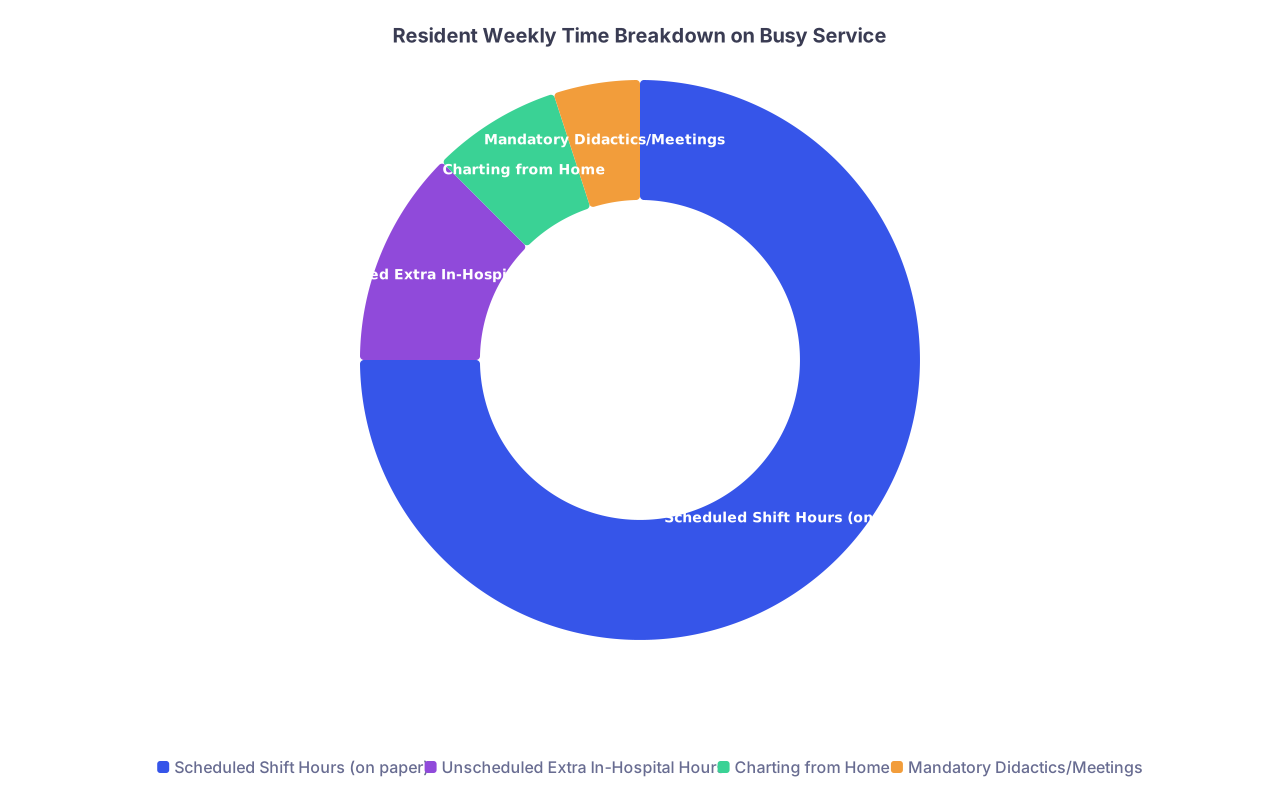
Most residents underestimate how many “little extras” add up: late notes, “quick” admissions, extra family meetings at 7:30 pm. Those minutes are not free.
| Category | Value |
|---|---|
| Scheduled Shift Hours (on paper) | 60 |
| Unscheduled Extra In-Hospital Hours | 10 |
| Charting from Home | 6 |
| Mandatory Didactics/Meetings | 4 |
Those 10 “bonus” in-hospital hours and 6 hours of home charting are exactly where you push back.
Extra: Script for When a Co-Resident Is Being Exploited
Sometimes you are not the one being asked. Your intern or co-resident is getting squeezed and is too scared to say anything.
Script to Attending / Senior
“I am concerned that [Name] has already been here for [X] hours and is being asked to stay for additional non-emergent work. That seems unsafe and potentially out of compliance with duty hours.
I suggest we redistribute the tasks or involve the chief so we protect both the team and the patients.”
You become the buffer. This is how you build a healthier culture.
When and How to Use Anonymous Reporting
If you have:
- Repeated violations
- Clear disregard when you bring up duty hours
- Evidence that program leadership is hand-waving it
Then you use your institution’s:
- Anonymous reporting system (often through GME or compliance)
- ACGME Resident Survey (answer honestly, not “to protect the program”)
- GME ombudsperson or confidential channels
Sample Language for Anonymous Report
“On [rotation], residents are routinely expected to exceed ACGME duty hour limits, including staying beyond 24 hours in-house post-call and completing substantial clinical documentation from home without logging it.
Residents who raise concerns are told this is ‘part of training’ and are discouraged from documenting actual hours. This raises serious patient safety and compliance concerns.”
You are not naming names unless the system asks. Focus on patterns and risk.
Quick Decision Flow in Real Time
At 8:30 pm, your brain is sludge. So keep this mental checklist:

| Step | Description |
|---|---|
| Step 1 | Asked to Stay Extra |
| Step 2 | Stabilize Patient |
| Step 3 | After Stabilization Use Script and Sign Out |
| Step 4 | Negotiate Reasonable Cutoff Time |
| Step 5 | Use Duty Hour Script With Attending |
| Step 6 | Document Hours and Go Home |
| Step 7 | Contact Chief for Guidance |
| Step 8 | Complete Documentation, Log Accurately, Consider Escalation Later |
| Step 9 | Emergent Safety Issue? |
| Step 10 | Will This Break or Stretch Duty Hours? |
| Step 11 | Attending Agrees? |
| Step 12 | Chief Intervenes? |
Print that if you have to. Tape it inside your locker.
Final Thoughts: What Actually Works
You do not change toxic work hour culture with inspirational talks. You change it with consistent, boring, professional friction.
Three key points:
- Scripts are your shield. Rehearse 2–3 lines that link your boundary explicitly to patient safety and ACGME rules. Use them every time, not just when you feel brave.
- Document everything. Log real hours, not fantasy hours. Add brief, factual comments when you are pushed past limits. Create a record that explains your numbers.
- Escalate strategically, not emotionally. Start with the person asking, then chiefs, then PD/GME. Offer solutions, not just complaints. When patterns do not change, use anonymous reporting and your ACGME survey honestly.
You are not being “difficult” by refusing unsafe extra hours. You are doing the actual job: protecting patients, your brain, and your future license from a system that will happily run you into the ground if you let it.