
You are three nights into a six-night stretch in the medical ICU. It is 3:17 a.m. You just finished pronouncing a patient, another is in atrial fibrillation with RVR, the vent alarms keep chiming from bed 12, and your senior just asked you to “circle back and reconcile all the drips before sign-out.” You open the chart to “just quickly review” one more ABG and realize you have been staring at the same number for 45 seconds.
That frozen moment? That is decision fatigue. Layered on top of a workload that does not stop and work hours that stretch your cognitive and emotional capacity to the edge. Let me break down how to manage all three in the ICU without burning yourself into the ground or making stupid mistakes that haunt you.
What Makes ICU Rotations Brutal (Beyond Just “It’s Busy”)
ICU is not just “more patients who are sicker.” It is a fundamentally different operating environment.
You are dealing with:
- Constant data streams: vents, drips, labs, tele, nursing notes, consults.
- Time pressure: nearly every decision has a clock on it.
- High-stakes uncertainty: you will act on incomplete data, repeatedly.
- Emotional load: frequent deaths, distraught families, moral distress.
That combination is exactly what drives:
- Heavy workload: cognitive + emotional + task volume.
- Long, often poorly structured work hours: days that start at 5:30 a.m. and end “whenever the work is done.”
- Decision fatigue: progressively worse decision quality as your brain runs dry.
If you treat an ICU month like just another inpatient rotation with more pages, you will get crushed. You need to attack it on three fronts: how you structure the work, how you use the hours, and how you protect decision quality.
Understanding Workload in the ICU: It Is Not Just “Number of Patients”
Residents always say, “I had 16 patients on wards but only 8 in the ICU—so why am I more exhausted?” Because ICU workload is non-linear. Eight vented, pressor-dependent patients is not half the work of sixteen stable CHF re-admissions.
Dimensions of ICU workload
Think of workload on at least four axes:
Clinical complexity
- Number of organ systems failing (respiratory + hemodynamic + renal + neuro, etc.).
- Number of active infusions (pressors, sedatives, insulin, anti-epileptics).
- Procedures needed: lines, intubations, paracenteses, bronchs.
Data density
- Frequency of new data: hourly I/Os, blood gases, q2h labs on the crashing septic patient, rapid cortisol, cultures.
- Device management: ventilator changes, CRRT adjustments, ICP monitors.
- Consult input: nephro, ID, cards, neuro, each with recommendations to reconcile.
Interruptions and micro-tasks
- Nursing questions: titration orders, clarification, safety checks.
- Pharmacy calls: drug interactions, dosing, substitution.
- Family updates that cannot be brushed off with “we’ll talk during rounds.”
Cognitive/ethical load
- End-of-life discussions, DNR/DNI decisions, withdrawing care.
- Moral distress: continuing aggressive measures you are not convinced make sense.
- The background hum of “if I screw this up, this patient dies.”
That is why a “capped” ICU service can still feel infinite.
| Factor | Ward Patient (Stable CHF) | ICU Patient (Septic Shock) |
|---|---|---|
| Active problems | 2–3 | 6–8 |
| Daily labs | 1–2 sets | 3–6 sets |
| Continuous drips | 0 | 2–5 |
| Pages per shift | 1–2 | 8–15 |
| Critical decisions | Rare | Hourly |
The takeaway: if you want any shot at managing ICU workload, you have to respect that complexity and stop measuring your day purely in “patient counts.”
Structuring Your ICU Workday So It Does Not Own You
You cannot control who rolls through the ICU doors. You can absolutely control how you approach the day.
Start-up routine: first 45–60 minutes decide your whole day
When I see interns flail in ICU, they lose the first hour. They wander, skim random notes, get sucked into the sickest patient before they know anything about the rest.
You need a fixed opening sequence. Something like:
Snapshot of the entire unit
Walk the board or list:- Who is vented and what are their settings?
- Who is on pressors, and at what doses?
- Who is “on fire” (overnight rapid up-titration of pressors, new arrhythmia, lactate rising)?
60–90 second per-patient triage review
Just for your assigned patients. For each:- Vital sign trends (mentally compress the last 12–24 hours, not just the last 10 minutes).
- Drip changes (new pressors, sedation weans, insulin adjustments).
- Big ticket labs and imaging (recent ABGs, lactate, CT, echo).
- Any acute overnight events flagged in the sign-out or nursing notes.
Quick bucket them: red / yellow / green
- Red: unstable, active problem requiring plan revision now (new sepsis, shock, ARDS escalation).
- Yellow: could destabilize, needs deliberate re-evaluation before rounds.
- Green: sick but stable; rounds will be the main work.
You do not fully “work up” each patient in this first hour. You are building a mental map so you know where to invest attention and when.
Pre-rounding without drowning in the chart
Pre-rounding in ICU is where residents waste absurd amounts of time scrolling progress notes that say nothing new. You need to be ruthless:
For each patient, aim for a 5–7 minute pre-round pass:
One-line status update in your head
“Day 3 septic shock on norepi and vaso, improving MAP, weaning FiO2, still oliguric on CRRT.”Look at:
- 24-hour vital trends, not single time points.
- Ventilator parameters: mode, tidal volume, PEEP, FiO2, peak/plateau pressures.
- Drips: which ones, current doses, change from 12 hours ago.
- Labs that actually matter:
- For shock: lactate, creatinine, LFTs, WBC, cultures.
- For resp failure: ABG/VBG, CXR/CT progression, PaO2/FiO2 ratio.
- For neuro: Na, osms, ammonia, drug levels, CT/MRI if new.
Build a micro-plan with 3–5 items max
Not a whole novel. Just:- Today’s main diagnostic goal.
- Today’s main therapeutic adjustment.
- Any weaning/extubation goals.
- Any big decisions looming (trach/PEG, code status conversation, transition to comfort).
If you cannot articulate those in a sentence or two, you do not understand the patient well enough yet.
Rounds design: protect your mental bandwidth
Rounds in ICU can be either the most efficient decision engine of the day or a 4-hour cognitive meat grinder. You can push them toward the first outcome.
Some non-negotiables if you want to stay functional:
Start with the sickest or most time-sensitive cases
Not the patient conveniently closest to the workroom. Open with the one on two pressors who might need a line, or the tenuous ARDS patient who might need paralysis or prone positioning.Limit on-the-fly literature deep dives
Rounds are for decisions, not for someone reading UpToDate aloud. Have the senior/fellow assign a focused question for later (e.g., “Check latest ARDS weaning criteria for proning duration”), then move on.Force a clear “today goal” for each patient
Example:
“Today’s goal: come off vasopressin and down-titrate norepi by 0.02 every 2 hours as long as MAP > 65.”
If the goal is vague (“continue to monitor”), you will drown in random micro-decisions the rest of the day.Operationalize orders immediately
After each patient, someone enters the main orders before walking to the next bed. Otherwise, by the fourth patient, half the crucial changes are living only in someone’s memory.
This structure is not about being pretty. It is about preventing decision fatigue from setting in at 11 a.m. instead of midnight.
Work Hours in ICU: Reality vs. What Your Program Says
Let us be honest. ICU rotations are where ACGME work-hour rules and clinical reality collide most violently.
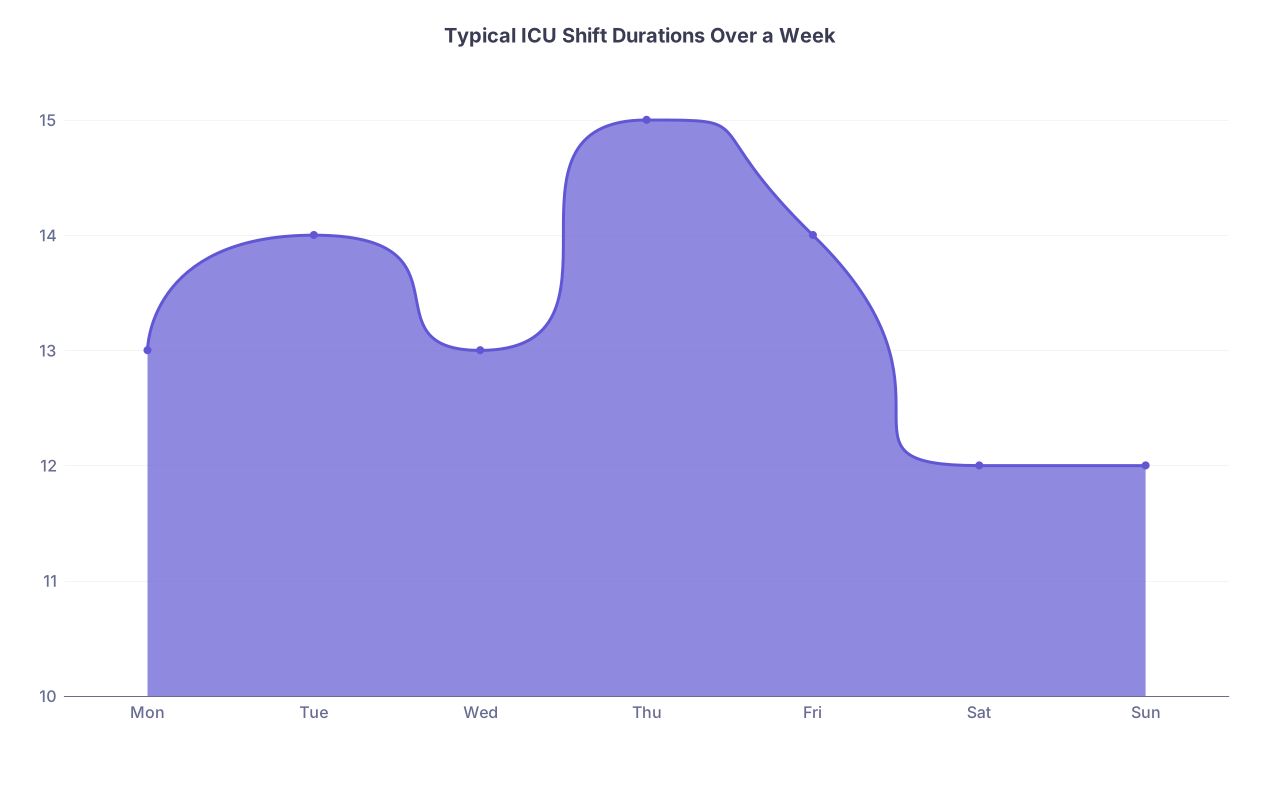
Typical ICU schedules and what they do to your brain
Common patterns:
- 7-on / 7-off days or nights, 12–14 hours “on paper” that easily bleed longer.
- Rotating blocks: 5–6 day shifts, 1 day off, then nights.
- Home call that is “light” but wrecks your sleep anyway.
| Category | Value |
|---|---|
| Mon | 13 |
| Tue | 14 |
| Wed | 13 |
| Thu | 15 |
| Fri | 14 |
| Sat | 12 |
| Sun | 12 |
By day 4–5, you will notice:
- Slower information processing (“Wait, when was that lactate drawn?”).
- Shortened fuse with nurses, RTs, even families.
- Avoidance of complex decisions (“Let’s just keep everything the same and reassess later”).
That is not personality. That is neurobiology.
Staying inside work-hour rules without destroying continuity
You are pulled between patient loyalty (“I know this family, I should stay”) and self-preservation. Here is the blunt truth: if you regularly violate duty hours in ICU, you will eventually hurt patients.
Practical strategies:
Hard stop time that you take seriously
If your program says “out by 6 p.m.,” aim to be wrapping real work by 5:00. The ICU will always expand to fill available time. You have to contract first.Structured sign-out, not a brain dump at the door
Before leaving:- Update a written list with vent/drip parameters and explicit overnight “if-then” plans:
“If MAP < 65 on norepi 0.2, add vasopressin 0.03 and call fellow if no response in 30 min.” - For each borderline patient, include an “acceptable range” so the night team is not paging q30min for trivial deviations.
- Update a written list with vent/drip parameters and explicit overnight “if-then” plans:
Let go of the illusion of indispensability
You are not the only one who can manage that ARDS patient. What you can do is leave a coherent plan so the next person is not guessing. That protects the patient more than you staying an extra two hours on fumes.Use your off days deliberately
If you spend your post-call day doing errands and catching up on life admin until midnight, you will crawl into the next shift half-charged. Call it what it is: that day is partial “work recovery,” not a blank day you can fill with tasks.
Decision Fatigue: What It Looks Like in ICU and How to Fight It
Decision fatigue is not a soft concept. It is exactly what reduces you from a thoughtful clinician into someone reflexively clicking “continue previous orders.”
How decision fatigue shows up in ICU practice
You will see these patterns in yourself (or your co-residents) around hour 10–12 of a long ICU shift:
Over-reliance on defaults
- Continuing every drip because rescanning each indication feels too hard.
- Leaving antibiotics broad “one more day” because re-evaluating source control is cognitively heavy.
Avoidance of big conversations
- Deferring family meetings until “tomorrow” again and again.
- Postponing code status clarification on patients who are obviously not going to have meaningful recovery.
Impaired risk assessment
- Either hyper-conservative (“let’s not extubate, I don’t want to re-intubate tonight”) or reckless (“just extubate, we’ll see what happens”) based more on your energy than the patient data.
Emotional numbing or reactivity
- Feeling nothing after a patient death, or exploding at minor issues because your regulatory systems are shot.
You will not notice the exact moment this shift happens. It is progressive and sneaky.
Tactics to reduce decision fatigue before it wrecks you
You will still get tired. The goal is to decide wisely when you are freshest and protect yourself when you are not.
1. Decide early, execute late
Use your sharpest hours (usually early to mid-morning for day shifts, early night for nights) to make as many big decisions as possible.
Examples:
Extubation and major vent changes:
Plan during rounds. Do it late morning or early afternoon when RT, nurses, and backup are all around.Code status and goals of care:
Have those talks earlier in the day, not at 7 p.m. when family is exhausted and you are brain-dead.Antibiotic narrowing or de-escalation:
Review cultures and imaging once during your cognitively “fresh” window and commit, instead of rethinking it every time someone asks, “Should we still be on meropenem?”
This “front-loading” of real thinking reduces how many high-stakes decisions are left hanging for your worst hours.
2. Convert recurring decisions into protocols
Anything you decide more than twice a day should probably be a protocol in your head.
Examples:
Hypotension in septic shock:
Your mental algorithm might be:- Verify cuff vs arterial line discrepancy.
- Check recent fluid balance and lung exam.
- If relatively dry, consider bolus.
- If adequately filled, titrate norepi up by predefined incremental steps, then add vasopressin.
- If escalating quickly, call fellow early.
Vent weaning:
- Daily SBT criteria: define them and stick to them.
- If criteria not met, list the 1–2 barriers and focus on those, not random vent tinkering.
By standardizing, you are not “dumbing down” your practice. You are preserving cognitive bandwidth for cases that do not fit the pattern.
3. Protect small windows of recovery during the shift
You cannot grind 13–14 hours straight and expect your prefrontal cortex to behave. ICU is not a video game marathon.
Concrete moves:
Two 10–15 minute deliberate breaks per 12-hour shift
Not “answer pages while you half-eat.” A true break:- Step out of the unit.
- Minimal screens.
- Hydrate, eat a real snack, breathe.
You will feel like you “do not have time.” That is exactly when you need it.
Micro-pauses before major decisions
Before a big call (extubation, withdrawing pressors, switching to comfort care):- Sit down.
- Re-summarize the case in one or two sentences.
- Ask yourself explicitly: “What am I missing?”
90 seconds of structured pause can prevent a bad impulse decision made in emotional overdrive.
4. Use your team as a cognitive scaffold
ICU is where hierarchy can help you, not just crush you.
Ask your nurses what they are worried about
They have seen more subtle decompensations than you have. Let them flag “this does not feel right” patients before the numbers blow up.Run your hardest calls by someone else
For borderline extubations, code-status gray zones, unclear shock states:- Grab your senior or fellow and verbalize your thinking.
- If you feel resistance to that because “I should know this,” that is ego, not competence.
Distribute thinking tasks
If you are post-call mush, let your co-resident or fellow take the lead on the complex new admission while you stabilize and execute on your existing patients.
This is not weakness. It is practice consistent with how high-reliability teams function in aviation, nuclear power, and other high-risk fields.
Specific ICU Scenarios: How Workload, Hours, and Decision Fatigue Collide
Let us walk through a few real-feeling scenarios and how to handle them.
Scenario 1: The 4:30 p.m. crashing admission when you are already late
You are supposed to be out by 6. You have two sign-outs left to pre-write. CT calls: “We are sending you a transfer, massive PE, hypotensive, ETA 10 minutes.”
What usually happens:
- You stay until 8:30 “to do right by the patient.”
- You rush the admission note, forget to update the MAR, miss that the patient is on a DOAC, and someone else has to clean that up later.
A better pattern:
Accept reality: you will leave late, but you do not need to own every task.
Define your role: initial stabilization and big-picture plan.
Do just enough:
- ABCs, secure lines, order initial labs and imaging, start appropriate anticoagulation or lysis discussions.
- Communicate clearly with night team: “I did X, Y, Z. These two things are still pending.”
Leave a brief, clear handoff note and get out as soon as acute stabilization is complete.
Scenario 2: Night 5 of 7, 3 a.m., borderline extubation decision
Your patient passed SBT during the day. They have borderline mental status but are otherwise solid. They are now more agitated, pulling at lines. The nurse calls: “Can we just extubate? They are fighting the vent.”
At 3 a.m., with your brain cooked, every option feels bad:
- Extubate and risk emergent re-intubation with limited staff.
- Sedate more and risk delirium, prolonged vent days.
Better move:
- Default policy: no planned extubations at 3 a.m. unless failure to act is clearly dangerous.
- Short-term plan:
- Optimize comfort (small sedation tweak, non-pharmacologic measures, sitter if possible).
- Document: “Candidate for extubation; plan reassess with day team + RT at 8 a.m.”
Make this a unit culture issue when you are on days: extubations should be planned daytime events unless emergently indicated.
Scenario 3: End-of-life discussions drifting day after day
You have a patient on day 21 of mechanical ventilation, severe multi-organ failure, poor neurologic status. Everyone on the team privately thinks the prognosis is terrible. Family has heard “guarded” for a week.
Workload effect:
- Every day, 20–30 minutes of rounds, labs, vent tweaks, and consult opinions on a patient whose trajectory is not changing.
Decision fatigue effect:
- No one wants to initiate a hard conversation at 5 p.m. after a day of crises. So you keep “buying time.”
A more disciplined approach:
During a fresh brain window (morning):
- Explicitly ask your attending/fellow: “What outcome is realistic here?”
- If consensus is poor prognosis, set a hard goal: “We will have a goals-of-care family meeting today.”
Block time like it is a procedure
- Put it on the team’s mental schedule just like a bronchoscopy or line placement.
- Involve palliative care early if available.
Recognize that committing to the conversation once prevents hundreds of tiny, exhausting half-decisions over several days.
Using Tools, Lists, and Visuals Without Becoming a Robot
A lot of ICU residents either drown in sticky notes and scratch paper, or they try to keep everything in their head and drop details.
You are better off with a consistent external brain.
One-page per patient, not five-page novels
Create or use a standardized ICU template:
- Header: Name, age, diagnosis, ICU day, code status.
- Systems-based bullets: Neuro, CV, Pulm, Renal, ID, Heme, Endocrine, Lines/Drains.
- “Today’s goals” section: 3–5 bullets only.
- “If-then” overnight box for the night team.
You update that once daily and jot acute changes. That replaces four half-filled index cards and a million EHR clicks.
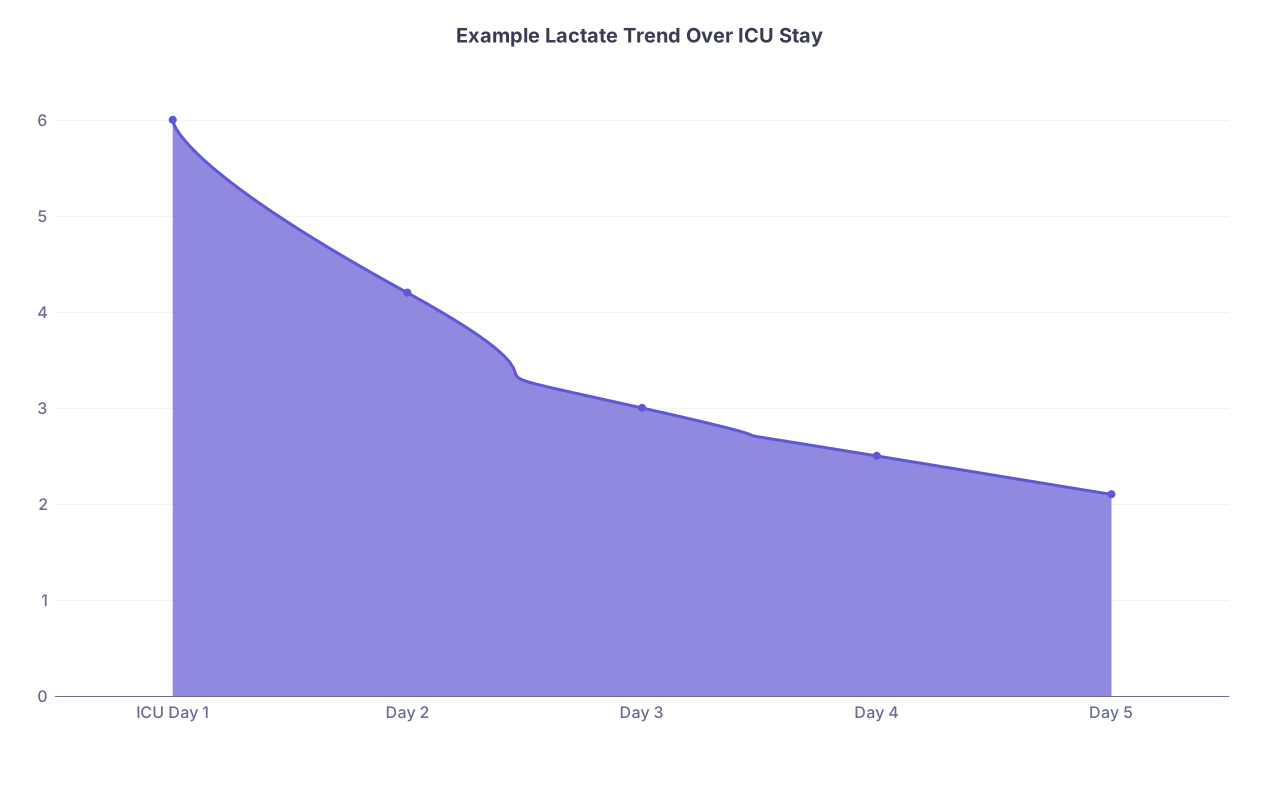
Visualizing trends instead of memorizing numbers
Your brain is bad at remembering five separate lactate values. It is good at recognizing a pattern.
| Category | Value |
|---|---|
| ICU Day 1 | 6 |
| Day 2 | 4.2 |
| Day 3 | 3 |
| Day 4 | 2.5 |
| Day 5 | 2.1 |
For each sick patient, mentally compress:
- Lactate trajectory.
- Pressor requirement trend.
- FiO2/PEEP vs oxygenation (PaO2/FiO2).
- Urine output/QD net fluid balance.
You do not store discrete numbers. You store “improving,” “static,” or “worsening” curves. That is how real ICU attendings think.
Turning ICU from “Survival Month” Into a Learning Accelerator
If you do not actively manage workload, hours, and decision fatigue, ICU becomes the month you just try to endure. Which is a waste, because it is one of the few rotations that actually changes how you think forever.
A few final practical habits that shift you from surviving to mastering:
One teaching point per shift, no more
After sign-out, ask your attending or fellow:
“What is one thing I should take away from this shift?”
Not a lecture. One concrete thing—vent trick, sepsis nuance, line choice.Debrief after errors or near-misses
Not in a self-flagellating way. Just:- What cognitive state was I in?
- Was I overloaded? Fatigued? Missing data?
- What system/behavioral change would have prevented it?
Actively study your own limits
Notice, “After about 11 hours, I stop generating good plans and start just tweaking.” Build your workflow so your biggest planning and conversation tasks are before that.
Key Points
ICU workload is not about patient numbers. It is the intersection of complexity, data density, interruptions, and emotional load. If you do not respect that, you burn out and make bad calls.
Managing ICU work hours is not just about logging under 80. It is about structuring your day so big decisions happen when your brain works, and signing out before fatigue makes you dangerous.
Decision fatigue in the ICU is real, predictable, and manageable. Front-load major decisions, standardize recurring choices, protect short recovery windows, and lean on your team so you stay capable of making the few critical judgments that actually change outcomes.