The way programs really handle ACGME duty hour audits has almost nothing to do with what you were told at orientation.
You heard the clean version: “Report honestly. We take compliance seriously. Your wellness matters.” In faculty offices and late-night texts between program directors and chiefs, the conversation is very different: “We’re getting audited. Pull every violation. Fix the patterns. Make sure the story is clean.”
Let me walk you through what actually happens behind the scenes when an ACGME duty hour audit is on the horizon, and what that means for you as a resident who’s living those hours, not just clicking them in MedHub or New Innovations.
How Programs Find Out They’re in the Crosshairs
There are three main triggers that make a program tighten up overnight:
- ACGME annual data says they’re an outlier.
- Multiple residents have flagged duty hour problems on the Resident/Fellow Survey.
- There’s a scheduled site visit or focused review, often after a prior citation.
No one announces, “We’re being audited” on a public email. That’s not how this works.
The first conversation is almost always private: PD, APD, program coordinator, maybe the department chair. They’re looking at a message from the ACGME with phrases like “areas of concern” and “focused review.” Somebody closes the office door. The coordinator prints things they normally keep digital. And the PD says something I’ve heard almost verbatim at three different institutions:
“We cannot look surprised. We need to show we know exactly what’s going on with our duty hours.”
That sentence matters. Programs don’t try to show you’re perfect. They try to show you’re “aware, proactive, and improving.” Those are the magic words.
The First 72 Hours: Quiet Panic and Rapid Cleanup
Within a few days of getting the heads-up, leadership starts the real work.
They pull raw data from whatever hours system you use—MedHub, New Innovations, Amion logs cross-checked with schedules, even call room sign-in sheets at some old-school places. Then they do what you’d expect any nervous organization to do when it knows it’s about to be inspected: they clean.
Here’s the stuff no one puts in the PowerPoints:
- They identify every resident who regularly reports over 80 hours, or stacks 28–30 hour shifts. Those names get highlighted. Literally.
- They scan for chronic rule-breakers: the person who always hits 84–88 hours, or who’s on their 4th “24+4” week in a row.
- They look for patterns on specific rotations: night float, ICUs, ED, certain surgical services.
Then comes the “data correction” phase. Some of this is legit—removing duplicates, correcting mistyped call types. Some of it is… creative interpretation.
Common quiet moves:
- Changing “in-house call” to “home call” when someone slept most of the night and logged the whole thing as clinical hours.
- Shifting hours so the “time off between shifts” looks legal (e.g., changing an end time from 11 pm to 10 pm to justify a 7 am start the next day).
- Nudging 82–84 hour weeks down to 79–80 by trimming “educational conferences” or “charting from home” that got logged as duty hours.
Is this universal? No. Is it rare? Also no. I’ve watched coordinators sit with spreadsheets and say, “We’re not going to let them go down for 2 hours difference when they were just here finishing notes.”
Programs that have previously gotten burned by ACGME are even more aggressive. Nobody wants a progress report requirement or a warning attached to their accreditation. Chairs hate that. It affects recruitment, fellowships, everything.
The “Duty Hour Refresh” You Suddenly Get
Once leadership sees the ugly parts of the data, they realize two things:
- They can fix some of it on paper.
- They cannot fix the resident survey answers that already went to ACGME.
So they go to their second lever: you.
You’ll see a sequence like this, often tightly timed:
- An email from the PD: “Reminder about accurate duty hour logging.”
- A didactic or noon conference labeled “Fatigue Mitigation and Duty Hour Compliance.”
- Chiefs pulled into a private meeting: “We need to get a sense of what’s really happening on nights and ICU. Where are we getting hit?”
The tone is subtle. Officially: “We want you to be honest.” Unofficially: “We need the system to not show that you’re consistently violating policy.”
I’ve sat in on a chief meeting where the PD literally said:
“If you’re staying late to help and not on a required call, that’s your professionalism, but that is not 'assigned duty'. That doesn’t all need to show up as logged hours.”
That’s the line many programs ride: treating anything “optional” or “altruistic” as off the books.
You’ll also suddenly hear phrases like:
- “If you’re done with patient care and just hanging out, that isn’t duty time.”
- “If you’re charting from home by choice, that doesn’t need to be logged.”
- “You’re allowed to leave; if you decide to stay, that’s different.”
Is that how the ACGME defines it? Not really. The official line is that all required clinical and educational work, including at-home charting, is duty time. But programs lean hard on the wiggle words: required vs optional, encouraged vs expected.
How They Rebuild the “Official Story”
When ACGME comes looking, they’re not just looking for raw numbers. They’re looking for a narrative:
Do you understand your problems, and do you have a plan?
So programs invent one, fast.
They assemble what I’ll call the “audit packet,” even if it never gets physically stapled:
- A summary graph of duty hour violation trends over the past 1–3 years.
- A list of the worst rotations and what “interventions” were done.
- A description of how residents can raise duty hour concerns safely.
- A fancy-sounding “Fatigue Management Curriculum” (that might be a single annual lecture and a policy PDF).
Here’s what those graphs look like under the hood:
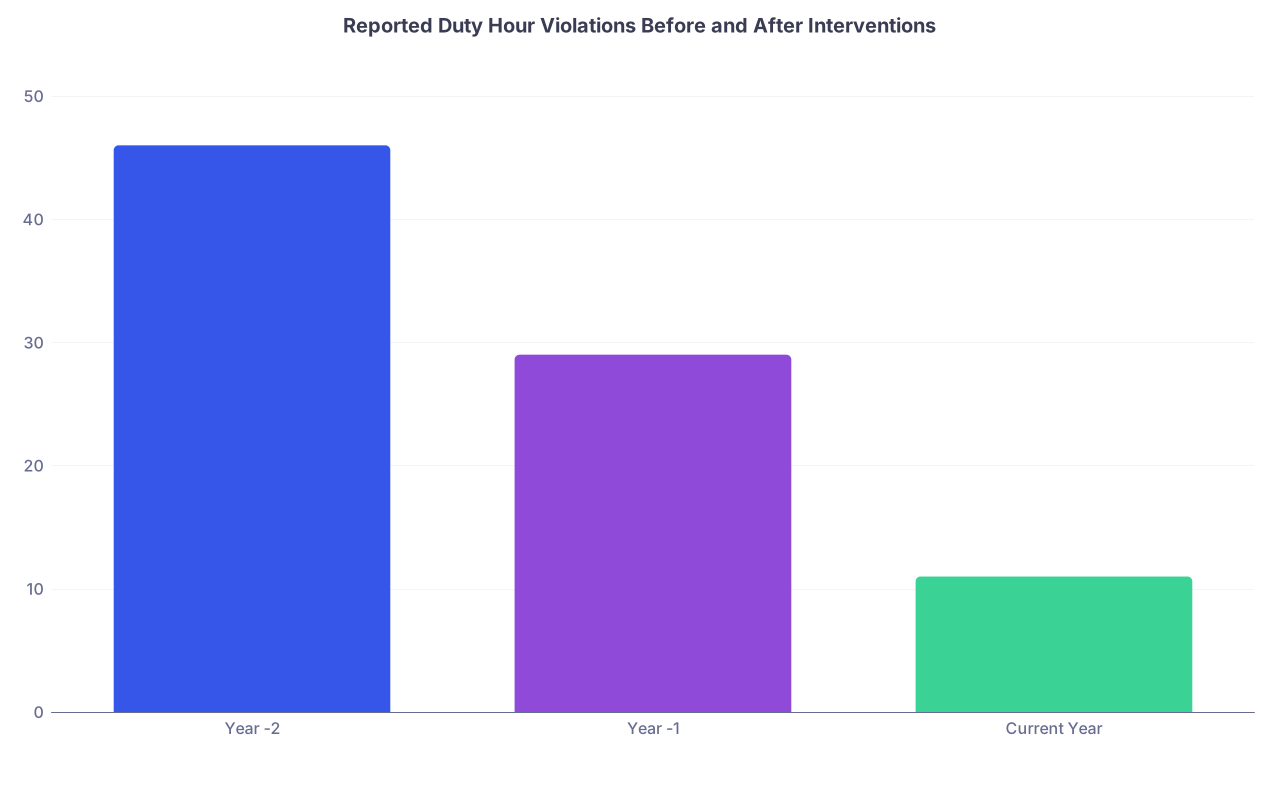
| Category | Value |
|---|---|
| Year -2 | 46 |
| Year -1 | 29 |
| Current Year | 11 |
What you do not see:
- The fact that some “improvement” came from teaching residents to under-report the gray zones.
- The chiefs texting: “Stop logging 85-hour weeks. You’re killing us.”
- The one or two residents who got pulled aside for “documenting things in a way that doesn’t reflect program expectations.”
Then there’s the policy side. Programs will literally rewrite or re-date policies in the months before an anticipated review. A “new” night float structure. “Recent” reduction in ICU caps. A “revised” jeopardy system.
Sometimes these changes are real and meaningful. Other times the practice changed 18 months ago but the documentation is updated right before the review so they can claim, “We recognized a problem and instituted X in May 2025.”
How Residents Get Scripted (Whether You Notice or Not)
Here’s a part most residents feel but don’t quite see clearly.
When a site visitor or ACGME reviewer talks to you, they’re testing two things:
- Are the policies being followed?
- Do the residents understand and “own” the system?
Programs know this. So they start—quietly—rehearsing you.
Not word-for-word, but close enough.
At pre-audit town halls or retreats, PDs and chiefs will emphasize key talking points:
- “We never want you to violate duty hours.”
- “If you’re approaching 80 hours, call us. We will flex coverage.”
- “On ICU we have built-in post-call and early cutoff rules.”
- “You are empowered to send people home to stay compliant.”
All true in theory. How often those things actually happen is… variable.
I’ve heard chiefs say to residents before an upcoming review:
- “If they ask if you’ve ever been punished for logging hours, absolutely not. That’s a huge violation.”
- “Emphasize that you feel comfortable bringing issues to leadership.”
- “If they ask how often you go over 80, frame it as rare and due to patient emergencies, not scheduling.”
Residents are not stupid. They hear the subtext: “Don’t throw the program under the bus.” You also know which residents are quietly identified as “risk of going rogue” in an interview. Those people sometimes get mysteriously scheduled off on the day of the site visit.
Is that ethical? No. Common? Yes.
What Site Visitors Actually Look At
Most residents have a vague idea that “ACGME might talk to us,” but they don’t really know what gets analyzed.
Here’s what’s usually on the table:
- 12–24 months of duty hour logs, including violation flags.
- The ACGME Resident and Faculty Survey results—especially items on workload, duty hours, and fear of retaliation.
- Rotation schedules, call schedules, night float structures.
- Policies on moonlighting, supervision, handoffs, and fatigue mitigation.
- Minutes from Clinical Competency Committee (CCC) and PEC (Program Evaluation Committee) if duty hours were discussed.
They cross-check:
If survey says “frequent duty hour violations,” but logs are 99% clean, that’s a red flag.
If logs show chronic violations on a service, but policies claim “no resident exceeds 24+4,” that’s another.
Programs know this is coming, so they pre-empt.
They’ll have PEC minutes that say things like:
“Residents reported concerns about duty hours and workload on ICU. Program responded by reducing cap from 18 to 14 and adding APP coverage.”
Sometimes that’s fully true. Sometimes the “concerns” were one or two verbal complaints and the cap change was already planned for other reasons, but it gets written as a “responsive intervention.”
The Gray Zone: Real Fixes vs Cosmetic Fixes
To be fair, not everything is spin. Some programs take duty hour scrutiny as a wake-up call and actually fix things.
Real fixes I’ve seen:
- Moving to a night float system instead of q4 overnight call.
- Formalizing “short call” or “early relief” shifts so people don’t live in the hospital post-call.
- Adding NPs/PAs to cover admissions during peak hours.
- Hard caps: no more than 5 new admissions after midnight, strict sign-out by X time.
Then there are cosmetic fixes:
- Reclassifying shifts from “call” to “shift work” without changing the actual schedule.
- Creating a jeopardy pool that almost never gets used because culture punishes calling out.
- Writing a “fatigue policy” that says residents can call an attending if tired, but no backup system exists in reality.
You feel the difference as a resident very quickly. If your day-to-day life doesn’t change after a program “response,” you’re living in the cosmetic category.
Programs under serious ACGME threat (warning, probation) are more likely to do real work-hour reform. Programs just trying to avoid a citation often do enough that it looks good on paper and at least somewhat better in practice, but you still feel the squeeze.
What This Means for You as a Resident
Here’s the part where I stop talking about what PDs do and talk directly to what you should do.
Because you are the one paying the physiologic and psychological price for all this.
Be Honest, But Be Precise
If you’re consistently hitting 85–90 hour weeks and logging 70, you’re hurting yourself and handing the program a shield they don’t deserve.
But also—do not just mash “85” into every week “to make a point.” Sloppy logging loses credibility fast. When I’ve sat on PEC reviews, we trust consistent, precise reporters. We side-eye chaos.
Log the actual:
- Arrival and departure times.
- Post-call departures (don’t mark 10:30 if you left at 2 pm).
- At-home work that is required, not optional.
Programs will sometimes “reinterpret” that data upstream. That’s on them. You control whether you are honest.
Use the Right Channels, Early
If your rotation is chronically unsafe from a duty hour standpoint, do not wait until the ACGME survey to explode.
Talk to:
- Your chief resident first. The good ones will try to fix schedules quietly.
- The APD or PD if it’s not budging.
- Your GME office or house staff council if you’re stonewalled.
The residents who get heard are usually the ones who brought concerns months ago, not the anonymous all-caps survey ranter who never spoke up once in person.
Watch For Retaliation. Document Everything.
Retaliation for honest reporting is a nuclear issue for ACGME. Programs know this—which is why they work so hard to avoid the appearance of retaliation, even when they’re annoyed.
If you:
- Raise duty hour issues,
- Log accurately,
- And suddenly start getting bad evals, schedule punishment, or closed-door “attitude” talks—
Write it down. Dates, people present, phrases used. If it escalates, your GME office and DIO will care, because that’s exactly the stuff that puts entire institutions on the line.
Good PDs will bend over backwards not to cross that line. Bad ones dance right up to it and hope you’re too tired or scared to push back.
How You Can Read the Room Before a Review
You can usually tell when your program is bracing for ACGME contact. Look for this cluster:
- Sudden emphasis on wellness, duty hours, and “open communication.”
- New slide decks about fatigue that feel oddly timed.
- Chiefs asking, “So how are nights really going?” in a way they didn’t last year.
- A “mock interview” session with residents as prep for a future site visit.
You might not be told, “We’re under review.” But if you’re seeing those things plus more pressure to keep the logs “clean,” you’re in the lead-up to an audit or focused visit.
At that moment you have two jobs:
- Protect yourself—do not lie, do not sign off on anything blatantly false.
- Be consistent—what you say to ACGME should match the reality you’ve described to your chiefs and PD, even if they wish it were rosier.
What Programs Won’t Tell You About Their Fear
Behind closed doors, PDs are not primarily scared of residents being tired. They are scared of three things:
- Losing accreditation status – even a warning can hurt recruitment massively.
- Looking incompetent to their chair and Dean – “You let this get to ACGME?”
- Being seen as losing control of their residents – if residents appear angry and disorganized in front of reviewers, it’s a bad look.
That fear cuts both ways. It makes them defensive and spin-heavy. It also makes them very motivated to avoid retaliating overtly, because that’s a fast way to ACGME hell.
You can use that. A program deeply worried about its image is more likely to fix real problems when they know residents are willing to speak clearly, calmly, and consistently, even if it’s uncomfortable.
Quick Reality Check: What the Duty Hour Rules Actually Are
Programs sometimes blur the rules in how they talk about them. Let’s strip it down.
| Rule Type | Typical Requirement |
|---|---|
| Weekly limit | ≤ 80 hours, averaged over 4 weeks |
| Day off | 1 day off in 7, averaged over 4 weeks |
| Shift length | Max 24 hours + 4 for transitions |
| Time off between | 8–10 hours between shifts |
| In-house call freq | No more than every 3rd night |
Programs sometimes “average” aggressively. If you’re at 88 hours one week and 65 the next, they’ll say “average is fine.” That’s legal for ACGME. It may still be brutal on your body. Do not confuse “compliant” with “humane.”
The Line Between Surviving and Selling Out
Let me be very clear: I am not telling you to sabotage your program in front of ACGME. You need your PD’s support for fellowships, jobs, letters.
But I am also not telling you to participate in fiction.
If a reviewer asks, “Do you feel comfortable reporting duty hour violations?” you don’t need to unleash three years of resentment. You can say, truthfully:
- “I report them. Sometimes it feels like we get subtle pressure to keep them down, but leadership has said the right things.”
- “On certain rotations it’s very hard to stay under 80, and we’re still working on that.”
- “I’ve never been punished for documenting accurately, but there’s a lot of informal pressure from peers to not make the program look bad.”
Those kinds of statements are honest, measured, and hard for anyone to retaliate against without looking exactly like what ACGME warns against.
You are allowed to tell the truth without theatrics.
Where This All Leads
Over the past decade, ACGME oversight plus resident survey data has forced many programs to move away from the worst abuses—the 120-hour weeks, the chronic q2 call, the “you’ll leave when the work is done” mindset.
But the system is still gaming-prone. Programs still polish their numbers. Residents still under-report to survive the culture and not be “that person.” And every few years, an audit or site visit pushes a program to re-write the same fatigue slides and hope nobody asks the wrong resident the right question.
Your job is to get through residency alive, sane, and with your integrity mostly intact. Understanding how your program behaves under ACGME scrutiny gives you leverage. It tells you when you’re being managed, and when there’s actually an opening for real change.
With that backstage picture in mind, you’re better equipped to decide how you’ll log your hours, how you’ll speak up, and how you’ll respond the next time someone says, “Just don’t put that in MedHub.”
Because the duty hour rules are only part of your life as a resident. The unwritten rules—the ones I’ve just laid out—are what you really live inside. How you handle those will shape not just your training, but the kind of attending you become.
And once you’re on the other side of this, trust me, the way you think about work hours for your own residents? That’s where the real test starts. But that’s a story for another day.