
The hidden currency of residency isn’t money. It’s call coverage.
You think your paycheck, your Step scores, or your research drive your trajectory. They matter. But inside most residency programs, the residents who quietly control coverage trades and extra calls often have more real leverage than the ones with “Chief Resident” on their badge.
Let me walk you through what really happens behind the schedule.
The Economy You Didn’t Know You Joined
Every residency has an unofficial marketplace. It’s not written anywhere, but everyone participates in it. The product: coverage. The currency: favors, reputation, and sometimes raw desperation.
Program directors pretend the schedule is “objective” and “equitable.” On paper, maybe. In reality, those schedules are living organisms. People get sick, someone’s partner goes into labor, a visa issue pops up, a conference comes through late, a senior melts down and needs a mental health day. The master schedule blows up every week in some way.
Who fixes that? Not the PD. Not the coordinator, not really.
The glue that holds the whole thing together is the informal trade network among residents. And within that network, there are repeat names. The people who “always help.” The ones the chiefs email or text first when they’re desperate.
Those residents are building something. Quietly. And most of your classmates are too burned out or too naïve to realize that’s happening.
What Coverage Trades Actually Buy You
When you pick up someone’s call or cover an extra night float, you’re never “just being nice.” You’re changing your position in a very real social and professional economy.
Here’s how that plays out in practice.
1. Reputation with Chiefs and Attendings
Let me be blunt: chiefs and PDs absolutely know who bails the program out of coverage disasters.
They may say, “Oh, everyone’s doing their part.” No. We tracked this stuff. On an IM service I worked with, one intern picked up six extra weekend calls in six months. Another refused to trade even once.
Who do you think:
- Got first dibs on a lighter elective when their parent got sick?
- Got a softer landing after a borderline professionalism issue?
- Had attendings advocating, “He’s a team player, we should rank him highly for fellowship”?
Exactly.
No one’s putting it in your evaluation as “Picked up three extra NF shifts.” But you’ll see words like:
- “Always willing to help”
- “Reliable in a crisis”
- “Strong team contributor”
Those phrases mean something behind closed doors when faculty discuss who gets letters, who gets leadership roles, and who gets a pass when they screw up.
2. Control Over Your Own Life
Residents who understand the coverage economy early end up with more control over their schedule.
They pay into the system strategically. They help when they can, and they do it in a way that buys flexibility later.
I’ve seen this dozens of times:
- A PGY-2 picks up two extra calls in Q3 of the academic year. When they need three days off for a last-minute fellowship interview tour, the chiefs don’t fight them. They remember.
- Another resident refuses every ask. When they come begging for a post-call day protected for their wedding rehearsal? Suddenly “the schedule is really tight” and “there’s not much room to move.”
Same program. Different currency balance.
The Types of Coverage Currency (What Really Trades)
Let’s organize what actually gets traded. It’s not just “call.” It’s different forms of pain and privilege that have different values depending on your program.
| Currency Type | Usual Perceived Value |
|---|---|
| Weekend call | High |
| Weeknight call | Moderate |
| Night float week | Very High |
| Holiday coverage | Extreme |
| Clinic coverage | Low to Moderate |
This table is the sanitized version. Now I’ll tell you how people really think about it.
Weekend call – Prime currency. Everyone hates it, especially golden weekends. Trading a weekend call for a weekday is usually an “upgrade” for the person giving up the weekend.
Weeknight call – Middleweight. You can often trade two weeknights for one weekend day and feel like it was fair. Chiefs secretly love people who’ll take weeknights because they’re easier to slot in.
Night float – Top tier pain. If someone takes an extra NF week for you, that’s a major debt. That’s not a “oh I’ll spot you one clinic” situation. That’s “you basically own me a kidney” territory.
Holiday coverage – Nuclear option. Thanksgiving, Christmas, New Year’s, Eid, Diwali—whatever is big in your program culture. People remember who worked them. And who refused.
Clinic coverage – Lower value. Annoying, but not as painful as call. Usually used as partial payment or “interest” on a bigger favor.
The People Who Get Used – And The People Who Get Respected
I’ll say the part no one says out loud: some residents get turned into doormats. Others become “indispensable.”
They might look similar on the surface—both do lots of extra coverage—but the difference is how they do it.
The Doormat Resident
This is the intern who can’t say no. Everyone knows it by October.
The text messages look like this:
“Hey, I know it’s last minute but could you possibly cover my call this Saturday? I’ll totally get you back.”
Except they never do.
This intern says yes because they want to be liked or they’re afraid of conflict. No clear ask for return, no boundaries, no tracking. Fast forward:
- By spring they’re exhausted, bitter, and silently fuming at everyone
- They’ve given away 6–7 calls and gotten 1 back
- Their work quality starts slipping
- And yes, the chiefs eventually start to see them as the “dumping ground” when there’s a hole. Because they always say yes
Good heart. Terrible strategy.
The Strategic Workhorse
Then there’s the one who also helps a lot, but it feels different.
Their pattern looks like this:
- They say yes selectively, not reflexively
- They specify the payback: “I’ll cover this weekend, but I’ll need your clinic on the 18th and a weeknight call in March. Does that work?”
- They keep a running list (literally in Notes or a spreadsheet) tracking who owes what
- If someone doesn’t pay back, they stop trading with them. And they’ll say it straight: “You still owe me for that weekend in December. I’m tapped until that’s settled.”
This person gains a quiet respect even from people annoyed by them. Because they’re consistent. They’re fair. And they clearly value their time.
That’s the person chiefs remember as “always reliable” instead of “always available to be used.”
What Chiefs and PDs Really Say About Coverage
You won’t hear this at orientation. But I’ve sat in the rooms where it’s said.
A few actual lines I’ve heard:
- “She took an insane number of calls this year. We need to be careful she doesn’t burn out, but I’ve never seen someone step up like that.”
- “He always has an excuse when we need coverage. Technically within duty hours but… not someone I’d want on my team in a pinch.”
- “When her dad got sick, we all bent over backwards to rearrange her schedule. She’s covered for three different residents this year without complaining.”
No one is keeping a public leaderboard. But faculty, chiefs, and coordinators all have a mental ledger of who they can count on when the schedule blows up. That ledger bleeds into:
- Who gets the strongest “I’d work with them anytime” LOR
- Who gets recommended for chief
- Who gets the benefit of the doubt when mistakes happen
- Whose schedule gets gently protected in their fellowship application year
Program directors will never say, “We reward people who do coverage,” because legally and ethically that sounds horrible. But the human reality? They remember when you saved them from a coverage crisis that could have blown up patient care.
How Coverage Debt Actually Works
Coverage debt is like a soft loan. If you do not manage it, inflation will eat it alive.
The resident currency rules I’ve seen play out:
Debt expires if you let it sit too long.
If you cover someone’s weekend in September and you do not cash that in until PGY-3, good luck. The social memory fades, or people tell themselves: “We’re in a different year now, it’s not equivalent.”Unequal trades need explicit agreement.
Weekend for weeknight, holiday for non-holiday, NF for clinic – these need to be spelled out. “I’ll do Christmas Eve if you do two weeknight calls and cover my clinic the week before my Step 3.”Your credibility matters more than the math.
If you’re known to pay your debts promptly and fairly, people will trust your proposed trades more. If you’re flaky, they’ll demand overpayment or avoid trades altogether.Chiefs have their own separate ledger.
If you help bail out chiefs directly (e.g., they text you, “I’m totally stuck, can you take this call?”), that debt is worth more than a peer-to-peer trade. Because you just saved their reputation with the PD.
The Dark Side: Burnout, Exploitation, and Quiet Resentment
Now, let’s talk about the cost. Because there is one.
Extra calls and coverage aren’t free. They’re paid for with sleep, sanity, relationships, and sometimes safety.
I’ve watched this pattern:
- PGY-1 says yes to everything
- PGY-2 is tired and still saying yes more than they should
- By early PGY-3, they’re bitter, snapping at co-residents, checking out emotionally
- They start talking about medicine like a trap they fell into
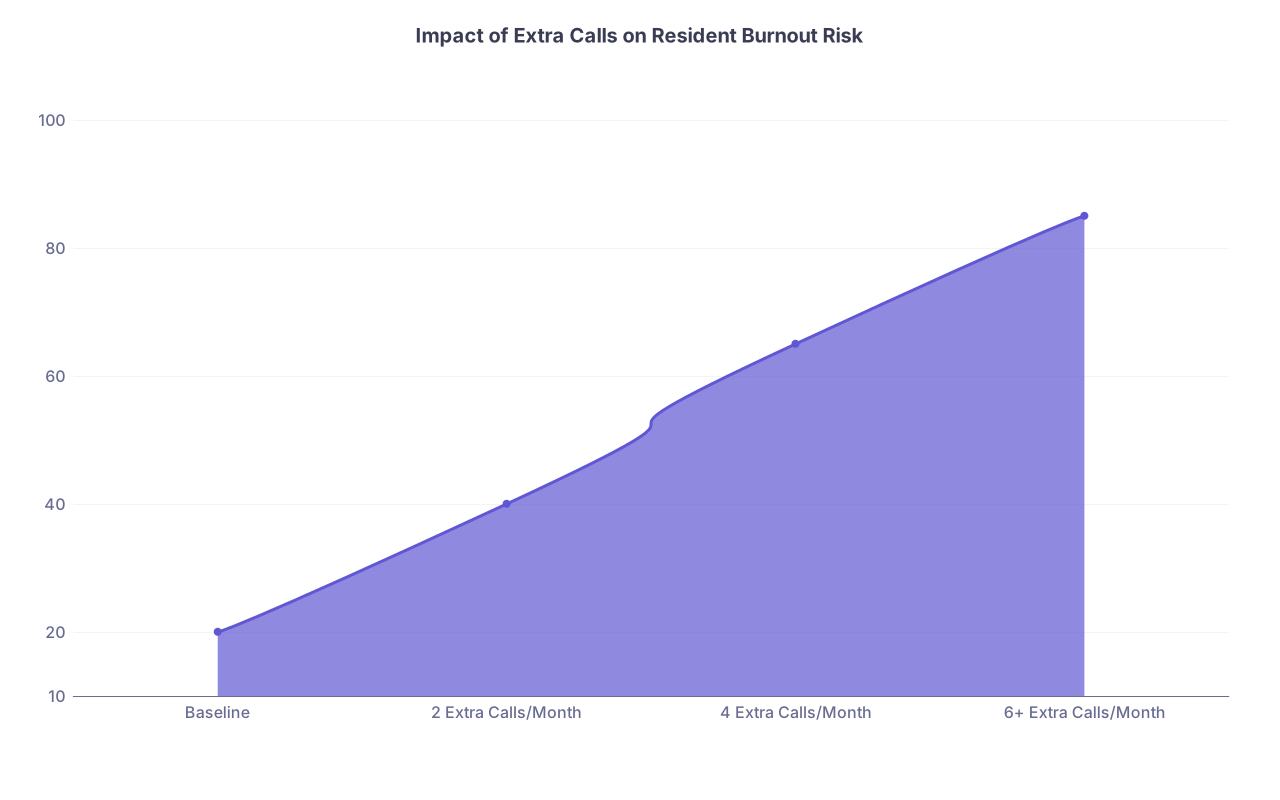
Coverage is one of the fastest ways to accelerate burnout if you’re not strategic.
| Category | Value |
|---|---|
| Baseline | 20 |
| 2 Extra Calls/Month | 40 |
| 4 Extra Calls/Month | 65 |
| 6+ Extra Calls/Month | 85 |
This chart is not from a specific study; it reflects what programs actually see. Once someone is regularly doing 4+ extras a month for several months, flags start to go up. Fatigue. Irritability. Errors.
The other dark reality: some programs (and some chiefs) will absolutely exploit the “yes” people until they break. Not maliciously, just lazily. It’s easier to text the person who always says yes than to confront the one who always refuses.
So if you’re going to play in this economy, you need rules. Your rules.
How to Play the Coverage Game Without Losing Your Soul
Here’s how the residents who do this well actually operate.
1. Set a Hard Cap – In Writing (Even If It’s Only For You)
You decide your limit before the chaos hits.
Something like:
- “I’ll do at most 1–2 extra calls per month, and never in back-to-back weekends.”
- “I’ll only agree to NF coverage during months where my daytime rotation is light.”
- “I will not work 14 days straight, period.”
You don’t need to announce this to the program. But you follow it. Every time someone asks, you check that mental cap before responding.
2. Respond Like an Adult, Not a Victim
When you can’t do it, say no like this:
“Sorry, I can’t safely add another call this month. I’m already at my limit. Hope you find coverage.”
Notice the structure:
- No over-apology
- Firm boundary
- No convoluted excuse they can argue with
And when you can do it:
“I can take your Saturday call if you cover my clinic on the 15th and one of my weeknights in March. Does that work?”
Clear terms. Immediate expectation.
3. Track Everything
The residents who get screwed are the ones who “kind of remember” helping people out.
Have a dead simple system:
- Note on your phone: “Coverage Ledger”
- Log date, person, what you did, and what the agreed payback is

Example entry:
- 10/5 – Covered Sat call for Alex (Heme/Onc). He owes 1 clinic (10/18) + 1 weeknight in Nov.
If someone doesn’t pay back on time, you don’t rage about it. You send a direct message:
“Hey Alex, just a reminder you still owe me that weeknight call from covering your 10/5 weekend. I’d like to use it for 11/14. That OK?”
No apology. Just business.
4. Use Extra Coverage as Strategic Leverage (Not Validation)
Do not do extra calls to prove you’re hardworking. That’s how you get chewed up and forgotten.
Do extra coverage when it clearly buys you something concrete:
- Protected time for multiple fellowship interviews in a tight span
- A specific lighter elective during a hard life event
- Goodwill from a powerful chief or attending you trust
- The ability to swap out of a rotation that’s historically malignant

| Step | Description |
|---|---|
| Step 1 | Asked to Cover Extra Call |
| Step 2 | Politely Decline |
| Step 3 | Negotiate Explicit Trade |
| Step 4 | Log Trade in Ledger |
| Step 5 | Within My Monthly Cap |
| Step 6 | Clear Benefit To Me |
If you cannot identify a real, tangible benefit, default to no.
How Coverage Trades Affect Your Long Game
Let’s tie it to what actually matters for your career.
Fellowship Applications
Fellowship directors talk to PDs. PDs talk about:
- “Team player vs. solo operator”
- “Shows up when things are bad, not just when it’s glamorous”
- “Handled extra workload without going toxic”
I’ve heard a PD say: “I’m not sending anyone to that fellowship who refused all coverage requests for three years.” Did it cost that resident a spot? Hard to prove. But it definitely did not help them.
In-Program Opportunities
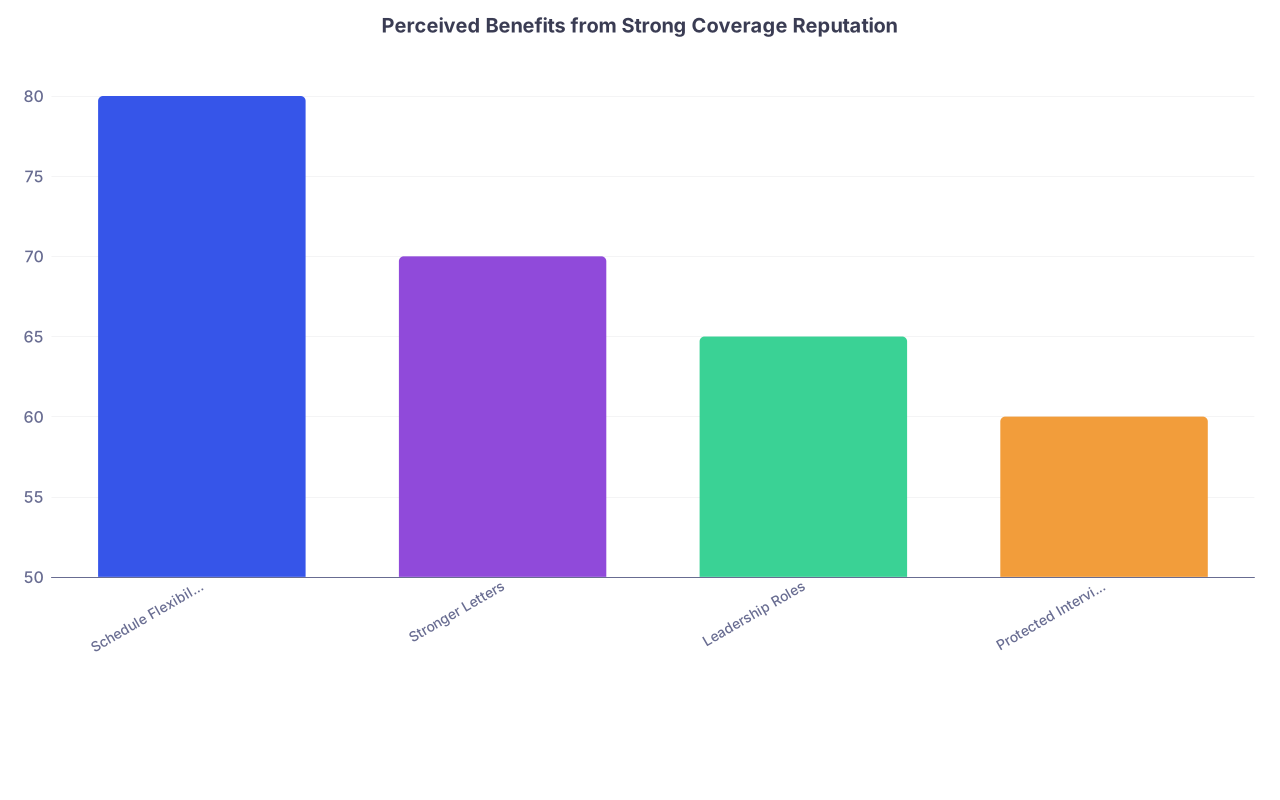
Coverage goodwill shows up in a hundred subtle ways:
- Who gets first dibs on that rare away elective
- Who’s asked to represent the program at a national meeting
- Who the chiefs choose as their “safe” intern pairings on rough rotations
| Category | Value |
|---|---|
| Schedule Flexibility | 80 |
| Stronger Letters | 70 |
| Leadership Roles | 65 |
| Protected Interview Time | 60 |
Again, this is the hidden layer. It’s not on the website. It’s in how people talk in the workroom when you’re not there.
How Not to Get Blacklisted While Still Saying No
You can say no and still be respected. The residents who get labeled as “not a team player” rarely say a simple no.
They do something worse:
- Say yes, then back out last minute
- Vanish on text for 18 hours when chiefs are scrambling
- Agree to trades and then conveniently “forget” the return
- Guilt-trip the asker instead of just declining
You’re allowed to have a life. You’re allowed to have limits. Just own them.
Better:
“Can’t do extra this month; I’m already maxed and not safe to add more call.”
Even chiefs respect that sentence more than a vague, flaky maybe.
The Holidays and High-Emotion Coverage
Holiday coverage is its own battlefield. I’ve seen full-on resident cold wars start over Christmas Eve.
Here’s the insider reality: programs try to be “fair” on holidays, but there is no configuration that doesn’t feel unfair to someone. So what chiefs and PDs remember is who escalates vs. who problem-solves.
If you get stuck with a holiday you truly cannot do:
- First, try to resolve it with peer trades yourself
- Bring chiefs a solution option, not just a complaint:
“I talked with Sam, he’s willing to take my Christmas Eve if he gets my New Year’s Day and I cover one of his weekends in January. Is that OK with you?”
You look like an adult. Chiefs love residents who bring them pre-packaged solutions rather than another fire to put out.

When to Involve the Program Director
Most of this should be handled peer-to-peer or with chiefs. But there are red lines.
PD involvement is justified when:
- Your coverage load is consistently, measurably unequal (and you have records)
- You’re being pressured to violate duty hours routinely
- Your refusals are being framed as “unprofessional” when you are within your rights
- A chief is clearly using one or two people as permanent coverage dumping grounds
You do not go in crying about one call trade gone wrong. You go in with:
- A calm summary
- Clear dates and names
- A specific ask: “I need help resetting expectations so I’m not carrying excess call beyond what’s fair.”
Most PDs will respond to that. They don’t want their “reliable” residents quietly burning out and then quitting.
A Final Word: You’re Not Powerless
The biggest lie of residency is that you have no control.
You do not control census. You do not control who codes next. You do not control which attending is on. But you absolutely can control how you participate in the hidden economy of coverage.
Learn the rules early:
- Your time is a currency.
- Coverage is a trade, not a gift.
- Boundaries are respected more than resentment.
If you handle this right, you come out of residency not just alive, but with allies who remember you as the person who could be counted on and who respected themselves enough not to be used.
And once you’re on the other side—as a fellow, as an attending, maybe as chief or PD—you’ll start seeing the same patterns from the other angle. The residents who get it. The ones who don’t. The ones you’d trust when the service is on fire.
With that foundation, you’re in a much better position to survive the hours. The next level is learning how to choose which rotations, services, and attendings to align yourself with to build the career—not just the schedule—you actually want. But that’s a story for another day.