
It’s 6:45 pm. Sign‑out technically ended 15 minutes ago, but your senior just poked their head into the workroom:
“Hey, we’re a body short tonight. Any chance you can stay and cover? I’ll make sure the PD hears about how helpful you are.”
You look at the list. Your brain is already fried from a post‑call clinic that never ended. But you also remember:
- You’re trying to be “the reliable intern”
- Your co‑resident just said yes last week
- The culture on your service is: real team players don’t say no
So you say it.
“Sure. I can stay.”
This happens again. And again. Suddenly, you’re the default yes-person for every orphan shift, every extra call, every “can somebody just help out this once?” And you swear to yourself that you’re doing it for the team, for your evals, for your fellowship prospects.
Let me be very clear: saying yes to some extra shifts is fine. Saying yes to every extra shift is a mistake that can quietly wreck your training, your reputation, and your long‑term career.
Let’s walk through how that happens—and how to stop before you burn yourself into the ground.
The Hidden Math: Extra Shifts Are Not Free
| Category | Value |
|---|---|
| Month 1 | 2 |
| Month 2 | 3 |
| Month 3 | 4 |
| Month 4 | 5 |
| Month 5 | 6 |
| Month 6 | 7 |
The first mistake residents make is pretending an extra shift is “just one day.”
It’s not. It’s a hit to:
- Cognitive performance
- Learning capacity
- Emotional bandwidth
- Physical health
Stack those hits and you’ve effectively redesigned your residency into a harder, less educational, more dangerous version of what you signed up for.
Let’s say:
- Your program averages 60–70 hours a week already
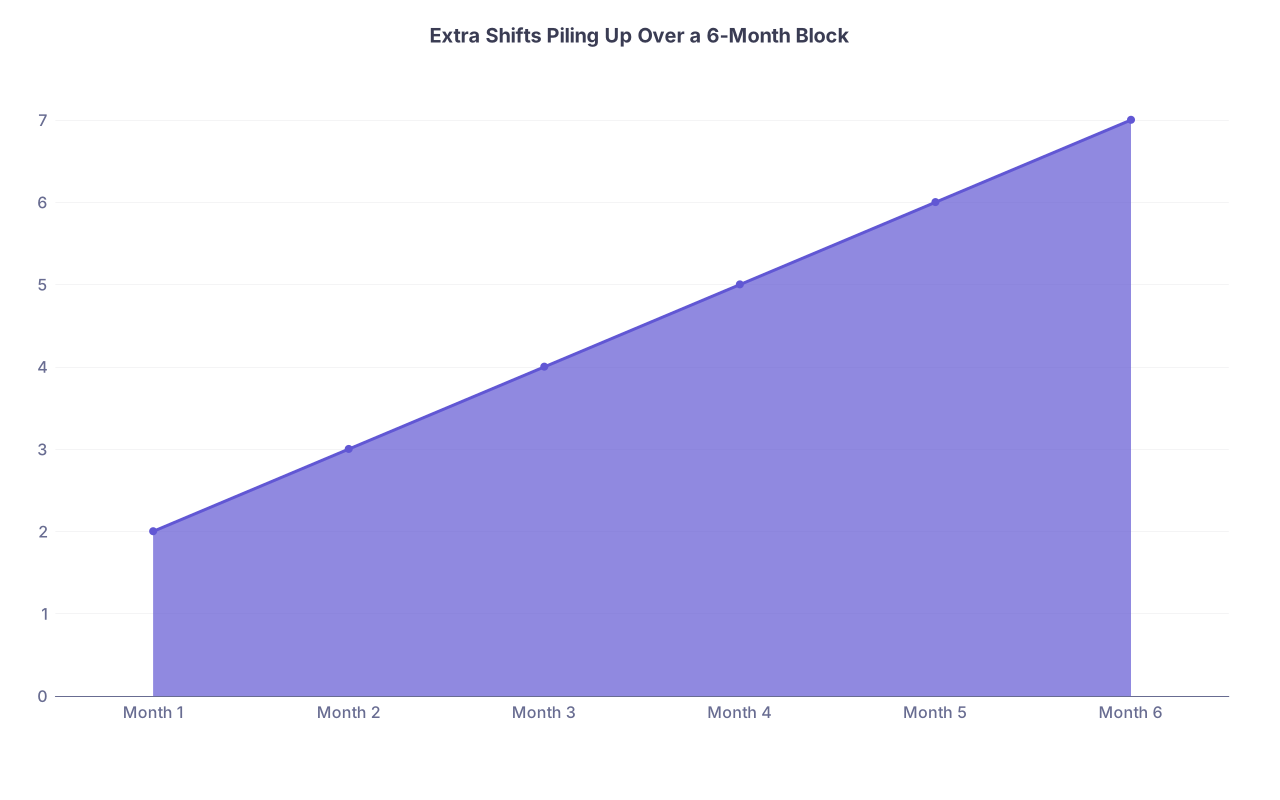
- You pick up 2–3 extra 12‑hour shifts a month
- You “float” for people on nights and weekends because “I’m single / I don’t have kids / I can handle it”
In 6 months, that’s:
- 20–30 extra shifts
- 240–360 extra hours
That’s basically adding another month of residency on top of your existing six. Without the structure, without the curriculum, and usually without meaningful appreciation.
The risk isn’t just being tired. It’s being consistently just tired enough that:
- You miss subtle exam findings
- You shortcut documentation
- You accept “sign-out diagnoses” without thinking
- You stop reading, stop asking questions, stop improving
I’ve watched residents sleepwalk through entire rotations because they were “just helping out” too often. No one wrote them up. No big disaster occurred. But their actual growth as physicians slowed to a crawl. Quiet damage.
Mistake #1: Confusing Being Helpful With Being Exploitable
You want to be a good teammate. That’s healthy. The trap is this: medicine is full of people and systems that will take whatever you give without giving much back.
You think you’re building a reputation as:
- “The hardest worker”
- “The one you can always count on”
Sometimes that’s true. Sometimes you’re just becoming:
- “The one who never says no, so ask them first”
Those are not the same thing.
What this looks like in real life
I’ve seen this pattern over and over:
- The same 3–4 residents always get texted first to cover shifts
- They often say yes out of guilt, fear, or habit
- The rest of the residency quietly learns: “If I say no, someone else will pick it up anyway”
Guess what that does? It centralizes the burden on the people least likely to set boundaries.
You think you’re doing the right thing. But you’re training the system to lean on you without limit.
Red flag you’re in this trap:
- You get asked to cover more than others, and no one can give a good reason besides “you’re always so helpful”
That’s not a compliment. That’s a warning.
Mistake #2: Sacrificing Learning for Labor
You did not come to residency to be cheap labor. You came to:
- Develop clinical judgment
- See enough pathology to recognize patterns
- Learn procedures safely
- Build relationships with mentors
Extra shifts can help with experience up to a point. Then there’s a very sharp drop‑off.

Common pattern I’ve seen:
- PGY‑1 says yes to every extra call
- They’re constantly post‑call or pre‑call
- They miss noon conferences for “just a few more discharges”
- They show up to M&M and journal club exhausted and mentally absent
- Their notes get shorter; their differential diagnoses get lazier
On paper, they’re “hard-working and reliable.” But if you talk to fellows and attendings quietly, you hear:
“He’s nice but doesn’t seem to be progressing.”
“She works nonstop but still misses basic stuff.”
Why? Because they traded deliberate learning time for sheer volume of tired work.
The mistake: equating “more hours” with “better training.” That’s not how skill acquisition works in medicine or anywhere else.
You grow when:
- You have time to reflect on cases
- You can read about what you saw
- You can actually remember what your attending taught you on rounds
If extra shifts are stealing that time, they’re not helping your career—they’re stunting it.
Mistake #3: Ignoring the Safety and Liability Angle
Let’s be blunt: tired residents are dangerous. To patients and to themselves.
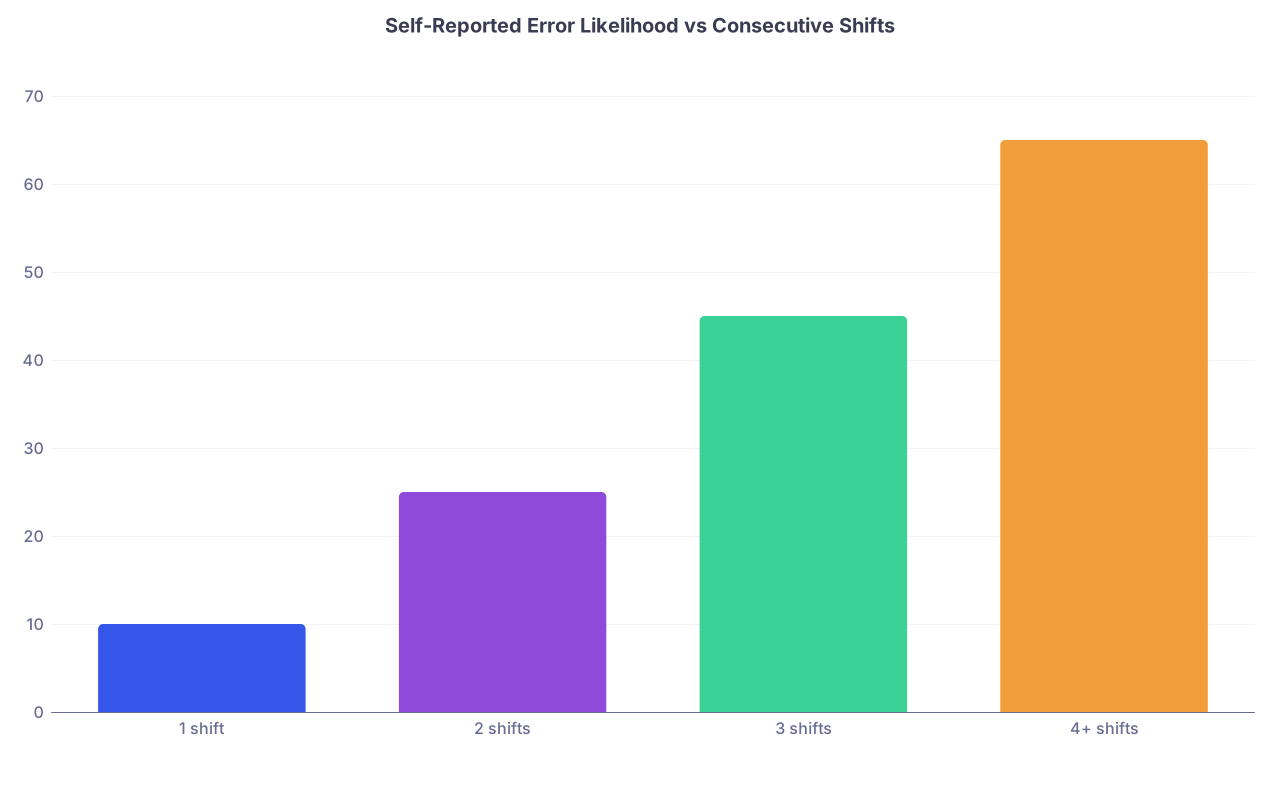
You already know about fatigue and medical error. You’ve seen the studies. The part people ignore is how extra shifts quietly push you into higher-risk territory without anyone formally tracking it.
| Category | Value |
|---|---|
| 1 shift | 10 |
| 2 shifts | 25 |
| 3 shifts | 45 |
| 4+ shifts | 65 |
When you stack extra shifts:
- Your reaction time slows
- Your threshold for double-checking drops
- You’re more likely to “just accept” previous documentation, labs, and interpretations
And here’s the ugly part: if something goes wrong, nobody is writing “this resident was pressured into extra coverage” in the chart. What they’ll see is:
- Your name on every order
- Your sign‑out
- Your note
Program directors and hospital leadership will absolutely talk about “contributing factors” and “systems issues” in public. But behind closed doors, they remember names.
You do not want to be the resident informally known as “the one who had the bad case” because you were too exhausted to catch something basic after your fourth extra night this month.
You also do not want your pattern of over‑work to show up in:
- Emails documenting duty hour violations
- Faculty side comments on your professionalism or judgment
Yes, it’s noble to help out. No, it’s not worth your license.
Mistake #4: Thinking This Will Automatically Help Your Fellowship or Job Prospects
There’s this quiet myth in residency:
“If I say yes to everything, people will see my dedication. That has to help my letters and fellowship chances.”
Sometimes. But often, the real outcomes are much messier.
| Group | Likely Interpretation |
|---|---|
| Co-residents | Easy to lean on / covers for us |
| Chiefs | Reliable but may lack boundaries |
| PD/Faculty | Hard worker vs. possibly disorganized or burnt out |
| Fellowship PDs | Care more about competence, letters, and research |
What faculty actually value:
- Clinical competence
- Judgment under pressure
- Professionalism (including self-awareness)
- Follow‑through on projects, QI, or research
If you’re always working extra shifts:
- Your research suffers
- Your QI projects stall
- Your scholarly output is thin
- You may show up tired or distracted in the rare teaching moments you do get
I’ve seen residents who practically lived in the hospital end up with mediocre letters. Why?
Because the letters that matter do not say “They covered a ton of shifts.” They say:
- “Their clinical reasoning is advanced for their level.”
- “They are reliable and thorough with follow‑up.”
- “They completed a meaningful project with real impact.”
You can’t reliably produce that kind of impression if you’re chronically stretched thin.
Mistake #5: Destroying Your Reputation for Boundaries
Here’s a career truth nobody likes to say out loud:
You’re not just training to be a doctor. You’re training people on how allowed they are to treat you.
If, during residency, you signal:
- “I’ll always figure it out if someone drops the ball”
- “I’m fine staying late; you don’t need to ask twice”
- “I never push back when something feels unsafe”
You’re not only setting yourself up for abuse now. You’re building a pattern for future jobs where:
- Partners will expect you to cover “just this one weekend” again and again
- You’ll be the one doing extra procedures, extra calls, extra admin
- You’ll have a terrible time negotiating contracts because you’re used to being grateful for scraps
Residents often think saying no will make them look:
- Lazy
- Difficult
- Not a “team player”
But the opposite is usually true when done correctly. Attendings respect:
- People who know their limits
- People who say, “I can do X safely, but not Y on top of it today”
- People who protect patient safety over social pressure
You’re not in high school trying to impress the varsity team anymore. You’re a professional. Act like one.
Mistake #6: Letting Guilt and Fear Drive Your Decisions
Most residents don’t say yes out of joy. They say yes because of:
- Guilt: “If I don’t do it, someone else will suffer.”
- Fear: “If I say no, they’ll think I’m weak or lazy.”
- Comparison: “Everyone else seems to handle it, so I should too.”
Those are terrible decision‑making frameworks for a safety‑critical job.

| Step | Description |
|---|---|
| Step 1 | Asked to cover extra shift |
| Step 2 | Say no and protect bandwidth |
| Step 3 | Consider yes with limits |
| Step 4 | Am I rested and within duty hours? |
| Step 5 | Is this truly an emergency? |
| Step 6 | Does this help my learning or goals? |
Sometimes, yes, there is a genuine emergency:
- Sudden illness
- Family tragedy
- Mass casualty events
Those are different. You step up as a team. But what passes for “urgent” in residency is usually:
- Poor scheduling
- Chronic understaffing
- Bad leadership planning
That’s not your job to fix with your health and your license.
You are allowed to think:
- “I am not safe to work another 12 hours tonight.”
- “I have already picked up extra recently; it’s someone else’s turn.”
- “My performance is slipping; I need rest more than I need praise.”
If guilt is the main reason you’re saying yes, you’re being emotionally manipulated by a broken system. Do not build your career around that.
How to Say No Without Setting Yourself on Fire
You do not need to become the person who never helps. You need to stop being the person with zero boundaries.
Here’s how to protect yourself without blowing up relationships.
1. Set a personal “extra shift budget”
Decide in advance:
- Max number of extra shifts per month (maybe 1–2)
- Absolute no-go zones (post-call days, pre-exam, during demanding rotations)
Then stick to it.
When your budget is spent, your answer is:
“I’ve already picked up my limit of extra shifts this month. I want to be safe when I’m here.”
Short. Clear. Relatable.
2. Use safety and duty hours as your backbone
Programs and hospitals can argue with your feelings. They cannot as easily argue with:
- ACGME duty hour rules
- Objective safety concerns
Phrases that work:
- “I’m at risk of violating duty hours if I take this on.”
- “Given my schedule, I don’t think I can safely do another night this week.”
- “I’m concerned I won’t be functioning well enough for patient safety if I stay.”
You are literally trained to advocate for patients. Turn 10% of that advocacy toward yourself.
3. Offer structured, limited help instead of a full yes
If you genuinely want to help but cannot afford the full ask:
- “I can stay an extra 1–2 hours to help with admits, but I can’t cover the whole shift.”
- “I can trade a future shift instead of adding one on top.”
- “I can help remotely with calls for 2 hours, but then I have to sign off.”
This signals:
- You’re not abandoning the team
- You are thinking about sustainability and safety

4. Loop in leadership when the pattern becomes chronic
If you are being asked disproportionately often, or the service is perma‑understaffed:
You talk to:
- Your chief residents
- Your program director
- Or both
Calmly. Specifically. Not in a vague “I’m tired” way.
Examples:
- “Over the last 2 months, I’ve been asked to cover 6 extra shifts. It’s affecting my learning and rest. Can we look at coverage more evenly?”
- “This service has needed extra help nearly every week. I’m worried this is a structural issue that’s landing heavily on a few of us.”
You’re not complaining. You’re flagging a patient safety and fairness problem. Good leadership takes that seriously. Bad leadership reveals itself—also useful data for your future decisions.
The Long Game: Protecting the Doctor You’re Becoming
Last piece that residents overlook: this isn’t just about surviving residency. It’s about who you become afterward.
If you train yourself to:
- Ignore your own limits
- Equate worth with self-sacrifice
- Think boundaries are selfish
You walk into attending life already primed for:
- Burnout
- Toxic group practices
- Terrible work‑life choices
On the flip side, if you:
- Learn to say yes strategically
- Learn to say no clearly and calmly
- Learn to see your time as a professional resource
You’ll make much better decisions when real money, contracts, and long‑term jobs are on the table.

Two Things To Remember
- Saying yes to every extra shift does not make you a hero; it quietly turns you into an overused, under-rested risk—clinically and professionally.
- Your reputation should be based on competence, judgment, and reliability, not your willingness to ignore your own limits. Protect your bandwidth. Protect your learning. The rest of your career depends on it.