
The fastest way to wreck your residency isn’t one catastrophic event. It’s death by hours. And research and moonlighting are two of the biggest, most seductive traps.
You’re not lazy. That’s not the problem. The problem is you’re dangerously willing.
You want a strong CV. You want extra income. You want fellowship. You want to help your family financially. So you say yes—research project here, moonlighting shift there—because everyone around you seems to be “doing it all” and “grinding.” Let me be blunt: a lot of those people are quietly falling apart.
This is about where hours go wrong. Not just the ACGME work-hour rules. The invisible hours. The ones nobody logs. The ones that end up costing you your health, your relationships, and sometimes your license.
Let’s keep you out of that mess.
The Hidden Math: Why Your Hours Are Lying to You
Most residents massively underestimate their true workload. They only count scheduled hours. That’s a rookie mistake.
Here’s the reality:
- Official duty hours: ~60–80 hours/week (varies by program/rotation)
- Research “on the side”: 5–20 hours/week (usually nights/weekends)
- Moonlighting: 4–24 hours/week (extra shifts, often nights)
And people tell themselves, “It’s just a couple of extra things.” No. It’s a second job disguised as “productivity.”
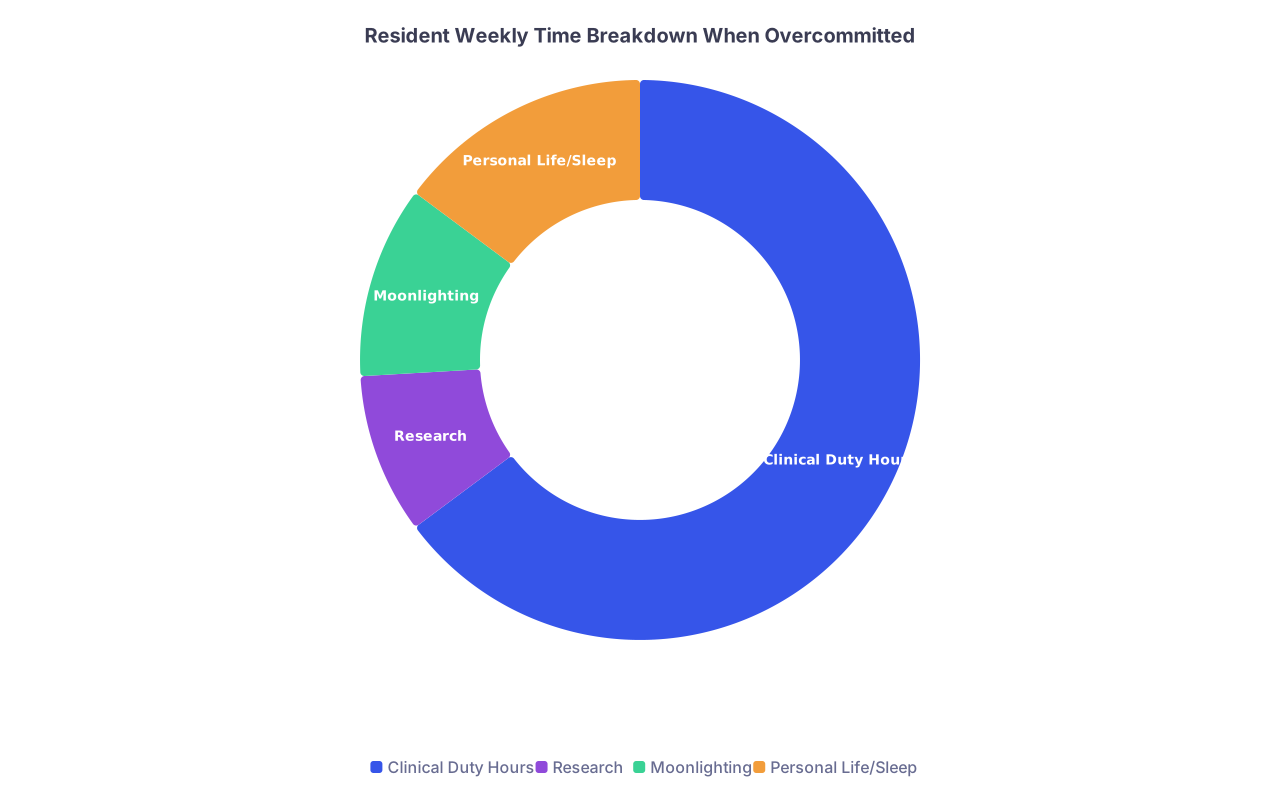
| Category | Value |
|---|---|
| Clinical Duty Hours | 70 |
| Research | 10 |
| Moonlighting | 12 |
| Personal Life/Sleep | 16 |
Look at that last segment. That “Personal Life/Sleep” wedge? That’s where burnout breeds. And errors. And depression. You think you’re just trading free time for productivity. You’re actually trading reaction time, empathy, and judgment.
Common miscalculations I see over and over:
- Treating research as “not real work” because it’s flexible
- Forgetting commute time to moonlighting sites
- Ignoring the recovery time after a night shift
- Not counting pre-rounding from home, reading, and notes finished at 10 p.m.
Your body doesn’t care what category the hours go under. Cognition fails the same whether you’re doing notes, a chart review, or handling admits for $120 an hour.
If you’re not brutally honest about your weekly total hours, you will absolutely overcommit.
The Research Trap: When “Scholarly Activity” Becomes Self-Sabotage
Research during residency isn’t the problem. Overcommitting to research is.
The dangerous pattern is always the same:
- You feel behind your peers
- You say yes to multiple projects to “catch up”
- Each one is “just a few hours a week”
- Deadlines converge, attendings email you, co-authors ping you
- You’re answering REDCap queries at midnight post-call and wondering why you’re so miserable
The mistake is not understanding the full lifecycle of a project before you agree.
The Specific Research Mistakes Residents Keep Making
Let’s be specific, because vagueness is how people get burned.
Saying yes to every project with your name on it
If you’re the 7th author on yet another retrospective chart review where your task is “data collection,” you’re donating your very limited time for a microscopic return.Joining projects with zero structure
No clear timeline, no designated project manager, PI ghosting for months, goals like “let’s just see where this goes.” Translation: this will drag on for years and haunt your inbox.Underestimating IRB and data work
Residents often think: “We already have the data; this will be quick.” Wrong. Cleaning data, de-identifying, merging datasets, and fixing errors will eat your weekends alive.Doing research outside your PI’s lane
If your attending has no track record of getting papers out in that niche, do not assume your project is going anywhere. A PubMed search of their name is not optional—it’s basic due diligence.Not protecting your exam/board study time
The resident who fails their board exam because they were drowning in research is not a hypothetical. I’ve seen it. Programs are not impressed by ten posters if you can’t pass boards.
Here’s what the tradeoff often looks like in reality:
| Commitment Type | Time Cost | Likely Benefit |
|---|---|---|
| 1–2 mentored projects with publishing PI | High | High (pubs, letters, mentorship) |
| 5+ scattered chart reviews | Very High | Low (weak pubs, burnout) |
| Case report with engaged mentor | Low–Mod | Moderate (OK for early CV) |
| “We’ll see” idea with no clear plan | Unbounded | Very Low (often never finishes) |
If you’re serious about protecting yourself, you need to start asking questions before you agree:
- Who’s really driving this project?
- What’s the realistic timeline to submission?
- What exactly is my role and how many hours is that, weekly?
- What has this PI actually published in the last 3–5 years?
If those answers are vague, that’s not a “great opportunity.” That’s a time sink.
The Moonlighting Mirage: Easy Money, Expensive Consequences
Let me be direct: moonlighting can be a smart move. For the right person, in the right amount, with the right boundaries.
But you’re not protected by magic just because you’re “still in training.” You are taking on physician-level responsibility. Often with less support. While already tired.
Here’s what residents keep getting wrong with moonlighting:
1. Ignoring True Fatigue
You can’t stack a 24-hour call, then a post-call moonlighting shift, and expect your brain to function. That’s not grind; that’s impairment.
Common red flags I’ve seen:
- Nodding off while writing a note at 3 a.m.
- Forgetting key parts of a HPI and needing to re-interview
- Snapping at nurses because your patience is gone
- Driving home after 26–30 hours awake
This is how bad outcomes happen. This is how car accidents happen. And yes, this is how your name ends up in a chart review with “provider failed to…”
2. Misunderstanding Liability and Coverage
Another ugly truth: some moonlighting sites are desperate for coverage and sloppy with onboarding. They rush contracts. They assume you won’t read the fine print.
You better read it.
Critical questions you must clarify before accepting:
- Are you covered by the site’s malpractice or do you need your own tail coverage?
- Does your residency program explicitly approve this moonlighting location? In writing.
- Are you practicing within the scope your program director has cleared (e.g., no independent ICU night coverage if you haven’t been signed off)?
If the answers are unclear, you’re risking more than your sleep—you’re risking your license.
3. Pretending Money Isn’t Driving Your Decisions
Residents often moonlight because they’re drowning in loans, supporting family, or just trying to live somewhere expensive. That’s real. I’m not minimizing that pressure.
But I’ve watched people chase short-term cash and pay for it with:
- Failed in-training exams
- Barely passing or failing boards
- Damaged reputations in their home program because they’re exhausted and irritable on service
- Strained relationships and health issues
Here’s the pattern no one talks about: A resident picks up 2–3 extra shifts a month. They feel great financially. Then they slowly add more. Their performance slips slightly. Chiefs notice. PD notices. Suddenly they’re on “informal” probation and stressed out—so they moonlight more to cope financially.
That spiral is avoidable. But not if you refuse to cap your hours.
How Work-Hour Rules Give You False Confidence
You think, “I’m under 80 hours, so I’m fine.” That confidence is misplaced.
ACGME work-hour restrictions are only counting duty hours for your residency. Moonlighting hours may or may not be tracked depending on your program’s culture and your honesty. (And yes, under-reporting is common. Don’t play that game.)
Pull back and look at your whole week:
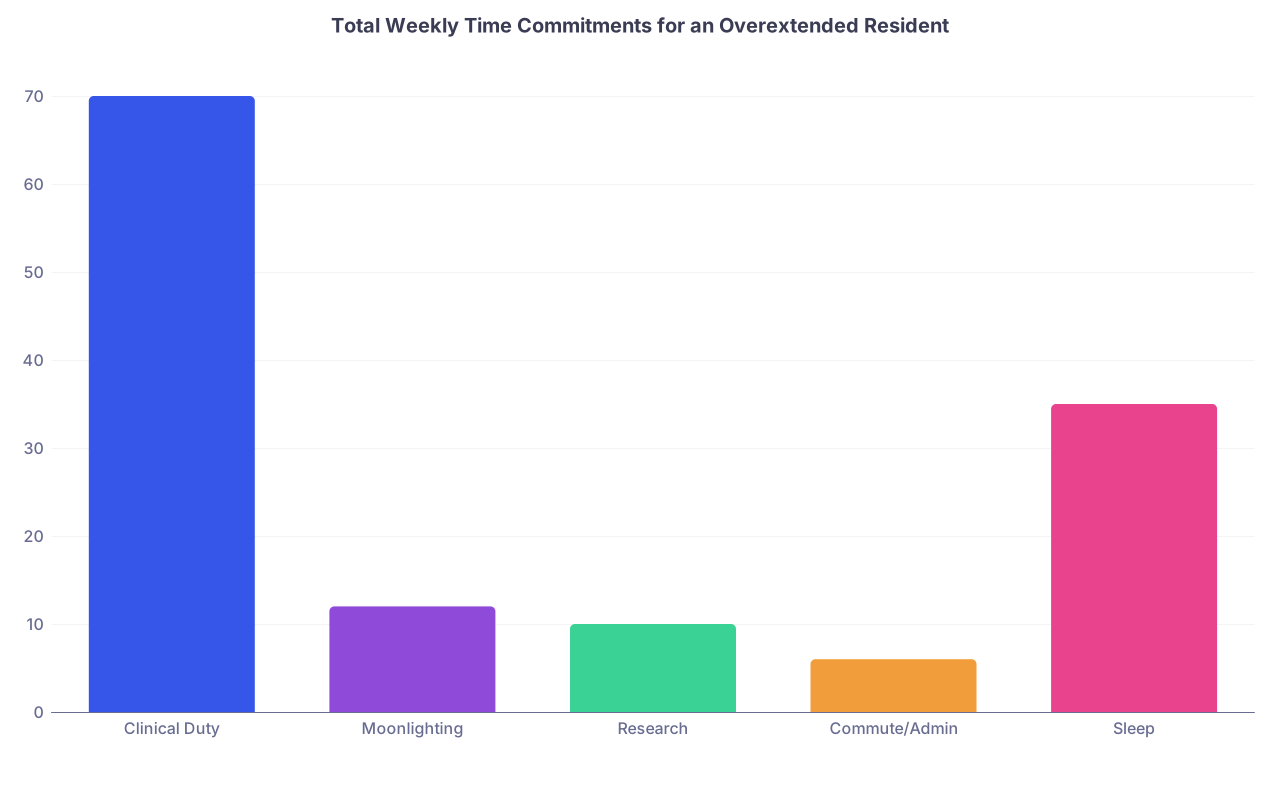
| Category | Value |
|---|---|
| Clinical Duty | 70 |
| Moonlighting | 12 |
| Research | 10 |
| Commute/Admin | 6 |
| Sleep | 35 |
That’s 133 hours accounted for. You have 168 hours in a week. That leaves 35 hours for everything else: eating, showering, talking to another human, exercise (if it still exists), errands, and staring at a wall trying not to cry.
ACGME compliance does not equal safety for you. Or for your patients. It just means your documented hours fit inside a regulatory box.
The mistake is thinking, “If it’s allowed, it’s safe.” That’s wrong. You have to set much tighter personal limits than the legal maximums.
Concrete Red Flags You’re Overcommitted
People in trouble rarely recognize it early. They call it a “rough block” or a “bad month.” Then 6 months go by.
Watch for these warning signs:
- You’re constantly working on research or moonlighting tasks while post-call instead of actually resting
- You’re too tired to study regularly for boards/in-training exams
- You keep telling yourself you’ll “catch up on rest” next week, next block, next year
- You’re behind on notes chronically and charting from home late at night
- You feel dread, not excitement, when you get emails from your PIs or moonlighting scheduler
- Your co-residents start joking that you’re “never off” or “always moonlighting”
If 3+ of those are true, your hours are wrong. You need to cut something before something breaks.
Protecting Yourself: Smarter Rules for Research
You don’t need to be anti-research. You need to be anti–time-wasting research.
Here’s how to avoid the classic traps:
1. Cap Active Projects
You are not a full-time research assistant. You are a resident.
A reasonable cap for most residents:
- 1–2 primary projects where you’re first or second author
- Maybe 1 low-maintenance side project (e.g., case report, QI with minimal extra work)
More than that, and you’re almost certainly diluting your impact and wrecking your schedule.
2. Demand Clear Structure Up Front
Before you say yes, get specifics:
- What’s the primary endpoint and question? (If they can’t say it in one sentence, that’s a problem.)
- Who is handling IRB?
- Who is doing stats? Is there a biostatistician on board?
- What’s the realistic target date for submission?
If the PI handwaves and says, “We’ll figure it out as we go,” then you, the trainee, will be stuck figuring it out. While on nights. During ICU. Don’t sign up for that.
3. Protect Study and Sleep Before CV Padding
Boards > pubs. Always. Fellowship directors will not be impressed with 15 posters if your board scores are weak or you barely passed on a retake.
Make a simple rule: if research starts consistently stealing time from board prep or core reading, you drop or defer a project. No debate.
4. Schedule Research Like a Clinic, Not a Background Task
If you treat research as “I’ll do it when I have time,” it bleeds into your worst hours—late nights, post-call haze, exhausted weekends.
Block it instead:
- One half-day every 1–2 weeks on a lighter rotation
- Strictly no major research tasks post-call
- No responding to non-urgent research emails after a certain hour
You’ll get more done in fewer, higher-quality hours. And you’ll actually remember your own data.
Protecting Yourself: Smarter Rules for Moonlighting
Moonlighting isn’t evil. But reckless moonlighting is.
Here are guardrails that actually work:
1. Set a Hard Monthly Cap
Don’t decide shift by shift. Decide at the start of the month:
- For most residents: 1–3 shifts per month is sustainable on average
- More than 4–5 shifts regularly? You’re playing with fire unless your main rotation load is unusually light and predictable
And once you hit your cap, you are unavailable. You’re not being a bad team player. You’re being a safe physician.
2. Respect Post-Call Reality
Non-negotiable rule: no moonlighting within 24 hours of a 24-hour call. I don’t care what the moonlighting coordinator says. Your nervous system is fried.
Also be honest about stretches like:
- 6 days in a row in a busy ICU + weekend moonlighting = your baseline is now “exhausted”
- Night float + extra night shifts = circadian chaos
You’re not a robot. Stop scheduling like you are.
3. Choose Safer Moonlighting Environments
Not all moonlighting is equal. Safer options:
- Settings similar to your main training environment
- Adequate backup (attending on call, clear escalation plans)
- Reasonable volume—it’s not a “deal” if you see 30 unstable patients overnight alone
High-risk for disaster:
- Solo coverage clinics with no supervision and complex patients
- Tiny EDs where you’re the only doctor on-site and everything comes through you
- Employers pushing scope beyond your training (“You can handle ICU admits alone, right?”)
If your gut is uneasy about the setup, listen to it.
4. Track Your True Weekly Hours
Don’t guess. Write it down.

| Step | Description |
|---|---|
| Step 1 | Estimate last week hours |
| Step 2 | Cut moonlighting or projects |
| Step 3 | Reduce by at least 1 shift or 1 project |
| Step 4 | Maintain with monthly recheck |
| Step 5 | Over 80 total with moonlighting and research? |
| Step 6 | Feeling tired and behind on studying? |
If your total “all in” hours are regularly >80–85, something has to go. You don’t get extra life points for suffering.
How to Say No Without Burning Bridges
One of the biggest reasons residents overcommit is fear. Fear of disappointing attendings. Fear of losing opportunities. Fear of missing extra money.
You can decline without detonating relationships. You just have to be direct and early.
For research:
“I really appreciate you thinking of me. Right now I’m at capacity with two ongoing projects and need to protect my board study time. I’d rather not commit and then drop the ball—if something opens up in 6 months, I’d love to revisit.”
For moonlighting:
“I’m going to cap my extra shifts at two per month to make sure I’m safe clinically and performing well in my program. I can take X and Y dates, but I need to pass on the others this month.”
The attending who punishes you for protecting patient safety and your own competence is not a mentor; they’re a liability.
Use Systems, Not Willpower
If you try to “just be better next month,” nothing will change. You need structure.
Simple systems that work:
- A running log of weekly hours (clinical + research + moonlighting)
- A personal max-hours/week rule (for example: total >80 → automatically decline new commitments)
- A quarterly “audit” of your CV vs. stress level—if your pub count is growing but you’re constantly exhausted, the cost is too high
One good visual:
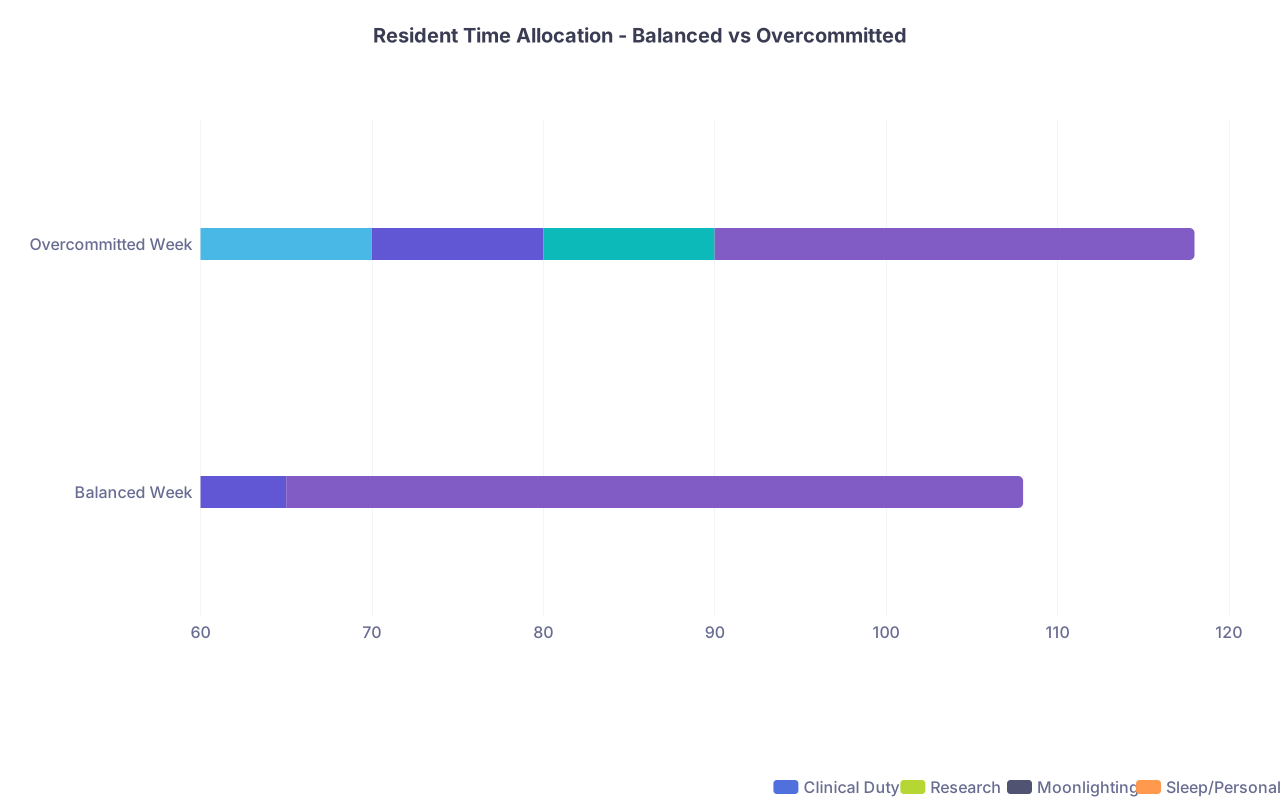
| Category | Clinical Duty | Research | Moonlighting | Sleep/Personal |
|---|---|---|---|---|
| Balanced Week | 60 | 5 | 0 | 43 |
| Overcommitted Week | 70 | 10 | 10 | 28 |
The second bar might look “productive” on paper. In actual life, it feels like drowning.
The Bottom Line: Where Hours Go Right
You don’t earn extra respect for destroying yourself. Behind every “superhuman” resident, there’s usually a cost you’re not seeing: failing boards, a wrecked relationship, chronic anxiety, or quiet regret.
Here’s what actually keeps you out of trouble:
- Treat all hours as real hours. Clinical, research, moonlighting, emails, commuting, calls—it all hits the same brain.
- Pick fewer, higher-yield commitments. One solid paper with a strong PI beats five half-dead projects. Two safe moonlighting shifts beat six miserable ones.
- Protect your core: sleep, boards, and clinical performance. If research or moonlighting start eroding any of those, you’re past the line. Pull back.
Your career is long. Your license is fragile. Your energy is not infinite. Don’t waste them flattering your own ego—or someone else’s—by pretending you can do everything.