The 24+4 rule is not a suggestion. Residents keep misreading it, and it is getting people hurt.
You would think “24 hours of in-house call plus up to 4 hours for transitions” is straightforward. It is not. Programs bend it. Chiefs miscount it. Residents rationalize it. Somewhere at 2:30 p.m. on a post-call day, everyone pretends the clock started later, or the rules “do not really apply to this rotation.”
I have watched residents nod along at orientation, then blow straight through the rule their first heavy call month. Not because they are lazy about rules. Because the details of 24+4 are easy to misinterpret when you are sleep deprived and trying to be a team player.
Let me walk you through the mistakes I see over and over, and how you avoid becoming the resident everyone quietly uses as “the example” when GME comes calling.
1. Starting the Clock at the Wrong Time
The most common error: residents start the 24-hour clock when it is convenient, not when it is correct.
The rule:
- 24 hours continuous in-house duty for direct patient care +
- Up to 4 additional hours for transitions of care only (no new clinical responsibilities)
The clock starts at the beginning of your continuous in-house duty period, not when “call actually got busy.”
Typical miscalculations I see:
“My call started at 6 p.m. but I was in the hospital since 7 a.m. for day work; I will count just from 6 p.m.”
Wrong. That is a 31-hour continuous duty period (7 a.m.–2 p.m. next day), not “20 hours of call.”“I signed out at 5 p.m., left for an hour, then came back at 6 p.m. for night float. So that break resets the duty clock.”
No. If the “break” is not a true rest period away from clinical responsibility (and usually ≥ 8–10 hours), you are risking violations. An hour to go home, shower, and come back? That is continuous duty with a commute in the middle.“Conference time does not count as duty hours, right?”
It usually does. If you are required to be there, the clock is running.
Here is the mental trap: you feel like “call” is separate from “the day,” so you treat them as two different chunks. ACGME does not. ACGME cares about continuous time in the role of doctor in the hospital.
Quick sanity check
If you answer “yes” to all three, your 24h clock started at that first “yes”:
- Were you in the hospital?
- Were you in your role as a resident (not a random visitor)?
- Could someone reasonably ask you to see a patient, write an order, or answer a clinical question?
If so, your duty hours started then. Stop pretending the overnight shift is separate when you have already been there all day.
2. Treating the “+4” as Extra Work Time
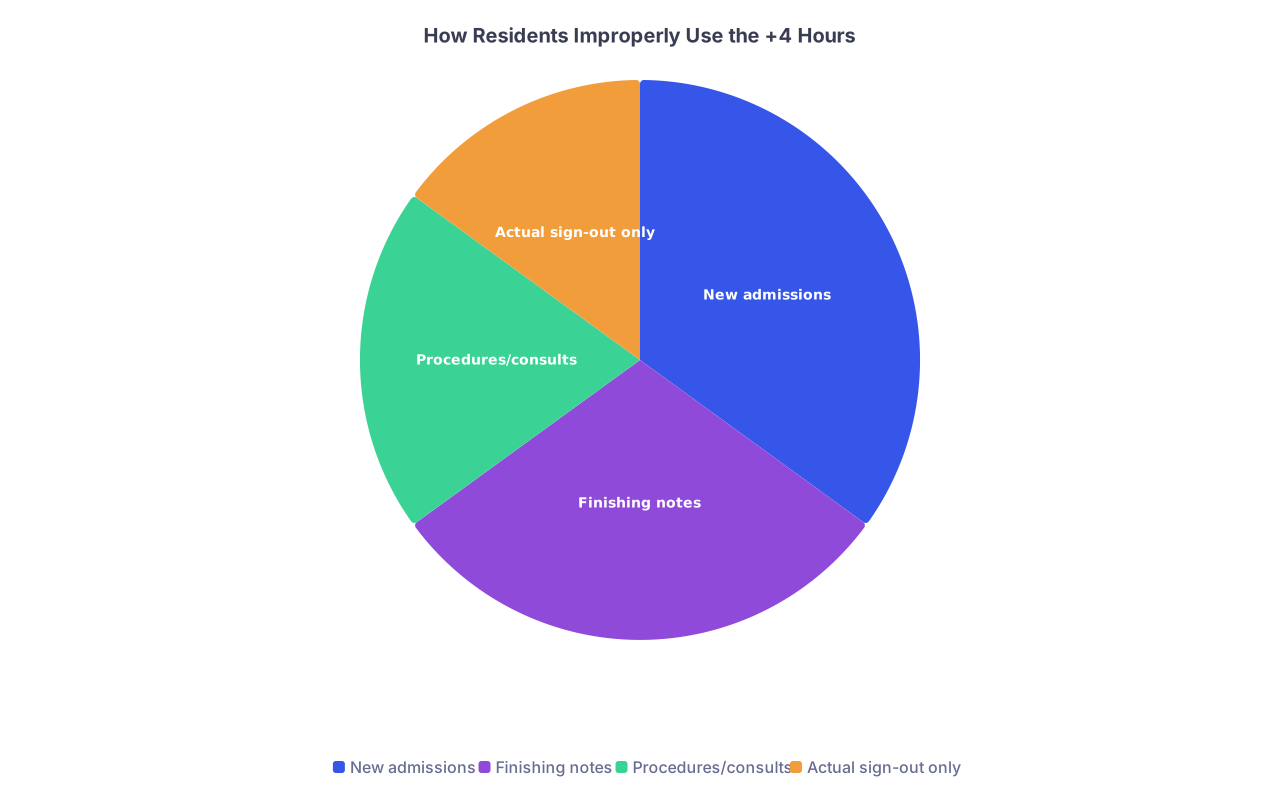
The 4 hours after the 24-hour period are for transitions of care only. Not for “just one more admission,” not for “can you help with this procedure,” not for “but the attending really wants you to see this consult.”
This is where programs and residents both get sloppy.
Common violations disguised as “normal culture”:
Post-call intern at hour 23:
“We just got an ED admit; do you mind picking it up? It is only one patient.”
That “one patient” turns the +4 from sign-out into active care. That is a duty-hours violation, no matter how nonchalantly it is presented.Senior resident at hour 24:
“Clinic is light today; just see a couple of follow-ups, then head out.”
Clinic is not a transition-of-care activity. Once you leave 24 hours, your only legitimate remaining time is to sign out your patients.ICU fellow saying:
“Stay to help with this intubation; you will never get this opportunity again.”
Educational value does not erase sleep deprivation. It just creates a pretty story for a root cause analysis later.
| Category | Value |
|---|---|
| New admissions | 35 |
| Finishing notes | 30 |
| Procedures/consults | 20 |
| Actual sign-out only | 15 |
If in the “+4” window you are:
- Admitting
- Rounding
- Calling consults
- Placing procedures (that are not part of immediate handoff)
- Running a code, except by pure emergency bad luck
…you are beyond what the 24+4 rule permits.
The +4 is a de-escalation zone. Wrap things up. Ensure safe handoff. Then go home.
If you are still doing real patient-care work at hour 27, that is not “being dedicated.” That is you, plus your senior, plus your attending, plus your program institutionalizing unsafe behavior.
3. Ignoring the 80-Hour Average and the 24+4 Interaction
Residents often treat 24+4 as if it exists in a vacuum: “As long as I do not exceed 28 hours, I am good.”
Wrong. Every 24+4 shift dumps a big load into your 80-hour rolling average. Repeat those without spacing and you blow the weekly cap.
Quick example:
- Four 24+4 calls in a 7-day span
- Each call day: 28 hours of duty
- You “just” show up the next day for a half-day clinic (another 4–5 hours)
| Day | Shift Type | Logged Hours |
|---|---|---|
| Mon | 24+4 call | 28 |
| Tue | Post-call clinic | 5 |
| Wed | Regular day | 12 |
| Thu | 24+4 call | 28 |
| Fri | Post-call half | 5 |
You are already at 78 hours by Friday afternoon without counting Saturday or Sunday. One casual “oh just cover for me for a few hours” and now you are violating 80 hours too.
The trap:
- Residents log fewer hours than reality to “keep the program out of trouble.”
- Chiefs create schedules that technically “look fine” on paper but do not reflect real work.
- People comfort themselves by saying “we average it over 4 weeks” while stacking call into weeks that would make any honest spreadsheet glow red.
The 24+4 rule is not permission to string four 28-hour days together in a row because “the four-week average is OK.” Bodies are not Excel sheets.
- Tracking your own real departure times, not the time that “sounds better” for MedHub.
- Being brutally honest about post-call reuse: if you keep staying for a “quick afternoon clinic,” you must count it.
4. Misunderstanding “No New Patients After 24 Hours”
This line in the rules gets abused constantly:
Residents must not be assigned additional clinical responsibilities after 24 hours of continuous in-house duty.
Residents and faculty twist that into:
- “No new patients after 24 hours… but you can help us ‘process’ this code outcome, finish the consult notes, and answer pages about the new admission we technically placed under the night float’s name.”
No. The intent is simple:
At hour 24, your capacity to safely manage new cognitive load is compromised. You can:
Hand off current patients
Clarify plans
Answer short questions that already arise from known patients
But you cannot:Take a fresh ED admit
Do the initial work-up of a new unstable patient
Go to clinic as the primary provider for a panel
Pick up additional cross-cover as if you were fresh
Yet I constantly see:
Attending: “We will put the new admit under my name; you just help ‘for educational value’.”
Still a violation if you are doing the resident work.Senior: “Night float will admit them formally. You just start the H&P, I will add them later.”
That is you admitting, just with paperwork gymnastics.
Remember the rule’s spirit: You are allowed to land the plane. You are not allowed to take off again.
5. Rounding and Notes: The Quiet Time Sink That Violates the Rule
Long rounds are silent killers for duty-hour compliance.
Here is how it plays out:
- Call starts: 7 a.m.
- Busy night, you are still putting out fires at 6 a.m. next day.
- Attending shows up 7:30 a.m., wants “teaching” rounds until 11 a.m.
- You finish notes, orders, discharge summaries, “just one more family update.”
- You leave at 1 p.m. “because the work had to get done.”
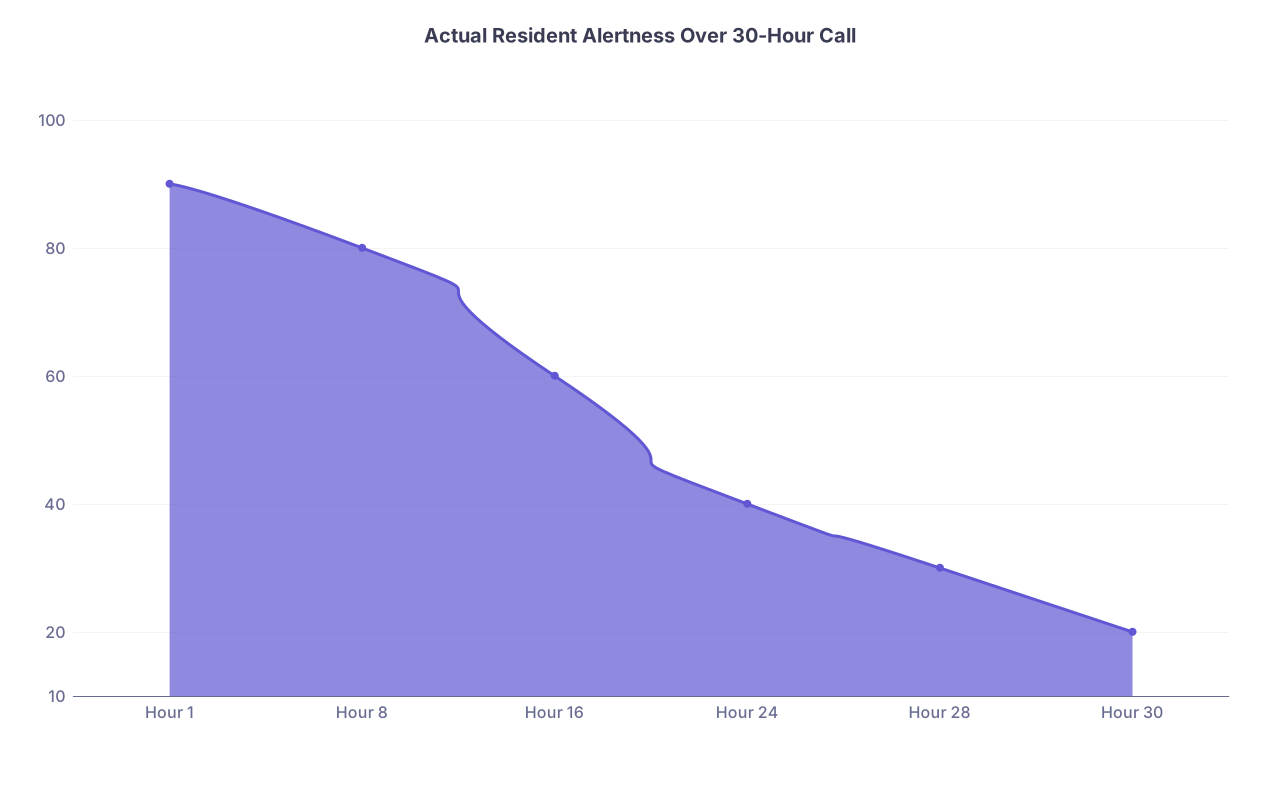
You think you did a 30-hour shift. You tell yourself “but rounds are mostly listening; it’s fine.”
It is not. Those last hours:
- You are making decisions about discharge meds at your lowest cognitive point.
- You are fielding pages that someone fresh could handle more safely.
- You are modeling to interns and students that staying after 24+4 “is what strong residents do.”
| Category | Value |
|---|---|
| Hour 1 | 90 |
| Hour 8 | 80 |
| Hour 16 | 60 |
| Hour 24 | 40 |
| Hour 28 | 30 |
| Hour 30 | 20 |
The mistake is thinking that if you are physically capable of finishing rounds and notes, you should.
How to avoid this:
- At hour 22–23, be explicit: “I will need to hand off remaining notes if we go past 24+4.”
- For non-urgent discharges, document on-call and let the day team finalize.
- Push back on “teaching” that clearly exists only to fill the attending’s schedule while you struggle to keep your eyes open.
Teaching is not teaching when the learner is too exhausted to form long-term memory.
6. Miscounting Home Call and “Just Staying Late”
Another recurring error: thinking the 24+4 rule only applies to classic in-house overnight call, and ignoring:
- “Home call” that is nonstop pages until 4 a.m.
- “Staying late” three or four hours beyond shift end, day after day.
The rule technically attaches to continuous in-house duty, but the spirit is about cumulative fatigue and safety. Residents often game their own perception:
“I was only in-house from 7 a.m.–11 p.m., then came in again at 5 a.m. That is not 24 hours straight.”
On paper, maybe. Physically, you got a 6-hour window that was mostly commuting, trying to sleep, answering calls, then returning.“I am on home call, so the hours do not count fully.”
Many programs undercount home call like this. GME and surveyors get very interested when every resident “miraculously” reports 79.5 hours each week with heavy home call.
You avoid this deception by asking yourself one blunt question:
Would I want a pilot in my condition flying a commercial plane right now?
If the answer is no, start treating those stretched “non-24” stretches with the same seriousness.
7. The Documentation Trap: Underreporting to “Protect the Program”
I have heard this sentence in at least three institutions:
“We do not put the real times into MedHub; we enter what they want to see so we do not get the program in trouble.”
This is how you end up with:
- GME believing your schedule is safe.
- Program leadership honestly thinking “no one is reporting violations, so our workload must be fine.”
- A resident making a catastrophic error at hour 27, with documentation suggesting they were well within rule limits.

Three common documentation mistakes:
Rounding departure time down
- Left at 1:40 p.m.? They log 1:00 p.m.
- That 40 minutes times dozens of shifts turns into huge underestimation.
Not counting “quick returns” or “just helping out for a bit” after going home
- Called back to the ED for a critical patient? That is duty time.
- Came back for an “important family meeting”? Same.
Failing to log administrative, mandatory teaching, or QI time
- If you are required to attend and cannot just opt out without consequences, it is duty hours.
The urge to “protect the program” is understandable. Everyone feels replaceable. Nobody wants to be “the complainer.”
But here is the ugly truth:
Underreporting does not protect your program. It protects the illusion that your workload is safe. Then when something breaks, it is your name on the chart.
8. Cultural Pressure: Confusing Professionalism with Self-Sacrifice
The 24+4 rule is crystal clear. Culture is not.
Subtle pressure phrases you should flag in your mind:
- “We all stayed late when we were interns. It is part of the job.”
- “If you were more efficient you would not have to stay so long.”
- “Do not log that as a violation; it will just create unnecessary work for everyone.”
- “You are not actually doing ‘work’ when you are just hanging around to see the case, so you do not need to count it.”
Every one of those is someone trying to normalize rule-breaking while avoiding responsibility. Residents absorb it because you want to be seen as strong, resilient, and “good to work with.”
But know this:
No one survives residency because they are uniquely able to bypass sleep physiology. They survive because the system either respects or ignores its limits.
If you consistently:
- Volunteer to stay late
- Pick up “one more patient” in the +4 window
- Take on extra sign-outs when you are barely coherent
…you are not just hurting yourself. You are shifting the normal for your whole team. Suddenly the intern who actually leaves at 24+4 looks “lazy,” when in reality they are the only one following the standard.

| Step | Description |
|---|---|
| Step 1 | Approaching 24 hours |
| Step 2 | Normalize overwork |
| Step 3 | More future requests |
| Step 4 | Reinforce boundary |
| Step 5 | Safer culture |
| Step 6 | Senior asks to stay |
You avoid the cultural trap by practicing a few short, repeatable lines:
- “I am at my 24 hours now; I can stay to hand off, but I cannot take new patients.”
- “I want to see that case, but I am already in my +4 window. I will catch the next one.”
- “For duty-hour accuracy, I need to log my actual departure time.”
Say it calmly. No apology. No long explanation. You are not negotiating. You are describing reality.
9. Practical Ways To Stop Misreading 24+4
You do not fix this with vague intentions. You need concrete habits.
Try these:
Time-stamp your day
- Write down or text yourself:
- Time you actually started patient duties
- Time your 24-hour mark hits
- Time you actually walked out of the building
- Write down or text yourself:
Set a silent alarm for hour 22 and 24
- Hour 22: start prioritizing handoff.
- Hour 24: no new responsibilities. You should already be landing the plane.
Pre-negotiate with your team at the start of the block
- “I follow the 24+4 rule tightly; I will always stay for safe sign-out, but I do not take new patients after my 24 hours.”
- Seniors who respect that up front are usually less pushy later.
Treat the EHR as evidence
- Check your note and order timestamps occasionally. If they show you actively working at hour 29, then your logged hours are fiction.
Use your GME office strategically
- Talk to them anonymously if needed. Good offices want accurate data and will back you more often than you think.
- If a specific rotation is chronically violating 24+4, it is not on you to personally “fix” it. Your job is to report it cleanly.

10. When You Are Already in Too Deep
Sometimes you read all this and realize:
“I have been doing this wrong for months.”
Fine. You start now.
Steps:
Stop falsifying your hours today.
- Enter accurate times from now on. No retroactive editing to “fix” the past.
Pick your line in the sand.
- For example: “After 24 hours, I do not take new admissions, period.”
- Or: “I never stay past 28 hours. If I am still there, I will call my chief and hand over.”
Talk to one ally.
- Another resident, chief, or faculty member you trust.
- Tell them explicitly: “I am trying to follow 24+4 properly; can you help reinforce that on service?”
Accept that some people will grumble.
- Let them. In six months, the same people will quietly text you when they are at hour 26 and do not know how to leave.
Key Takeaways
- The 24+4 rule is 24 hours of continuous in-house duty plus up to 4 hours for transitions only, not 28 hours of “anything goes.”
- The biggest errors are starting the clock too late, using the “+4” for real work, and underreporting hours to “protect the program.”
- Protect yourself and your patients by treating 24+4 as a hard safety boundary, documenting real hours, and refusing to equate professionalism with being endlessly available.