The way most residents swap call is dangerous—for your work hour compliance and for your license.
You think you are just helping a co-resident out. In reality, you may be quietly stacking violations that will show up on a duty hour report three months later with your name on top. I have watched residents get pulled into the PD’s office “just to talk about your hours” after one sloppy swap.
Let me walk you through the common traps so you do not become that example.
1. Treating Call Swaps Like Casual Favors Instead of Legal Events
This is the foundational mistake: treating call swaps as casual, verbal “bro deals” instead of formal schedule changes with real regulatory consequences.
What this looks like
- Saying “I’ll cover your Sunday 24, you take my Friday night?” in the workroom and never documenting it.
- Text-only agreements that never make it into the official schedule or duty hour system.
- Last-minute “I can’t make it, can you just sign in for me?” nonsense.
Here is why this is a problem:
The ACGME does not care what you texted.
They care what the schedule and logs show. If your name is on that call in the system, it is your hour, no matter what backroom swap you thought you did.Program leadership hates ghost swaps.
When your PD or chief gets an angry email from GME because your “official” schedule is noncompliant, “But I swapped with Alex” will not save you. They cannot defend hours they do not know about.Coverage ambiguity is a patient safety risk.
I have seen two residents both assume the other was covering a night after a half-baked text conversation. Nursing found out the hard way.
How to not screw this up
- Never consider a swap “real” until:
- It is updated in the official scheduling system, and
- A chief or schedule admin has explicitly approved it.
- Use program-approved channels (duty hour software, official swap forms, specific email threads). If your program says “no text-only swaps,” they mean it.
- Keep proof. Screenshot the approved schedule change or the confirmation email. When there is a question later, you need receipts.
If you remember nothing else: If it is not in the official schedule, it did not happen.
2. Ignoring the 8- and 10-Hour Turnaround Rules
This one burns residents constantly, especially on services that blur post-call and clinic.
The core rule (for most programs):
- You should have at least 8 hours off between duty periods,
- Desirable to have 10 hours, and
- Required time off after 24+4 call (often 14 hours or “leave by X time and no next day clinic,” depending on institution).
Call swaps are a perfect way to accidentally nuke those rules.
Classic violation patterns
- Back-to-back nights:
You swap into a Thursday night and forget you already had Wednesday night. Suddenly you are on 24+24 with inadequate rest in between. - Late call into early clinic:
You cover a colleague’s evening shift that runs late and still show up to your own 7 a.m. clinic without realizing you have barely 6 hours off. - Post-call clinic “just for a few patients”:
You agree to pick up someone’s clinic “since you are already here,” destroying your post-call relief.
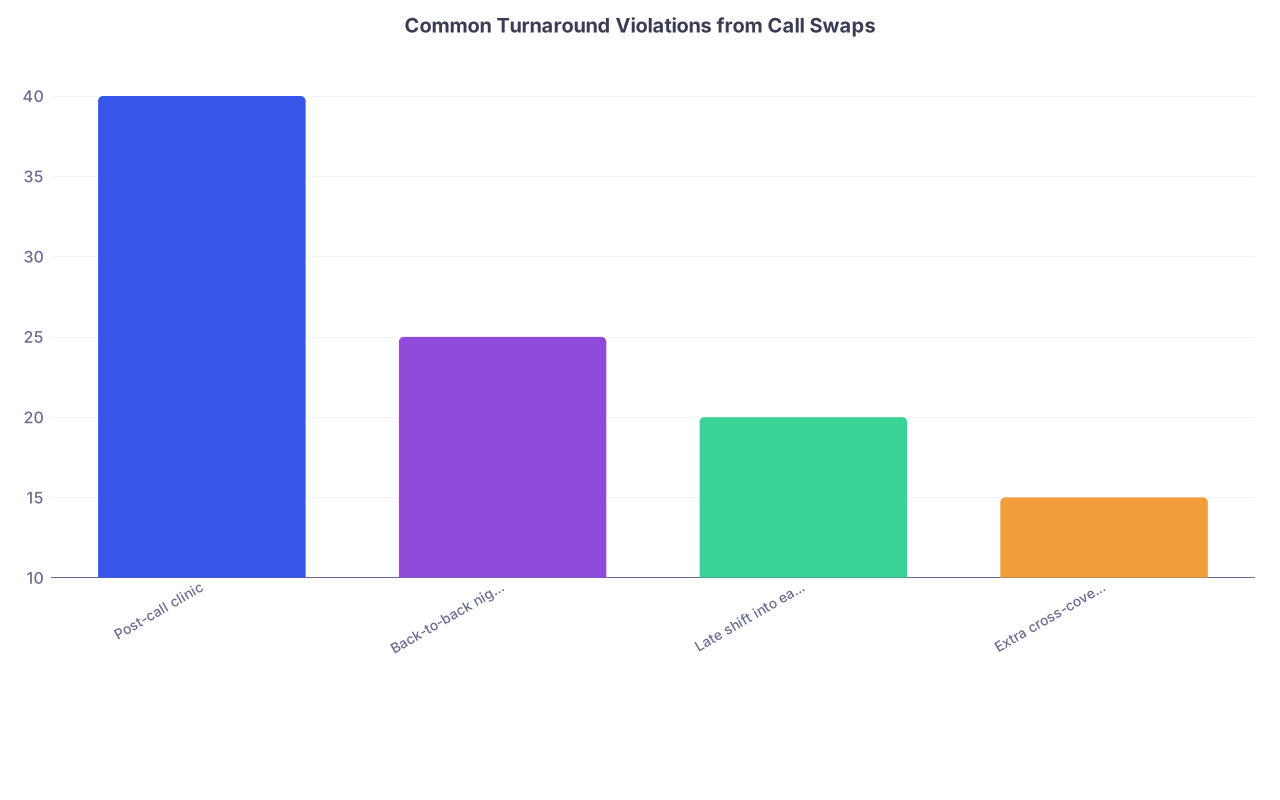
| Category | Value |
|---|---|
| Post-call clinic | 40 |
| Back-to-back nights | 25 |
| Late shift into early clinic | 20 |
| Extra cross-cover after call | 15 |
What you must check before any swap
When someone asks “Can you take my call?” your brain should automatically run through:
- What am I doing in the 12 hours before that shift?
- What am I scheduled for in the 12 hours after?
- Does this force me under 8 hours rest, or blow up my post-call protections?
If the answer is fuzzy, it is probably a bad swap.
Practical guardrails:
- If you are coming off a 24-hour call, you do not add:
- Morning clinic
- Noon conference you “must” attend in person
- Afternoon OR
Just go home. You are post-call for a reason.
- If a swap creates less than 8 hours between any two duty periods → treat it as an automatic no unless a chief signs off and documents it as a justified exception.
3. Failing to Add Up the 80-Hour Week (and the 4-Week Average)
Residents routinely destroy their 80-hour compliance with a single “helpful” weekend swap they did not count out.
You are not just trading one day for another. You are shifting the distribution of work in ways your brain is not tracking in the moment.
How the math bites you
You think: “I am around 65 hours this week—what is one extra 24?”
Reality: That “one extra 24” is never just 24:
- 2–3 hours pre-call
- 1–2 hours post-call sign-out and notes
- Delayed exit because of unstable patients
Your “24” is more like 28–30.
Do that twice in a block and suddenly your 4-week average crosses 80, and the report spits your name out in red.
| Scenario | Approx Weekly Hours |
|---|---|
| Baseline ICU week | 70 |
| Baseline + 1 overnight call | 94–98 |
| Baseline + 2 overnight calls | 115–125 |
| Light elective week | 45–50 |
| Elective + 1 weekend call | 70–75 |
Notice the pattern: an “extra” call on an already heavy week is almost always fatal for compliance.
The hidden trap: 4-week rolling averages
Programs do not just care about one week. Many track:
- 80 hours per week, averaged over 4 weeks
- Number of 24+4 shifts in 7 days
- Frequency of in-house call in 4-week blocks
So you might think, “I am on a chill elective next month, I will pick up extra call now.” Then your elective gets busier than expected, you sign out late, and suddenly your rolling 4-week average is over.
How to protect yourself
- Before accepting a swap, estimate your hours for that week:
- Heavy ward/ICU? Assume 70–80 hours baseline. Any extra call is high-risk.
- Clinic/elective? Maybe you have some room, but still do the math.
- Ask your chief (or check your system) where your rolling 4-week average stands. If you are already borderline, stop swapping in.
- Never accept an extra 24 on a week you already:
- Had another 24, or
- Have multiple late-admitting days.
4. Double-Booking Yourself Without Realizing It
You would be shocked how often this happens. Especially on complex schedules with:
- Rotations at different sites
- Home call mixed with in-house call
- Optional moonlighting layered on top
The resident assumes they are free. The system says otherwise.
How double-booking sneaks in
- Swapping into a home call day from one service while you are still on evening float for another.
- Covering call at a community site while you are still technically scheduled for cross-cover at the main hospital.
- Doing “unofficial” moonlighting and forgetting it still counts toward your 80 hours.

| Step | Description |
|---|---|
| Step 1 | Check current rotation |
| Step 2 | Check for home call or backup |
| Step 3 | Check moonlighting commitments |
| Step 4 | Do not swap |
| Step 5 | Confirm with chief |
| Step 6 | Any night duties? |
| Step 7 | Conflict with proposed call? |
Why this is dangerous
- Duty hour violations get multiplied.
Two overlapping responsibilities mean more “on duty” time than is actually safe or legal. - Coverage gets compromised.
Both services think they have a resident. They actually have half of one. - You look disorganized.
Chiefs remember the resident who “forgot” they were on backup. It will hurt you when schedule favors or letter requests come up.
How to avoid it
Before agreeing to any call swap:
- Check all of the following:
- Main schedule (rotation calendar)
- Call schedule (all sites)
- Backup / jeopardy assignments
- Moonlighting commitments (yes, they count)
- If anything is unclear: email the chief with “Can you confirm I am truly free on [DATE] if I take this call?”
If you are not 100% certain you are free, you are not free.
5. Trading Into More Intense Blocks Without Thinking Long-Term
Short-sighted swapping is another classic.
You help someone out now. You pay for it three months later when you are destroying yourself on back-to-back heavy rotations.
Common bad trade patterns
- Moving calls out of elective and into ICU/wards because “I am less busy now, I will just push it.”
- Accepting multiple swapped calls all in the same future block “because I will be at full strength then.”
- Stacking calls on fellowship-application months, Step 3 months, or interview-heavy months.
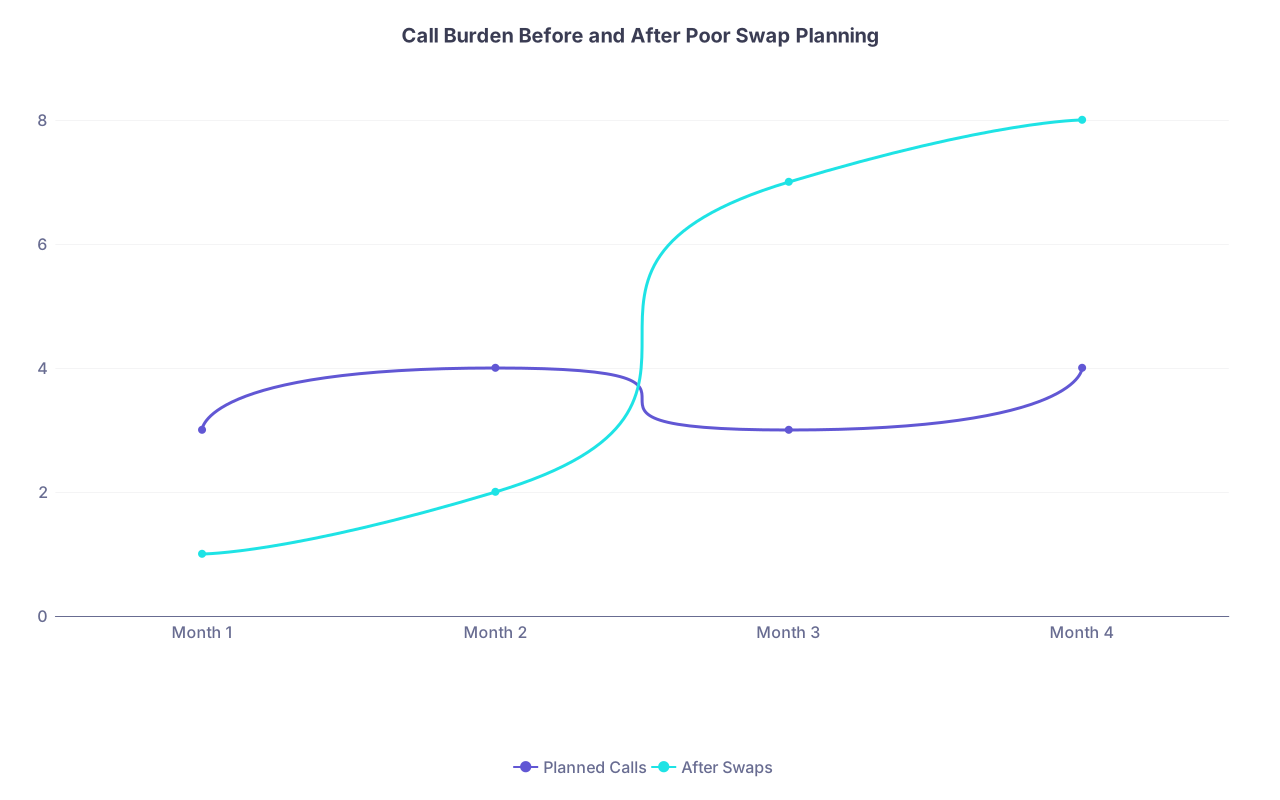
| Category | Planned Calls | After Swaps |
|---|---|---|
| Month 1 | 3 | 1 |
| Month 2 | 4 | 2 |
| Month 3 | 3 | 7 |
| Month 4 | 4 | 8 |
The result: your “easy” month disappears, your heavy month becomes brutal, and your ability to stay compliant plummets.
The long game
You must ask:
- What rotation will I be on when this swapped call actually happens?
- Will I already be exhausted that month?
- Am I piling calls directly before big exams or interviews?
Good rule of thumb:
Do not move calls from easy to hard months unless there is a serious reason.
And if you must, try to spread them instead of clustering.
6. Not Looping in the Right People (and Getting Burned Later)
One of the worst feelings: sitting in a semi-formal “meeting” with the PD and hearing, “Why did you not inform us of these swaps?”
You knew about them. Your co-residents knew. But the people who sign the compliance reports did not.
Who actually needs to know
Depending on your program:
- Chief residents – almost always
- Scheduling coordinator – often the one who updates official systems
- Rotation director – especially if the swap crosses rotations or sites
- GME office – for unusual or repeated exceptions

The dangerous assumptions
- “The night senior knows I swapped; that is enough.”
No. The night senior is not responsible for your duty hour records. - “We told the attending.”
Also not enough. Attendings are not updating your MedHub/New Innovations entries. - “The schedule will get updated eventually.”
Sometimes it does not. Then your logs and the official call list do not match.
Simple process that saves you
For every swap:
- Get written agreement from the other resident (email or message on official platform).
- Email the chief and scheduler with:
- Date being swapped
- Who is taking which call
- Rotations involved
- Do not assume it is done until:
- You see it changed in the official system
- Or you get explicit “Updated” confirmation
If that seems excessive, compare it with sitting through a formal remediation plan for “repeated” duty hour violations that were actually unrecorded swaps.
7. Logging Hours That Do Not Match Your Real Swaps
Here is a subtle but deadly mistake: your actual shifts and your recorded hours stop matching.
This is where programs get very nervous. Discrepancies make it look like either:
- You are underreporting to hide violations, or
- You are inflating or misrepresenting your hours.
Both are bad.
How this happens
- You swap a Friday overnight but forget to adjust your logged hours.
- You work a 28-hour call you were not originally scheduled for and still log “usual day 6–6.”
- You move a weekend call and then log “day off” because the official schedule never changed.
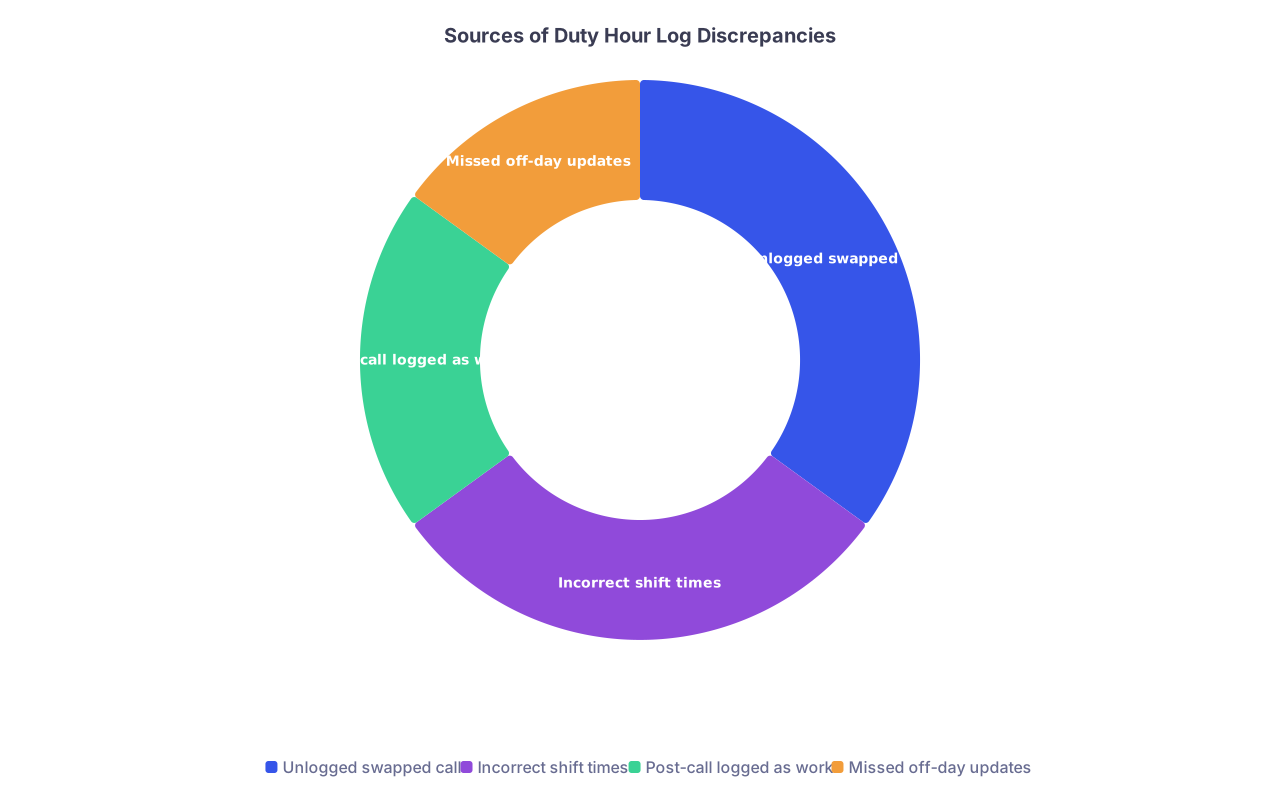
| Category | Value |
|---|---|
| Unlogged swapped call | 35 |
| Incorrect shift times | 30 |
| Post-call logged as work | 20 |
| Missed off-day updates | 15 |
Why leadership cares so much
ACGME and institutional auditors love mismatched data. It is their favorite red flag. When your printed schedule says one thing and your logs say another, someone is going to be asked to explain.
Spoiler: that someone is you.
How to keep your logs defensible
- After every call swap that goes through, immediately:
- Update your duty hour log for that day and the post-call day
- Make sure the two residents’ logs mirror the actual reality
- When in doubt, record what you actually worked, not what the old schedule says.
- Use comments in the duty hour system if available:
- “Covered call for [Name], approved by [Chief], schedule updated [DATE].”
If your logs match your real life and the swap trail is documented, you are on solid ground.
8. Letting Emotional Pressure Override Compliance and Safety
This one is uncomfortable, but I am going to say it clearly: your colleague’s emergency does not suspend duty hour rules or patient safety.
You are allowed to be a good human and respect limits.
Toxic patterns I have seen
- “Please, you are my last option, my family is in town.”
Guilt-tripping you into an extra 24 on an already horrendous week. - “Everyone else said no, you are the only one who can.”
Translation: everyone else saw the trap. You are the last person who has not. - “I will owe you, I swear.”
They will forget. Or repay you during a calm month. You are the one who will answer for this week’s violation.

How to respond without destroying relationships
You can say no without being a jerk. Use:
- “I checked—I am already near my 80-hour limit this block. I cannot safely take that call.”
- “This would give me less than 8 hours between shifts; chiefs have been clear about that.”
- “If chiefs approve an exception and update the schedule, I am open. But I cannot do it off the books.”
If someone gets angry with you for respecting safety rules, that is their problem, not yours.
The unspoken truth:
The same co-resident who pressures you now will not be sitting next to you when you are explaining a violation pattern to the clinical competency committee.
9. Forgetting “Home Call” Still Counts (And Can Wreck You Quietly)
Home call feels harmless because you are not always in the hospital. But for the ACGME and your program:
- Home call hours still count toward 80 hours.
- Frequent or intense home call can still trigger violations.
Residents routinely load up on home call swaps because “it’s just phone calls.” Then they get slammed with consults, admissions, or urgent returns to the hospital.
How home call swaps go wrong
- Taking extra home call on a heavy inpatient week.
You are already at 70+ hours in-house. Add 10–15 hours of real work at home, and suddenly your week is 85–90. - Covering home call for two services on the same night.
Each attending thinks you are “just backup.” You are actually drowning.
How to treat home call properly
- Before accepting a home call swap, assume:
- It will be busier than the person asking claims.
- You will be called in at least once.
- The hours will add up more than you expect.
- Log it honestly:
- Phone time + any call-backs to the hospital.
- No, you cannot magically compress it into “0.5 hours” because you were watching Netflix in between.
Respect home call. It can crush your 80 just as effectively as in-house call.
10. Not Building a Personal System for Call Swaps
The residents who avoid all of these mistakes do one thing differently. They treat call swaps like operations, not friendships.
They have a system.

| Step | Description |
|---|---|
| Step 1 | Receive request |
| Step 2 | Check schedule and duties |
| Step 3 | Estimate weekly and 4 week hours |
| Step 4 | Politely decline |
| Step 5 | Email chief and scheduler |
| Step 6 | Wait for formal approval |
| Step 7 | Confirm swap in official system |
| Step 8 | Update duty hour log after shift |
| Step 9 | Within limits? |
Minimum viable system you should have
- Personal calendar that mirrors your:
- Rotations
- Call nights
- Backup/jeopardy
- Moonlighting
- Quick hour estimator:
- Wards/ICU: count 12–14 hours per day
- Clinic: 9–10
- Call: 24–30 depending on your site
- Standard email template for swaps:
- “On [DATE], [Your Name] will cover [Other Name] for [Service/Call]. In return, [Other Name] will cover [DATE]. Please update schedule if approved.”
Stop improvising. The stakes are too high for that.
FAQ (Exactly 5 Questions)
1. If my co-resident and I agree on a swap but the chiefs forget to update the schedule, am I still responsible for violations?
Yes. You are still responsible for what you actually worked and for whether it complied with duty hours. If the schedule is wrong, that becomes a documentation problem on top of a potential compliance issue. This is why you must always:
- Confirm the change is visible in the official system, and
- Log your hours based on reality, not the outdated schedule.
2. What if saying no to a swap will seriously damage relationships with my co-residents?
It probably will not, if you explain it clearly and consistently tie your “no” to safety and rules, not to personal preference. The people who chronically guilt-trip others into unsafe swaps are usually already known to the group. Your job is not to enable their poor planning. Protecting your license, your health, and your patients comes first.
3. Can I ever exceed 80 hours in a week if I make it up the next week?
Only if your program explicitly operates under the “80 hours averaged over 4 weeks” model and accepts that some weeks will be higher. Even then, you should never casually exceed 80. High-hour weeks increase fatigue, mistakes, and scrutiny. Repeatedly relying on high/low swings to stay under the 4-week average is exactly the pattern that gets flagged in reviews.
4. Do moonlighting hours really count toward duty hour limits?
Yes. They absolutely do. Internal moonlighting (inside your institution) always counts. External moonlighting is usually required to be reported and counted if you are still a resident. Pretending those hours do not exist is one of the fastest ways to get labeled as unreliable with duty hour reporting.
5. What is the single safest rule of thumb for deciding on a call swap?
Use this: If I add this call, will I still have at least 8 hours between any two shifts, stay under 80 hours for the week (and over 4 weeks), and avoid stacking call on already heavy rotations? If you cannot confidently answer “yes” to all three, do not agree to the swap without explicit chief approval and documentation.
Key points you cannot afford to ignore:
- Call swaps are not favors; they are regulated schedule changes that can trigger real violations if mishandled.
- You must always check rest periods, weekly and 4-week hours, and future rotation intensity before agreeing to anything.
- If the swap is not documented in the official system and reflected in your duty hour logs, you are setting yourself up for trouble.