No, you’re not weak. If you’re tired in residency, that means your physiology is working, not failing.
The myth that “good residents don’t feel tired” is one of the most damaging, unscientific, and stubborn lies in medical culture. It’s also directly contradicted by every decent study on sleep, performance, and physician well‑being from the last 30 years.
Let’s dismantle it.
The Origin of the “Never Tired” Myth
This myth didn’t come from data. It came from ego, nostalgia, and bad incentives.
I’ve heard the exact same lines at three different hospitals, across two countries:
- “When I was a resident, we did 120 hours a week and we were fine.”
- “If you really love medicine, you won’t feel it.”
- “The strong ones just push through.”
Here’s what those statements actually mean in plain language:
- “We didn’t measure the damage, so we pretended there wasn’t any.”
- “I’m confusing adrenaline and fear with resilience.”
- “I’ve normalized dysfunction so deeply I think it’s a personality trait.”
None of this matches what we know from physiology and sleep research. The data are brutal and consistent: long hours, sleep deprivation, and circadian disruption absolutely hammer cognitive performance, mood, and health. You’re supposed to feel that.
If you don’t feel it, that’s the abnormal thing. That’s either denial, dissociation, or stimulants talking.
What the Data Actually Show About Resident Fatigue
Let’s look at actual evidence instead of hallway bravado.
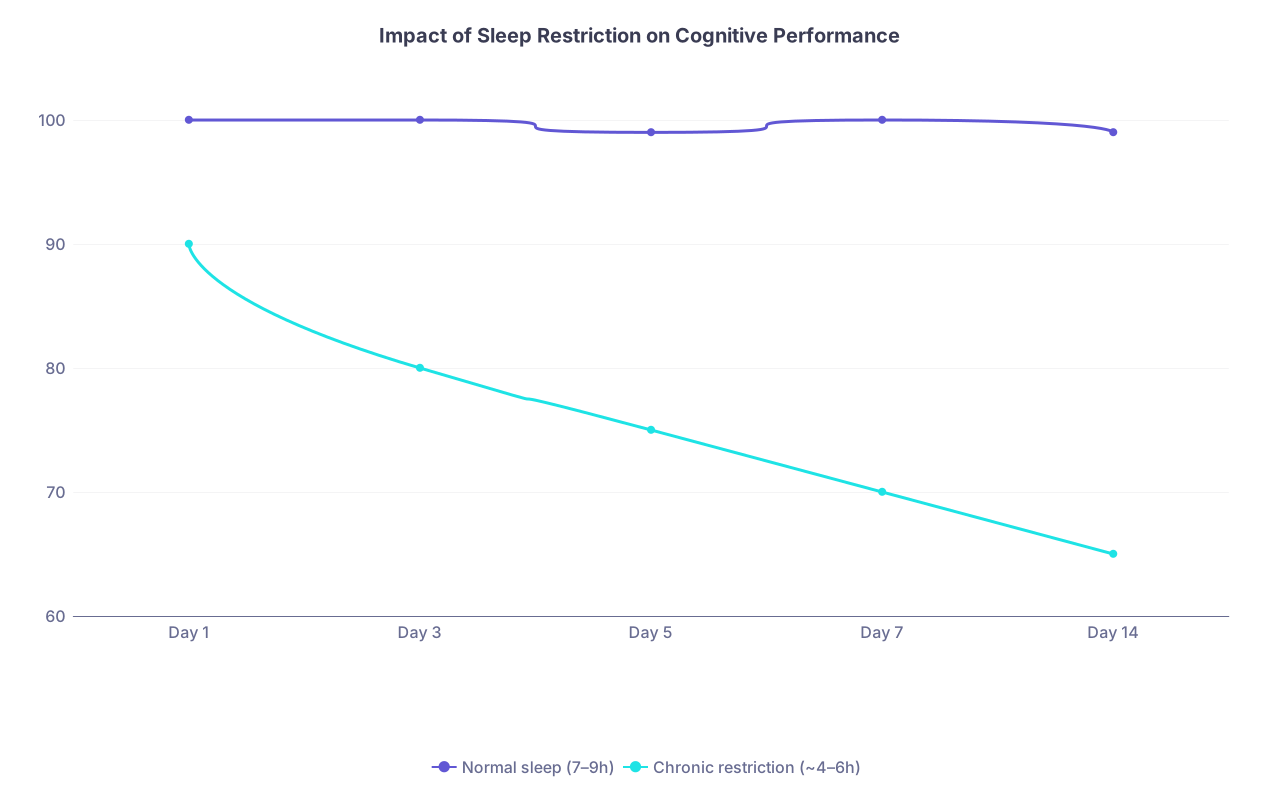
| Category | Normal sleep (7–9h) | Chronic restriction (~4–6h) |
|---|---|---|
| Day 1 | 100 | 90 |
| Day 3 | 100 | 80 |
| Day 5 | 99 | 75 |
| Day 7 | 100 | 70 |
| Day 14 | 99 | 65 |
This mirrors findings from classic sleep research: with chronic partial sleep deprivation, performance drops to levels similar to being legally drunk, and people consistently underestimate how impaired they are.
Now layer on residency:
- The 2014 NEJM FIRST trial on surgical residents: interns on flexible (i.e., longer, more variable) duty hours had higher rates of burnout and job dissatisfaction without clear patient benefit. More hours did not make them “stronger;” it made them more burnt out.
- Studies on extended shifts (>24 hours) show increased medical errors, more needle sticks, more car crashes post-call. These are objective outcomes, not vibes.
- A BMJ study found physicians working more than 55 hours/week had significantly higher risk of depression and anxiety.
These are not subtle effects. They’re not “maybe in some people.” They’re big, population-level shifts.
Your fatigue isn’t personal weakness. It’s a predictable response to a workload that exceeds the capacity of a human nervous system to stay sharp nonstop.
Fatigue vs Weakness: Two Completely Different Things
Here’s the part that gets twisted: feeling tired is not the same as being unable to function, show up, or care.
You can be:
- Profoundly exhausted
- Still competent, careful, and caring
- And simultaneously fully aware that this is not sustainable or healthy
That’s not weakness. That’s insight.
Weakness is ignoring risk, refusing to ask for help, or pretending you’re invincible while your performance is quietly falling apart. The people bragging that they “don’t get tired” are often exactly that: impaired and unaware.
I’ve seen PGY-2s fall asleep standing in the OR, their shoulder slowly gliding down the doorframe. I’ve watched a medicine intern type the same progress note sentence three times in a row at 4:30 a.m., then stare at it, confused why the note looked “too long.” These weren’t lazy or fragile residents. They were high performers being pushed well past normal human limits.
They still cared. They were still trying. And they were very obviously tired.
That’s not pathology. That’s physiology screaming, “Enough.”
Your Brain on Residency Hours
Strip away the white coat and you’re left with a human brain running on basic neurobiology.
What sleep restriction does, over and over in the literature:
- Lowers attention and vigilance
- Slows reaction time
- Impairs working memory (the “hold three things in your head while you write orders” skill)
- Worsens mood regulation and emotional reactivity
- Increases risk‑taking and reduces error recognition
Translation to residency: you’re more likely to miss subtle changes, skip steps in procedures, forget to pend the lab you definitely meant to order, snap at a nurse, or sign out something poorly because your brain simply doesn’t have enough fuel.
And the kicker: your subjective sense of “I’m doing okay” doesn’t track the objective impairment. People adapt to feeling lousy and call it baseline.
That’s why the myth that “strong residents don’t feel tired” is so backwards. The residents who don’t feel tired after brutal stretches are not superhuman. They may be:
- Running on chronic sympathetic overdrive
- Using caffeine or stimulants to numb fatigue perception
- Completely detached from their own body’s signals
None of that is strength. It’s just a different kind of risk.
How Many Hours Before You Break? (Spoiler: Less Than the System Uses)
Let’s be concrete for a moment.
| Weekly Hours | Typical Effects on Residents |
|---|---|
| 40–50 | Tired some days, generally recover with weekends |
| 60–70 | Chronic fatigue, sleep debt, more errors late in week |
| 80+ | Persistent exhaustion, mood changes, cognitive decline |
| 90–100 | High burnout risk, health consequences, safety issues |
These are approximate, but they match both the literature and what residents actually report when they’re honest and not posturing.
Now compare that to common call patterns: 28‑hour calls, q4 or q5 stretches, night float plus continuity clinics. The system is routinely operating residents at the “we already know performance is impaired” level and then acting shocked when residents feel destroyed.
You are not failing to “tolerate” the workload. The workload is exceeding what humans reliably tolerate safely.
The Culture That Equates Suffering With Strength
The myth isn’t just accidental. It’s reinforced on purpose, because it serves the system.
Here’s how it plays out on the ground:
- A senior brags they “did 30 hours and then hit the gym.”
- An attending dismisses a resident’s fatigue with “this is what you signed up for.”
- A program director subtly praises the people who never say no and labels them “hardworking,” regardless of how ragged they look.
Meanwhile, residents who:
- Ask to go home post-call when it’s technically allowed
- Admit they’re too tired to safely take on something extra
- Or show any sign of being human
…get tagged as “not resilient” or “not a team player.” That label sticks. It affects letters, opportunities, how attendings speak about you behind closed doors.
Make no mistake: this is a control mechanism, not a performance metric. If everyone admitted how exhausted they truly were, a lot of current scheduling practices would be indefensible.
The system benefits from the myth that “strong” equals “never tired.” So it keeps repeating it.
Feeling Tired Is Data, Not a Diagnosis
Here’s the reframing you actually need:
“Feeling tired” is not a verdict on your moral character. It’s a data point about your current physiological state.
Good residents use data.
If you’re exhausted, a competent response is not, “I guess I’m weak.” It’s:
- “I need to slow down and double‑check my orders.”
- “I’m going to ask a co‑resident to look at this plan with me.”
- “This is my second 28‑hour shift in 4 days; my margin for error is lower.”
That’s professionalism. You’re factoring your own limitations into your clinical reasoning. Same way you would factor in renal function before giving contrast.
The residents who scare me are the ones who insist they’re “fine” at hour 26 and refuse backup. That’s not toughness; that’s denial mixed with impaired judgment.
No, Caffeine and Hustle Culture Don’t Fix This
There’s a whole subculture that tries to “optimize” around this reality: more caffeine, energy drinks, elaborate sleep hacks, productivity systems.
Some help at the margins. None meaningfully change core physiology.
| Category | Value |
|---|---|
| Well rested | 8,8 |
| Sleep deprived no caffeine | 3,4 |
| Sleep deprived with caffeine | 6,4 |
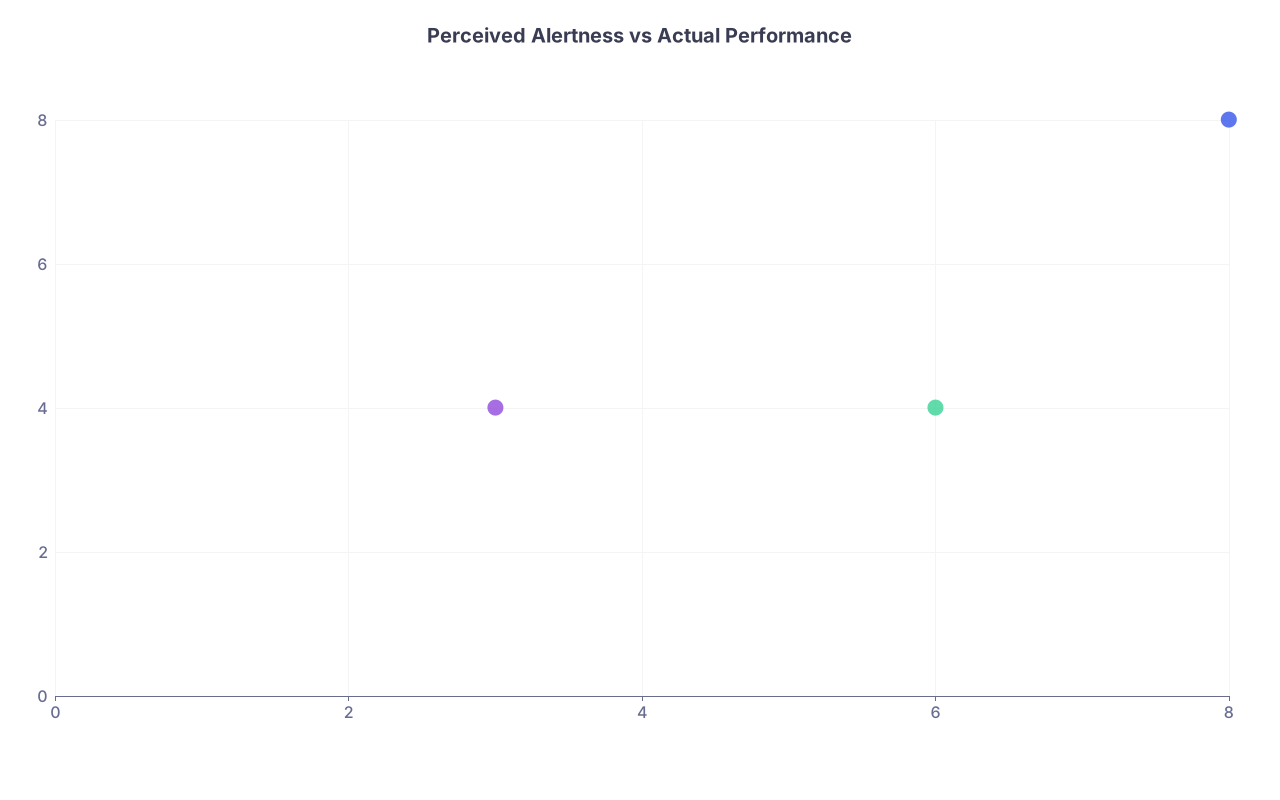
Roughly what studies show:
- Caffeine bumps perceived alertness more than it restores actual performance.
- People on caffeine while sleep deprived feel “good enough” while still missing more signals, making more errors, and reacting more slowly.
- Stimulants don’t restore the complex cognitive functions you need for nuanced clinical decisions.
So yes, have your coffee. Just don’t pretend it turns a physiologically exhausted brain into a fresh one. It doesn’t.
What Strong Residents Actually Do
Set aside the macho noise. Residents who perform well over time share very different traits than the caricature of the invincible machine.
They:
- Admit fatigue early instead of waiting until they crash.
- Build micro‑systems to reduce cognitive load when they’re tired: templates, checklists, standardized workflows.
- Speak up when they’re not safe, even if it’s uncomfortable.
- Use their team—nurses, co‑residents, pharmacists—because they know solo heroics are overvalued and overrated.
I’ve watched one PGY‑1 on nights quietly tell the nurse, “Hey, I’ve been up 24 hours now and my brain is mush. If I forget something or seem off, please double-check me.” That wasn’t weakness. That was one of the safest behaviors I saw all year.
Compare that to the resident who rolls their eyes, insists they’re fine, and then misses a K of 2.6 on a lab they ordered.
Who’s “stronger” there? The answer’s obvious.
System vs Individual: Where the Real Problem Lives
You can’t “mindset” your way out of chronic sleep deprivation. No amount of grit makes 28‑hour calls physiologically smart. This is a systems problem being shoved onto individuals.
But while the system is slow to change, you’re still stuck living inside it. So the move is:
- Stop internalizing systemic dysfunction as personal inadequacy.
- Treat your fatigue as a predictable, evidence‑based consequence of the structure.
- Protect your performance and sanity within that reality as much as you reasonably can.
This is not about becoming soft. It’s about refusing to pretend you’re a robot when your brain is screaming otherwise.
When Fatigue Crosses the Line
There’s normal, predictable, “this job is hard” tired, and then there’s collapse.
Watch yourself for the following:
- You’re making repeated small mistakes (orders, doses, missed tasks).
- You feel emotionally flat or detached from patients consistently, not just at 3 a.m. occasionally.
- You’re having intrusive thoughts like, “If I get into a car crash on the way home, at least I’ll sleep.”
- You stop caring about errors because you’re too numb to feel alarmed.
That’s not garden‑variety tired. That’s a danger zone—for you and for patients.
At that point, the “I must be weak” story becomes actively harmful. It keeps you from raising your hand when you absolutely should. It keeps you in the game when you’re no longer playing safely.
Saying, “This is too much; I need help,” is actually what a responsible, strong clinician does. Full stop.
The Bottom Line
Let me be blunt.
If residency hours and call schedules did not make you tired, that would be abnormal. You’re not weak for feeling exhausted; you’re working as designed in an environment that routinely ignores design specs.
Three key truths to walk away with:
- Feeling tired in residency is physiology, not failure. Every solid study on sleep and performance says you should feel what you’re feeling.
- “Good” residents aren’t the ones who never feel tired; they’re the ones who recognize fatigue, compensate for it, and speak up when they’re not safe.
- The myth that strong residents don’t get tired exists to protect a broken system, not to improve patient care—or your performance.
You’re not weak. You’re human. That’s not a bug in this job. It’s the only reason patients can trust you.