
It’s 5:45 a.m. You’re driving to the hospital after a soul-crushing overnight “short call” that somehow turned into 28 hours. In MedHub or New Innovations, you dutifully logged 24 hours, plus an hour for “transition of care.” You know that’s fiction. Your senior knows. The chief knows. And the program director? They definitely know.
Yet nobody says a word.
Let me walk you through how that game is actually played from the other side of the table—how program directors (PDs), chiefs, and attendings quietly enforce duty hour rules when it suits them… and how they bend them when it doesn’t.
The Official Rules vs. the Real Operating System
On paper, ACGME duty hour rules are simple:
- Max 80 hours/week averaged over 4 weeks
- One day off in 7, averaged
- In-house call no more than 24 + 4 hours
- 10 hours off between duty periods (with “flexibility”)
- Caps on night float, in-house call frequency, etc.
Programs build beautiful schedules around this. Spreadsheets. Color-coded block diagrams. Presentations for the CCC and PEC.
Behind closed doors, the real operating system is different: a mix of culture, soft pressure, strategic under-reporting, and quiet course correction when the numbers start to look bad.
Here’s the part nobody tells you as a resident: PDs care about three things more than your exact number of hours:
- Staying out of ACGME trouble
- Keeping the hospital happy
- Not burning through residents so fast that the program gets a reputation
Actual hours? That comes after those three.
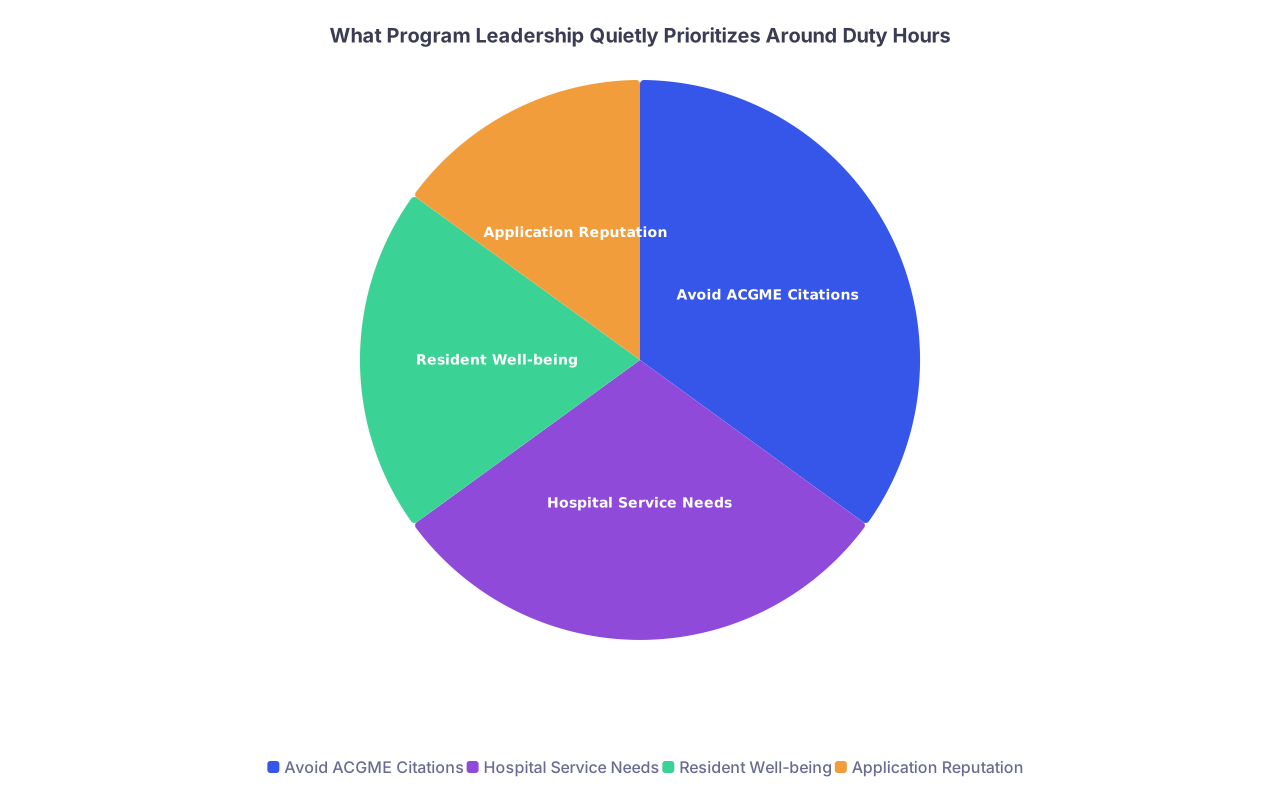
| Category | Value |
|---|---|
| Avoid ACGME Citations | 35 |
| Hospital Service Needs | 30 |
| Resident Well-being | 20 |
| Application Reputation | 15 |
How Duty Hours Are Really “Monitored”
Let me be blunt: PDs know your reported hours are not perfectly accurate. Many of us have literally sat in a meeting and said, “If they were truly entering exact times for pre-rounding and post-call notes, this would be 100 hours a week.”
We still use the data. Just… adjusted through a mental filter.
The Timekeeping Systems: MedHub, New Innovations, Etc.
From your side, it’s a tedious web portal. From the PD’s side, it’s a dashboard with:
- Average hours per week per rotation
- Which rotations generate the most “violations”
- Time between shifts
- Which PGY level is getting hammered
What actually triggers attention is not your individual long week. It’s patterns.
If one resident logs 82 hours a week once? Nobody cares. If a whole rotation shows 82–88 hours consistently over four weeks? Now that rotation director is getting a polite but pointed email.
I’ve watched this exact scenario in a big-name IM program: the wards team was consistently logging 85–90 hours, mostly because the interns actually entered their real post-call departure times for a few months. At the next faculty meeting, the PD didn’t say “We’re breaking ACGME rules.” They said, “The data suggests this rotation is out of compliance. Fix the workflow or we’ll be forced to change the call model.”
Notice the framing: not “we’re overworking them,” but “the data suggests.” That’s deliberate. It leaves room to “normalize” the data without formally admitting the culture is the real issue.
How Chiefs and PDs Pre-Filter the Truth
Here’s a quiet trick you might have lived through:
You get an email from the chiefs:
“Hey everyone, our ACGME survey window is coming up. Please make sure your duty hour logs are accurate and reflect our compliance with 80 hours/week and days off.”
Read that again. That’s not “log your actual hours.” That’s “make sure what you log matches the story we’re supposed to tell.” It’s code.
I’ve seen chiefs pull residents aside: “If you’re staying late just to finish notes, don’t log that as clinical duty. Log your expected time, not the time you’re just sitting charting.” That’s how you turn a 15-hour day into a 12-hour day on paper.
Some programs are more blatant. At one surgical program, the chief literally said during orientation:
“If you’re logging more than 80 on average, you are out of compliance.”
Not the program. You. That flips the blame from structure to individual behavior, which is absurd, but incredibly effective at shutting down honest reporting.
How Programs Quietly Enforce Duty Hours (When They Want To)
Now, it’s not all villainy. There are PDs who take duty hours seriously. You just need to understand what levers they actually pull when they mean business.
Rewriting Rotations From the Top
The PD has one real power tool: the block schedule.
When duty-hour data, complaints, and ACGME surveys all point to the same rotation, that’s when the hammer drops. I’ve seen:
- “Q3 overnight call” converted to night float
- Mandatory post-call days strictly enforced with emails to attendings
- Admissions caps lowered on paper and enforced by hospitalists or nocturnists
- Extra swing shifts or “admitter” residents added to spread the pain
Here’s the quiet part: they time these changes strategically.
They don’t overhaul a brutally non-compliant rotation two months before the ACGME site visit. They do it six months after they barely dodge a citation, once they can claim they “identified an issue and took action.”
The story for ACGME becomes: “We noted an area of concern and modified the call system. Since implementing X, Y, Z, logged duty hour violations have dramatically decreased.”
It’s survival, not altruism.

Weaponized “Wellness”
Programs have started branding duty-hour adjustments as “wellness initiatives.” Sometimes that’s legit. Sometimes it’s a rebranding of forced ACGME compliance.
Example I watched up close:
- Residents on ICU were logging 90-hour weeks, with multiple 28+ hour “24+4” shifts.
- ACGME survey that year was ugly: multiple residents selected that duty hours weren’t respected.
- PD and chair had a moment of panic, because a citation on ICU would hit their marketing and fellowship pipelines.
Solution? They rolled out:
- “Night team restructuring focused on wellness”
- New policies: “No new admissions after 20 hours into a shift”
- A wellness committee with free pizza and a few yoga classes
Actual driver? Staying off ACGME’s radar.
The structural changes were helpful, yes. But the timing and messaging were about optics as much as outcomes. Residents got some relief. The program got cover.
Selective Crackdowns
Another insider move: PDs choose what to enforce.
They might be aggressive about:
- Post-call days (“I don’t want to hear about anyone staying past noon post-call”)
- No more than X nights in a row
- Mandatory days off on ambulatory blocks
But quietly ignore:
- Pre-rounding that starts 30–60 minutes before your “official” start time
- Staying late to “help the team” on bad call nights
- Logging a full day off when you still came in for half the day for a family meeting or clinic
They enforce what’s easy to show in a spreadsheet. They bend what lives in the gray zone of “professionalism,” “education,” and “service.”
That gray zone is where a lot of your extra hours live.
How They Bend the Rules Without Saying It Out Loud
Now let’s talk about the bending. The work-arounds. The stuff that never goes in an email.
The “Just Don’t Log It” Culture
You’ve heard variations of this:
- “If you stay to finish your notes, that’s on you, not duty hours.”
- “You can pre-round from home; that isn’t duty time.”
- “You’re welcome to attend this optional teaching session on your post-call day.”
Those statements are not neutral. They’re not accidentally vague. They are intentionally constructed to keep certain hours off the books.
Pre-rounding from home is the classic example. If you’re spending an hour before arriving:
- Reviewing all labs and imaging
- Pre-writing notes
- Calling family members
- Messaging consultants
That’s work. But culturally, many programs pretend it’s not—because counting it would blow up their duty-hour compliance overnight.
I watched one cardiology-heavy IM program “solve” early-morning chaos by telling seniors: “Pre-chart at home and come in at 6:30 instead of 5:30.” They advertised this as a win. Nobody recalculated duty hours. They just silently extended the workday into your bedroom.
“Voluntary” Work That Isn’t Voluntary
Education is the other loophole.
Programs will:
- Hold optional evening board review after your shift
- Expect you to show up on your day off for M&M if you’re presenting a case
- Run mandatory “scholarly activity” meetings over lunch that actually require prep time
- Encourage you to come in “just for this one procedure” on your golden weekend
Official stance:
“Educational activities don’t necessarily count as duty hours if they are voluntary and not required for patient care.”
Real stance:
“If we say it’s voluntary but your evaluation and reputation depend on participating, we’re going to pretend it doesn’t count.”
Residents feel the pressure. They show up. They don’t log it. The program stays miraculously clean on paper.
Creative Labeling and “Reclassification”
When programs get really nervous, they start to reclassify hours.
I’ve seen:
- “Research time” being labeled as non-clinical and not tracked in duty hours, even when research residents are taking home call or answering patient portal messages
- “Jeopardy” days technically assigned to a non-clinical rotation, so the hours get hidden under an easier block
- Lunch-conference time not counted as duty hours on outpatient rotations (which is nuts—you’re physically there in a mandatory educational activity)
One surgical program went a step further. They suddenly shifted several residents to a “fellows” status on certain rotations to claim they weren’t fully under resident duty-hour caps for specific services. On paper? Compliant. In reality? The same bodies doing the same work with a different label.
| Real Activity | How It Gets Framed |
|---|---|
| Pre-rounding from home | “Professional preparation” |
| Staying late to finish notes | “Personal time management” |
| Optional evening teaching session | “Voluntary education” |
| Coming in on day off for a procedure | “Career-building opportunity” |
| Jeopardy coverage on clinic day off | “Schedule flexibility” |
Where PDs Actually Draw the Line
Despite all of this, most PDs aren’t cartoon villains. The good ones genuinely do not want you dangerously overworked. They’re juggling pressure from:
- Hospital administration that wants bodies on the wards
- ACGME that wants pretty data
- Applicants who read Reddit and know which programs are malignant
- Faculty who trained in the pre-duty-hour era and think you’re “soft”
So where do they actually step in decisively?
True Safety and PR Disasters
Two things scare PDs:
- A sentinel event (bad patient outcome) linked to fatigue
- A resident publicly blowing the whistle (ACGME complaint, social media, news)
If a patient is harmed and there’s even a whisper that an exhausted resident missed something because of unsafe hours, leadership reacts. Fast. Suddenly:
- Extra backup is added
- Strict post-call rules are enforced
- Chiefs are told not to guilt residents into staying late
- Wellness initiatives get funding
Is it reactive and self-protective? Yes. But that kind of event is where bending the rules stops being cute and starts being a liability.
The ACGME Survey and Site Visits
There’s a reason PDs get visibly tense around ACGME survey season.
If your program has even a hint of a duty hour citation risk, you’ll see:
- Reminders to log hours “accurately and on time”
- Chiefs explicitly telling you not to “game the system” (which is ironic, given everything else)
- A sudden push for days off to be honored
- Attendings being told not to schedule “optional” extra clinics or rounding on protected time
Before site visits, I’ve seen mock interviews where PDs literally script how residents should talk about duty hours:
“Focus on how we respond when issues arise.”
“Emphasize that you feel safe reporting concerns.”
The survey and site visit are the only times when the program can’t fully control the narrative. So they try to pre-load your talking points.
How to Survive This System Without Getting Crushed
You can’t single-handedly fix residency culture. But you can play this game smarter.
Be Honest Enough to Protect Yourself
If you’re regularly working 90–100 hour weeks on a service, and you’re logging 75 to “be a team player,” you’re lying to yourself more than to the program. That’s how burnout creeps in and becomes normalized.
I’m not going to tell you to log to the minute every time. You’d get pressure quickly in some places. But if a rotation is consistently abusive, someone has to reflect that in the logs, or nothing will change.
The residents who quietly started logging 85–90 in that IM service I mentioned? They forced the ICU and wards to change. Not with angry emails. Just with boring, annoying data the PD couldn’t ignore once it was a pattern.
Use the Right Channels—Strategically
The cultural reality:
- Complaining constantly to everyone = ignored as “that resident”
- Going nuclear straight to ACGME = scorched earth, maybe helpful, often messy
- Quiet, consistent documentation and escalation = change with less blowback
Who actually listens when data + safety + burnout align?
- The PD who cares about their reputation and accreditation
- A strong APD (associate PD) who actually meets with residents and isn’t just a figurehead
- Chief residents who aren’t fully co-opted by leadership
Bring specifics:
- Approximate hours by week
- Number of days off missed
- Concrete examples of leaving post-call at 5 p.m.
- Any patient care or safety near-misses tied to fatigue
It’s harder to dismiss specifics than vague “we’re overworked” gripes.
Don’t Internalize the Guilt
One of the quietest, most effective tools programs use is guilt.
“If you go home now, your co-intern is going to drown.”
“If you log those hours, our rotation will get in trouble.”
“We all did this; it’s just how you learn.”
You’re not obligated to sacrifice your health to cover for structural problems. That doesn’t mean abandoning your team. It does mean refusing to see unsafe hours as a personal failing.
If you are hitting the 80-hour line regularly, it’s not because you’re slow. It’s because the system is misdesigned or understaffed. PDs know this, even if some won’t say it out loud.

| Step | Description |
|---|---|
| Step 1 | Resident Logs Long Hours |
| Step 2 | Pattern Seen in System |
| Step 3 | Chief Reviews Reports |
| Step 4 | Quiet Chat With Resident |
| Step 5 | Talk With Rotation Director |
| Step 6 | Adjust Caps or Call Schedule |
| Step 7 | Encouraged to Log Less or Be Efficient |
| Step 8 | Report Improvement to ACGME |
| Step 9 | Single Resident or Whole Rotation |
What I’d Tell You If We Were Sitting in My Office
If you were sitting across from me as a resident, tired and frustrated, here’s what I’d say without the committee-speak:
- Yes, most programs bend duty hour rules. Some just hide it better.
- Your PD likely cares more than you think, but they’re chained to forces you rarely see: hospital CFOs, department chairs, ACGME politics.
- Honest, consistent logging is one of the few tools residents actually have that leadership can’t fully spin away. Use it when a rotation is truly unsafe.
- Protect your own line. When you’re too tired to be safe, speak up—even if the culture shames you for it. A “weak” resident who goes home alive and intact is stronger than a “hero” who slowly disintegrates.
You are not imagining the disconnect between the glossy “we care about wellness” brochure and the 6 a.m. to 9 p.m. reality on wards. That gap is real. It exists in almost every program.
Learning to see that clearly—and to act strategically inside it—is part of surviving residency with your sanity and integrity intact.
FAQ
1. Can I get in trouble for honestly logging >80 hours?
You shouldn’t, but in some cultures you’ll get side-eye or subtle pressure. If you’re the only one logging high hours on an otherwise “clean” rotation, they’ll frame it as a you problem. If multiple residents log similar hours and you can tie it to structural issues, you have more protection and leverage.
2. Is it ever okay to under-report my hours?
Ethically, you should log your real work time. Practically, many residents fudge small amounts to avoid constant “violations” for minor overages. What I’d push you to avoid is systematically under-reporting truly unsafe weeks. That’s how nothing ever changes.
3. What’s the safest way to raise duty hour concerns?
Document first—rough logs, screenshots, calendar entries. Then talk to someone with actual influence who isn’t hostile: a trusted chief, APD, or PD. Frame it around patient safety and sustainability, not just “we’re tired.” If your program has a history of retaliation, use confidential channels (anonymous surveys, GME office, ACGME reporting) and coordinate with co-residents so you’re not isolated.