
You’re nine months into internship. It’s 6:10 am, you’re in the workroom pretending to pre-round, but really you’re staring at the new block’s call schedule someone just emailed out.
Your co-intern who shows up late, disappears post-call, and documents like a raccoon with a keyboard somehow landed three golden golden weekends in a row and a string of Q5 calls.
You? Three Friday calls, two Sunday nights, and a post-call “mandatory teaching” on your one decent day off.
And when you scroll the list, the pattern hits you like a truck: people who are tight with the chief… mysteriously “balanced,” “fair,” “optimized.” People who keep their head down and do the work… mysteriously “needed for coverage.”
You’re not imagining it.
Let me walk you through what’s actually happening behind the scenes when chiefs “make the call schedule” — and why some people reliably get better shifts.
How Call Schedules Actually Get Made (Not the Story You Were Told)
Here’s the official story chiefs tell interns at orientation: “We use an algorithm / fairness system / ruleset to make the schedule. We try to distribute nights, weekends, and holidays equally. Tell us your requests and we’ll do our best.”
Now here’s what really happens in most programs.
First, there’s a skeleton. A few constraints:
- ACGME rules (duty hours, day-off requirements).
- Service requirements (ICU needs X bodies, wards need Y).
- Faculty demands (certain attendings refused to work with post-calls on specific days).
- Institutional stuff (clinic days that can’t be moved, conferences, etc).
Then the chief opens the Excel sheet or the clunky web scheduler and starts plugging in names. And this is where the pretense of pure “fairness” evaporates.
Almost every chief I’ve known or worked with does some version of this:
- They protect the truly vulnerable first: someone with a new baby, serious medical issue, or major family event they personally know about.
- They protect the people they trust: the residents who show up, don’t make drama, and make the chief’s life easier.
- They then “spread the pain” across everyone else, using fairness as a loose guideline — not a law.
- They punish, quietly, the people who create chaos: constant complainers, unreliable residents, those who burned them before.
No one writes this down. You will never see it in a policy. But that’s the actual hierarchy of priorities in most real call schedules.
The Chief’s Real Job: Protecting the Program (and Themselves)
You think the chief’s job is to protect residents.
The program thinks the chief’s job is to protect the program.
The chief thinks their job is to survive the year with minimal disasters, keep the PD happy, and not destroy their own chances for a good fellowship or job.
So when they open the schedule, they’re not asking, “How do I make this perfectly fair?” They’re asking:
- How do I keep the worst fires from starting?
- Who can I count on to not implode when I give them a rough stretch?
- Who’s already on thin ice with the PD or faculty?
- Who will email the PD if I cross them?
- Who will actually show up and cover if someone calls out?
You know who gets better shifts? The people who make those questions easy.
Not always the nicest. Not always the smartest. Almost never “the hardest worker” in the naive sense. It’s the residents who reduce risk for the chief.
The Quiet Power of Reputation: What Chiefs Say When You’re Not in the Room
Let me be blunt: by the time chiefs are making your second or third block schedule, they already have a mental label on you.
Good, neutral, or problem.
You’re in one of those drawers. And that drawer decides how flexible the rules become in your favor.
When chiefs and attendings talk — and they absolutely talk about you by name — it sounds like this:
“Can you move Maria to nights? She’s solid, she’ll handle it.”
“Don’t put Jason alone on cross-cover. Remember last time?”
“I’d rather have Priya on that Sunday call; she always swaps if someone’s in a pinch.”
“That guy? He’ll complain to the PD if you don’t give him what he wants.”
Those comments shape your life more than any documented policy.
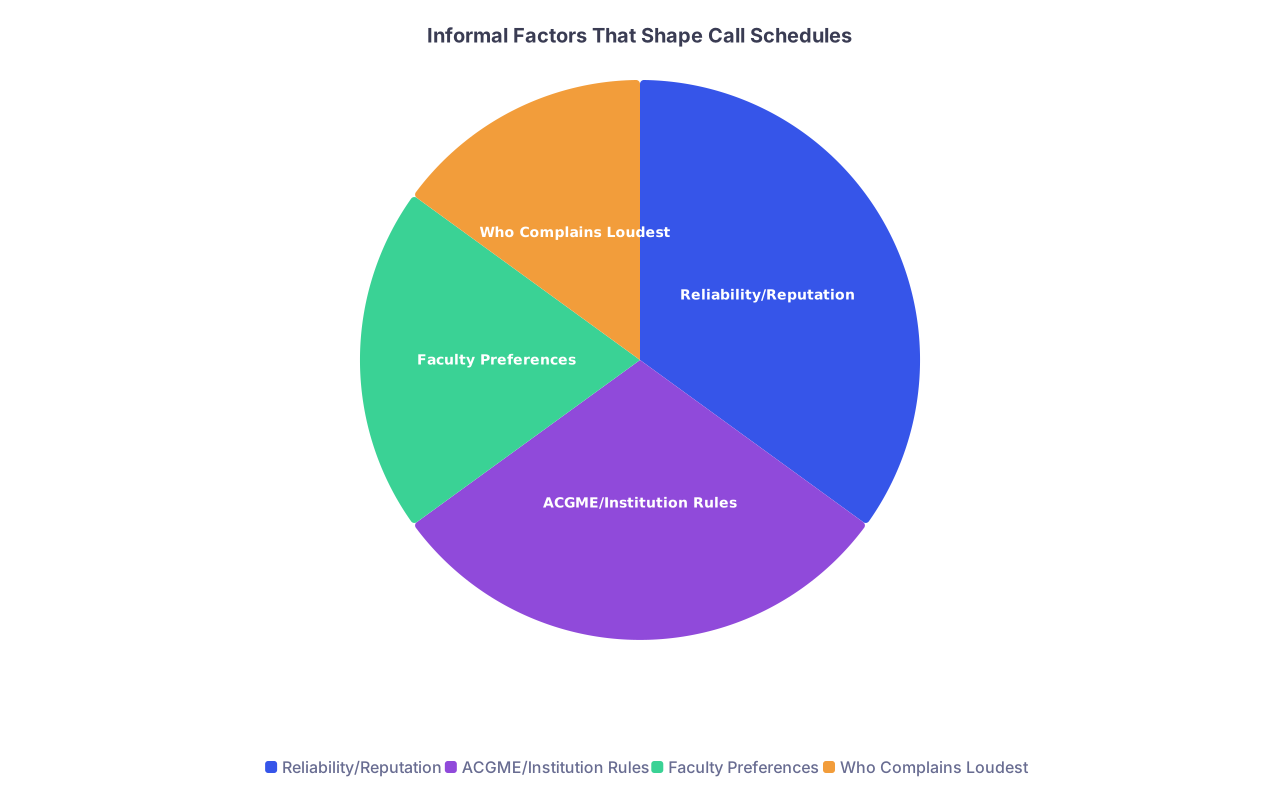
| Category | Value |
|---|---|
| Reliability/Reputation | 35 |
| ACGME/Institution Rules | 30 |
| Faculty Preferences | 20 |
| Who Complains Loudest | 15 |
Notice what’s at the top. It isn’t “fairness.”
Requests, Favors, and Who Actually Gets Them Granted
On paper, requests are first-come, first-served or limited per person.
That’s cute. Reality is messier.
Here’s the unwritten triage most chiefs use when they see a request:
- “Is this a real reason or just a preference?” Huge difference between “sister’s wedding, I’m in the ceremony” and “friend’s birthday party.”
- “Has this person come through for me or the team before?” Did you cover an extra night when someone’s dad was in the ICU, no drama?
- “Is this the 5th time they’re asking for ‘one little change’ this year?” Chronic askers get marked. Chiefs remember them.
- “If I deny this, how much headache will it cause me?” Some people escalate everything. Chiefs know exactly who they are.
- “If I approve this, who pays the price — and will that person explode?”
This is why you see miracles for some residents and brick walls for others.
The chief will almost always take a hit for someone they trust, like, or owe. They will rarely die on a hill for the perpetually difficult.
Why Some Mediocre Residents Get Cush Shifts
You’ve seen it. Residents who aren’t that strong clinically, not that fast on notes, not that beloved by attendings… but their schedules are somehow… gentle.
This is usually not accidental.
Let me tell you the kinds of “mediocre but protected” residents that get favorable treatment:
- The one with powerful connections: son/daughter of a faculty member, or recommended strongly by someone the PD loves.
- The one who social-engineered early: grabbed coffee with the chiefs, joined scheduling committee, became “friendly” in a way that feels convenient more than genuine.
- The one who's flaky but charming: late sometimes, but everyone laughs with them, not at them. They apologize well. Chiefs know attendings won’t go nuclear even if they’re annoying.
- The one with a narrative: new baby, sick parent, major documented hardship. Chiefs are human. They bend reality more for these residents.
Is this fair? No.
But residency is not a controlled lab experiment. It’s a messy workplace with humans making judgment calls under time pressure.
The more you pretend it’s meritocratic and perfectly fair, the more blindsided you’ll be.
Who Gets Hammered with Bad Shifts (and Why)
The residents who quietly get crushed by the call schedule usually fall into a few buckets.
The Quiet Workhorse
You show up. You’re capable. You don’t complain. You don’t push back when you’re assigned extra patients. The chief subconsciously learns: “I can dump more on them and nothing blows up.”
That’s not respect. That’s exploitation dressed up as trust.
The Chronic Complainer
Ironically, the person who complains all the time does not necessarily get better shifts. They get labeled as “difficult.” The chief does the minimum required by policy, but beyond that? No extra help. They’re not going to invest political capital to help someone who drains them daily.
The “Invisible” Resident
You are always technically fine. No disasters, but no one remembers a single shift where you stood out. You did not introduce yourself to the chiefs. You don’t show face at resident events, you leave quickly post-call. You basically don’t exist in their mind outside of a name in a cell. Invisible people rarely get special consideration. You get whatever is left that satisfies the spreadsheet.
The Unreliable
Showed up late a few times. Missed a handoff. Called out “sick” suspiciously around big exam weeks. Canceled a swap at the last minute. Chiefs have one priority with you: risk containment. They’ll cluster you in places where, if you implode, the damage is manageable. That usually means worse shifts.
How Schedules Drift Over the Year: The Cumulative Effect You Don’t See
Call schedules rarely stay static. Swaps, sick calls, emergent coverage — the board is constantly being rewritten.
And I’ve watched this pattern play out block after block:
- The same 4–6 “reliable” residents quietly pick up last-minute shifts.
- The same 2–3 “fragile” residents almost never get asked, because everyone is afraid they’ll burn out or blow up.
- The same 2–3 “protected” residents somehow have “pre-existing conflicts” every time something ugly needs coverage.
Over time, those micro-inequities accumulate.
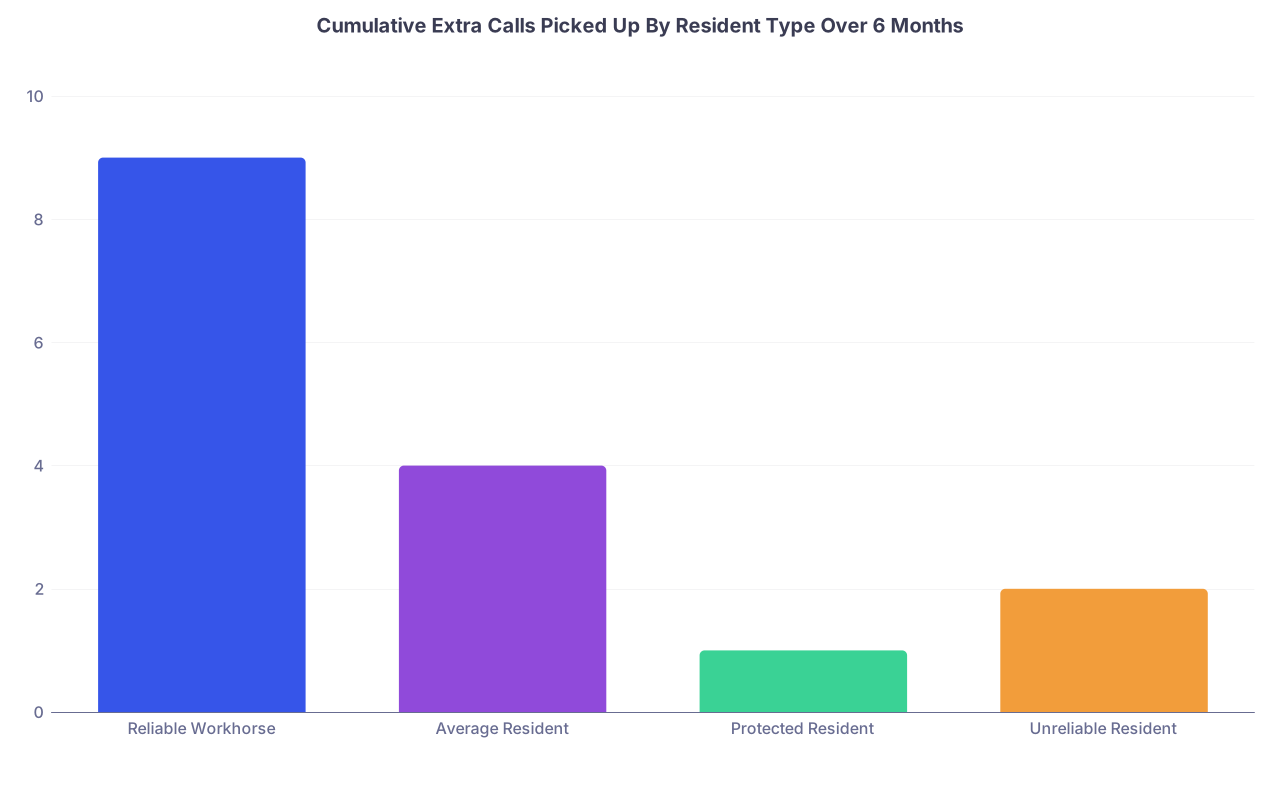
| Category | Value |
|---|---|
| Reliable Workhorse | 9 |
| Average Resident | 4 |
| Protected Resident | 1 |
| Unreliable Resident | 2 |
You don’t notice the pattern in month one. You absolutely feel it by month eight — in your sleep debt, your mood, your resentment.
The system rewards those who push back selectively and punishes those who always say yes. Not because chiefs are malicious, but because they’re managing chaos and gravitate toward the path of least resistance.
How Chiefs Talk to Each Other: The “Do Not Screw This Person” List
There’s another level to this mess: chief-to-chief handoffs.
Every year, the outgoing chiefs debrief the incoming ones. Some of that is benign: “These rotations always run short in January,” “This attending hates post-calls on clinic days.”
But then there’s the resident rundown.
I’ve heard versions of this so many times:
- “You cannot screw over Alex. PD loves them. Just don’t.”
- “Be careful with Sam. Parents know the department chair.”
- “If you short-change Nina on her vacation, she will go straight to GME. Handle her by the book.”
- “You can lean on Rob to help with coverage. He'll rarely say no.”
- “Do not put Chris alone on nights in the MICU. Patient safety issue.”
Those sentences shape the baseline you start from before you even prove yourself to the new chiefs. They’re inheriting a political map of your class.
That’s why a second-year with a mediocre reputation from intern year still can’t get a decent holiday, even after “improving.” The story about you is sticky. You’re working against last year’s narrative.
What You Can Actually Do Without Becoming a Sycophant
Let me be clear: I’m not telling you to kiss up to chiefs or accept abuse. I’m telling you which levers actually move the schedule needle and which are a waste of oxygen.
1. Make Yourself Low-Risk, Not Invisible
Chiefs like people who lower their anxiety. That doesn’t mean being a silent martyr. It means:
- You show up on time, you communicate clearly, you don’t disappear.
- If you have a tough stretch, you tell them early: “Hey, these back-to-back nights plus clinic are brutal. Can we tweak something next block?” Calm, neutral, early.
- When you cover a shift for someone, you do it cleanly — no last-minute drama, no passive-aggressive commentary drifting back to the chief.
You want your name associated with “handles business, tells me before things explode.”
2. Use Your Requests Strategically
One of the fastest ways to lose chief goodwill is weaponizing “requests” like they’re Amazon returns.
Be selective and specific:
- Ask for what actually matters (weddings, major family events, Step 3, fellowship interviews).
- Put it in writing early.
- Offer something: “I can take an extra Sunday call later in the block if helped with this one.”
You’re signaling you understand the tradeoffs. Chiefs respect that. They remember it.
3. Build a Real, Not Cringey, Relationship
I don’t mean becoming their best friend. But you can stop treating them like a faceless admin bot.
Small moves matter:
- When they’re on the floor with you, ask one or two real questions about fellowship, their year as chief, what actually makes their life harder or easier.
- If they fix something for you once, you say: “I know that probably made someone else’s life harder. Thank you for helping me with that.” You show you understand the cost.
You’re not manipulating. You’re making it easier for them to see you as a human they want to help, not just a name in Excel.
4. Learn When (and How) to Push Back
The resident who gets walked on all year rarely gets “rewarded” at the end. They just get walked on more.
But there’s a right way to push back.
Bad version:
All-caps email at 11 pm to all chiefs and the PD: “THIS IS UNFAIR. I’M ALWAYS GETTING SCREWED.”
Good version:
One-on-one, calm: “I’ve noticed over the last three blocks I’ve had X nights and Y weekends, which is more than the others. Is there something I’m missing? I’d like to make sure it’s more balanced going forward.”
You’re not accusing. You’re documenting. Chiefs know you’re keeping receipts. That often leads to quiet correction over the next few blocks.

| Step | Description |
|---|---|
| Step 1 | See New Schedule |
| Step 2 | Document Hours and Violations |
| Step 3 | Email Chief With Specifics |
| Step 4 | Escalate To PD or GME |
| Step 5 | Compare To Prior Blocks |
| Step 6 | Request Meeting With Chief |
| Step 7 | Ask For Future Adjustments |
| Step 8 | Truly Unsafe or Just Unfair |
| Step 9 | No Fix |
There’s a path. Use it thoughtfully.
The Dark Side: When Politics Cross the Line
Some of what I’ve described is just human nature under pressure. But sometimes the politics become toxic.
You’re in dangerous territory when you see:
- A resident clearly targeted with consistently worse schedules after a personal conflict with a chief or attending.
- Protected categories (pregnancy, disability, race) being used as reasons to deny fair scheduling under the table.
- Retaliation after someone goes to GME: worse calls, worse rotations, “forgotten” requests.
That’s not “residency is hard.” That’s a hostile environment.
And programs get very nervous when this becomes visible on paper.
If you’re in that territory, you collect data. Screenshots. Old schedules. Email requests with time stamps. Then you talk — not rant — with someone outside the chief structure: ombudsperson, GME, sometimes a trusted attending.
Pattern and proof matter. One bad block is noise. Six bad blocks with clear disparities and documented requests? That’s a problem for them, not just you.
What Chiefs Won’t Tell You, But Think Every Day
I’ve sat in rooms where chiefs are alone, staring at the board, just sighing.
Here’s the inner monologue you’ll never hear out loud:
“If I make this resident mad, I’m going to get a three-paragraph email and possibly a PD meeting. If I make that other one mad, they’ll just vent to their co-intern and move on. So yeah, I’ll nudge the pain toward them.”
“I wish I could give everyone a perfect schedule, but I can’t. Someone is going to feel screwed. My only choice is who.”
“This person always helps when I’m desperate. I owe them. I’m going to give them that golden weekend.”
“This person burns every bridge. Why would I go to war with the PD to defend them?”
None of that shows up in the official “scheduling policy.” But it absolutely shows up on the call calendar you live under.
A Quick Reality Check: You Can’t Optimize Everything
One more uncomfortable truth: sometimes you’re just unlucky. You rotate through the ICU during flu season. You get the year they rolled out night float. Your class is lopsided and coverage is a mess. The chiefs are weak or conflict-avoidant.
You’re not going to hack your way into a dream schedule every block.
What you can do:
- Avoid being the person they feel safe screwing over.
- Avoid becoming the resident they like screwing over.
- Earn enough goodwill that when there is a little slack, some of it falls your way.
- Protect your non-negotiables (major life events, exam windows, mental health cliffs) with clear, early, documented requests.
The rest? That’s residency. It’s ugly by design.
| Resident Type | How Chiefs Usually Treat Them |
|---|---|
| Reliable Workhorse | Given extra coverage, few favors |
| Politically Connected | Protected from worst rotations |
| Chronic Complainer | Minimal fairness, no extra help |
| Invisible Resident | Gets leftovers, little flexibility |
| Trusted Ally | Gets real favors, better weekends |
Looking Ahead: Using This Knowledge Without Becoming Cynical
You’re not going to fix the politics of call schedules in your program. Chiefs will still be human. Programs will still prioritize service. There will still be years when you look at the schedule and feel your stomach drop.
But now you at least know the hidden rules.
You know why that one resident always gets decent nights. You know why another keeps getting hammered. You know what chiefs are balancing behind the scenes and which levers actually matter.
From here, your job is to be intentional:
Choose when to be flexible and when to plant a flag. Build small, real relationships with the people holding the scheduling pen. Protect the days that actually matter to you. Stop assuming “working hard” automatically equals “treated fairly.”
With those pieces in place, you’re in a much stronger position for the rest of residency. You’ll still have brutal stretches — everyone does — but you won’t be the one wondering, in month 18, why the system keeps accidentally screwing you.
You’ll understand that it wasn’t an accident at all.
And once you survive this phase, the politics do not disappear; they just shift to vacation schedules as an attending and OR block time in practice. How you learn to read and play this game now will quietly shape the rest of your career.
But that’s a story for another day.
FAQs
1. Is it worth joining the scheduling or wellness committee to get better shifts?
Sometimes. Being in the room where decisions happen helps, but if you join purely to game the system, people smell it. The residents who get the most benefit are those who do the work seriously, understand the constraints, and earn trust. If you’re lazy or self-serving on the committee, it’ll backfire; chiefs and PDs will label you as political dead weight.
2. How do I approach a chief if I think my schedule is consistently worse without sounding accusatory?
Be specific and calm. “Over the last three blocks I’ve had X nights and Y weekends; this seems higher than my peers. I want to check if there’s a reason for that and see if we can even it out going forward.” Bring data, not vibes. You’re inviting a conversation, not demanding retroactive justice. Forward-looking language (“going forward”) is crucial.
3. What if my co-residents keep asking me to cover and I feel guilty saying no?
You’re training them. If you always say yes, you become the de facto backup system, and chiefs subconsciously factor that in. Start using conditional yeses: “I can cover this one, but I’ll need help with X later,” or occasionally a clean no: “I’m at my limit this month; I can’t safely add more.” Protecting your bandwidth isn’t selfish; it’s how you prevent becoming the permanent dumping ground.