

It’s 2:17 a.m. You’re on call, again. Your pager hasn’t stopped. You realize that if you stay to pre-round, you’ll blow past the 24+4 duty-hour limit. You’re wondering:
“If I report this, will I get in trouble? Could this actually affect my board eligibility or even my ability to graduate?”
Let me be direct:
Your board eligibility and graduation are far more at risk from not addressing work-hour problems than from bringing them up.
You’re right to worry, though, because the system sends mixed signals. On paper, programs swear duty hours are sacred. In real life, a senior might tell you, “Just don’t log that post-call time.”
Let’s walk through what’s actually at stake and how this really works.
1. The Core Question: Can Work Hours Jeopardize Board Eligibility or Graduation?
Here’s the short version, then I’ll unpack it.
- Simply reporting or raising concerns about work hours does NOT make you ineligible for boards or graduation. Programs and accrediting bodies explicitly forbid retaliation for this.
- Chronic, unaddressed duty-hour violations can indirectly threaten both board eligibility and graduation—but the risk is mostly to the program first, and to you if your training ends up not meeting requirements.
- Falsifying duty hours, lying about your time, or disappearing to avoid work hour “overages” can absolutely hurt you—professionally and on your evaluations. That’s the real minefield.
So the question isn’t “Will they punish me for logging my hours?”
The question is “How do I handle work hour issues without sabotaging myself?”
Let’s separate three different pieces: ACGME rules, board requirements, and your program’s graduation requirements.
2. What the ACGME Actually Cares About
The ACGME doesn’t care about your specific weekly spreadsheet. They care if your program is structurally safe and compliant.
Core duty-hour standards (for most specialties):
- Max 80 hours per week, averaged over 4 weeks
- One day off in 7, averaged over 4 weeks
- Max 24 hours of in-house clinical work, with up to 4 extra hours for transitions/education
- No more frequent than every 3rd night in-house call, averaged over 4 weeks (with some nuance by specialty and year)
Now the important part for you:
- ACGME requires programs to monitor duty hours and fix systemic problems.
- ACGME requires a “non-punitive” environment for reporting duty-hour violations.
- ACGME reviews anonymous resident surveys every year where you report if duty hours are being violated and whether you feel safe reporting it.
If your program has chronic work-hour problems and hides them, the program can get cited, put on warning, or even lose accreditation.
But that’s on the program, not you. Your board eligibility is tied to graduating from an accredited program, not “never going over 80 hours.”
3. How Board Eligibility Actually Works
Boards (ABIM, ABFM, ABS, etc.) care about three main buckets:
- Duration and type of training (e.g., 3 years of IM, 5 years of general surgery) in an ACGME-accredited program
- Clinical competence and professionalism — your program says “yes, this person is ready”
- Completion of required procedures, rotations, and milestones
They do not ask: “How many 79-hour weeks did you work?”
They ask: “Did you complete an accredited program with acceptable performance and professionalism?”
Where duty hours fit in:
- If systemic duty-hour abuse leads to loss of accreditation for your program, your future residents could be in trouble. If you completed training while it was accredited, you’re generally okay. But if you're in the middle when accreditation is withdrawn, it can get messy.
- If repeatedly exceeding work hours means you’re too exhausted to function, you could start failing rotations, get professionalism concerns, or need extended training. That’s where graduation and then board eligibility can get impacted.
But again: logging your true hours and raising concerns is not what blocks you from boards.
Ignoring the problem until your performance craters might.
4. Can Programs Punish You for Reporting Work Hour Concerns?
On paper: No. Retaliation for reporting duty-hour concerns is a clear violation of ACGME rules. Programs get nailed for that.
In real life:
Retaliation can be subtle:
- Suddenly you’re “not a team player”
- Your “professionalism” comments start sounding vague and negative
- You stop getting strong letters or leadership roles
I’ve seen this happen. Not everywhere. But often enough that residents are rightfully nervous.
Here’s the crucial distinction:
- Documented, explicit retaliation (email saying “stop reporting this; you’re hurting the program”) is a huge red flag and actionable.
- Soft, subjective evaluations that magically worsen after you complain are harder to prove, but still matter.
You need to be smart and tactical:
- Use the system, but don’t be naïve about politics. Use channels that are designed to protect you.
- Avoid being the solo martyr if the problem is clearly program-wide. Group feedback carries more weight, and it’s harder to target one person.
- Stay professional in how you raise the concern. “We can’t safely discharge these patients by 1 p.m. post-call and still meet the duty-hour rules; can we look at redistributing tasks?” is very different from “You’re breaking the rules and I’m reporting you.”
5. Where You Can Actually Get Yourself Into Trouble
Let’s be blunt. The real ways work-hour issues can blow back on you personally:
1. Falsifying Duty Hours
If you’re logging 60 hours when everyone on your service knows you’re doing 90, and this pattern shows up, that can be called dishonesty.
If a program gets investigated and your logs clearly don’t match reality, you’re exposed.
Program directors and GME offices hate duty-hour falsification. If the ACGME comes in, they look worse when residents are clearly under-reporting to “protect the program.”
2. Disappearing or Abandoning Work to “Stay Under 80”
Leaving critical work undone, walking out mid-care, or refusing cross-coverage in the name of duty hours is a fast way to earn “unprofessional” or “unsafe” labels.
You’re expected to:
- Put patient safety first
- Then communicate and escalate if staying would break duty-hour rules
- Work with your chief or attending to find a solution
If you just vanish or refuse reasonable work without discussion, that will show up on evaluations. That can affect promotion and graduation.
3. Letting Burnout Wreck Your Performance
Unchecked work-hour abuse leads to burnout. Burnout leads to:
- Incomplete notes, late orders
- Snapping at nurses, attendings, patients
- Forgetting handoffs or missing key updates
- Mediocre or failing evaluations
If that spirals into remediation or extended training, then yes, your graduation and board eligibility timeline can be affected.
6. How Work Hours Really Interact with Graduation Requirements
Your program cares about a few concrete things:
- You complete required months/rotations
- You hit procedure numbers or experience minimums
- You meet Milestones (competency-based expectations)
- You avoid big professionalism flags
Duty hours interact with those because:
- If you’re constantly post-call and exhausted, you may underperform on daytime rotations
- If your service is so overloaded you can’t get core experiences (like clinic time in IM or continuity in FM), your training can be considered inadequate
- If you or your co-residents are always post-call lingering “just to get things done,” you may be normalizing a broken system instead of forcing the program to fix it
But no program is going to say, “You logged too many 82-hour weeks; you can’t graduate.”
They will say, “You’re not meeting expectations in patient care or professionalism,” if things deteriorate.
7. How to Raise Work Hour Concerns Without Shooting Yourself in the Foot
Here’s the part you actually need: a simple framework.
Step 1: Know Your Program’s Stated Rules
Find:
- The resident handbook or policy on duty hours
- The reporting mechanisms (online portal, anonymous option, chief resident, program administrator)
- Whether there’s a GME office ombudsperson or resident rep
Programs are required to have this.
Step 2: Start Low-Risk and Local
If this is a team-level problem (one service, one attending), start with:
- Chief resident
- Rotation director
- Senior resident you trust
Frame it like this:
- “We’re consistently staying 3–4 hours past when we should be done post-call, and still not getting work finished. Can we adjust how admissions are distributed or timing of consults?”
You’re highlighting a system problem, not blaming individuals.
Step 3: Use Program-Level Feedback
If it’s program-wide or chronic:
- Bring it up (politely but clearly) in residency meetings
- Use anonymous surveys if they exist
- Document dates/patterns for your own memory, in case you need specifics later
If multiple residents are saying the same thing, it’s much harder for leadership to label it as “one complainer.”
Step 4: Escalate Safely if Needed
If nothing changes, or you face subtle retaliation:
- Contact the GME office or DIO (Designated Institutional Official)
- Use the ACGME Resident/Fellow Complaint process (they take these seriously, especially if multiple people report similar issues)
You can submit complaints anonymously to ACGME, but be realistic: the more specific, the more they can act.
8. Talk About This Before It Becomes a Crisis
Most people wait until they’re already wrecked. Don’t.
If you’re regularly breaking duty hours, ask:
- Is this a seasonal problem (e.g., winter surge) or constant?
- Is this one rotation or the whole program?
- Are seniors and faculty acknowledging it, or pretending it doesn’t exist?
If leadership is transparent—“We’re working to fix this; here’s what we’re changing; keep logging honestly”—you’re probably in a place that will eventually course-correct.
If the vibe is more like—“Everyone else makes it work, why can’t you?” or “Just don’t log that time”—that’s a program sending you a message: protecting their image > your safety.
That’s when you start documenting and involving higher-level people.
9. Quick Reality Check: What Actually Puts Your Boards/Graduation at Risk?
| Situation | Risk to Boards/Graduation |
|---|---|
| Honestly logging >80 hours some weeks | Very low |
| Raising concerns through official channels | Very low (and protected) |
| Program loses accreditation mid-training | Moderate (needs transition plan) |
| Chronic burnout leading to poor performance | Moderate to high |
| Falsifying duty-hour logs | High (professionalism concerns) |
| Abandoning work to avoid overages | High (safety/professionalism) |
That’s the truth. Your behavior and honesty matter more than the raw number of hours you work in a bad month.
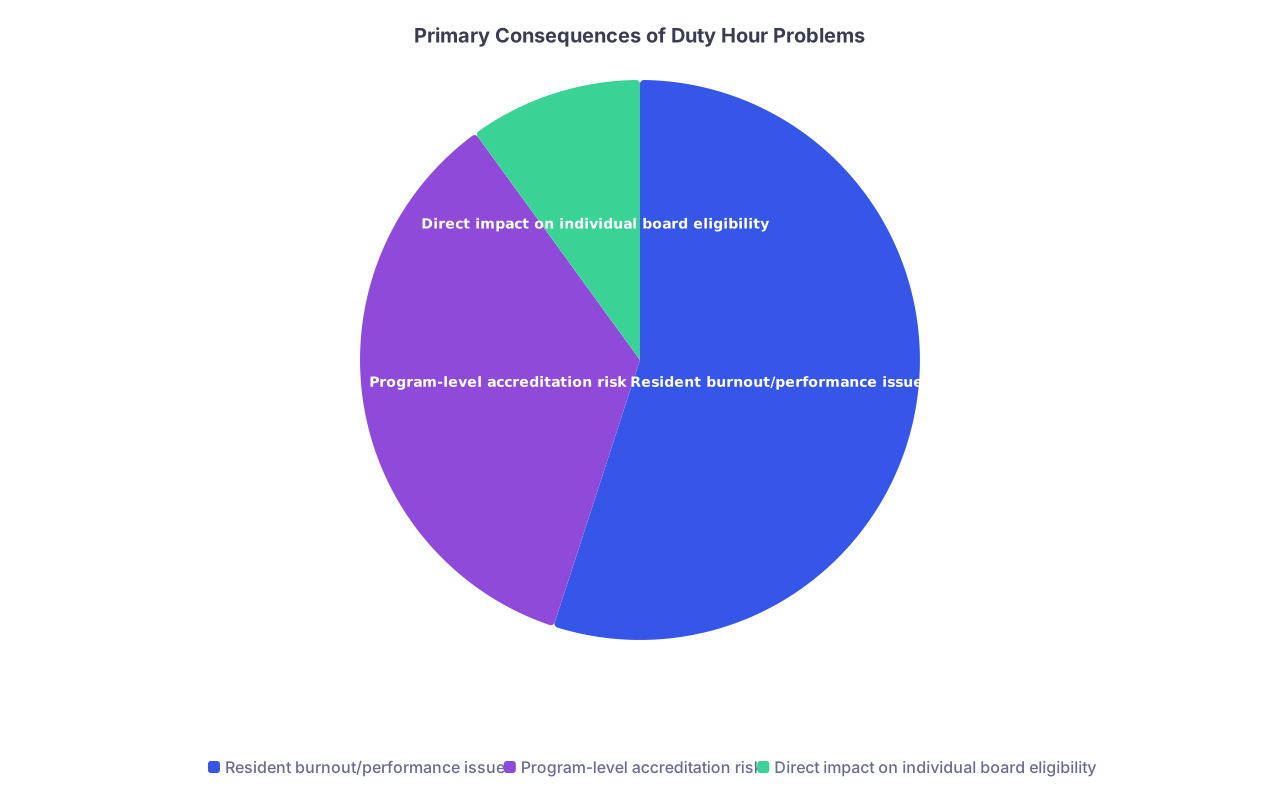
| Category | Value |
|---|---|
| Resident burnout/performance issues | 55 |
| Program-level accreditation risk | 35 |
| Direct impact on individual board eligibility | 10 |

| Step | Description |
|---|---|
| Step 1 | Notice chronic overages |
| Step 2 | Talk to senior or chief |
| Step 3 | Continue logging honestly |
| Step 4 | Raise at program meeting |
| Step 5 | Contact GME or DIO |
| Step 6 | Consider ACGME complaint |
| Step 7 | Improves? |
| Step 8 | Program responds? |
| Step 9 | Still unsafe? |

10. Practical Do’s and Don’ts
Let’s end with some blunt, usable advice.
Do:
- Log your hours honestly, even if they look bad.
- Talk to chiefs and rotation directors early, not when you’re already broken.
- Use group feedback where possible—safety in numbers.
- Keep your tone focused on patient safety and learning, not “I want to work less because this sucks” (even if that’s partly true).
Don’t:
- Lie on your duty-hour logs to make leadership happy.
- Grandstand alone in public forums if everyone else is terrified; be strategic.
- Walk out on unsafe situations without escalating and handing off appropriately.
- Ignore your own burnout until you’re getting formal letters about performance.

FAQ: Work Hours, Boards, and Graduation
Can going over the 80-hour limit make me ineligible for boards?
No. Boards don’t track your weekly hours. They care if you completed an accredited program and met competence and professionalism standards. The 80-hour rule is an ACGME program compliance issue, not a direct board eligibility metric for you.Can my program stop me from graduating if I keep reporting duty-hour violations?
They legally shouldn’t, and if they overtly do, that’s a huge ACGME problem. What can happen is more subtle: strained relationships, harsher subjective comments. That’s why you should be professional, use proper channels, and ideally act with peers, not in isolation.Should I under-report my hours to avoid getting my program in trouble?
No. That protects no one long-term. Falsifying hours is unprofessional and can backfire badly if there’s an investigation. If the program is truly at risk because of accurate reporting, that means it needs structural changes, not falsified spreadsheets.What if my senior tells me to “just not log” certain hours?
You’re not obligated to help your senior or program break the rules. A reasonable response: “I’m going to log my time accurately; let’s talk to the chief about how to fix the schedule so we’re not routinely over.” If pressure continues, that’s something to bring to the chief or PD—maybe with other residents.Can work-hour problems lead to extra training time or delayed graduation?
Indirectly, yes. If chronic overwork leads to poor performance, missed clinics, or incomplete requirements, you might need remediation or an extension. The culprit is burnout and lack of learning opportunity, not the simple fact that your logged week said 84 hours.Is it ever okay to stay late and “not log it” for learning or a special case?
A one-off where you chose to stay for a unique case or family meeting is not the hill to die on. But if “just this one time” is weekly reality, that’s not voluntary learning; that’s exploitation. As a rule, log honestly. If you occasionally choose not to log a rare extra hour for your own benefit, that’s on your conscience—but don’t let that become the norm.If my program loses accreditation while I’m there, am I screwed for boards?
Not automatically. Usually there’s a transition plan so current residents can finish in an accredited setting or transfer. But it gets complicated and stressful. This is one reason honest duty-hour reporting matters—chronic abuse can be a symptom of a program heading toward bigger problems.
Key Takeaways
- Honest reporting of duty hours and raising safety concerns do not by themselves jeopardize your board eligibility or graduation.
- The real dangers are dishonesty, unprofessional behavior, and burnout-driven poor performance, not the raw number you log in a bad month.
- Use your channels—chiefs, PDs, GME, and if needed ACGME—early and professionally. Protect your training, your patients, and your future self.


