
Most residents have more rights than they realize — and most programs quietly hope you never figure that out.
You’re not powerless when duty hour rules are broken. You actually have leverage, options, and protections. The problem isn’t that residents have no rights. The problem is that the system runs on you not wanting to rock the boat.
Let’s fix that.
1. Quick baseline: what are the duty hour rules you can actually enforce?
I’ll keep this tight and practical. I’m talking about ACGME rules here (US context). If your program is ACGME-accredited, these are not optional suggestions. They’re requirements.
Core highlights:
- Max 80 hours/week, averaged over 4 weeks
- 1 day off in 7, free of all clinical duty and required at-home work, averaged over 4 weeks
- In-house call no more often than every 3rd night, averaged over 4 weeks
- Adequate rest between shifts (varies by PGY and specialty, but the idea is simple: no endless back-to-back abuse)
- You cannot be required to violate duty hours to stay in good standing
| Rule | Standard |
|---|---|
| Weekly hours | ≤ 80 hrs, 4-week average |
| Days off | 1 day off in 7, 4-week average |
| In-house call frequency | No more than every 3rd night, 4-week avg |
| Education vs service | Must prioritize resident education |
| Moonlighting | Counts toward 80-hour limit |
If your reality is: “I’m at 95 hours/week, no real day off, pre-rounding on my off day, getting told not to log violations,” you’re not just “tired.” Your program is out of compliance.
And that matters. Because accreditation is their pressure point.
2. Your core rights when duty hours are broken
Let me be very blunt: you have more explicit rights than your program will ever advertise to you.
You have the right to:
Report true duty hours without retaliation
ACGME is crystal clear: residents must be able to report work hours honestly. “Adjusting” your hours to avoid violations is not compliance; it’s falsification.A safe, fatigue-mitigated learning environment
Fatigue management is not optional. Programs must provide some combination of:- Reasonable scheduling
- Access to rest facilities
- Strategies for fatigue (e.g., transport options, backup coverage)
Graduation not contingent on violating duty hours
Your program cannot formally or informally require rule-breaking to “get enough cases” or “prove your commitment.”Due process if you’re disciplined for raising concerns
If they come after you for speaking up? There must be a defined due-process pathway. That’s not just internal policy; it’s baked into accreditation expectations.Direct access to the ACGME without going through your program
You can file concerns or complaints directly with ACGME. They don’t have to go through your PD, chair, or GME office.
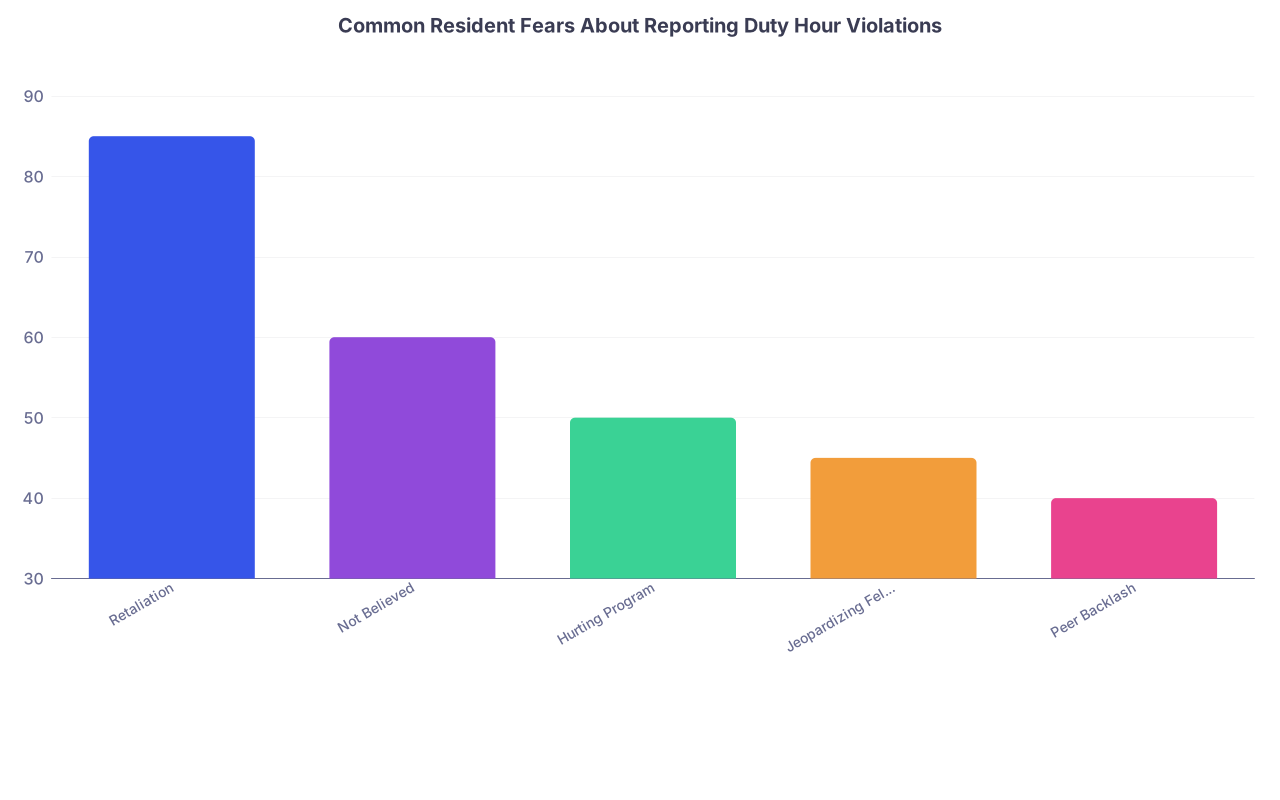
| Category | Value |
|---|---|
| Retaliation | 85 |
| Not Believed | 60 |
| Hurting Program | 50 |
| Jeopardizing Fellowship | 45 |
| Peer Backlash | 40 |
Most residents stay quiet because of fear, not because they lack rights. Programs know this.
3. Practical options: what you can actually do, step by step
Here’s the real meat: what you can do when duty hours are consistently broken. Use as much or as little of this as you need.
Step 1: Document before you escalate
Don’t go on vibes. Go on data.
Start keeping your own log (separate from the official system):
- Arrival and departure times
- On-call hours, including “informal” stuff (pre-rounds, post-call notes)
- “Off” days where you’re required to come in for rounding, notes, clinic, or teaching
- Specific requests to alter hours in the system or “not log that”
This doesn’t need to be fancy. Notes app, Excel, Google Sheet. But it needs to exist.
Why? Because when the answer you get is, “We’re within the 80 hours on average,” your response can be, “Here are 6 weeks where I was at 90+ hours with no true day off.”
Step 2: Try the lowest-risk internal route first (when safe)
Not because you owe the program anything, but because sometimes this actually works with minimal blowback.
Options inside the program:
Chief residents – Some chiefs are just mini-administrators. Some are genuinely resident advocates. Test the waters with a factual, non-emotional read:
“We’re regularly at 90+ hours; I’m worried we’re out of compliance and people are unsafe. Any plan to fix this?”Program director – If you trust them at all, you can try:
“I’m logging honestly and coming out >80 with no real day off. How should we address this so that we’re compliant?”
Watch their response carefully. Do they talk solutions or tell you to “average” it out?Program evaluation committee / resident reps – Most programs have resident reps who collect feedback. This is a place to formally raise:
“Chronic duty hour violations on X rotation, pressure not to log accurately.”
If the answer you get is basically, “Stop logging reality,” you now know what you’re dealing with—and that it’s not just a misunderstanding. It’s a culture problem.
4. Your escalation ladder (with pros and cons)
When internal “conversations” go nowhere or feel unsafe, you move up the ladder.
4.1. GME office / DIO (Designated Institutional Official)
Every hospital with residency programs has a GME office and a DIO. They’re the ones who sign off on ACGME stuff.
You have the right to contact them directly.
How to approach:
Use specific language:
“I’m concerned our program may be out of compliance with ACGME duty hour requirements. We’re averaging X hours/week with Y days off. There’s also been pressure to adjust reporting. I’d like guidance on how to address this safely.”Ask explicitly about non-retaliation:
“What protections are in place for residents who raise concerns?”
If the GME office is functioning, this can trigger internal review, schedule changes, or at minimum a warning shot to the program.
4.2. Anonymous surveys and reporting channels
You likely have several tools already:
- ACGME Resident/Fellow Survey (annual, anonymous)
- Internal anonymous feedback tools from GME
- Hospital compliance hotlines
Don’t treat these like a vent box. Treat them like a legal document. Use clear, non-ranty language:
- “Chronic violation of 80-hour rule on [rotation] for [specialty] residents.”
- “Residents explicitly told to alter duty hour logs to avoid violations.”
- “No protected day off in 7 for months at a time.”
Multiple residents saying this across tools gets attention.

| Step | Description |
|---|---|
| Step 1 | Self documentation |
| Step 2 | Chief residents |
| Step 3 | Program director |
| Step 4 | GME office or DIO |
| Step 5 | Institutional reporting or compliance |
| Step 6 | Report to ACGME |
4.3. Direct complaint to ACGME
This is the part most residents underestimate.
You can go straight to ACGME:
- Through their online complaint form
- Without program approval
- Without notifying your PD
ACGME takes these seriously, especially when:
- Multiple residents independently report similar problems
- There’s evidence of pressure to falsify hours
- Violations are systemic, not occasional
Downside: this is thermonuclear compared to a quiet chat with your PD. It can trigger site visits, citations, and serious heat for your program.
But that’s exactly why it works.
5. Protection from retaliation: what’s real vs fantasy
Let’s be honest. Retaliation happens. Not always explicit, but it happens:
- Suddenly “unprofessional” evals
- Subtle badmouthing to fellowship programs
- “Concerns” about your “resilience” or “fit”
- Being pulled from key rotations or opportunities
Legally and from an accreditation standpoint, you have protections:
ACGME requires non-retaliation
Programs are required to allow residents to report concerns without fear of reprisal. Retaliation—if proven—can absolutely destroy them in a site visit.Your institution likely has whistleblower protections
Hospitals usually have policies protecting people who raise safety/compliance concerns. That includes you.Paper trails are your shield
If you suspect retaliation, document:- What you reported
- When you reported it
- Who knew
- What negative actions followed and when
Pattern matters. One grumpy eval doesn’t prove anything. Three bad evals immediately after you reported to GME? That starts to look very different.
You can bring in outside support
- State medical society
- AMA resident/fellow section
- If it’s extreme: an employment lawyer who knows academic medicine
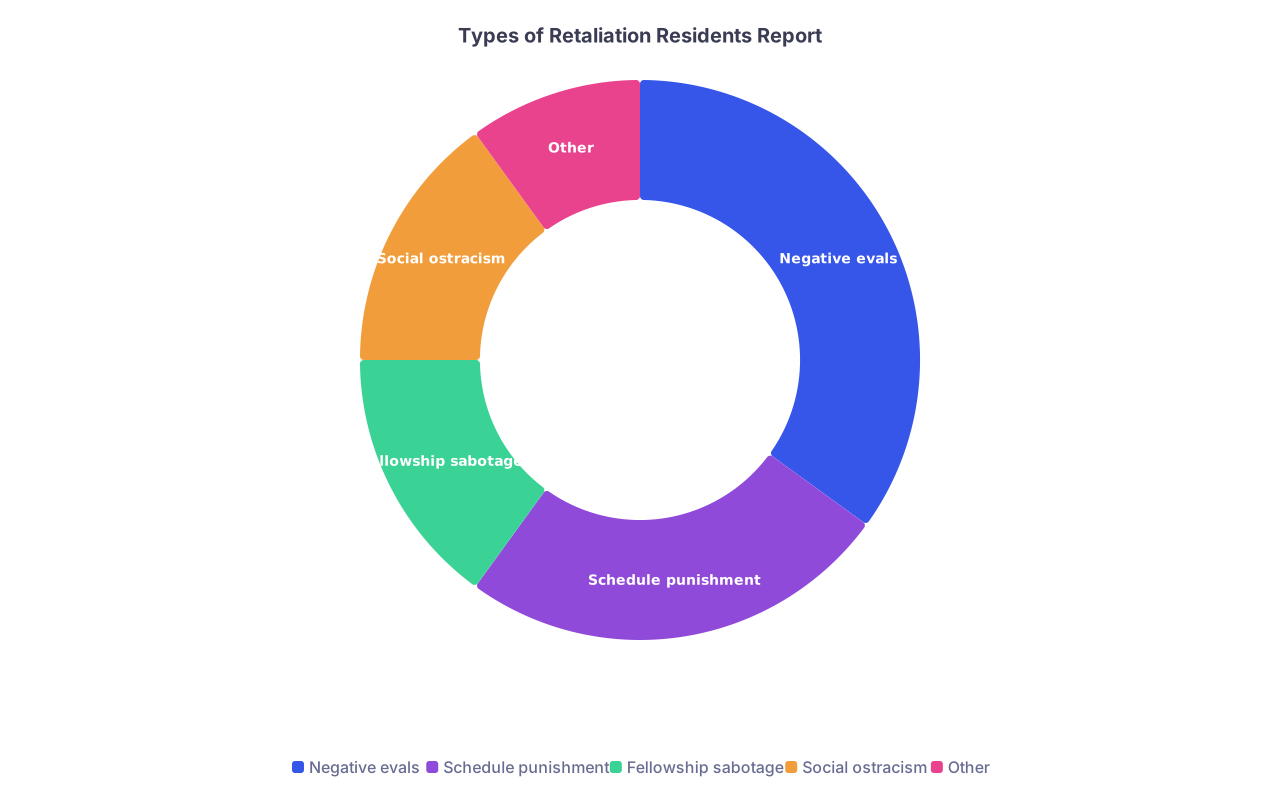
| Category | Value |
|---|---|
| Negative evals | 35 |
| Schedule punishment | 25 |
| Fellowship sabotage | 15 |
| Social ostracism | 15 |
| Other | 10 |
Is there risk? Sure. This isn’t a zero-risk process. But the idea that “if you say anything, your career is over” is exaggerated and frankly used as a control tactic.
6. Smart strategies: how to protect yourself while pushing back
You don’t need to martyr yourself to fix your program. You do need to be strategic.
Here’s how I’d approach it if I were in your shoes:
Strength in numbers
If three or four residents from the same class or rotation bring the same concern, it’s much harder to label it as a “you” problem.Be factual, not dramatic
“I worked 97 hours last week with zero day off, and I was asked not to log it” is 100x more powerful than “This program is abusive and terrible.”Separate feedback from personality conflicts
Don’t mix: “Dr. X is a jerk” with “We are consistently breaking 80-hour rules.” Stay on structural issues.Use phrases that trigger action
- “ACGME compliance”
- “Patient safety risk due to fatigue”
- “Pressure to falsify documentation”
People perk up when those words hit their inbox.
- Know when to take the W
If they adjust call schedules, add another resident, or cap admissions and your hours drop into compliance, that’s a win. You don’t need an apology tour. You need a safer schedule.

7. When things are truly toxic: exit strategies
Sometimes the culture is so entrenched, the leadership so defensive, that your best move is planning your way out.
Your rights here:
- To transfer programs (not easy, but possible)
- To report serious violations even on your way out
- To get accurate documentation of your performance that doesn’t punish you for raising concerns
If the abuse is severe (chronic 100+ hour weeks, clear retaliation, patient harm from fatigue that’s ignored), talk to:
- GME / DIO
- A trusted faculty mentor outside your department
- An attorney if you’re seeing clear retaliation tied to protected reporting
You don’t have to “rescue” the program. But leaving quietly without documenting anything just sets up the next class to go through the same nonsense.

FAQs
1. Can my program force me to log fewer hours than I actually work?
No. That’s falsifying institutional records and directly undermines ACGME compliance. If they’re “suggesting” you not log pre-rounds, post-call work, or at-home charting that’s required, that’s a red flag. Log reality. If they push back, document it and consider going to GME.
2. What if my co-residents want to keep quiet and “not cause trouble”?
Common. Some people are just trying to survive. You don’t need everyone on board. Even 2–3 residents speaking consistently helps. And you can still use anonymous channels if you’re the only one willing to speak.
3. Will reporting duty hour violations hurt my fellowship chances?
Indirectly, programs sometimes try to punish “troublemakers” with bad letters or commentary. That’s why you document everything, maintain strong performance, and build relationships with faculty who know your work. If needed, you can explain in future interviews: “Our program had serious compliance issues; I raised them through proper channels.”
4. How bad do violations have to be before I contact ACGME?
Not one-off bad weeks. Residency has surges. You contact ACGME when:
- Violations are chronic (over months),
- They’re systemic to certain rotations or the whole program, and
- Leadership ignores or suppresses internal reporting.
Multiple residents each reporting the same patterns is very persuasive.
5. Can I be fired for refusing to work beyond duty hours?
They probably won’t say “You’re fired because you refused to violate duty hours.” They’ll say “performance,” “professionalism,” etc. That’s where documentation and due process matter. Before making a hard stand like walking out, get advice—from GME, a mentor, or even a lawyer—because once you pull that trigger, there’s no going back.
Bottom line:
- You do have rights around duty hours, safety, and honest reporting.
- You have multiple internal and external channels to use, with real teeth, if your program is out of bounds.
- The more you document and move strategically (not emotionally), the more power you actually have in a system that’s counting on your silence.