
What happens when your program director pulls your duty hour report in front of the CCC and your name is the one that does not match reality?
If you think duty hour logging is just annoying busywork, you are one mistake away from a giant problem. I have watched residents go from “star intern” to “on probation” because of patterns in their work-hour logs. Not clinical errors. Not professionalism disasters. Just… how they logged (or failed to log) their time.
You can be clinically excellent and still get crushed by this.
Let me walk you through the duty hour logging mistakes that actually get residents in trouble — with programs, with the ACGME, and sometimes with state boards — and how to avoid becoming the cautionary tale everyone whispers about.
The Biggest Myth: “Nobody Really Cares About Duty Hours”
They do. They absolutely do.
Programs get evaluated on this. ACGME site visitors look at your logs. GME offices watch for noncompliance patterns. Hospital administration cares because violations mean risk and liability.
Yet residents keep making the same naive assumptions:
- “If I underreport, I look tough and committed.”
- “If I overreport, I look like I can’t handle residency.”
- “If everyone else is ‘rounding down,’ I should too.”
- “The system is fake. We all know we work more than this.”
Those attitudes are exactly what get people burned.
Here is the uncomfortable truth: programs do not get in trouble because residents honestly log violations. They get in trouble when logs are obviously fake, inconsistent, or manipulated. That screams culture problem. And then ACGME starts digging.
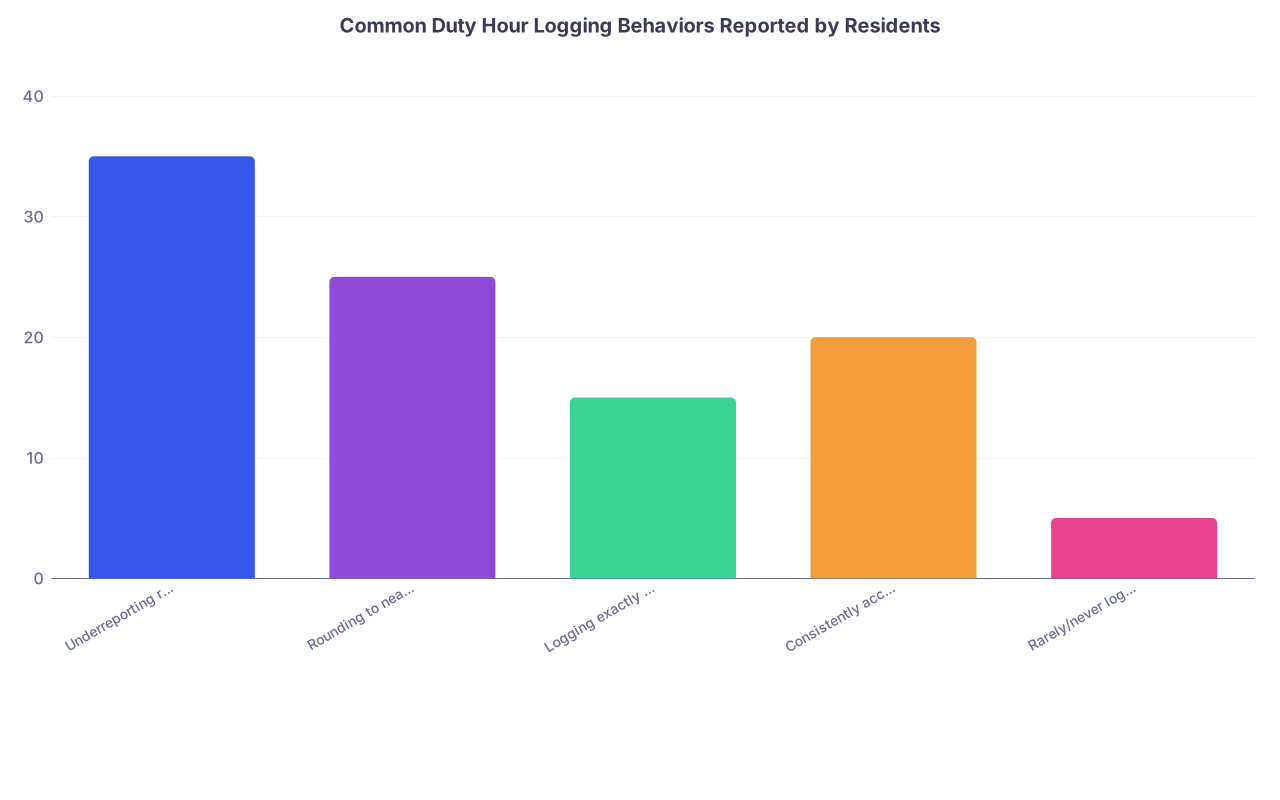
| Category | Value |
|---|---|
| Underreporting regularly | 35 |
| Rounding to nearest half hour | 25 |
| Logging exactly scheduled hours | 15 |
| Consistently accurate logging | 20 |
| Rarely/never logging | 5 |
If you remember nothing else: misaligned, dishonest, or sloppy logging is far riskier than truthfully documenting that your ICU month was brutal.
Mistake #1: Systematic Underreporting to “Look Strong”
This is the classic intern mistake. You want to be the workhorse. So you start shaving time.
You stay until 8:30 pm, log out at 7:30. You roll in at 5:45 am, log 6:15. You work “off the clock” from home and pretend it does not count.
It feels noble. It looks deceptive.
I have seen this backfire in a few specific ways:
ACGME climate survey mismatch
Residents tell the ACGME: “We work >80 hours routinely.”
Duty hour data says: “Nope, always 70–75.”
That discrepancy triggers questions about falsification, coercion, or program dishonesty. Programs then start looking for the “overly compliant” people. If your logs are suspiciously perfect, you get attention you do not want.Safety event investigations
A bad outcome happens. Risk management pulls EMR access times, call schedules, and your logged hours. If there is a pattern of charting at 11 pm while your hours say you left at 7 pm, people stop trusting anything you record. Including your notes. Including your incident reports. That is a poisonous label to carry.Wellness and support denial
You tell your PD you are burned out and overwhelmed. They pull your duty hours and see 60–65 hours a week, no violations, nice spacing of calls. You just destroyed your own credibility. Their mental note: “Other interns are managing the load. Maybe this one is not resilient.” Brutal, but I have heard that exact sentence.
Do not underreport to look strong. The people actually running the program know roughly how much time a normal person needs for that service. If your hours look magically lighter than everyone else’s, it looks like gamesmanship, not grit.
Mistake #2: Logging the Scheduled Hours Instead of the Real Ones
This is the “I just click the default times” shortcut. It is fast. It is also a problem.
You know exactly what I mean:
Your schedule says 6:00–18:00. You just auto-fill that for every shift. Even on the days you left at 3 pm. Even when you rounded until 9:30 pm.
What this does:
- Destroys data the program needs to fix rotations.
- Creates patterns that scream “fabricated” to auditors.
- Hides real structural violations that could be addressed.
Programs are required to monitor systems-based contributors to violations: long commutes between sites, bad sign-out structure, impossible clinic templates, poorly staffed rotations. They often use duty hour data for this. If everyone just hits “default,” leadership cannot prove to GME that the night float system is broken or that clinic is routinely running past 8 pm.
Worse: if your program ends up under ACGME scrutiny, a pattern of every single intern logging the exact scheduled hours with no variance looks fake. Which then triggers confidential resident interviews. If in those interviews residents say, “Yeah, we do that because that is what we were told,” the program is now in deep trouble.
And you are now “the class who falsified logs.”
Mistake #3: Pretending Home Work Is Not Work
This one is sneaky. Residents convince themselves that if they are:
- Dictating notes from home
- Finishing charts on their couch
- Returning patient calls after “leaving”
- Doing telehealth follow-up at night
- Prepping case lists or H&Ps for clinic
…it somehow does not count as duty hours.
That is wrong. Legally and from an ACGME standpoint.
If it is patient care, program-related work, or required educational activity, it is work. That includes “just going through my inbox.” If your epic login records show hours of after-hours activity and your duty hour logs stay flat, again, the credibility problem emerges.

You do not have to nickel-and-dime every 6-minute MyChart message. But if you are routinely spending an extra hour or two every night finishing work, be honest about that. Otherwise, you are:
- Training your program to think the workload is sustainable.
- Masking structural problems like absurd clinic templates.
- Setting up the narrative that “residents are fine” when they are clearly not.
Mistake #4: Rounding Away Violations
I have heard this line more times than I can count:
“I just round up or down so I do not trigger a violation — it is easier for everyone.”
No. It is easier for the program in the very short term. In the medium term, it is dangerous for you.
Common version:
You leave at 10:10 pm, log 10:00. Those ten minutes mean the difference between a 14-hour and 14.25-hour shift. Do that on a 28-hour call and it is the difference between being barely compliant and clearly non-compliant.
Individually, those choices seem harmless. As a pattern, they create a false sense of safety.
Here is what happens when you get used to “rounding away violations”:
- Your internal alarm for “this is unsafe” gets blunted.
- You start tolerating 28.5, 29, 30-hour shifts as “close enough.”
- When a rare investigator actually looks at your EMR timestamps, the discrepancy looks deliberate.
I am not telling you to obsess over 5 minutes. But do not systematically falsify to avoid red flags. That is how duty hour rules die by a thousand cuts.
If you are over, you are over. Let the violation stand. If it happens frequently, that is evidence your PD can use to change the structure. But only if you actually log it.
Mistake #5: The “Copy-Paste” Month
You log one week correctly. Then for the next three, you just copy the pattern.
You think: “It is basically the same every day, I am just saving time.”
Except:
- Call nights vary.
- Admissions surge some days.
- Admin days are different.
- Conferences, procedures, cross-cover change your real time.
Patterns that are too clean raise suspicion. No one works identical hours every day for a month. Real life has noise.
Program leaders and GME folks are not stupid. When they see 28 days of 6:00–18:00 with no deviations, no late stays, no early finishes, they assume one of two things:
- You are not logging honestly.
- You are barely engaging with the system and just clicking through.
Both make you look unreliable. And when something serious happens — remediation, promotion decisions, fellowship letters — that “unreliable” reputation sticks.
Mistake #6: Ignoring the 8/10-Hour and 24+4 Rules
Everyone focuses on the 80-hour weekly limit and forgets the other rules that get programs nailed:
- Minimum 8 hours off between shifts (goal 10).
- Max 24 hours of continuous clinical work, plus 4 for transitions/education, not new patients.
- One day in 7 free of all clinical duties, averaged over 4 weeks.
The dangerous mistake: logging in a way that hides violations of these other rules.
Example:
You leave at 11 pm, and you are back at 6 am. You log 11 pm and 6 am honestly. That is 7 hours off. You just created documented evidence that the system is not compliant. That should be flagged and addressed.
If instead you “fix it” and log 10 pm or 7 am to protect the service, you have:
- Created a paper trail that says “everything is fine.”
- Removed the trigger that would force leadership to deal with the schedule.
- Accepted chronic sleep deprivation as your personal problem, not a system flaw.
The 24+4 rule is similar. If you are still admitting at hour 25 and document your shift as 28 hours “because that is what you actually worked,” your program can use that data to restructure call. If you log 24 every time, nothing changes, and the risk compounds.
And if a sentinel event happens at hour 27? There will be a very uncomfortable sequence of meetings where people will pull call schedules, duty hours, and EMR timestamps and ask why no one told the truth.
Mistake #7: Letting Others Pressure You to Falsify
This one still makes me angry when I see it.
Sometimes it is subtle:
- “Just be smart about how you log that.”
- “We do not need a bunch of violations right now.”
- “GME is on our back — try to keep it under 80 this month.”
Sometimes it is explicit:
- “Do not log that as a violation.”
- “No one should be logging more than 80 here.”
- “We were told to keep afternoons under 12 hours.”
Those statements are red flags. Full stop.

| Step | Description |
|---|---|
| Step 1 | Hear suggestion to change logging |
| Step 2 | Document exact hours truthfully |
| Step 3 | Save email or note of pressure |
| Step 4 | Consider confidential report to GME |
| Step 5 | Follow reasonable guidance |
| Step 6 | Is it about hiding real hours |
You are never obligated to falsify duty hours to protect a program. In fact, doing so can put you on the hook later if it comes out that logs were knowingly inaccurate.
What to do instead:
- Calmly say, “I am going to log what I actually worked. If there is a better way to structure the call, I am happy to talk about that.”
- If the pressure continues, screenshot or write down exactly what was said, by whom, and when.
- Use confidential reporting channels to GME or the DIO if you think this is systemic.
The mistake is staying silent and then going along with it. Residents almost never get in trouble for honest logging. They do get in trouble for participating in a cover-up when the program comes under review.
Mistake #8: Not Understanding That These Logs Are Legal Documents
Your duty hour entries are not just “app data.” They are part of the institutional record.
When things go bad — a major adverse event, a lawsuit, an ACGME citation — people subpoena schedules, notes, emails, and yes, duty hour records. I have been in those rooms. Lawyers absolutely ask:
- “How many hours had the resident worked in the prior 24/48 hours?”
- “Were duty hours being accurately tracked?”
- “Is there evidence of falsification or coercion?”
If you have a track record of creative logging, someone will point it out. And suddenly you are the resident whose accuracy is “questionable.” That is not a label you want in any official proceeding.
| Problem Type | Who It Hurts First |
|---|---|
| Honest, frequent violations | Program & system |
| Systematic underreporting | Residents & patients |
| Falsified logs under pressure | Program and residents |
| Sloppy, inconsistent logging | Resident credibility |
Notice something: honest violations primarily hurt the system because they force change. Dishonest or sloppy logging hurts you directly.
How to Log Duty Hours Without Destroying Yourself
Let me give you a practical framework that does not require perfection, just consistency and honesty.
Log within 24 hours
The longer you wait, the more you guess. Guessing creates patterns that do not match reality. Block 2 minutes at sign-out or before you leave to enter the day.Be directionally precise
You do not need to log 6:07 am. But if you came in around 6, log 6. Came in at 6:45? Log 6:45. Do not routinely “round” in one direction to avoid violations.Always include significant at-home work
If you spend 45–60 minutes or more most days doing real work from home, build that into your entries. If once in a month you spent an extra 2 hours on a massive backlog, log that too.Let violations be violations
If you reasonably believe you exceeded:- 80 hours in a week
- 24+4 hours on a call
- Minimum time off
- 1 in 7 days free
…log it. Then tell your chief or PD neutrally: “My hours are showing a violation this week based on X, just wanted you to be aware.”
They may not love it. That is not your problem to solve alone.
- If you are ever asked to change true entries to “help the program,” stop
Ask them to send any requested changes in writing (email). Most people will suddenly back off when they realize you will have documentation.

A Quick Reality Check: It Is Not About Perfection
Will you sometimes get home and realize you forgot to log? Yes. Will you occasionally misremember by 15 minutes? Of course. That is not what gets people in serious trouble.
The real problems are:
- Patterns that clearly favor the program over truth.
- Evidence of systematic underreporting.
- Logs that do not match what residents say on surveys.
- Discrepancies with EMR access and call records during investigations.
You are allowed to be human. You are not allowed to be deliberately dishonest about work hours that are supposed to protect both you and your patients.