
Last month I watched an intern stand in the resident workroom at 4:55 p.m., backpack on, badge half-untethered, just…frozen. List was signed out. Orders done. Notes in. But she still didn’t move. Another resident joked, “Wow, leaving early today?” She laughed, dropped her bag, and sat back down.
She walked out at 6:15. Her shift ended at 5.
That’s the fear you’re asking about. Not abstract. Very real in your nervous system. But how real is it in residency culture, and what’s just our own catastrophizing brain turning the volume up to 100?
The ugly truth first: the fear isn’t random
I won’t sugarcoat it. The fear of being labeled “lazy” for leaving on time doesn’t come out of nowhere. You didn’t invent this in a vacuum.
You’ve probably:
- Heard upper levels brag about “back when we stayed until midnight every day.”
- Seen attendings praise the resident who “stayed late to help” but never explicitly praise the one who handed off safely and left on time.
- Watched residents log 80 hours but quietly admit they’re actually doing 90.
- Been told in med school, “Be the first one there and the last one to leave.” Over and over. Like it’s a moral law.
So yeah, when your shift is technically done but your co-intern is still typing furiously, you start spiraling:
“If I leave now, will my attending think I don’t care?” “Will this end up in my eval?” “Is everyone quietly putting a mental asterisk next to my name?”
Here’s the part that makes this worse: residency is this weird combo of actual evaluation + vague vibes. You’re constantly judged, but no one hands you a rubric. That void gets filled with anxiety. And the easiest “rule” your brain clings to is: staying late = good; leaving on time = bad.
But that equation is not actually that simple.
What programs actually care about vs what your anxiety says
If you strip away the posturing, this is what most programs truly care about: Are you safe? Are you reliable? Do you function as a teammate? Are you learning and progressing?
Notice what’s missing: “Do you heroically ignore your contract hours just to impress people.”
Let me be blunt: the residents who scare attendings and PDs are not “the ones who leave at 5.” It’s:
- The ones who chronically miss key tasks.
- The ones who sign out sloppily and dump chaos on night float.
- The ones who can’t prioritize and are still working at 8 p.m. on things that should’ve been done at 3.
Those folks might also stay late. A lot. And still be labeled…not lazy, but disorganized, unsafe, or not ready.
On the flip side, I’ve heard this exact attending quote (said after the resident left at 5:15, by the way):
“X is solid. Gets work done, doesn’t linger just to be seen. I like that.”
So yes, there are fossils in the system who think “early = weak.” But for most people in charge, the red flags are about quality and judgment, not timestamps.
Let me put some structure to this.
| Perception Label | What Usually Causes It | Leaving On Time Effect |
|---|---|---|
| Lazy | Dodging work, dumping on others, poor follow-through | Only if you leave tasks undone or dump |
| Disorganized | Chronic late notes, missed labs, constant chaos | Can happen whether you stay late or not |
| Solid/Dependable | Safe sign-outs, work done efficiently, good communication | Very compatible with leaving on time |
| “Hero” | Always staying late, picking up extra work | Can backfire as boundaryless or unsafe |
Leaving on time, by itself, is neutral. It gets colored by everything around it.
The social pressure: why leaving feels dangerous
The real trap isn’t policies. It’s vibes.
You know the moments:
- It’s 6:58 p.m. Your shift ends at 7. Senior starts a new admission they could hand off to night float but says, “We’ll just do it.” You’re now in the moral panic zone: if you suggest looping in night float, do you look selfish?
- You’re done, you sign out. Another intern sighs loudly and says, “I’ll just finish all these notes at home.” Suddenly you feel like you’re abandoning them.
- Someone casually jokes, “Wow, must be nice to leave on time.” You laugh it off but it lands.
None of that is formally in your evaluation. But it hits your “tribe acceptance” button. Hard. Because residency is essentially survival by group approval.
And this is how your brain spins it:
- “They think I’m lazy.”
- “If I leave, they’ll remember this on my eval.”
- “Everyone else is fine staying late; maybe I’m just weak.”
Here’s the harsh reality: some residents do silently judge. Some are keeping mental score of “who helps and who doesn’t.” Medicine is full of people who equate worth with self-sacrifice. That culture is not fully gone.
But here’s what’s also true and doesn’t get said enough:
- Plenty of chiefs and attendings are actively watching for burnout and like residents who have boundaries.
- Some co-residents will actually respect that you protect your off time—as long as you’re not dumping on them.
- Nobody is logging every 10-minute variance of your exit time across the year.
Your anxiety is taking a kernel of truth (“people notice behaviors”) and blowing it up into “every decision I make is a career-defining referendum.”
Where leaving on time does become a problem
I’m not going to lie to you. There are scenarios where leaving on time can be interpreted badly. Not because it’s 5 p.m., but because of what’s attached to that exit.
Red flags:
- You leave with obvious unfinished work that someone else has to scramble to pick up.
- Your sign-out is consistently rushed, incomplete, or careless.
- You disappear before urgent issues are clarified (e.g., “We’re still deciding if Room 12 needs the ICU, where did the intern go?”).
- You have a pattern of never offering help when the team is drowning, especially if others frequently help you.
That’s where “lazy” or “not a team player” shows up. Not “oh you left at 5:02.”
So the real question isn’t “Is it okay to leave on time?”
It’s “Can I look my co-residents in the eye and say: my work is done, my sign-out is safe, and I’m not routinely bailing when the team is on fire?”
If yes, leaving on time is not the moral failure your brain says it is.
What attendings and PDs quietly notice (that no one tells you)
Here’s the part you don’t see as an applicant or early intern: attendings and PDs compare what you say on surveys and wellness check-ins to what you do.
They see:
- Residents complaining of burnout but proudly bragging about “never leaving before 8.”
- Interns who are chronically exhausted, making more mistakes, because they “don’t want to be the first to leave.”
- Teams that stay late because they’re weirdly inefficient earlier in the day.
A lot of them (not all, but a lot) are tired of this martyr culture. They want residents who:
- Prioritize sick patients and critical tasks early.
- Ask for help when overloaded instead of silently drowning.
- Sign out clearly and then actually go home.
Some will even think less of you if you hang around with no clear purpose just to be seen as “hardworking.” They can spot performative suffering. It’s obvious.
That said, no one will complain if you occasionally stay late to help when the team is buried. The key word is occasionally, and the key phrase is “for a real reason.” Not because you’re scared of optics.
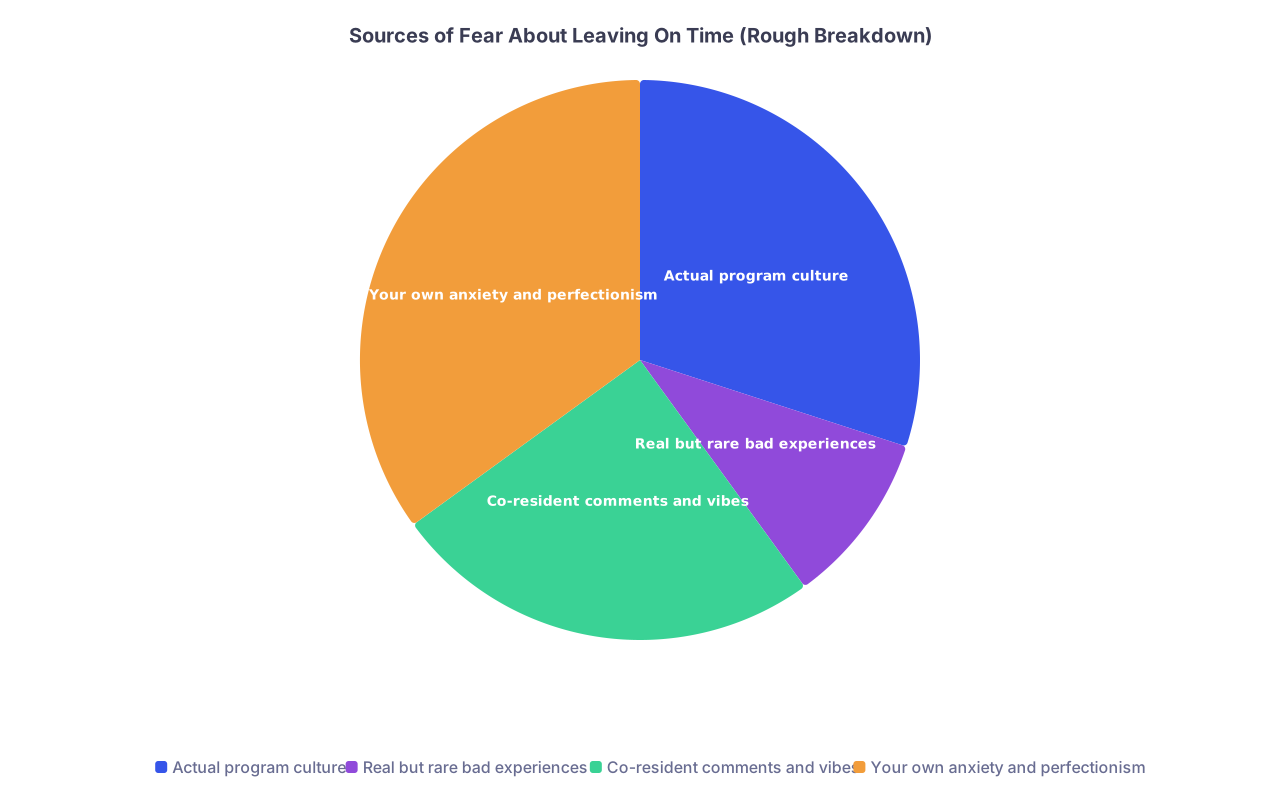
Your brain vs. reality: how much of this fear is real?
Let’s put numbers to the gut feeling.
| Category | Value |
|---|---|
| Actual program culture | 30 |
| Real but rare bad experiences | 10 |
| Co-resident comments and vibes | 25 |
| Your own anxiety and perfectionism | 35 |
Yeah, I made up those percentages, but the point stands: a big chunk of this is you trying to preempt judgment that either isn’t coming, or won’t be as harsh as you think.
You only remember the one snarky comment like, “Oh, half day?”
You don’t remember:
- The 15 neutral days where nobody cared when you left at 5:10.
- The times your senior said, “You’re done, go home, I’ve got this.”
- The times people were clearly more concerned about sick patients than what time anyone badged out.
Your brain is biased toward potential threat. Residency just gives it endless material.
So what do you actually do on those 4:55 p.m. days?
This is the real practical test. Not your philosophy. The micro-actions.
Here’s a simple internal checklist I’ve seen work well:
- Is my work truly done?
- Orders in?
- Notes done or clearly handed off?
- Critical labs/imaging followed up?
- Is my sign-out clear, complete, and anticipatory?
- “If X happens, do Y” spelled out?
- Any unstable patients flagged clearly?
- Is the team in meltdown mode?
- New rapid response?
- Flood of admissions?
- Someone obviously drowning?
If 1 and 2 are yes, and 3 is no, you can literally say:
“Hey, I’m all done and signed out. Anything you need from me before I head out?”
That last sentence buys you an insane amount of social capital. You’re:
- Showing willingness.
- Giving your senior a chance to say “Yes, please help with X” if needed.
- Putting the responsibility on them to decide if the coverage is adequate.
Most reasonable seniors will either say, “No, you’re good, go home,” or “Actually, could you just finish that one thing?” You’re not being lazy in either scenario.
If 3 is yes—things are exploding—then yeah, it probably helps your reputation to stay a bit. Not forever. Not hours. Just enough to stabilize the chaos or complete a critical task. Then the same line:
“Things are more stable now, is it okay if I head out?”
You’re not a robot following the clock. You’re a doctor using judgment.
Burnout is not a flex, and everyone knows it
Every year there’s That Resident. The one who:
- Stays late every day.
- Covers for everyone.
- Voluntarily takes extra admissions.
- Never says no.
They get praised…for a while. Then:
- They start making more errors.
- They get short-tempered with nurses and med students.
- They fall behind on notes and start staying even later.
- They start having “fitness for duty” conversations behind closed doors.
The same people who called them “rock star” a year ago now whisper “I’m worried about them.”
You’re scared of being labeled lazy if you leave on time. But the opposite label—boundaryless, a liability to themselves—exists too. People just talk about it less.
Here’s the quiet reality: a resident who consistently leaves on time, does safe sign-outs, and protects their sleep is often safer, sharper, and better to work with than the hero who stays till 9 p.m. every night.
The system can exploit both. But only one of them has any realistic shot at surviving this long term.
How real is the label “lazy” for leaving on time?
Honest answer:
- In some malignant or extremely old-school programs? More real than it should be. People will interpret leaving on time, no matter what, as lack of commitment.
- In most mainstream programs? The label “lazy” only attaches if you combine leaving on time with:
- Repeatedly unfinished work.
- Poor sign-outs.
- No sense of team responsibility.
- In decent, somewhat progressive programs? There’s growing awareness that leaving on time is healthy when your work is done. You might get a side-eye from one co-resident, but leadership often doesn’t see it as a problem.
The part your anxiety refuses to believe: you have more room to leave on time than you think, as long as you’re safe, organized, and not abandoning your team when they’re on fire.
You’re not going to get blacklisted because you didn’t hang around an extra 40 minutes pretending to review labs that don’t exist.
A quick reality check timeline

| Step | Description |
|---|---|
| Step 1 | 4 -45 pm |
| Step 2 | Finish critical tasks |
| Step 3 | Prepare detailed sign out |
| Step 4 | Sign out updated |
| Step 5 | Offer brief help |
| Step 6 | Ask if anything else needed |
| Step 7 | Stabilize urgent issues |
| Step 8 | Confirm with senior |
| Step 9 | Leave on time or slightly after |
| Step 10 | Work done? |
| Step 11 | Team overwhelmed? |
This is the kind of pattern people remember: takes care of business, helps when needed, doesn’t martyr themselves unnecessarily.
FAQs
1. Will leaving on time hurt my fellowship chances?
If your application is otherwise strong—good letters, solid clinical performance, decent scholarly work—leaving on time by itself won’t tank you. Letters don’t say, “They left at 5 every day.” They say, “Hardworking, reliable, great team player” or “Spotty follow-through, needed reminders, inconsistent.” Focus on the behaviors that generate those phrases, not the exact time you badged out.
2. What if my co-residents actually do think I’m lazy?
Some might. Especially the ones who tie their worth to suffering. You can’t control everyone’s lens. What you can control: be the person who finishes work, offers help when reasonable, and communicates clearly. If someone still decides you’re lazy because you don’t needlessly stay late every day, that’s about their baggage, not your value.
3. Should I stay late my first few months just to “set a tone”?
You don’t need to perform misery to build a good reputation. Early on, you’ll probably stay late anyway because you’re slower. That’s normal. But don’t create a fake baseline where you stick around just to be seen. Set your “tone” with thoroughness, teachability, and safe care—not with martyr hours you can’t sustain.
4. How do I actually say I’m leaving without sounding selfish?
Use simple, direct language tied to patient care. Something like: “My notes and orders are done, and I’ve signed out my patients. Anything else you need from me before I head out?” You’re not announcing, “I value my free time more than the team.” You’re asking permission, showing awareness, and maintaining boundaries.
5. Is it better to lie on my duty hours so I don’t look weak?
No. That’s how programs get cited, and it buries systemic problems. If you’re constantly staying late, your PD needs to see that in aggregate data. Lying just makes it look like you’re fine and the system is fine when neither is true. Document reality. If your hours are out of control, they should be worried—not impressed.
If you remember nothing else, remember this: leaving on time isn’t lazy; leaving chaos behind is. Safe care, clear sign-outs, occasional extra effort when the team’s drowning—that’s the combo that builds a good reputation. The clock is just background noise.