
The residency myth that “you’ll bounce back once it’s over” is only half true—and the half that’s missing is the part that keeps me up at night.
If you’re like me, you’ve heard both extremes:
On one side, the old‑school attendings who brag about 120‑hour weeks and say, “You’ll be fine, it builds character.”
On the other, the horror stories: “Residency fried my brain,” “I still can’t sleep normally,” “I don’t remember three years of my life.”
So which is it? Can chronic sleep loss in residency actually cause permanent damage—or is it just temporary misery?
Let me be blunt: residency‑level sleep deprivation absolutely can leave lasting effects for some people. Not everyone. Not always. But yes, there’s real risk. Pretending it’s harmless is delusional.
The good news: you’re not doomed, you’re not powerless, and there are pretty clear patterns in who gets hit hardest and what actually seems to stick long‑term.
Let’s go through this in a way that doesn’t sugarcoat anything—but also doesn’t just catastrophize for no reason.
What “Chronic Sleep Loss” in Residency Really Looks Like
When people outside medicine talk about “not sleeping,” they mean 6 hours a night, maybe 5. Cute.
Residency sleep loss is different. It’s this:
- Night float where you average 3–4 hours of broken sleep in a call room five nights in a row.
- 28‑hour calls where you maybe grab a 40‑minute nap at 3:30 a.m. curled up in a chair.
- Flipping back and forth: nights → days → nights → days in the same month.
- Post‑call days that are technically “off,” but you’re so wired and anxious you can’t sleep properly anyway.
And that’s not for a week. It’s month after month, sometimes for years, depending on specialty and program.
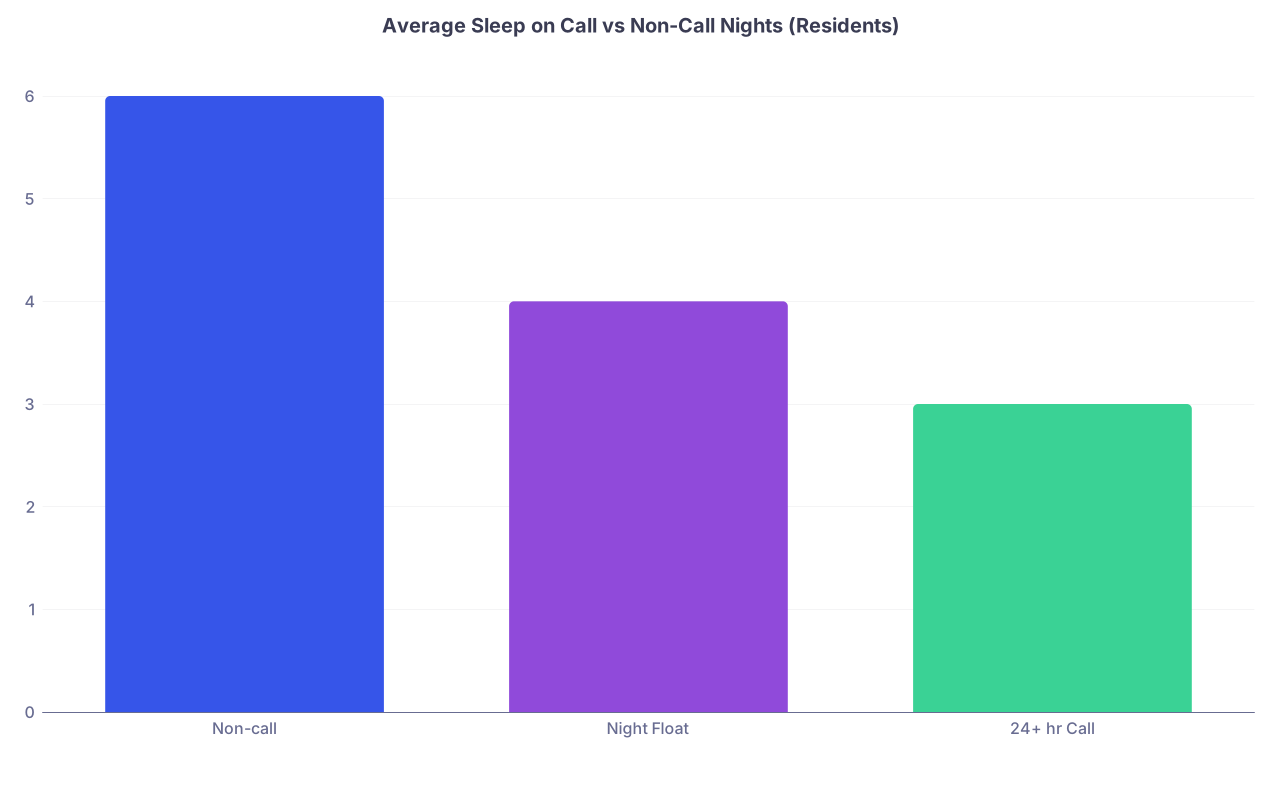
| Category | Value |
|---|---|
| Non-call | 6 |
| Night Float | 4 |
| 24+ hr Call | 3 |
Those are averages from multiple resident surveys. Averages. Meaning plenty of people get less.
So when we say “chronic sleep loss,” we’re not talking about being a little tired. We’re talking about:
- Consistent sleep under 6 hours
- Regular all‑nighters or near all‑nighters
- Circadian rhythm constantly disrupted
That’s the level where research starts to show not just “you’re cranky,” but “your brain and body are actually adapting in ways that might not fully reverse.”
The Scariest Part: What the Science Actually Says About “Permanent”
Here’s where my brain loves to spiral: does this mess up your brain forever?
The uncomfortable answer: prolonged sleep deprivation is linked to changes that look, at least partly, like real damage. But the full story’s more nuanced.
1. Cognitive function and memory
Studies on chronic partial sleep restriction (think 4–6 hours per night for weeks) show:
- Reaction times go down and keep getting worse over time.
- Working memory and attention drop.
- People feel like they’re “getting used to it,” but on tests they’re objectively still impaired.
The worst part: after you restore sleep, performance improves, but not always fully, especially after really prolonged deprivation. Some studies suggest certain deficits linger, although how long and how severe varies a lot.
In other words: your brain can heal—but not infinitely, and not for everyone.
2. Structural brain changes
This is the part that makes my stomach drop.
Some imaging and animal studies show:
- Chronic sleep loss is associated with loss of synapses and changes in white matter.
- Short sleep over years is linked to higher risk of earlier cognitive decline and dementia.
- Sleep is when the brain’s “glymphatic system” clears metabolic waste; less deep sleep means more junk building up.
Do we have a study that follows residents for 40 years and proves residency alone causes permanent brain injury? No. But we have enough pieces to say: running your brain on empty for years is not benign.
3. Mood, anxiety, and burnout
Sleep and mood are tightly connected. Residency doesn’t just cause “tiredness”; it ramps up:
- Depression
- Anxiety
- Emotional blunting
- Burnout and depersonalization
The part that worries me: some attendings will tell you, “I’ve never been the same since residency—I’m more numb, more pessimistic, more forgetful.” You hear that enough times and it stops sounding like random anecdotes.
Is that purely sleep? No. It’s trauma, stress, moral injury, lack of control, all wrapped together. But chronic sleep loss pours gasoline on all of it.
What Actually Seems to Stick Long-Term
This is where I try to separate “internet horror stories” from patterns that seem real.
Common long‑term issues people report after residency
I’ve heard (and seen) the same themes from older residents and attendings:
- “My sleep is still messed up years later.”
- “I wake up at 3 a.m. like I’m on call.”
- “I can’t fall asleep before midnight, even when I’m exhausted.”
- “My memory for small details feels worse now.”
These line up with what we’d expect:
- Circadian rhythm gets trained into weird patterns.
- Hypervigilance persists (brain still scanning for “pager about to go off”).
- Chronic stress and sleep loss together reshape habits and baseline functioning.
Does that mean your brain is “permanently damaged” in some dramatic, MRI-visible way? Not usually. But “I don’t feel like I ever fully returned to my pre‑residency baseline” is something a lot of physicians quietly admit.
What usually improves once residency is over
Here’s the reassuring side that people don’t talk about enough, probably because suffering is more interesting than recovery.
When people finally get:
- Consistent 7–8 hours of sleep
- More control over their schedule
- Less overnight call
They often notice:
- Way better mood and patience
- Clearer thinking
- Fewer “I’m going to snap” moments
- More normal appetite and energy
So yes, there’s recovery. Sometimes a lot. The catch is it can take months or more than a year to really stabilize, and many doctors never actually protect their sleep once they’re attendings… so they never find out how much they could recover.
Worst-Case Scenarios (Because That’s Where My Brain Goes)
If I let my catastrophizing run wild, here’s what I imagine residency could do to me long term:
- I come out of training unable to sleep normally, stuck at 4–5 hours a night.
- I’m in my 40s with hypertension, extra weight, and prediabetes partly fueled by years of messed-up sleep.
- I’m more irritable, emotionally flat, and detached, and I call it “just being efficient.”
- My memory is worse and I chalk it up to “getting older,” but really it’s accumulated sleep debt and chronic stress.
That’s the nightmare version. Can it happen? Yes. Does it happen to everyone? No. Is it inevitable? Absolutely not.
But ignoring that these are actual risks is just sticking your head in the sand.
Who’s Most at Risk of Long‑Term Effects?
Some people take residency-level abuse and seem… weirdly okay later. Others get wrecked.
From what research and real‑world stories suggest, higher‑risk people look like this:
- History of insomnia, depression, or anxiety before residency
- Strong circadian preference (true night owls forced onto early rounds, or vice versa)
- Chronic medical issues: migraines, autoimmune, GI issues that flare with stress
- People who never really learned to sleep well (phones in bed, no wind‑down, caffeine late)
And then there’s specialty and schedule. Some tracks are just more brutal.
| Residency Type | Relative Sleep Strain |
|---|---|
| Surgical (Gen Surg, Ortho, Neuro) | Very High |
| OB/GYN | Very High |
| Internal Medicine | High |
| Emergency Medicine | High (circadian disruption) |
| Pediatrics | Moderate-High |
| Psychiatry | Moderate |
This isn’t universal—there are chill IM programs and absolutely soul‑crushing psych ones—but if you’re already fragile around sleep, picking a highly call‑heavy specialty at a malignant program is… not ideal.
What You Can Actually Do About It (Before and During Residency)
Here’s the part that drives me crazy: people act like you have no control. That’s not true.
You don’t control call. You do control how close you’re running to the edge when call hits you.
Before residency: build a “sleep reserve”
No, you can’t “bank” sleep in a literal sense. But you can:
- Go into residency not already sleep‑broken from Step studying and chronic all‑nighters.
- Train your body to fall asleep quickly and predictably when given the chance.
- Learn one or two fast‑acting wind‑down routines you can use post‑call.
Stuff that actually helps:
- Fixed wake time (yes, even on days off) so your circadian rhythm is more stable.
- No phone in bed. I hate this advice, but it’s true.
- A concrete “shut it down” ritual: dim lights + hot shower + something boring and low‑stakes (not TikTok, not high‑stakes news).
Think of it like going into a marathon with decent training vs having done nothing and hoping adrenaline carries you through. The race will still hurt. But you’re less likely to blow out a knee at mile three.
During residency: your job is “minimum viable damage,” not perfection
The goal isn’t perfect sleep. That’s laughable. The real goal is to avoid chronic, unbroken destruction.
Things that sound small but matter over years:
- Protecting post‑call sleep like it’s a procedure. No errands. No social guilt. Blackout curtains. White noise. Eye mask. Phone on Do Not Disturb except for true emergencies.
- Learning how to nap aggressively. 20–90 minutes when you can grab it. Don’t wait until you’re collapsing.
- Limiting caffeine after a certain hour (everyone’s different, but many people should stop by 2–3 p.m.). If you need an IV of cold brew at 5 p.m. to function, you’re sacrificing your post‑call night for 3 more hours of half‑awake productivity.
- Pushing back—politely but firmly—when your program ignores work‑hour rules. It’s not just being “soft.” Chronic 30‑hour shifts with 2 hours of sleep are objectively unsafe for you and your patients.
And yes, therapy or coaching. Not because you’re broken, but because you’re trying to survive a system that is.
How to Judge If a Program Is Going to Break You
When you interview or talk to current residents, do not just ask “How are the hours?” Everyone lies or normalizes suffering.
Ask questions that smoke out the reality:
- “On night float, how many hours of sleep do you realistically average?”
- “On a 24‑hour call, how often do you get an uninterrupted 3‑hour block?”
- “What happens if you’re still pre‑rounding at hour 28? Do people actually go home?”
- “How many times a month do you feel truly non‑functional from sleep deprivation?”
And then watch their faces. Do they laugh in that dark, “you have no idea” way? Do they say, “It depends on the attending…” a lot? That tells you more than the words.

| Step | Description |
|---|---|
| Step 1 | Look at Specialty |
| Step 2 | Screen programs hard |
| Step 3 | Still ask sleep questions |
| Step 4 | High risk for chronic loss |
| Step 5 | Moderate risk |
| Step 6 | High call field? |
| Step 7 | Residents look exhausted? |
If sleep is a major fear for you (like it is for me), you’re not being dramatic by making it a top factor in your rank list. You’re being realistic about long‑term risk.
So… Is It “Permanent Damage” or Not?
The honest, deeply unsatisfying answer:
- Residency‑level chronic sleep loss can absolutely contribute to long‑term health issues (cardiovascular disease, metabolic problems, mood disorders).
- Your brain can adapt and recover a lot, but probably not infinitely, and not if you never prioritize sleep for years.
- Whether it feels “permanent” depends on your baseline vulnerability, your specialty, your program, and how much you fight for recovery afterward.
You’re not guaranteed to be permanently damaged. You’re also not magically protected because you’re “young and resilient.”
You’re signing up for a system that will constantly push your brain and body past their limits. Your job is to:
- Go in as strong as you can.
- Refuse to treat your own sleep as optional when you do control it.
- Choose training environments that don’t treat basic human physiology as a joke.
If You’re Sitting There Freaking Out
Same. I read the literature and then imagine worst‑case scenarios at 2 a.m.
Here’s what I hang onto so I don’t just bail on this career path entirely:
- Lots of doctors come out the other side functional, happy, and sharp—especially the ones who later actually prioritize sleep.
- The risk isn’t all‑or‑nothing. Every hour of sleep you protect, every call‑month you mitigate, every small boundary you set nudges you away from the worst‑case curve.
- You are allowed to factor your own long‑term brain and body into your decisions—specialty choice, program choice, and how you live during training. That’s not weakness. That’s self‑preservation.
If you remember nothing else: residency sleep loss isn’t harmless, but it’s not destiny either. The system will push you toward burnout. You don’t have to willingly help it.