Anxious About Having Kids with 28-Hour Calls: Is It Possible?
What if you finally match… and then realize your schedule basically makes having kids feel impossible for the next 3–7 years?
Because that’s the thought, right?
You picture yourself stumbling out of the hospital post–28-hour call, seeing the sun rising, and then you suddenly remember: “Oh my god. I want a family. How does this even work?”
You’re not crazy. That fear is rational. Residency plus kids is not some cute Instagram story. It’s messy, guilt-heavy, sleep-deprived chaos. And the 28‑hour call model makes everything feel worse.
But “Is it possible?” has a very different answer than “Is it easy?”
Let’s be honest about both.
What 28-Hour Call Actually Looks Like (And Why It Freaks You Out)
First, you’re not overreacting to the idea of 28‑hour call. It’s brutal.
Typical “24+4” call structure:
- You start around 6–7 AM on Day 1.
- You work all day. You admit all night.
- You maybe nap for 30–90 minutes if the floor doesn’t explode.
- You round the next morning.
- You might leave at 10–11 AM. Sometimes noon. Sometimes later if the service is drowning.
So that’s 28–30 hours where you are not home. Not awake with a baby or a toddler. Not able to help if your partner texts you, “She’s been crying for two hours and I’m losing it.”
And then the “post-call day off” is often:
- Get home, shower, eat something, crash for 4–5 hours.
- Wake up groggy, with a headache, and maybe 3–5 “free” hours before you start resetting for the next day.
- Emotionally, you’re wrecked. Physically, you’re a shell.
Is this how you raise a kid? That’s the anxiety loop.
You start asking yourself:
- “Will my kid even know me?”
- “What if my partner burns out or resents me?”
- “What if something bad happens at home and I’m stuck at the hospital?”
- “What if I’m so tired I snap at my kid or make a mistake caring for them?”
And the worst one:
“What if I try to do both and end up failing at both?”
I’ve watched this play out in real life—IM, surgery, OB, peds residents, some with colicky newborns, some with kindergarteners. Nobody looks at them and thinks, “Wow, this is smooth and balanced.” It’s not.
But they exist. They make it through. Their kids are real, attached, loved, and okay.
That tension is what you’re trying to make sense of.
Is It Actually Possible to Have Kids on 28-Hour Call?
Short answer: Yes, it’s possible.
Long answer: It’s possible if some non-negotiable conditions are in place. Without those, it’s a slow-motion disaster.
Let’s be blunt: the system is not built for resident parents. You don't get a “parent track” schedule. You get the same q4 call or night float as everyone else, plus childcare Tetris on hard mode.
The people who pull it off usually have at least two or three of these:
- A partner with a relatively flexible or non-medical schedule
- Local family willing to do serious childcare (not just “date nights,” I mean “3 AM emergency pickup when you’re stuck on call”)
- Enough money to afford backup childcare, extra daycare hours, or a nanny
- A program that’s at least mildly human and not psychotic about coverage requests
- Co-residents who aren’t jerks and will swap when you have pediatrician visits or emergencies
Without some combination of that, is it impossible? No. But the margin for error is razor thin, and the emotional cost is high.
Here’s the mental trap: you’re probably imagining parenting like your own childhood or like your non-medical peers’ Instagram posts. Two parents at dinner, weekend trips, one parent at every soccer game. Residency just doesn’t line up with that picture.
Parenting in residency looks more like:
- FaceTiming your toddler from a supply closet at 8 PM
- Missing bedtime on 1/3–1/2 of nights on some rotations
- Not being there for some “firsts” (steps, words, first day of preschool) and pretending you don’t care while part of you absolutely does
- Feeling like a visitor in your own house when you’re mid-ICU block and you’re leaving before sunrise and getting home after bedtime
It’s not a clean “yes/no, possible/impossible.” It’s: “Yes, but not in the way you’re picturing, and not without sacrifice.”
The Real Schedule Clash: Call vs Childcare
The main problem isn’t just being tired. It’s logistics. Childcare and call schedules do not line up nicely.
Most formal childcare options are something like 7 AM to 6 PM, Monday through Friday. Residency is… not that.
Let me put the mismatch side-by-side:
| Aspect | Typical Residency Call | Typical Childcare Option |
|---|---|---|
| Start time | 5–7 AM | 7–8 AM |
| End time | Next day 10–12 PM (post-call) | Same day 5–6 PM |
| Nights | Frequently in-house | Usually not available |
| Weekends | Often required | Rare, expensive if available |
| Last-minute needs | Constant | Almost never accommodated |
So if you’re on 28-hour call:
You leave home before daycare opens.
You don’t get home until the next late morning.
You need someone else covering:
- Bedtime
- Overnight wakeups
- Morning routine
- Daycare drop-off
- And sometimes pickup if your “post-call” exit gets delayed
That someone is not theoretical. It has to be a real human with keys to your home, a car seat that actually fits in their car, and the ability not to panic when your toddler throws up.
If you don’t have a partner + family + money patchwork that covers all the gaps, you’re left in this terrifying place where a random bad night on call can implode your childcare.
That’s the part that should scare you. Not because it’s unsolvable, but because you need to respect it enough to plan like hell.
Three Common Scenarios (And What They Really Feel Like)
Let me walk through the patterns I’ve seen over and over.
1. Resident + Non-Medical Partner + No Local Family
This is super common. And honestly? It can work, but the partner carries a massive load.
What it feels like:
- They do most drop-offs, pick-ups, sick days, and random school events.
- They’re solo parenting every time you’re on call or on nights.
- They may quietly (or loudly) resent the hell out of your schedule.
You, meanwhile, feel:
- Guilt when you walk in and your partner looks exhausted and snappy.
- Guilt when your kid clearly runs to them first.
- Guilt when you’ve been home for 20 minutes and you already have to go write notes or sleep.
And on 28-hour call, if your partner gets sick or overwhelmed, there’s not much you can do. You can’t leave the hospital because your toddler has a fever. You can’t just “work from home” and keep them. That helplessness is rough.
The couples that survive this usually:
- Communicate constantly and brutally honestly
- Get outside help even if it strains their budget
- Treat childcare like a non-negotiable, not an optional luxury
2. Resident + Resident Couple with a Kid
This is the “how are you even alive?” combo.
Two call schedules. Two sets of nights. Two exhausted humans. One small person who doesn’t care what ACGME rules are.
On paper, it’s doable: you trade off call months, stagger nights, use daycare and backup care, and pray.
In reality:
- There will be months when both of you are slammed.
- You will miss things. Both of you.
- The logistics spreadsheet starts to look like a military operation.
But—and this matters—I’ve seen couples make this work. Often by throwing money and favors at the problem: nannies, neighbors, co-residents, grandparents flying in for a month.
Is it ideal? No. Is it survivable? Yes, with planning and humility and a lot of letting go of perfection.
3. Resident with Strong Local Family Support
This is the secret cheat code.
If you have parents/siblings nearby who are truly willing to be in the trenches—not just “call me if you need anything” but “we’ll take the baby overnight when you’re both stuck”—your risk of total meltdown drops significantly.
28-hour call is still awful. But if your mom or in-laws can do pickup, bedtime, and even overnight sometimes, the level of anxiety is completely different.
If you have this option and a decent relationship with them, don’t romanticize “doing it all on our own.” That’s ego talking. Use the help.
Emotional Fallout: The Guilt You’re Already Feeling
You’re not just worried about logistics. You’re worried about being a bad parent before you’ve even started.
Here’s what people don’t say out loud: resident parents walk around with a baseline of guilt that borders on chronic pain.
You might:
- Miss birthdays, recitals, sports games
- Be too tired post-call to be fully present when you finally are home
- Have stretches where your kid clings to your partner or nanny more than to you
- Hear another parent casually say, “I would never miss a school play” and want to sink into the floor
And then your brain goes, “If I really cared, I’d find a way. Maybe this means I shouldn’t do medicine. Or I shouldn’t have kids. Or both.”
That voice is vicious. And one thing I can tell you from watching this up close:
Your kid does not measure you the way you measure yourself.
They don’t count events. They absorb patterns. Do you love them? Are you safe? Do they feel wanted? Do you light up when you see them? Do you come back?
You will screw up. You will miss things. And your kid can still grow up secure and loved.
You’re afraid residency will break you as a parent before you even begin. It might break your fantasy of what kind of parent you thought you’d be. But that’s different from breaking your relationship with your kid.
Concrete Ways People Actually Make This Work (Barely, But They Do)
You probably want something more practical than “it’s hard but possible.”
So here’s the non-fluffy version of what I’ve seen actually help.
Ruthless, Boring Planning
This is not the season for vibes. It’s spreadsheets and backup plans.
- Look at your call schedule the moment you get it. Map out daycare, partner work, family help, and backups for the worst rotations.
- Assume someone will get sick at the worst possible time. Build at least one backup plan that does not rely on you leaving work.
- If you can afford it, lean heavily on extra childcare: nanny + daycare, or a sitter who can do evenings and early mornings.
Lowering the Bar on “Good Parent”
If your image of “good parent” is:
- At every event
- Organic meals prepped in glass containers
- Calm, patient, creative, emotionally available 24/7
You’re going to feel like garbage.
A more honest standard for residency might be:
- Consistently loving, even if often tired
- Present in small, protected pockets of time
- Reliable about showing up when you say you will (as much as call allows)
- Willing to apologize when you’re short-tempered or absent
It’s not pretty on Instagram, but it’s real.
Being Strategic About Timing
People will fight about this forever: “When’s the best time to have kids in medicine?”
There isn’t a perfect answer. But some patterns:
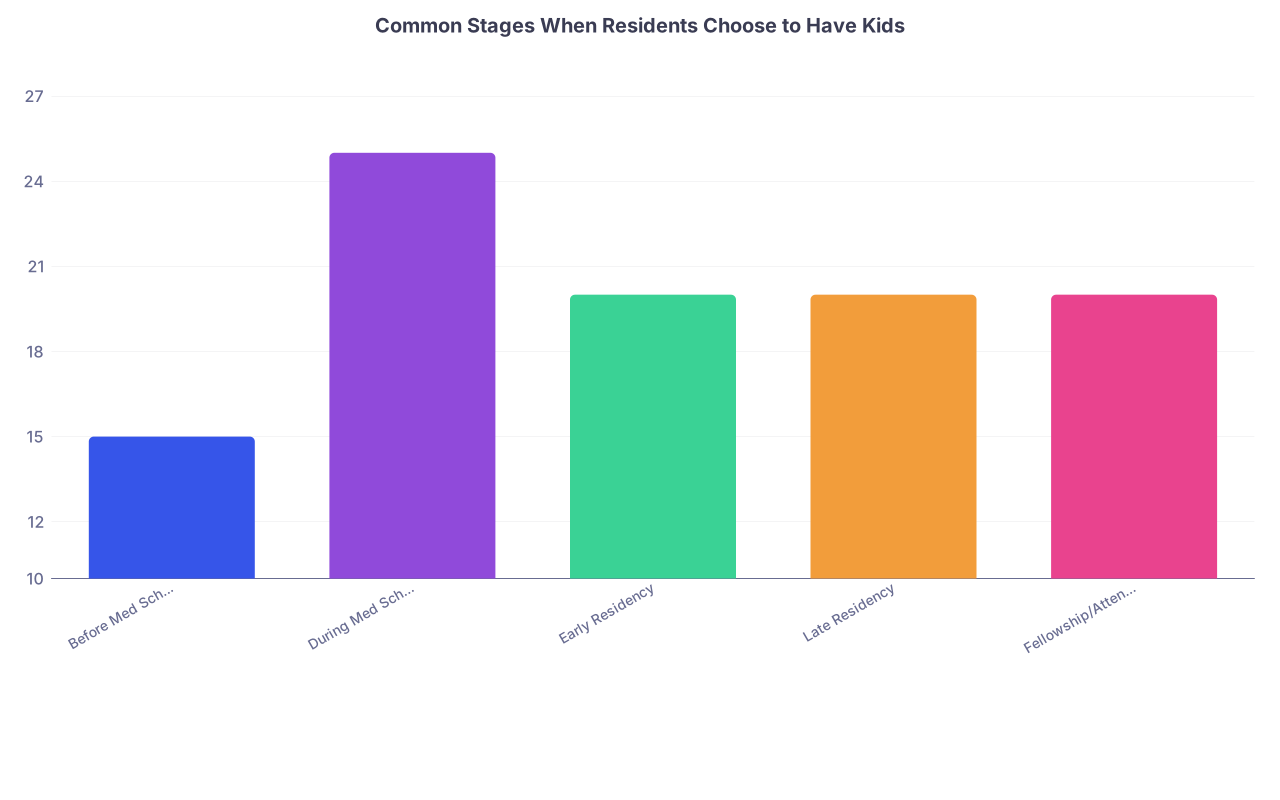
| Category | Value |
|---|---|
| Before Med School | 15 |
| During Med School | 25 |
| Early Residency | 20 |
| Late Residency | 20 |
| Fellowship/Attending | 20 |
If you already know you want kids, these questions matter more than some abstract “right time”:
- How long is your training path? (Surgery + fellowship is very different from 3-year peds.)
- How old do you want to be when you start trying?
- Do you have any fertility concerns now? (History of PCOS, irregular cycles, known male factor issues, etc.)
Some people delay and then get blindsided by fertility problems later. That’s a real risk too. You’re not wrong to think about that. I’ve seen residents in their mid-30s sobbing in call rooms after getting bad AMH numbers or IVF news. That’s a different kind of grief.
So yes, it might make sense to have kids in residency despite 28-hour calls, because waiting until “life calms down” in medicine is a bit of a myth.
The Residency Culture Piece (Programs Are Not All the Same)
Let me say this clearly: some programs are awful to parents. Some are shockingly decent.
You want clues. Things I listen for when residents talk:
- Do people openly mention kids, or is it like a dirty secret?
- Do faculty with children exist and talk about them like actual priorities?
- When a resident has a sick kid, do co-residents roll their eyes or say, “We got you, go home”?
- What’s the vibe around pregnancy and leave? Supportive or resentful?
Programs can’t erase 28-hour calls, but they can control:
- How rigid they are with switching shifts for pediatrician visits, school events, etc.
- Whether they pile judgment on resident parents or treat them as normal humans with normal lives
- Whether they make your partner feel welcome at events or like an extra
If you know you want kids sooner rather than later, this culture matters way more than a few extra work hours per week on paper.
A Rough Mental Flowchart: Should You Try for Kids on 28-Hour Call?
Not a perfect decision tree, but here’s the kind of internal logic I’d use:

| Step | Description |
|---|---|
| Step 1 | Want kids in near future |
| Step 2 | Consider kids during residency |
| Step 3 | Can wait until after if desired |
| Step 4 | High stress but possible |
| Step 5 | High risk of burnout |
| Step 6 | Plan carefully and accept tradeoffs |
| Step 7 | Delay or rethink timing |
| Step 8 | Training length long? |
| Step 9 | Support system strong? |
| Step 10 | Partner on board? |
If you land in “support system shaky, partner unsure, training long,” I’d be cautious. Not “never,” but “maybe not right away.”
If you land in “support strong, partner solid, training long, early 30s,” then yeah, I’d say: it’s going to be brutal, but probably worth trying if having kids is a core non-negotiable for you.
One More Thing You’re Secretly Afraid Of
You might not say this out loud, but I know it’s there:
“What if I have kids during residency, and I end up resenting them because they made an already hard time harder?”
That thought feels ugly. But it’s not uncommon.
You might have days where you feel trapped from both sides—by medicine and by parenting. No real rest, just shifting responsibilities. It’s not because you don’t love your kid. It’s because you’re human and exhausted and overextended.
The only honest answer is: yes, there will probably be moments like that. The key isn’t avoiding them entirely—it’s not letting those moments define the story.
Resident parents I respect most say things like:
- “That year was hell, but I’m glad we didn’t wait.”
- “I missed stuff, but my kid is okay. We’re okay.”
- “I wouldn’t choose that exact timing again, but I don’t regret having them.”
Not glowing, not romantic, but real.
Quick Reality Check Before You Spiral
Let me condense this without sugarcoating:
- 28-hour calls and kids do not mix nicely. The logistics and guilt are real, not imagined.
- It is still possible to be a loving, secure, good-enough parent during residency—if you have support and you drop the fantasy of doing it all perfectly.
- You’re not weak or dramatic for being anxious about this. You’re actually thinking about the stuff that matters, which is more than I can say for the people who just “wing it” and then explode six months into internship.
You won’t find a version of this where it feels easy. You’re choosing between hard options. But “hard” and “impossible” are not the same thing.
And no, your kid will not look back and count your 28-hour calls. They’ll remember who you were when you were home.