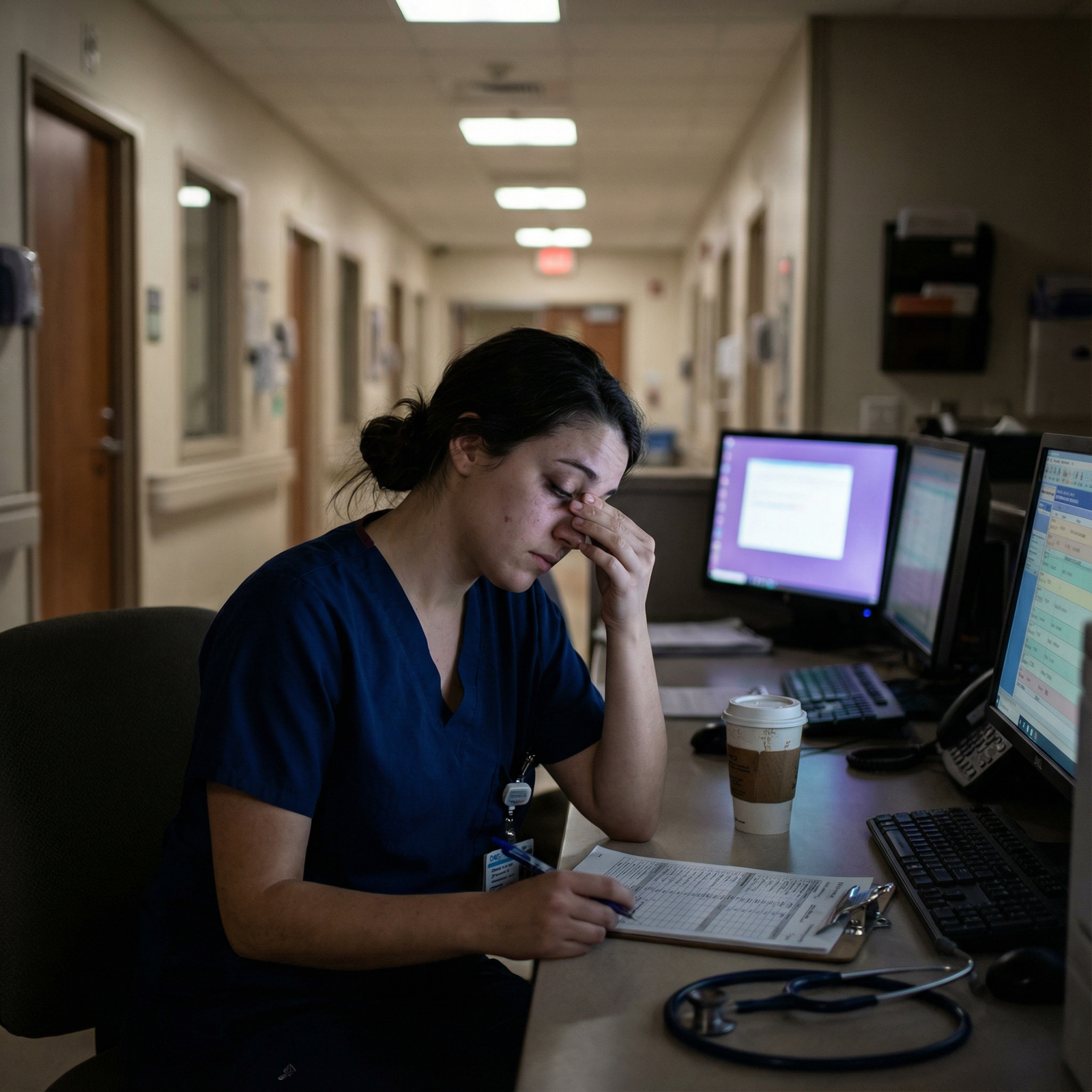
It’s 4:12 a.m. You’re on call. Your eyes burn, your pager just went off again, and you’re staring at an order you’re about to sign thinking, “If I screw this up, someone could die and it’ll be my fault.”
And then the next thought hits you, the darker one: “I am too tired to be safe. What if I miss something huge and never even realize it until it’s too late?”
I know that exact brain spiral. The “I’m going to be the headline: ‘Resident Error Leads to Tragedy.’” The fear that your own exhaustion is a ticking time bomb.
Let’s talk about that honestly. Because pretending “you’ll be fine” doesn’t help. But neither does the catastrophizing where your brain insists one typo in an order set equals career-ending malpractice and lifelong guilt.
The Ugly Truth: Yes, Fatigue Affects Safety (You’re Not Imagining It)
Let me just say it out loud so your anxious brain doesn’t keep whispering it as a secret: yes, fatigue absolutely affects performance.
Not in a vague way. In a “this has been measured and compared to blood alcohol levels” kind of way.
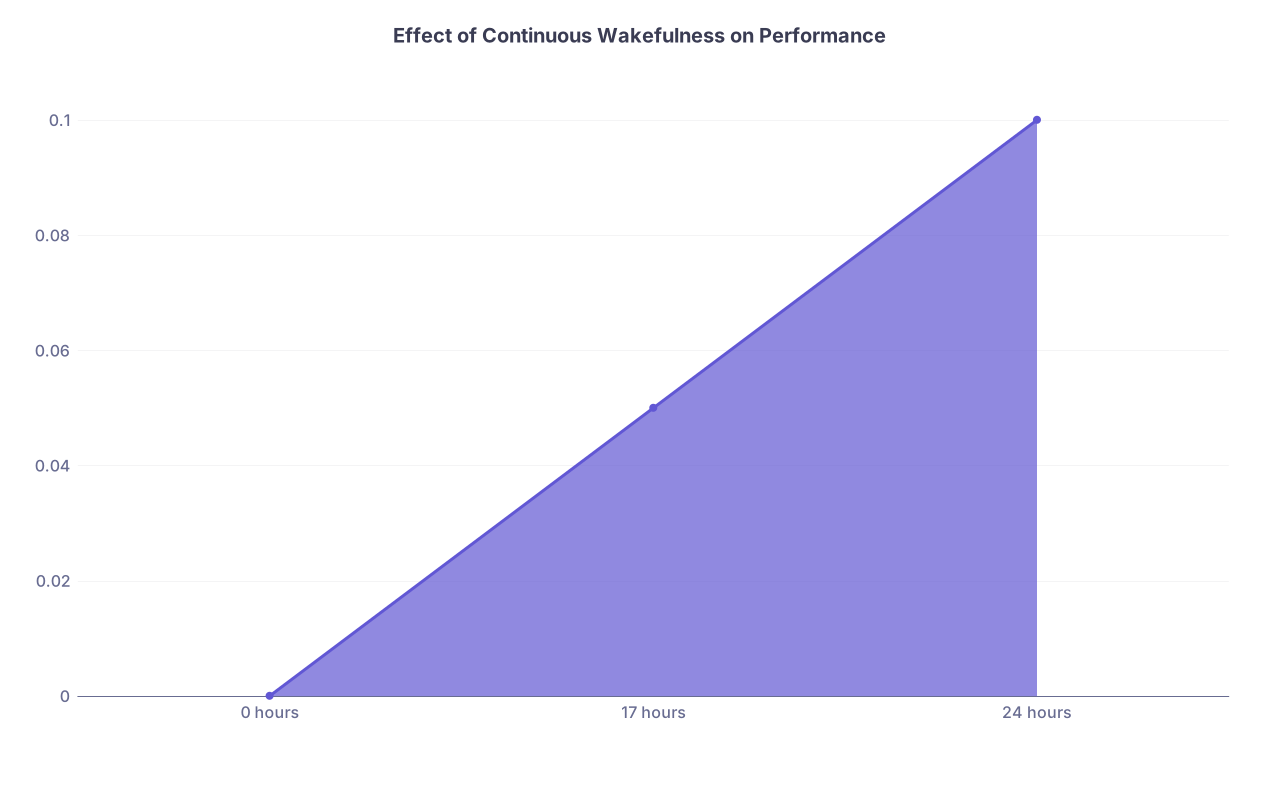
| Category | Value |
|---|---|
| 0 hours | 0 |
| 17 hours | 0.05 |
| 24 hours | 0.1 |
That 0.05 and 0.10 are roughly equivalent blood alcohol levels in terms of impairment. Staying awake 17–24 hours can put your cognitive performance in the same ballpark as someone who’s legally drunk.
So no, you’re not weak for feeling slower, foggier, and more paranoid about mistakes at 3 a.m. That’s your brain trying to keep you alive.
Here’s the part your anxiety doesn’t tell you though: medicine has built layers around that reality. Some of them are clunky, some are bureaucratic, but a lot of them do work.
The system doesn’t assume you’ll be “sharp enough” after 24 hours. It assumes you won’t be. And then it puts up guardrails.
The Safety Net You Forget Exists When You’re Spiraling
When you’re terrified you’ll kill someone because you’re tired, you’re usually picturing a scenario where it’s just you, your fried brain, and a critically ill patient with zero backup.
That’s almost never the reality.
Let me break down some of the invisible safety nets that are easy to ignore when you’re panicking.
1. You’re Not Practicing Alone (Even When It Feels Like It)
There is always somebody above you. Even when you’re “the only one in-house.”
- Senior resident
- Night float
- Chief resident
- Attending on call
Even on services where the attending is “home call,” they’re still on. You can wake them up. You are allowed to wake them up. Good attendings would rather be mildly annoyed than read a morbidity and mortality case about you guessing alone at 4 a.m.
The hardest mental shift is this: the times you most need to call for help are precisely the times you’re least sure you “deserve” to.
The right hierarchy is this:
- Uncertain + exhausted = call
- Gut feeling “something is off” = call
- Anything that feels even remotely like “this could go bad fast” = call
Not: “I’ll only call if the patient is literally coding.”
2. The System Knows You’ll Be Tired and Builds in Backups
You’re not the only line of defense between a bad order and a harmed patient.
Common real-life guardrails:
- PharmD double-checks high-risk meds (heparin drips, chemo, certain antibiotics, electrolytes).
- ICU nurses who’ve seen 15 years of residents at 3 a.m. and know when to say, “Are you sure you want that dose?”
- Hard stops in the EMR for crazy doses, contraindications, allergies.
- Protocols, order sets, sepsis bundles, stroke pages, STEMI pathways.
Do they catch everything? No. But they’re there because everyone already knows residents will be tired and imperfect.
Your anxiety assumes there will be no backup. The system assumes you’ll need backup.

3. Residency Work-Hour Rules Exist for a Reason (Even If They’re Imperfect)
Are ACGME work-hour limits enough? Debatable. Are they better than nothing? Absolutely.
| Rule Type | Typical Limit |
|---|---|
| Max hours/week | 80 hours (avg over 4 weeks) |
| Max shift length (intern) | 16 hours |
| Max shift length (upper) | 24 + 4 hours transition |
| Days off | 1 day off in 7 (avg over 4 weeks) |
| In-house call frequency | No more than Q3 |
Do programs fudge these? Some do. Do residents underreport to avoid drama? Yes. But the baseline reality: your schedule could be worse, and it has been historically. It’s not your imagination that older attendings had even more brutal call and made it out alive, but that doesn’t make what you’re feeling less valid.
You’re allowed to say: “Even 24 hours is too much for my brain to feel safe.”
You’re also allowed to say: “I can function, but I need systems and habits that reduce my chance of hurting someone.”
That second sentence is where your power actually is.
Concrete Ways to Protect Patients When You’re Exhausted
Here’s where anxiety loves to get stuck: “I’m tired, therefore I’m dangerous, therefore I’m a bad doctor.”
You’re not a bad doctor for being tired. You’re a bad doctor if you know you’re tired and pretend it doesn’t matter.
So let’s get uncomfortably specific about what to actually do when you’re in that terrible half-awake state.
1. Slow Down on Anything That Can Kill Someone
You cannot brute-force your way through fatigue with willpower, but you can manually lower the risk with friction.
Stuff to automatically slow down for:
- Insulin, potassium, anticoagulants, pressors, opioids
- New orders in very unstable patients
- “Weird” presentations that don’t quite fit any diagnosis cleanly
- Discharge orders for high-risk meds or fragile patients
Minimum safe process:
- Say the order out loud to yourself.
- Re-check dose, route, frequency, and weight/renal function if relevant.
- If brain fog is bad: write it on scrap paper, then enter it in the EMR.
If something feels even slightly off and you hear that little internal, “Is that right?”—that’s your cue to stop and confirm, not push through.
2. Use a “Tired Brain Checklist” When You’re Struggling
You need habits that work when your IQ has dropped 30 points from sleep loss.
Make yourself a tiny mental or written checklist for:
- Cross-cover calls
- Post-call sign-out
- Admissions at night
For example, cross-cover call checklist:
- Vitals now? Vitals trend?
- Last set of labs? Any recent imaging?
- What’s changed from baseline?
- Is this “treat and move on” or “something’s really wrong”?
- Do I need to see them in person now?
- Do I need to call my senior/attending?
This sounds basic. At 3 p.m., you could do this in your sleep. At 3 a.m., you literally can’t do it in your sleep. That’s the point.
3. When You Feel Unsafe, Say the Quiet Part Out Loud
One of the strongest moves you can make is also one of the hardest to admit: “I am too tired to safely do this alone.”
That doesn’t mean you walk off service. It might mean:
- “Can you double-check this insulin dosing with me?”
- “I’ve been up 22 hours. Before I sign out this ICU patient, can we quickly go over the vent and drips together?”
- “I’m starting to feel foggy—can I run this admission by you before I finish the plan?”
That’s not weakness. That’s literally how you keep people alive.
The residents who scare me aren’t the ones who say, “I’m exhausted, help me think this through.”
It’s the ones who say, “I’m fine, I’ve got this,” when they’re clearly running on fumes and pride.
4. Use Nurses and Pharmacists as the Safety Allies They Actually Are
Here’s a secret that shouldn’t be a secret: experienced nurses and pharmacists will save your butt more than once in residency.
If a nurse says, “Are you sure?”—stop. They’ve seen a lot of 3 a.m. errors.
If pharmacy pages you with, “Just confirming this dose…”—that’s them giving you a free second chance, not challenging your authority.
The insecure, defensive resident hears, “They think I’m stupid.”
The safe, tired-but-self-aware resident hears, “Thank God someone else is looking at this.”

| Step | Description |
|---|---|
| Step 1 | Notice you feel too tired |
| Step 2 | Slow down and double check |
| Step 3 | Call senior or attending |
| Step 4 | Proceed and document clearly |
| Step 5 | Use checklists and standard orders |
| Step 6 | Ask nurse or pharmacy to double check if needed |
| Step 7 | Critical decision? |
| Step 8 | Still unsure? |
The Fear Behind the Fear: “What If I Actually Hurt Someone?”
Let me say the thing you’re really scared of: not just “a mistake,” but a harmful mistake. One that sticks with you. That changes how you see yourself forever.
You will make mistakes in residency. That’s a given. Most will be:
- Annoying
- Embarrassing
- Educational
A smaller number will be:
- Potentially harmful but caught in time
- Minor harm that heals
Very, very few are fatal. And those almost always have multiple contributing factors:
- System issues
- Communication breakdowns
- Poor handoffs
- Bad documentation
- Multiple people missing the same red flag
It is almost never “the one tired resident at 3 a.m. who single-handedly killed a patient because they were too weak to push through fatigue.”
Your job is not to be superhuman. Your job is to:
- Notice your own limits earlier
- Speak up sooner
- Build boring, unsexy safety habits that keep you from being the last unchecked step in a long chain of errors
You’re not responsible for eliminating all risk from medicine. You are responsible for not pretending you’re functioning well when you’re not.
When the Work Hours Truly Are Unsafe
Sometimes the fear isn’t irrational. Sometimes your program is legitimately blowing past safe boundaries.
Yellow flags:
- Regularly exceeding 80 hrs/week averaged over 4 weeks
- Repeated 28–30+ hour stretches with heavy responsibility
- No real backup at night for sick patients
- Culture where asking for help is mocked or punished
If that’s you, you’re not overreacting. That’s dangerous.
What you can do:
- Quietly track your hours and shifts for yourself.
- Talk to trusted seniors: “Is this normal here? How do people handle this?”
- Use your GME office, chief residents, or program director if patterns are bad, not just one bad month.
- If you’re a med student / applicant: pay attention during away rotations and interviews. Residents saying, “We’re fine, you get used to it” with dead eyes? That’s data.
You’re allowed to care about your own safety too. The fantasy of “I’ll just destroy myself now and be fine later” is how burnout and depression sneak up on people.
How to Quiet the Constant “What If I Kill Someone?” Loop
This fear doesn’t go away entirely. Honestly, you probably don’t want it to. A little fear is what keeps you from becoming reckless.
But the 24/7 catastrophizing where you:
- Re-play every overnight decision on repeat
- Imagine worst-case outcomes for every cross-cover call
- Interpret normal fatigue as a moral failing
That’s fixable.
A few things that help:
Structured debrief for bad nights
After a brutal call: ask a senior or attending to walk through any cases you’re worried about. “Can we quickly review Mr. X and Ms. Y from last night? I just want to make sure I didn’t miss anything major.”
Often you’ll hear, “That’s exactly what I would’ve done,” and your brain can stand down.Differentiate error vs. outcome
Bad outcome ≠ bad care. Good outcome ≠ good care. You judge your performance by process, not by whether the patient got better or worse.Therapy. Yes, really.
A ton of residents are in therapy. The fear of harming someone is a completely legitimate topic to unpack with a professional, not something you just white-knuckle through alone.Talk to second- and third-years honestly
Ask them directly: “What’s your closest call? How did you handle the fear afterward?”
You’ll realize you’re not the only one who’s gone home thinking, “Did I just ruin someone’s life?”
FAQ (Exactly 4 Questions)
1. What if I’m so tired I literally feel unsafe—can I refuse to do something?
You can and should say, “I’m exhausted enough that I’m worried about making a mistake. Can you walk through this with me or have someone double-check what I’m doing?” Flat-out refusing might escalate fast, but framing it as a safety concern and request for help is both reasonable and defensible. If you’re being forced into clearly unsafe practice repeatedly, that’s a GME-level issue, not a personal failing.
2. Will one serious mistake end my career?
Usually, no. Serious events are investigated, and the outcome depends on intent, honesty, pattern of behavior, and system factors. If you hide, lie, or blame others, that’s career-killing. If you’re transparent, reflective, and willing to learn, it’s more likely to become a painful but survivable part of your training story. Most attendings have one case that still wakes them up at night—and they’re still practicing.
3. Is it normal to dread every call shift because of this fear?
Yes. Many residents start dreading call not just because of the hours, but because they’re scared of being the one “in charge” while exhausted. It tends to get better as your pattern-recognition improves and you experience more “I handled that okay” nights. If the dread is so intense you can’t sleep, eat, or think straight, that’s a sign to talk to someone (program leadership, peers, or mental health support).
4. How do I know when to wake up my attending at night?
Simple rule: if a bad outcome would make you say, “I should’ve called,” then call. Unstable vitals, rapid changes, anything involving pressors/intubation/code status, big management shifts, or your gut screaming “I’m out of my depth”—that’s attending or at least senior-level territory. You will never get in real trouble for “over-calling” with legitimate concerns. You will feel awful if you under-call and regret it.
Here’s your next step:
Take a scrap piece of paper (or a note on your phone) and write a tiny “Tired Brain Safety List” for yourself: 3–5 things you’ll always double-check or get help with when you’re exhausted (for example: insulin, heparin, new pressors, discharges on opioids).
Keep it in your pocket or saved in your notes. Tonight or on your next call, use it once. Just once. Prove to your anxious brain that you’re not helpless against fatigue—you’re building your own guardrails.