
The fantasy that you can “do it all” in residency and your relationships won’t take a hit is a lie.
If you’re scared residency is going to wreck your relationship, your friendships, maybe even your future marriage or ability to have kids…you’re not crazy. You’re just paying attention.
I’m going to be blunt: residency will stress every relationship you have. But that’s not the same as “it will destroy them.” Those are two very different outcomes. And which one happens actually has a lot less to do with your specialty’s hours and a lot more to do with how you and the people around you handle those hours.
Let’s do an actual hours reality check, not the vague “80-hours-ish, you’ll be fine” nonsense people throw around.
What Residency Hours Really Look Like (Not the Brochure Version)
First, the numbers, because your brain probably wants to know: “How bad is this actually?”
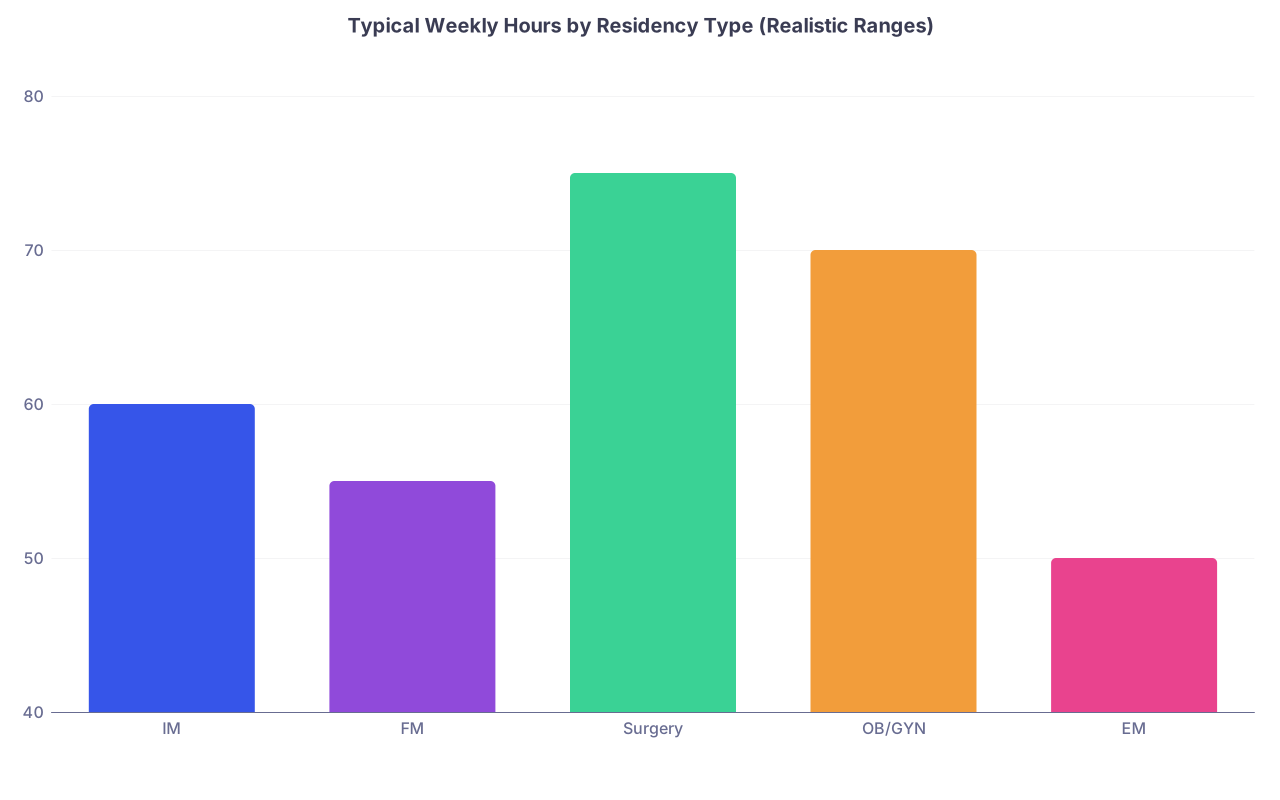
| Category | Value |
|---|---|
| IM | 60 |
| FM | 55 |
| Surgery | 75 |
| OB/GYN | 70 |
| EM | 50 |
These are ballpark averages people actually report, not the sugar-coated “we comply with 80 hours” line:
- Internal Medicine: 55–70 hours/week, some rotations lighter, some brutal wards at 75ish
- Family Medicine: 50–60 hours/week; clinics more predictable but nights/call still hit
- Surgery (especially general, ortho, neurosurg): 70–80 hours most weeks, some feeling like more
- OB/GYN: 65–80 hours, call-heavy, nights, unpredictable
- Emergency Medicine: 36–45 hours of shift work, but odd hours and recovery time mess with life
Now, here’s the part nobody says out loud: it’s not just the total hours. It’s when those hours are and how they scatter your life.
- Random nights and weekends
- Flipped sleep schedules
- 6-day work weeks as “normal”
- Home call that sounds easy but destroys dinner anyway because your brain can’t relax
Relationships don’t get killed by “I work 65 hours.” They get killed by:
- “I can’t tell you if I’ll make your birthday dinner until the day of.”
- “I’m off Sunday, but I just worked 6 nights and I’m a zombie.”
- “I haven’t actually had a real conversation with you in 10 days; I’m just collapsing into bed.”
That’s the reality check.
How These Hours Actually Hit Different Relationships
Romantic partners (dating, engaged, married)
This is the one that scares people the most: “What if they leave? What if they get tired of this? What if I become that resident whose spouse is basically a single parent?”
Here’s what I’ve seen play out over and over:
Patterns that usually hurt relationships:
- Partner didn’t really believe the hours would be that bad, thought it was med school but “a bit more.”
- Resident feels guilty all the time → overpromises → cancels → partner feels like they’re always second place.
- No defined plan for “we time.” It’s always “when things slow down,” which they don’t.
- Silent resentment on both sides: you resent that they don’t “get it,” they resent that they come after your pager.
Patterns that usually protect them (even in bad hours specialties):
- Brutally honest expectations before residency starts. No sugarcoating.
- Very boring, very specific habits: weekly check-ins, shared calendars, small consistent rituals.
- Partner has their own life, friends, hobbies, identity. They’re not sitting at home suspended, waiting for you to be available.
And yeah, I’ve watched relationships break during intern year. I’ve also watched co-residents in surgery and OB–with objectively awful schedules–stay rock solid with partners who actually understood what they were signing up for.
The hours are the stress test. Not the sole cause.
Friends and social life
This one decays more quietly.
Friendship deaths in residency rarely blow up in one big fight. They just…fade.
How it usually happens:
- You say no to 3–4 things in a row.
- They stop asking because they’re “trying not to bother you.”
- You feel guilty because you “haven’t texted back in weeks.”
- Six months go by and suddenly it feels too awkward to restart.
Here’s the harsh truth: during residency, your friendships will not all get equal attention. Some will go into “maintenance mode.” Some will die. That’s normal. It hurts, but it’s normal.
The relationships that survive are usually the ones you:
- Intentionally check in with even when you’re tired (“Car ride home = 10-min call to one friend.”)
- Give context to (“If I go dark for a week, it’s not you. It’s this service.”)
- Let be low maintenance (“Voice memos, memes, quick texts” instead of long hangouts as the only option)
You’re not going to be the “always available” friend. But you can still be the “still shows up in small ways” friend.
Family (parents, siblings, future kids)
Here’s the nightmare spiral I know you’ve thought about: “What if I miss my parents aging, my siblings’ life events, my kids’ childhood?”
The painful answer: you will miss things. The important nuance: missing things is not the same as missing everything.
Most residents I know:
- Miss some holidays, not every holiday.
- Miss some recitals, games, birthdays—but are very present on off days.
- Learn to double down when they are off, instead of half-working and half-resting and half-present (yes, that’s three halves; you get the point).
Parents usually swing between two extremes:
- The “I brag about you but low-key guilt-trip you about never calling” parent.
- The “I’m just happy you’re alive and sleeping sometimes” parent.
You can’t fix their entire emotional experience. But you can do this:
- Set a realistic minimum: “I will call my mom once a week, even if it’s 5 minutes.”
- For big life events: be honest early. Don’t say “I’ll try” if you know your schedule makes it almost impossible. People handle clear “no” better than ghosting and excuses.
Future kids piece: yes, plenty of residents have kids. Even in surgery. Is it easy? No. Is it impossible? Also no. It just compresses your free time to almost nothing and ramps up the stakes at home.
What Actually Destroys Relationships (Spoiler: It’s Not Just Hours)
Let me be direct. The hours load the gun, but they’re not what pulls the trigger.
The stuff that truly wrecks relationships in residency usually looks like this:
Chronic flaking with no repair.
Not just canceling once; that happens. But canceling, not acknowledging, and acting like they “should understand.” People will understand a hard week. They won’t understand being treated like an afterthought.Using “I’m tired” as a hall pass for everything.
You are tired. Deep-bone, soul-level tired, especially on q4 call or nights. But if “I’m tired” is the only reality that matters in your head, your partner/friends eventually stop bringing their needs to you. And that’s when distance hardens.Never articulating your limits.
You say yes to extra shifts, side projects, boards study groups, social plans → then you explode and shut down on everyone. If you never tell anyone your capacity, they’ll keep adding until you break.Resenting people for not reading your mind.
“They should know I care even if I don’t text.” They don’t. People remember how they feel around you, not what your internal intentions are.Refusing to decide what matters most.
If everything is equally important—research, social, wellness, family—then nothing truly wins. Your time gets sliced so thin that your relationships never get enough to feel solid.
Things That Actually Help (And Don’t Require You To Be a Superhero)
Let’s talk about things you can actually do. With 60–80 hour weeks. Not fantasy-life suggestions.
1. Do a brutal expectations talk now (before Match or before PGY1)
If you’re already in a relationship, you need one big, honest conversation. Not a vague “it’ll be hard but we’ll get through it,” but a detailed “here’s what life may actually look like.”
Stuff you should actually say out loud:
- “There will be weeks where I come home and just shower and sleep. That’s not because I don’t care about you.”
- “I might miss some important things. That will hurt both of us. I want to decide together what’s truly non-negotiable.”
- “There will be days you feel like you’re doing this alone. I want you to tell me when you feel that, so we can adjust instead of letting it silently grow.”
If your partner responds with: “You’re overreacting; it won’t be that bad, we’ll be fine”—that’s a red flag. Not necessarily a dealbreaker, but a you-two-are-not-on-the-same-page warning.
2. Use systems, not vibes
When you’re exhausted, you will not spontaneously remember to call your partner, text your friends, or schedule dinner with your family. You won’t. Your brain will be operating on “coffee, pager, not die” mode.
You need systems that don’t rely on your willpower.

| Step | Description |
|---|---|
| Step 1 | Start of Week |
| Step 2 | Check Schedule |
| Step 3 | Pick 1 partner plan |
| Step 4 | Pick 1 friend check in |
| Step 5 | Pick 1 family call |
| Step 6 | Put on shared calendar |
| Step 7 | Protected in advance |
Example system:
- Sunday night: 10 minutes with your calendar and your partner (if you have one).
- Pick ONE block for intentional time together (even if it’s just breakfast).
- Pick ONE friend to send a longer message or do a quick call.
- Pick ONE family check-in.
- Put it in the calendar like it’s a consult. Don’t trust your memory.
That’s it. Three humans, once a week, on purpose. It’s not magic, but it’s the difference between “I lost everyone over three years” and “I stayed tethered, even lightly.”
3. Micro-rituals beat grand gestures
You’re not going to pull off elaborate date nights every week. That’s just not real life in residency.
But you can build tiny, repeatable rituals that quietly keep bonds alive:
- Always sending a “headed home” text so they know when to expect you.
- Five-minute FaceTime while you brush your teeth on nights.
- Same coffee shop every post-call morning with your partner, even if it’s 30 minutes and you’re half-asleep.
- Voice messages instead of live calls—people can listen whenever.
These things sound small. They are small. But used consistently, they’re glue.
4. Accept that some loss is inevitable—and not a moral failure
Here’s something nobody tells you because everyone is busy pretending they’re balancing it all:
You will drop some balls.
- Some friendships will fade that you wish hadn’t.
- Some family members will not fully get it.
- Some people will think you’re “too busy” or “care more about work than them.”
This hurts. You can’t fix all of it.
Your job is not to keep every single relationship exactly as it was pre-residency. That’s impossible. Your job is to:
- Decide which relationships matter most right now.
- Give those ones deliberate, consistent attention.
- Forgive yourself for the ones that can’t get the same level of care.
5. Be honest about red-flag dynamics before residency amplifies them
Residency stress doesn’t create new relationship issues from nothing. It amplifies what’s already there.
Some dynamics that explode under residency hours:
- Partner is already insecure about your time or attention.
- You already avoid conflict or shut down instead of talking.
- You feel responsible for managing everyone’s emotions.
- One of you secretly thinks medicine is “just a phase” that will calm down soon.
Under 70-hour weeks, these become powder kegs.
Harsh but true: sometimes the relationship that breaks in intern year was already cracked; residency just exposed it. That’s not you being unlovable. That’s stress revealing structural problems.
Quick Comparison: Which Specialties Tend To Be Hardest On Relationships?
Not to start a war, but people obsess about this, so here’s a simple, honest snapshot.
| Specialty Type | Typical Strain on Relationships* |
|---|---|
| Lifestyle (Derm, PM&R, Path) | Low–Moderate |
| Outpatient-heavy (FM, Psych) | Moderate |
| Inpatient IM, Peds | Moderate–High |
| Shift-based (EM, Anesthesia) | Highly variable |
| Surgery, OB/GYN, Neurosurg | High–Very High |
*Strain = combo of hours, schedule unpredictability, nights/weekends, emotional toll.
Key point: I know people in “easy” specialties who are lonely and divorced. I know people in trauma surgery who are in rock-solid marriages.
Hours increase the difficulty level. They don’t determine the outcome.
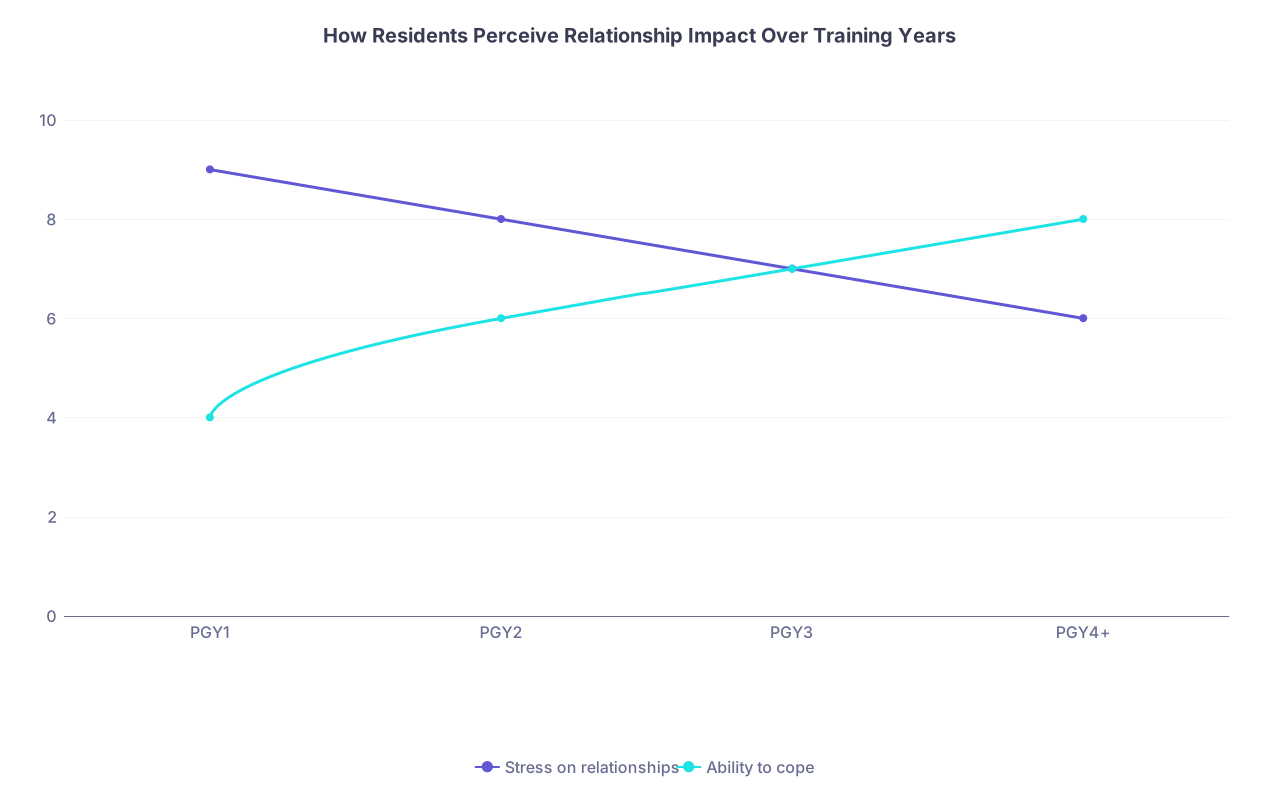
| Category | Stress on relationships | Ability to cope |
|---|---|---|
| PGY1 | 9 | 4 |
| PGY2 | 8 | 6 |
| PGY3 | 7 | 7 |
| PGY4+ | 6 | 8 |
Reality that might actually reassure you a bit: most people report PGY1 as the worst. Then they get slightly better at coping, negotiating time, and setting boundaries over time—even if hours don’t dramatically drop.
What If You’re Already Terrified You’ll Lose Everyone?
Let me name the fear directly:
- “What if I wake up at the end of residency and I’m a stranger to everyone I care about?”
- “What if nobody wants to be with someone whose job is like this?”
- “What if I’m trading every relationship I have for this career?”
Here’s what I’ve actually seen, over and over:
- Residents do maintain close relationships—but fewer of them, and more intentionally.
- People leave relationships that were half-in before residency and later find ones that actually fit their life.
- Many of them come out of residency with:
- One or two ride-or-die friends
- A partner who really understands what “busy” means
- A more grounded sense of who’s really in their corner
You’re not doomed to end up alone. You are doomed to have to prioritize, say no, and let some relationships change form or end.
That’s not moral failure. That’s capacity.

If You Remember Nothing Else, Remember This
Residency will absolutely stress-test your relationships. Some will crack. Some will bend and then come back stronger.
What decides which ones survive isn’t just:
- Your specialty
- Your hours
- Your call schedule
It’s:
- How honest you are about what you can and can’t give
- Whether you create tiny, boring, consistent habits to stay connected
- Who you choose to invest in, even when you’re exhausted
You don’t have to be perfect. You just have to be intentional.

FAQ (Exactly 6 Questions)
1. Is it unrealistic to start residency in a serious relationship?
No. Lots of people do. What is unrealistic is starting residency with a relationship built on “we’ll figure it out” without actually talking specifics. If your partner truly understands that there will be missed events, last-minute cancellations, and long stretches where you’re wiped—and they still choose in—that’s workable. If they want pre-residency levels of time/energy, they’re going to be miserable and so will you.
2. Which is worse for relationships: long hours or night shifts?
Both are rough, but in different ways. Long consistent days (say 6a–7p, 6 days/week) destroy free time but at least give some predictability. Nights wreck your circadian rhythm and your ability to overlap with a 9–5 partner. The real killer is unpredictability—rotations that constantly change your schedule so nobody can plan anything. That’s where clear communication and weekly planning become critical.
3. Should I delay residency to “fix” or “stabilize” my relationship first?
Be very careful with this. If the only way your relationship survives is by you not moving forward with your career, that’s a warning sign. Stabilizing communication, expectations, and conflict patterns before residency? Smart. Putting your entire life on pause because your partner “isn’t ready” for what your career actually is? That usually backfires and breeds resentment.
4. Can I realistically have kids in residency without destroying myself?
People do it. In every specialty. It’s hard. You’ll be tired, you’ll miss some stuff, you’ll rely heavily on your support system (partner, family, childcare). The residents who cope best usually: pick a less brutal time in training (not peak intern chaos), have a partner or support willing to shoulder a lot, and are ruthless about protecting home time when they’re off. It’s not “balanced,” but it can be meaningful and loving.
5. How do I explain residency hours to someone who’s never been in medicine?
Use concrete examples, not just numbers. Instead of “I’ll work 70 hours,” say: “For this month, I’ll leave home at 5:30 a.m. and probably get back around 7:30 p.m., six days a week. I’ll be on my feet most of the day and reachable by pager during call. On my day off, I might sleep a lot because that’s my only true recovery.” Ask them to tell you how that sounds to them. Their reaction will tell you a lot.
6. What’s one small thing I can do now to protect my future relationships in residency?
Make a list of your top 3 people you absolutely want to keep close through residency. Not 10. Three. Then send each of them a message this week that says something like: “Hey, residency is going to be intense. I care a lot about staying in your life. Can we talk sometime soon about how to keep in touch when I’m really busy?” Start that conversation now, before the hours hit.
Open your calendar right now and block off 10 minutes this week labeled: “Residency expectations talk.” Use it to either (1) sit down with your partner, or (2) text one friend and one family member to set up a real conversation. Don’t just worry about losing people—start building the habits that make them stay.