
What if you get to residency and your body just… breaks? Like you literally can’t handle the 70–80-hour weeks everyone jokes/complains/brags about?
The fear you won’t say out loud
Let me guess what’s playing on loop in your head:
“…What if I match, start intern year, and realize I actually cannot physically or mentally do this? Like I just shut down. Then what? I quit? I fail patients? I get fired? I ruin my career before it even starts?”
You hear residents flexing about “easy” 70-hour weeks and “only” 24-hour calls. Meanwhile, you’re thinking:
- I get migraines with bad sleep.
- I already struggle with anxiety/depression.
- I need real food and some semblance of exercise to not feel like trash.
- Even 60-hour weeks in 3rd year sometimes wrecked me.
And then the darker spiral:
“If I can’t do 80 hours, maybe I don’t deserve to be a doctor. Maybe I picked the wrong career and it’s too late to undo it.”
Let me be blunt: this fear is common, rational, and not a sign you’re weak. It’s a sign you’re paying attention.
But you also need to separate three very different things that get mushed together in your brain:
- What residency hours actually look like (not the horror-movie version in your head).
- What happens if you genuinely can’t handle it.
- What you can do now and during residency to not end up broken.
Let’s pull this apart.
What 80-hour weeks in residency really mean (and don’t mean)
First annoying truth: some rotations really do feel like they’re trying to see how far they can push you without technically breaking ACGME rules.
But second truth: “80 hours” is very often a ceiling, not your permanent baseline.
| Specialty Type | Typical Range (PGY-1/2) | True 80-hour Rotations? |
|---|---|---|
| Outpatient-heavy (FM, Psych) | 45–65 hrs/week | Rare |
| Mixed (IM, Peds, OB) | 55–75 hrs/week | Some rotations |
| Surgical specialties | 65–80 hrs/week | Common on certain services |
And then there are the legal guardrails that do exist, even if programs sometimes quietly test them:
- 80-hour average per week, over 4 weeks
- 1 day off in 7, averaged over 4 weeks
- Max 24 hours of continuous clinical duty (plus up to 4 hours for sign-out/education)
- At least 8 hours between shifts (ideally 10)
Do programs sometimes cheat? Yes. Especially malignant ones or insanely busy services. You’ll hear “we’re at 79.9 hours, we’re fine” with a smirk.
But the reality on the ground is usually:
- Some rotations feel brutal (ICU, ED, certain surgical months)
- Some feel “only” busy (wards, nights, consults)
- Some are… dare I say… manageable (electives, clinic blocks, research time)
You’re not at 80 every week for 3–7 years straight. Your anxiety brain is projecting one worst-case week onto your entire future.
Still, let’s not sugarcoat it: if your absolute limit is 45 hours or you crash physically past 55, residency is going to be a serious problem.
So then the real question becomes: what if you already suspect your limit is lower than what residency expects?
Are you actually unable to handle it — or just scared you might be?
This is the part where you’re probably lying to yourself in both directions.
I’ve seen:
- People convinced they “can’t tolerate sleep deprivation”… then somehow function on trauma call nights that would kill a normal person.
- People who thought they were fine… and by October of intern year they’re getting panic attacks in stairwells and forgetting basic orders.
Your brain is a terrible predictor when it’s scared.
Let’s test your situation with some real questions:
- During your busiest clerkship (like surgery or medicine), what actually happened when you had a string of 12–14 hour days? Did you collapse? Get sick? Barely make it but still function?
- Have you ever done stretches of 60+ hour weeks (exams, projects, rotations, extra jobs)? What broke down first—sleep, mood, cognition, physical health?
- Do you have a chronic condition (migraines, autoimmune disease, GI issues, mental health) that reliably flares with stress/sleep loss?
If your honest answers are:
- “I suffered, but I adapted somewhat over 1–2 weeks, and I could still think clearly most of the time.” → You’re probably more capable than you think.
- “I became unsafe. I made scary mistakes, had severe physical symptoms, or crashed into major depression/anxiety every time.” → That’s a red flag you need to respect.
There’s also the fun overlap where anxiety makes you feel like you’re physically incapable… and then the fear itself makes your body perform worse. Cool system.
This is where having a real doctor/therapist, not just your inner critic, assess you is crucial.
What actually happens if you can’t handle the hours?
This is the nightmare scenario your brain refuses to look at directly. So let’s stare at it.
Here are the main paths I’ve actually seen:
You struggle, ask for help early, and things get adjusted.
- Schedule modifications (less night float, fewer ICU months back-to-back)
- Formal disability accommodations (protected time for appointments, schedule tweaks)
- Medical leave for a few weeks or months, then return with a plan
You crash, try to hide it, and things implode.
- Errors increase, attendings lose trust
- Bad evals accumulate
- You eventually get pulled from service anyway—just now with worse optics and less sympathy
You and the program agree it’s not working.
- You resign or are non-renewed
- You might transfer to a less intense program, a different specialty, or step away from clinical medicine
The outcome your brain dramatizes—“I fail once, therefore I’m permanently unemployable and disgraced”—is extreme. It happens almost never.
What actually happens more often:
- Someone takes 3–6 months medical leave for mental health, returns with better support, finishes.
- Someone in surgery realizes they simply cannot tolerate the lifestyle, transfers to radiology, anesthesia, or a primary care specialty.
- Someone finishes residency slower (takes a leave or does a remediation year), then still gets a job.
Is it fun? No. Does it destroy your life? Usually not.
The absolute worst, realistic-case:
- You do not complete residency.
- You pivot to a different medical/non-medical career using your degree and experience.
Is that painful? Yes. Is it the same as “life over”? No. It’s just not the Pinterest version of your future.
How much control do you actually have?
More than you think, less than you want.
1. Choice of specialty and program matters. A lot.
If you already know your body and brain don’t handle chronic sleep deprivation, choosing trauma surgery at a county hospital is… not strategic.
That doesn’t mean you have to default to derm. But be honest:
- Outpatient-heavy fields: family med, psych, some peds, PM&R, path
- Mixed but intense: internal med, OB/GYN, EM
- High-intensity monsters: surgery fields, neurosurg, ortho, some IR-heavy radiology programs
And within each specialty, the program culture is everything.
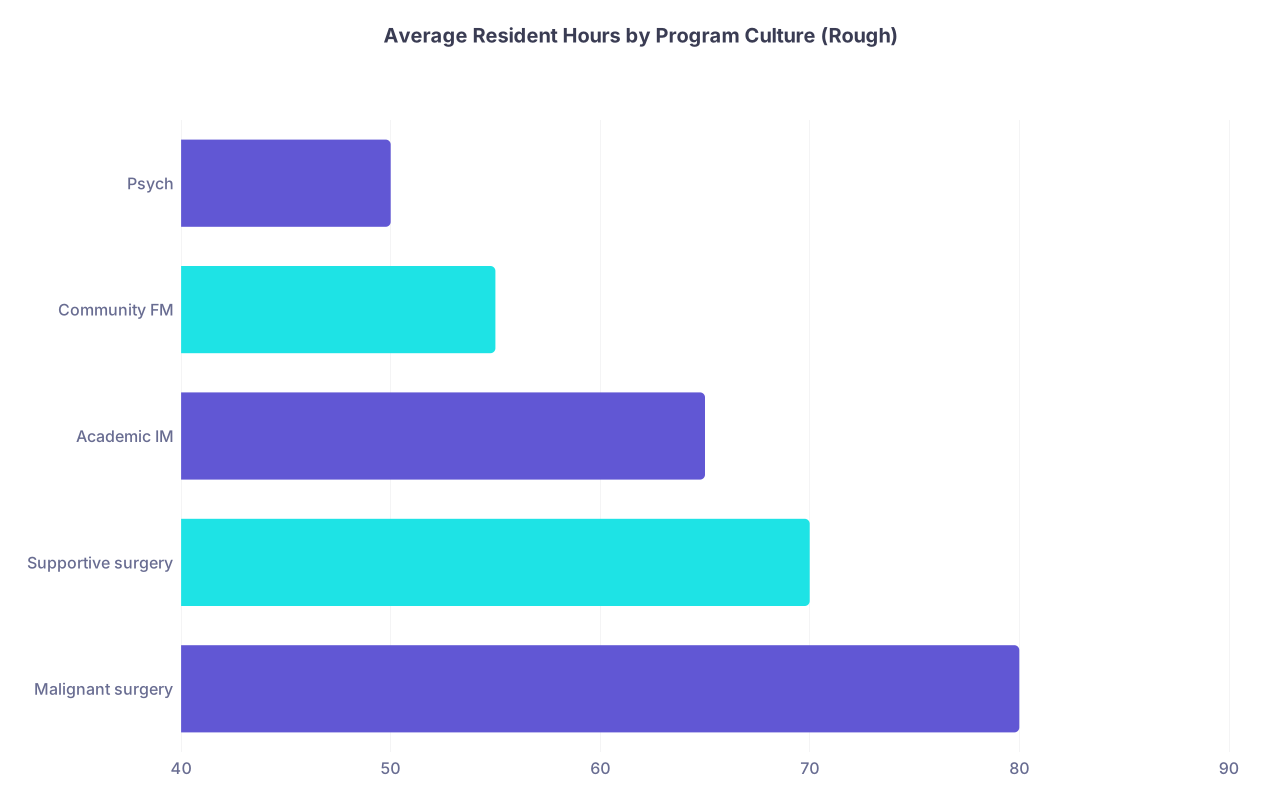
| Category | Value |
|---|---|
| Malignant surgery | 80 |
| Supportive surgery | 70 |
| Academic IM | 65 |
| Community FM | 55 |
| Psych | 50 |
Red flags from residents on interview day:
- “You’ll be fine as long as you don’t log every hour.”
- “Technically we get a day off a week…” followed by eye-rolls.
- “We don’t really believe in using sick days.”
- Everyone joking about “sucking it up” and “no wimps.”
Green-ish signs:
- Residents openly talk about mental health resources and actually using them.
- Chiefs/Admin say, “If you’re hitting 80 regularly, we want to know. That’s a problem.”
- People seem tired but not dead behind the eyes.
You cannot perfectly predict, but you are not helpless. Where you apply and how you rank programs is one of the few levers you control.
2. You can get accommodations. Yes, even in residency.
Residency is a job. Jobs are covered by disability laws.
If you have:
- ADHD, depression, anxiety, bipolar, PTSD
- Chronic illness (autoimmune, migraines, IBD, etc.)
- Sleep disorders
You can, in many cases, get things like:
- Slightly modified schedules
- Protected time for therapy/appointments
- Avoiding certain types of shifts if medically necessary (this one is trickier but possible in some places)
Will every program love it? No. Will some quietly judge? Yes. But your options are not “suffer silently” vs “get kicked out.”
I’ve watched residents get:
- Formal reduced schedules after a hospitalization for suicidality.
- Night float adjustments due to documented sleep disorders.
- Staggered step-up plans after going out on leave.
You need documentation. You need the GME office involved. You need a physician backing you. But it’s absolutely a thing.
3. You can treat your body like a tool you’re sharpening, not a victim you’re sacrificing
No, I’m not about to tell you “just sleep more and meal prep.” That advice is insulting when you’re on q4 call.
But you do have some non-negotiables you can protect more than you think:
- Micro-sleep: those 10–20 minute naps on call are not optional; they’re survival.
- Non-hero logging: actually log your hours accurately so there’s data when things are bad.
- Basic boundaries: when you’re post-call and someone hints you should “just stay a bit longer,” sometimes the correct answer is “No, I’m not safe to stay.”
You’re not a passenger. You’re not completely in charge either. It’s somewhere in the messy middle.
How to know if you’re actually in danger vs just scared
Some fear is appropriate. Residency should intimidate you a little. But you need to know when the alarm bells mean something serious.
Big red-flag signs that 80-hour weeks could truly be unsafe for you:
- You’ve had multiple hospitalizations or near-hospitalizations related to stress or sleep loss (psych or medical).
- You’ve had serious suicidal ideation or attempts in the last 1–2 years, especially linked to academic pressure.
- Your chronic illness predictably flares with moderate sleep changes, not just extreme ones.
- You already feel constantly maxed out at 45–50 hours/week of school/clerkships and can’t imagine sustaining more without breaking.
If that’s you, this is not a “push through, you’ll adjust” situation. That’s fantasy.
It means:
- You absolutely need a treating doctor who knows your career path and is brutally honest about risk.
- You may need to recalibrate specialty choice, program type, or even whether clinical residency is the right move for you right now.
- This doesn’t mean “never be a doctor,” but it might mean “not in the shape of a 6-year general surgery residency starting this July.”
So… what if you really, truly can’t handle 80 hours?
Then you adjust the plan. Not your entire worth as a human.
Real outcomes I’ve seen (not theoretical):
- A surgery intern who developed severe depression switched to radiology, finished, is now happy and alive.
- A psych resident took a full year of leave for mental health, came back, finished, now does part-time outpatient.
- An IM resident with brutal autoimmune disease stepped away, later built a career in clinical research and medical education, no longer does overnight clinical work.
Were these people “too weak” for medicine? No. They just didn’t fit the trap we all secretly fear: the one mold where the only acceptable doctor is a 29-year-old with no health problems, endless stamina, and no limits.
Your body having limits doesn’t disqualify you from this field. But refusing to acknowledge those limits? That’s how people get hurt—patients and residents both.
If you’re still reading and your chest is tight…
Here’s what I’d tell you if we were sitting in a call room at 2am and you whispered, “I don’t know if I can do this”:
- You don’t have to decide your entire future tonight.
- You do need real data about yourself: how you function under less-than-ideal conditions, not theoretical doom.
- There are more off-ramps, side doors, and alternate paths in medicine than anyone tells you during premed.
- You’re allowed to want a life that doesn’t destroy you. That’s not weakness. That’s common sense.
You are not the only one quietly Googling “what if I can’t handle residency hours.” You’re just one of the few actually facing it instead of dissociating until Match Day.