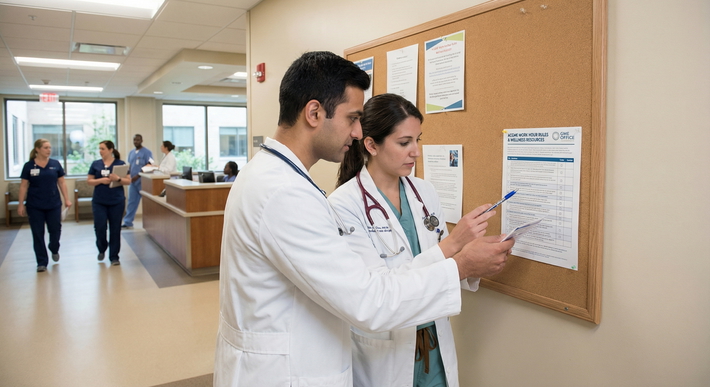
It’s 2:37 a.m. You’re an intern on wards, half-conscious, staring at the EMR. Your cross-cover pager has not stopped all night. You just finished writing a note that you barely remember typing. You stand up to see a patient and the room tilts for a second.
Your senior looks over from the other computer, watches you a little too long, and says: “I’ll take that one. You finish those orders and then eat something.”
You think they’re just being nice.
They’re not. They’re running interference. Protecting you. And they’re doing more than you realize.
Let me walk you through what actually happens behind the scenes when seniors quietly keep interns from getting crushed. Because a lot of this never gets said out loud, and you will not find it in any ACGME handbook.
The Real Job of a Good Senior: Not Letting You Break
On paper, the senior is “team leader,” “workflow coordinator,” “clinical supervisor.”
In reality? Their unspoken job is: do not let the intern go over the edge.
I’ve sat in resident workrooms at 3 a.m., heard a PD tell us bluntly at the start of the year: “I care about patient safety. And I care about your interns not getting destroyed. If I hear your intern is drowning and you look fine, you and I will have a problem.”
That message trickles down. The good seniors take it seriously. They do it quietly so you do not feel weak or incapable. Here’s what they’re actually doing.
1. The Constant Headcount of Your Bandwidth
A good senior is not just tracking admissions and discharges. They’re tracking your cognitive capacity.
They watch your charting speed. Your body language. How often you sigh before picking up the phone. How long you stare at a vitals trend before acting.
They notice when:
- You stop pre-charting.
- Your notes get weirdly short or weirdly long.
- You start missing obvious things—like not noticing a K of 2.9 or a heart rate of 140.
- You reread the same order set three times.
When that happens, the senior quietly adjusts the load without announcing it. They take the next admission “to help the team move faster.” They call radiology instead of making you do it “because I know the attending.” They review the chart themselves before they ask you to go see the patient.
You think: “Wow, my senior is on top of things tonight.”
Translation: they’re seeing cracks in your bandwidth and patching them before something breaks.
The Covert Ways Seniors Block Dangerous Overwork
There’s a set of tricks seniors use that never get written down. They’re not about “professionalism” or “time management.” They’re pure damage control.
2. The “I’ll Just Do It” Maneuver
Every good senior has done this.
The intern is drowning. It’s 6:15 p.m., sign-out is at 7. There are:
- Two discharges half-written
- New admission in the ED
- Family wanting an update
- Attending texting about a transfer status
- And a page about low urine output
A mediocre senior will say, “Okay, let’s divide and conquer, you do X, I’ll do Y.”
A seasoned senior looks at you—eyes red, shoulders slumped—and says: “You finish those two discharges. I’ll do everything else. If anyone asks, I assigned it to myself. You’re capped.”
Then they sprint:
- Call the ED, place admitting orders themselves.
- Call the family, apologize for delay, give update.
- Call the nurse about the urine output and handle it.
- Shield you from further pages by telling nursing “Page me first for the next hour.”
You see maybe 20% of that. The other 80% you just feel as “The night got slightly less horrible for some reason.”
3. Quietly Capping Your Load Before The System Does
The ACGME and the EMR have rules: max number of patients, max number of admits, work-hour limits.
Good seniors impose stricter limits on interns than the system does. Quietly.
That might look like:
- You’re at 8 patients on a busy IM service. Official cap is 10. The senior takes the next two “for teaching purposes” and never tells you they just protected you from your last two admits.
- You’re on call, and technically the system will let you admit up to your cap until 4 p.m. The senior starts telling admitting: “We’re full; give that case to the other team” while you think the hospital is just “distributed evenly” today.
- You hit hour 28 on a “24+4” day and you’re still writing a note. Senior logs your time out and tells you to go home. They finish your note. If questioned, they say, “I told them to log out at that time; I supervised the rest.”
To you it feels like random luck. It isn’t. It’s controlled triage of your work hours by someone who has already been on the edge and knows exactly what it looks like.
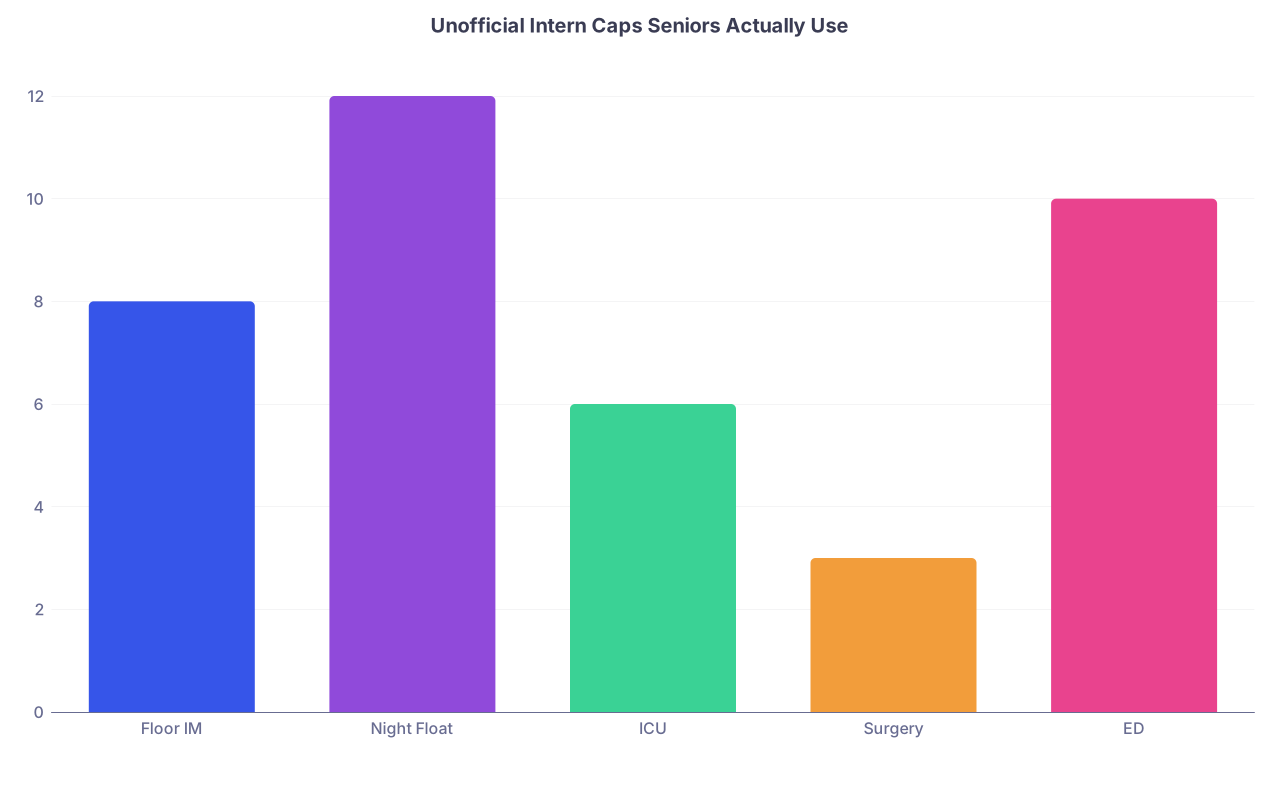
| Category | Value |
|---|---|
| Floor IM | 8 |
| Night Float | 12 |
| ICU | 6 |
| Surgery | 3 |
| ED | 10 |
Publicly they’ll say “We follow institutional caps.” Privately, seniors will say in the workroom: “Nobody’s intern should be carrying 14 patients. I don’t care what the policy says.”
4. The Fake “This Is For Teaching” Move
Sometimes they have to protect you and your ego.
So instead of saying, “You’re too overloaded, I’m taking work away from you,” they say, “Let me staff this one directly, it’s a good teaching case for me too,” or “I’ll dictate this discharge so you can finish pre-rounding, it’s good practice for me.”
You feel like they’re doing it to learn or to demonstrate how to structure a note. Maybe that’s 10% true. The other 90% is they see that your cognitive lights are flickering.
I’ve heard seniors literally say in the workroom after you leave: “No way I’m letting them write three complex discharge summaries after that night. I’ll just do it and call it ‘efficiency teaching.’”
The Battles You Never See: Seniors vs Attendings, Chief Residents, and Nursing
You think your senior is just another middle layer. They’re actually your first line of defense in a system that will absolutely chew you up if nobody intervenes.
5. Pushback Against Attendings (That You Do Not Hear)
A lot of attendings are great. A few are… not tuned in to intern limits.
You see the attending say on rounds: “Let’s add full ROS and detailed hospital course to all discharge summaries; it’s better for billing and clarity.”
You nod, miserable.
Your senior smiles and says, “Absolutely.” Rounds end. You go off to write notes.
Then, away from you, in a separate conversation, your senior will say to that same attending: “Dr. X, we can do that on a couple of complex patients, but our intern left at 9 p.m. twice last week finishing notes. I’d rather they focus on accuracy and early dispo. I can help with complex ones.”
Translated: I’m not letting you balloon this intern’s workday for marginal benefits.
You rarely hear these conversations. They happen after you log out, in hallways, in offices, in brief “huddles” with chiefs in the background.
6. The Quiet Complaints to Chiefs and PDs
Seniors file the “real” feedback on workload. Interns almost never do, because you’re afraid you’ll be labeled weak or ungrateful or “not a team player.”
Good seniors know that. So they become your proxy.
Things like:
- “The new sign-out template adds 20 extra minutes to every sign-out; my intern is constantly over.”
- “The overnight cross-cover for this combined service is unsafe. We had 40 patients and one intern last night.”
- “Dr. Y consistently gives new consults to the intern after 4 p.m. on call days. We’re blowing through duty hours.”
I’ve seen chiefs respond only when the complaint comes from a senior or above. They assume interns are still calibrating and might overstate things. When seniors say, “This is dangerous,” leadership usually takes it more seriously.
You’ll never know which changes happened because your senior advocated for you two months earlier.

| Step | Description |
|---|---|
| Step 1 | Intern Overwhelmed |
| Step 2 | Senior Notices |
| Step 3 | Senior Takes Workload |
| Step 4 | Senior Talks to Chief |
| Step 5 | Chief Adjusts Schedule |
| Step 6 | Future Intern Load Lower |
| Step 7 | Fix Today? |
Tactics Seniors Use Within the Team: How They Quietly Rebalance Work
Not all protection is top-down. A lot of it is micro-level: who writes which note, who calls which family, who pre-rounds on which patient.
7. Redistribution Without Drama
You’ll see this on busy services.
Two interns. One is fresh off nights and functioning at 60%. The other is moving fast. Officially both get 8 patients.
A tuned-in senior will:
- Give 10 patients to the stronger intern, 6 to the exhausted one.
- Have the senior themselves take 2 of the complex ones directly.
- Out loud, they’ll say, “I’m just arranging people by which patients they’ve followed before,” or “Let’s not reshuffle too much; I’ll follow these.”
They’re hiding the fact that they don’t want one intern to implode. Nobody needs to be called out as “the weak one” that day. The work just gets shifted in a way that makes sense on paper.
I’ve done this. I’ve also watched weak seniors do the opposite—rigidly give equal lists “for fairness” and then watch one intern fall hopelessly behind. That’s how you get 9 p.m. notes and missed labs.
8. Protection on Post-Call Days
Call days are where good seniors stand out.
Official rule: post-call interns should leave “by X time” and not pick up new work.
Real life? If nobody enforces that, attendings will keep asking “one more thing” until you’re there well past what’s safe.
So here’s what the good seniors do:
- On rounds, they preemptively say: “We’ll have [Intern] sign out at 11; I’ll handle any follow-up that comes after that.”
- When an attending asks you directly at 10:45 a.m. “Can you also update that family before you leave?”, the senior steps in: “If they’re not out by 11, we hit a duty-hours issue. I’ll call the family after rounds.”
- At 10:59, they literally walk you to the door. “You’re done. Log out. Go home. Don’t check the EMR from your couch.”
If you’ve never had a senior look you in the eye and say, “No seriously, go home right now,” then you haven’t seen what a protective senior looks like.
Because here’s the truth: left alone, 90% of interns will stay and keep grinding, even when they’re at hour 29 and thinking in slow motion. A good senior doesn’t trust you to self-limit. They step in.
Night Float: Where Seniors Really Earn Their Halo
Daytime seniors can somewhat control the chaos. Nights are where things get feral.
On nights, there’s less oversight. Fewer attendings in-house. Nursing pages jump straight to the intern. That’s where senior protection really matters.
9. Pager Triage: The Invisible Shield
You’ve probably seen a version of this. The senior says at the start of the night: “If you’re getting crushed, forward your pager to me for 20 minutes, I’ll help you catch up.”
What they’re really doing:
- Watching your page volume.
- Watching how long you stay out of the workroom on each call.
- Checking how long it takes you between hearing an alarm and acting on it.
When it spikes? They’ll just tell you: “Send your pager my way for a bit, go do those three things and come back.” They then eat an hour of pure chaos so you can clear your backlog.
A brutally honest senior will also filter:
- Nonsense pages: “Patient wants ice chips” at 3 a.m. — they’ll handle without pulling you away from a sick admission.
- Redundant pages: “FYI BP 160/92 in a stable patient” — they’ll acknowledge and not drag you into it.
- Dangerous ones: “New chest pain, 2 days post-op” — they’ll go themselves, or drag you with them and explicitly teach.
You might only remember that the middle of the night “wasn’t as bad as it could have been.” That’s not luck.
10. Ordering You to Sleep
In some ICUs and heavy services, good seniors will literally enforce micro-breaks.
I’ve heard this exact line multiple times:
“You’re no good to me after 3 a.m. if you haven’t closed your eyes once. I don’t care if you just lie down for 20 minutes. I’ll watch the pager.”
What you don’t see is that seniors are calculating your error probability. After a certain point, an exhausted intern is a liability. For patients and for themselves. If a senior lets you stay up for 28 straight hours without even a pause, they’re not “tough”; they’re reckless.
Some even game the schedule. “You take the 9 p.m.-1 a.m. surge. I’ll cover from 1-3 while you crash. Then you’re back for early morning chaos while I drag myself to sunrise.”
It’s a rotation of partial sanity.
When Seniors Fail You – And Why It Happens
Not every senior is a guardian angel. You’re going to meet ones who:
- Take every consult for themselves and leave you drowning in floor work.
- Care more about pleasing attendings than protecting the team.
- Wear overwork as a badge of honor and expect you to do the same.
You need to understand what’s going on behind that.
11. The “I Suffered, So You Should Too” Culture
There’s a toxic thread in residency: “I survived 30-hour calls Q3 with 20 patients and handwritten orders; you’ll be fine.”
Those seniors have not processed their own trauma. They confuse suffering with training quality. They think if they give you any protection, they’re “softening” you.
You’ll hear:
- “You’re tired? This is residency.”
- “You should be able to handle 12 patients by now.”
- “When I was an intern, we didn’t complain about this.”
What they’re really saying: “No one protected me. I don’t know how to protect you. And I’m not going to admit that what happened to me was wrong.”
You cannot fix that as an intern. You can, however, watch and learn what not to become.
12. The Overwhelmed Senior Who Can’t Protect Anyone
Sometimes seniors want to help but are themselves overloaded or scared.
They’re:
- Covering multiple services at night.
- Being hammered by an attending with impossible expectations.
- Under pressure from chiefs to hit metrics (dispo times, LOS, notes done by noon) and start prioritizing those over human capacity.
An overwhelmed senior will default to survival mode. That means you, as the intern, lose your shield. Not because they don’t care, but because they’re barely keeping their own head above water.
Those rotations are when you feel residency age you by a year in four weeks.
How You Can Help Seniors Help You (Without Looking Weak)
You can’t control your senior. But you can make it easier for the good ones to do their job.
No, this isn’t about “being positive” or “showing initiative.” I mean very practical, non-cringe things.
13. Give Them Real Data, Not Vague Complaints
“I’m drowning” is hard to operationalize.
“I have 11 patients, 3 discharges, 1 new admit pending, and 5 progress notes not started at 4 p.m.” is something a good senior can work with.
That’s when they can say:
- “Okay, I’m taking two of your notes.”
- “You’re not going to that family meeting; I’ll go.”
- “Don’t pre-round on these two tomorrow, I’ll see them first.”
You’re not whining. You’re sharing metrics. Seniors think in workflow, not vibes.
14. Be Honest About When You’re Dangerous
There’s a line you cross when tired goes from “uncomfortable” to “unsafe.”
Signs:
- You reread every med list three times because you don’t trust yourself.
- You cannot remember the last patient’s name once you leave the room.
- You find yourself about to sign an order you didn’t fully check.
You do not need to say, “I can’t handle this.” You can say, very plainly: “I’m tired enough that I’m worried about missing something important.”
Good seniors hear that and flip into protection mode. They’ll double-check your orders. They’ll co-sign decisions. They’ll take the next admit.
And if a senior dismisses that? Remember who they are. You’ll be a senior one day. Do not become them.
When You Become the Senior: What You Owe Your Interns
Eventually, the roles flip. You’ll be the one with the pager and the power to decide who suffers how much.
Here’s the truth: attendings and PDs notice which seniors protect their interns. And they respect it. Quietly.
I’ve sat in CCC meetings where someone said:
“X is clinically solid, but their interns are always crushed. Y, on the other hand, runs a tight ship and their interns leave on time.”
Guess which one they choose for chief. Or for the competitive fellowship letter highlight.
So when you’re in charge:
- Cap your interns below the official cap.
- Take a hit yourself rather than let them go over 28 hours in a fog.
- Push back against attendings when expectations become absurd.
- File the real feedback when the system is unsafe.
You can’t fix residency. But you can make your corner of it far less brutal.
| Situation | What a Protective Senior Does |
|---|---|
| Post-call approaching noon | Forces intern to leave, finishes tasks |
| Intern near patient cap | Takes extra admits themselves |
| Night cross-cover chaos | Takes pager, triages pages |
| New documentation burden | Negotiates expectations with attending |
| Overloaded service design | Escalates concerns to chiefs/PDs |
FAQs
1. How do I tell if my senior is actually protecting me or just controlling everything?
Look at what happens when you’re overwhelmed. If they lighten your load, adjust caps, or take work off your plate without humiliating you, they’re protecting you. If they take all the interesting cases, dump scut on you, and you’re still staying late, that’s not protection—that’s exploitation dressed up as “leadership.”
2. Is it okay to tell my senior I’m over duty hours or too exhausted to be safe?
Yes. And it’s smarter to frame it in concrete terms: “If I stay, I’ll be at 30 hours on duty and I’m already triple-checking every order because I don’t trust myself.” A good senior will react to that. If they blow it off, that’s a red flag about them, not about you.
3. My senior never offers help, and I’m consistently leaving late. What can I do without getting labeled weak?
Start by giving them data: “Yesterday I left at 8:45 and today I still have four notes at 5 p.m. Is there a way we can split things differently?” If nothing changes over time, talk to a chief or another trusted senior privately. Frame it as a systems/workload issue, not a character attack.
4. Does protecting interns mean seniors should always suffer more?
No. A burned-out senior can’t protect anyone. The best seniors are strategic: they redistribute work, negotiate with attendings, and fight for reasonable systems changes so the pain is spread rationally, not just pushed up the ladder. Good programs notice and support seniors who do this well.
5. Will being a “protective” senior hurt my reputation as hardworking or ambitious?
In strong programs, the opposite is true. Faculty know who runs safe, efficient teams. Seniors who burn their interns to look impressive usually get a reputation for being selfish or shortsighted. The ones who protect their interns, hit deadlines, and keep patients safe? Those are the people PDs put in leadership roles and write the best letters for.
Two key truths to leave with you:
- Good seniors are running quiet interference for you almost every day, in ways you never see and they never brag about.
- You’re going to be that senior soon. Decide now which side of this you want to stand on—because your interns will never forget which one you chose.