
The way most residents handle call when they are burning out is wrong.
They either:
- Try to “push through” and hope the next block is lighter, or
- Quietly swap a few shifts, buy more coffee, and pretend it is fine.
That is how you end up making a mistake at 3:47 a.m. that haunts you for a year.
You do not need another vague “prioritize self‑care” speech. You need a concrete way to restructure your call schedule using the tools you actually have: rotations, coverage models, ACGME rules, schedule templates, and program politics.
Here is how to fix it.
Step 1: Diagnose What Actually Makes Your Call Unsafe
“Burnout” is a blob word. It hides the real scheduling problem. You cannot negotiate or redesign anything until you know exactly what is killing you.
Do this like you would work up a sick patient: quickly, factually, and in writing.
A. Track 2–4 Weeks Of Call Like a QI Project
For the next stretch of call (or the last 2–4 weeks if you have good memory or messages), write down:
- Date and type of call (in‑house 24, night float, home call, twilight, etc.)
- Actual hours in hospital (start and end times)
- Number of admissions / consults
- How many hours of real sleep you got
- Post‑call responsibilities (clinic, mandatory conference, notes, sign‑out delays)
- Your subjective state: 0–10 scale for exhaustion and stress at end of shift
Do not make this fancy. A note on your phone works.
You are looking for patterns, not perfect data.
Common concrete patterns I see when residents show me logs:
- You are consistently over 80 hours in violation of duty hours, and “we just round it down”
- You are doing back‑to‑back 24s with only one “day” off that includes mandatory clinic
- Night float plus weekend day shifts; your circadian rhythm never recovers
- Home call that is actually in‑house call with no bed, just a couch in the workroom
B. Separate Emotional Exhaustion From Schedule Design
Your feelings are valid. But the chief who writes the schedule cannot fix “I feel awful.” They can fix:
- “I averaged 94 hours/week this month”
- “I had 5 shifts in 7 days that ended past noon post‑call”
- “I worked 12 days straight with no 24‑hour off period”
Translate:
- “I am burning out” → “My current call structure violates restorative time and safety norms.”
- “I dread nights” → “Our night float block has no protected recovery days.”
Once you write it like that, it stops sounding like a personal weakness and starts sounding like a systems problem. Which it is.
Step 2: Know the Rules Better Than Your Program Does
You cannot restructure call effectively if you do not know what is actually allowed.
Most residents vaguely know “80‑hour rule” and not much else. Weak position. You want to walk into any conversation with chapter and verse.
Core ACGME Duty Hour Rules (Broadly Across Specialties)
Confirm your specialty’s exact language, but generally:
- 80 hours/week averaged over 4 weeks, including in‑house call and moonlighting
- 1 day in 7 free of clinical duty (also averaged over 4 weeks)
- In‑house call no more frequent than every 3rd night, averaged over 4 weeks
- Minimum 8 hours off between scheduled shifts (often 10 is recommended)
- Maximum 24 hours of continuous duty, plus up to 4 hours for transitions (no new patients)
Then there are additional specialty‑specific or institutional rules (e.g., stricter caps for interns, maximum night float duration, limits on consecutive night shifts). Your GME office and program handbook have these.
Print or save PDFs:
- ACGME common program requirements for your specialty
- Your program’s official duty hour policy
Highlight:
- Anything you suspect your schedule is violating
- Any language that supports fatigue mitigation, wellness, and safety
You are not doing this to be litigious. You are doing it so when someone says, “We really cannot change that,” you know whether that is actually true.
Step 3: Identify Your Levers – What Can Actually Move
You cannot redesign the entire residency. You can absolutely reshape how your call works within existing constraints.
Here are the levers that usually exist, even in rigid programs:
| Lever | Examples |
|---|---|
| Rotation trades | Swap ICU vs wards month, move heavy call block later |
| Shift model changes | Convert a few 24s into 16+crosscover or admit-only shifts |
| Call distribution | Rebalance weekends, nights, or holiday coverage |
| Service caps | Admission caps, no new patients after X time |
| Post-call rules | Protected post-call days, no clinic after 24s |
A. Rotation-Level Fixes
Sometimes the real problem is which rotation you are on during heavy call.
Examples I have seen work:
- Swapping a night‑heavy ward month with a lighter elective
- Moving ICU from immediately after a brutal night float block to later in the year
- Pairing a hard call month with a lighter clinic rotation instead of another inpatient service
Ask yourself:
- Which rotation amplifies the damage of call (bad supervision, insane volume)?
- Which months are more flexible (electives, research, outpatient blocks)?
You may not eliminate call, but you can buffer it with less‑toxic rotations.
B. Within-Rotation Call Structuring
This is where most real fixes live.
Common tweaks that reduce burnout without adding FTEs:
- Convert 1–2 full 24‑hour calls per week into:
- A 16‑hour admit shift (7a–11p) + separate night cross‑cover resident
- A night “short call” ending at midnight
- Create a “twilight” shift that soaks up evening admits so nights are not destroyed
- Build a hard cap on admissions per shift with a clear, enforced divert plan
- Introduce a no new patients after X time rule (e.g., no new admits after 2 a.m. unless critical)
Programs often say “we cannot” until someone shows them a simple alternative schedule that does not break rules or coverage.
So you will build that.
Step 4: Map Your Current Schedule and Design a Better One
You need two things:
- A clear map of your current call structure
- A proposed alternative that is concretely safer and still covers the service
A. Map Your Current Call Like a Flow Diagram
You want to see, on one page, how your current system works.
Example for a ward service with q4 24‑hour call:

| Step | Description |
|---|---|
| Step 1 | Day Team 7a-5p |
| Step 2 | Short Call 7a-9p |
| Step 3 | Long Call 7a-7a |
| Step 4 | Post Call 7a-12p |
| Step 5 | Next Day 7a-5p |
| Step 6 | Next Long Call 7a-7a |
Underneath, write simple numbers:
- Number of long calls per 4‑week block
- Average hours per week (real, not fantasy)
- Consecutive days without 24 hours off
Now you know what you are fixing.
B. Design 1–2 Safer Alternative Models
You are not going to the chiefs saying, “I am tired.” You are going saying, “This schedule is unsafe. Here are two ways to fix it without breaking rules or coverage.”
Examples of alternative models:
24 + recovery modification
- Same number of 24s, but:
- True hard stop at 10 a.m. post‑call
- No clinic, no mandatory didactics, no scut post‑call
- Scheduled day off always follows every 3rd 24
- Same number of 24s, but:
16‑hour admit + night cross‑cover
- Admit resident: 7a–11p, no staying overnight
- Night resident: 9p–7a, cross‑cover only, no or minimal new admits
- Day team: 7a–5p, finishes notes, dispo, teaching
Shorter night blocks + built‑in recovery
- Nights limited to 3–4 in a row
- At least 2 full days off after a night run
- No transition directly from nights to busy day clinic
Lay one out week‑by‑week. Literally write:
- Mon: Resident A 7a–11p, Resident B 9p–7a
- Tue: Resident C 7a–11p, Resident A 9p–7a
Then tally hours and check against:
- 80‑hour rule
- Day‑off rule
- Maximum continuous duty
If you do not check this yourself, someone at the meeting will, and that will be the end of it.
Step 5: Gather Evidence That Your Current Call Is Unsafe
You are not whining. You are doing a safety intervention.
So treat it like that.
A. Use Your Data Log
From Step 1, pull 3–5 specific examples:
- “On 9/14, I worked 27 continuous hours (7a–10a next day) and still had mandatory clinic. I slept 0.5 hours total. I felt unsafe driving home.”
- “During my last ICU block I averaged 92 hours/week over 4 weeks. I documented it honestly.”
No need for drama. Just facts.
B. Add Near-Miss or Error Data (Carefully)
You do not need to throw yourself or colleagues under the bus. You can say:
- “There were three near misses on medication orders between 4–6 a.m. on our service last month. All by post‑call residents.”
- “I caught myself almost writing an order on the wrong patient at 5 a.m. during my fifth 24‑hour call in 10 days.”
This frames the issue correctly: patient safety and institutional risk, not “resident comfort.”
C. Know Your GME/Institution’s Language
Most hospitals have:
- A “fatigue mitigation” or wellness statement
- A risk management perspective on duty hours
Find phrases like:
- “The program must ensure an environment conducive to patient safety and resident well‑being.”
- “Residents must have sufficient rest to safely perform clinical responsibilities.”
You will use their own language when you make your case.
Step 6: Plan the Conversation Strategically
You do not fix call structures with a hallway complaint. You fix them with a focused, prepared ask.
A. Choose the Right Person and Context
Best initial targets:
- Chief residents who do scheduling
- Associate program director (APD) with a known interest in wellness or education
- Program director if chiefs are unresponsive or part of the problem
Avoid:
- Venting to attendings who have zero say in scheduling
- Blasting the issue on group chats before you have a plan
Aim for a short, scheduled meeting:
- “I have some duty hour and patient safety concerns about the current call structure and a couple of possible solutions. Could we meet for 20 minutes to review?”
That subject line gets attention.
B. Go In With a Simple Agenda
You want something like this:
- Brief description of current call and your data
- Clear link to safety and duty hour standards
- 1–2 practical alternative models that keep coverage
- Specific, realistic ask
Example of a realistic ask:
- “Can we pilot this modified night schedule for one 4‑week block on Ward B and track duty hours and pages?”
- “Can we enforce a 10 a.m. hard cut‑off post‑call with no clinic or didactics that day?”
You are offering something testable, not demanding they rebuild the program.
Step 7: Script What You Will Actually Say
Do not wing this. People get emotional, lose their thread, and the meeting turns into “hang in there, we all went through this.”
You want calm, clinical, and specific.
You can adapt something like:
“I want to talk about the current call structure on the blue service. Over my last two blocks, I tracked my hours and noticed I averaged 88–92 hours per week, with multiple 24‑hour shifts that extended beyond 26 hours on site when post‑call clinic is included. On three of those shifts I had less than one hour of fragmented sleep.
This pattern is not just exhausting. It is creating safety issues. For example, on 9/12 I almost placed an insulin order on the wrong patient at 4:30 a.m., which I caught on recheck. We have also had several near misses with cross‑cover orders by post‑call residents.
I know coverage is tight, so I sketched two alternative models that stay within ACGME rules and keep patient coverage but reduce consecutive hours and post‑call exposure. Could I walk you through those and see if we could trial one for a month on a single service?”
Then shut up. Let the silence work.
If they try to slide to generic wellness talk, gently redirect:
“I am working on my own coping strategies. This is bigger than that. The issue is the structure of the schedule and how it conflicts with duty hour guidance and fatigue mitigation. That is the part I am hoping we can adjust.”
You are steering back to systems, not “resilience.”
Step 8: Anticipate Pushback and Have Ready Answers
You will get pushback. That does not mean you are wrong. It means you are proposing change.
Common lines and how to answer them:
“We all did this; it is just part of training.”
- “The ACGME created its current duty hour standards because that old model was unsafe. Our current pattern is effectively recreating the old system. I am asking that we align with our own stated standards.”
“We do not have the manpower.”
- “I understand we cannot add residents. That is why I built these models using existing FTEs. They shuffle shifts and enforce caps but keep the same number of bodies.”
“The residents said they like the 24s because they get more days off.”
- “Some do. I am not asking to ban 24s, I am asking to modify how often they occur, what happens post‑call, and how many consecutive days we string together. We can preserve some 24s and still keep them safe.”
“If we change this service, everyone will want changes.”
- “That might be good. It would let us standardize to a safer model across services instead of leaving it to each rotation. We can treat this as a pilot to collect data before wider adoption.”
You are showing you have thought through the operational consequences. That earns respect.
Step 9: Use Data and Allies to Lock In Changes
If you win a small change or a pilot, your job is not done. You need to prove it works.
A. Collect Before/After Data
During the trial period, track:
- Actual duty hours
- Number of pages overnight
- Number of admissions per shift
- Self‑reported fatigue (simple 0–10 scale is fine)
- Any near misses or safety events
A simple chart helps:
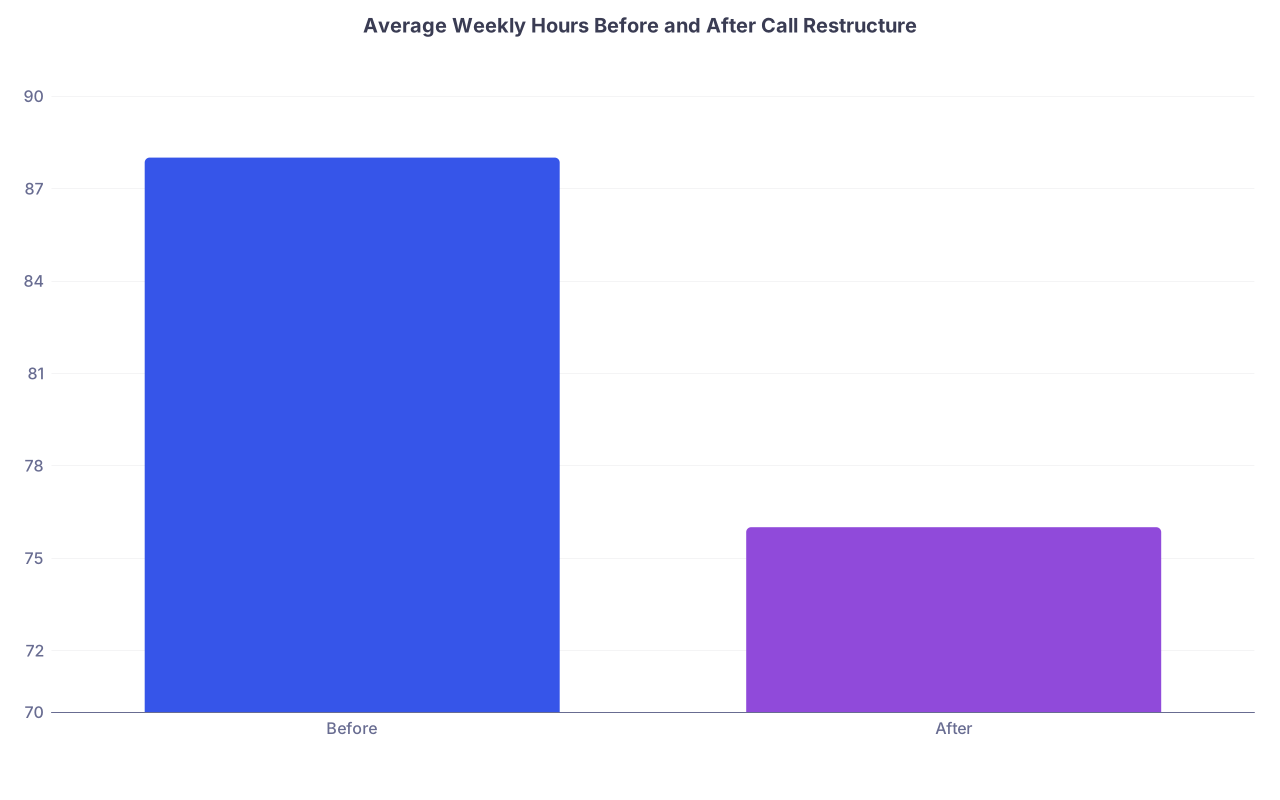
| Category | Value |
|---|---|
| Before | 88 |
| After | 76 |
This kind of visual, even if approximate, is powerful in a meeting.
You want to be able to say:
- “Average weekly hours dropped from about 88 to about 76.”
- “Residents reported feeling 2 points less fatigued on a 0–10 scale.”
- “We saw fewer overnight near‑misses.”
B. Get Other Residents On Record
Quiet support does not move programs. Documented support does.
Ways to do this:
- Short anonymous survey after the pilot (“Which schedule felt safer?” “Would you want this model continued?”)
- Group email from several residents thanking chiefs for the change and asking to continue it
Avoid turning this into a mutiny. You want collaborative pressure, not open war.
Step 10: If Your Program Stonewalls – Escalate Strategically
Sometimes you do all this and nothing changes. Then you decide how much you are willing to push.
Options, in order of escalation:
A. Use Formal Duty Hour Reporting
Most programs have anonymous duty hour reporting systems (often through MedHub, New Innovations, etc.). Use them accurately.
If you work 95 hours, log 95. If you are pressured to falsify, document that pressure (screenshots, dates).
When enough violations flag, the program has to respond.
B. Involve the Program Director and GME Office
If chiefs and APD are resistant, you can:
- Request a meeting with the PD:
- “I am concerned our call schedule is chronically out of compliance with duty hours and is creating safety issues. I have data and some potential solutions. Can we discuss this?”
- If internal avenues fail, contact the GME office or resident council:
- They exist precisely for issues like this.
C. Use the Nuclear Option Sparingly
Reporting directly to ACGME or external bodies is serious. It can blow up relationships and may or may not improve your personal day‑to‑day life.
If you are at the point of real patient danger and program negligence, talk confidentially with:
- A trusted faculty mentor outside your program
- The institutional ombuds office
- GME leadership
Get guidance before you press the red button.
Step 11: Personal Micro-Fixes While the System Catches Up
You are still in the trenches while all this plays out. There are a few call‑structure micro‑tweaks you control directly.
A. Protect Post-Call Time Like It Is Sacred
Even if the system is sloppy about it:
- Say “no” to nonessential meetings post‑call.
- Batch discharge summaries, notes, and callbacks before 9–10 a.m. so you can leave.
- Practice saying: “I am post‑call and at my safe limit. I need to sign out now.”
If an attending consistently keeps you past reasonable hours post‑call, document it and show your chiefs.
B. Build a Low-Effort Recovery Routine
Overly elaborate “self‑care” is useless when you are a zombie. You need a 3–item checklist you can execute half‑asleep:
- Eat one actual meal within 2 hours after call (not just vending machine trash).
- Sleep 3–5 hours minimum before doing anything else. No “quick errands.”
- One small decompression ritual: 10‑minute walk, hot shower, or music with phone on do not disturb.
That is it. Not journaling, not yoga, not a life overhaul. Just the basics that keep your brain from turning to paste.
C. Trade Smart, Not Desperate
Last‑minute swaps can make your schedule worse.
Instead:
- Look at your whole call calendar for the next 2–3 months.
- Identify the 1–2 worst stretches (e.g., three 24s in a 7‑day period, nights after ICU).
- Proactively trade to break those clusters early, even if it means a slightly annoying shift in a lighter week.
You are smoothing peaks, not trying to create some mythical “perfect” schedule.
Example: Turning a Brutal Call Month into a Tolerable One
Let me put this all together briefly.
You are a PGY‑2 on a ward service with q3 24‑hour call. Your schedule for a 2‑week span:
- Mon: 24
- Thu: 24
- Sun: 24
- Wed: 24
You are dying.
What you do:
- Log everything for one block. You see:
- 90–95 hours/week
- 4–5 days in a row without a 24‑hour off period
- Multiple duty hour violations
- Pull ACGME rules and find your program’s duty hour policy explicitly promising “adequate rest.”
- Sketch an alternative: convert Sun and Wed 24s into:
- Sun: 7a–11p admit; separate night cross‑cover 11p–7a
- Wed: 7a–11p admit; same
- Keep Mon and Thu 24s with strict 10 a.m. cut‑off and no clinic
- Tally hours: now averaging ~76–78 per week, still fully covered.
- Meet with chief: present data, safety concerns, and the alternative. Ask for 1‑month pilot.
- Pilot works: fewer violations, residents like it, no coverage gaps.
- Use data and resident feedback to make it permanent.
Is it a dream lifestyle? No. But you just cut nearly 15–20 hours/week of pointless, dangerous exhaustion.
Final Thoughts
Here is what I want you to remember:
- Burnout from call is often a schedule design problem, not a personal weakness. Treat it like a QI project, with data, rules, and specific fixes.
- You have more leverage than you think when you come with solutions instead of complaints. A couple of smart call structure tweaks can drop your hours and risk meaningfully.
- Small, targeted changes beat fantasy overhauls. Restructure one service, one block, one call type at a time—and use every win to push the next improvement.