
The way most programs handle duty hour violations is lazy and ineffective.
Another email. Another reminder. Nothing changes.
You want a step-by-step plan that actually stops repeat violations on your team. Here it is.
1. Get Clear On The Problem You Actually Have
Most residents jump straight to “we need more people” or “the rules are unrealistic.” That is noise. You need a precise diagnosis.
You are dealing with one (or more) of these:
- Structural overload – Too much work for the number of humans present. Even a perfect system would violate.
- Workflow inefficiency – Work is technically doable within hours, but the way your team works makes it impossible.
- Cultural drift – “We just stay until it is done,” “Everyone leaves late,” “Logging is optional.”
- Documentation games – Actual violations are present, but people under-report or alter time to avoid “getting in trouble.”
You fix each of those differently. So first you need to see what is real.
1.1 Pull the receipts, not the vibes
Within the last 4–6 weeks:
- Duty hour logs (actual entries, not just summary graphs)
- Call and shift schedules
- Census trends (patients / resident per day)
- Admits per call
- Cross-cover and night float coverage pattern
Line them up week by week.
Now answer bluntly:
- Are violations clustered (same days, same rotation, same call level)?
- Are they person-specific (one or two residents always over)?
- Are they pattern-based (e.g., always post-call, always on certain weeks)?
You cannot solve “excessive late stays” as a blob. You solve:
- “Post-call resident on Blue Team regularly leaving after 11:30”
- “Night float hitting 90 hours in 2 weeks during Week 3–4 of block”
- “Interns always staying past 10pm on admit days”
That level of granularity.
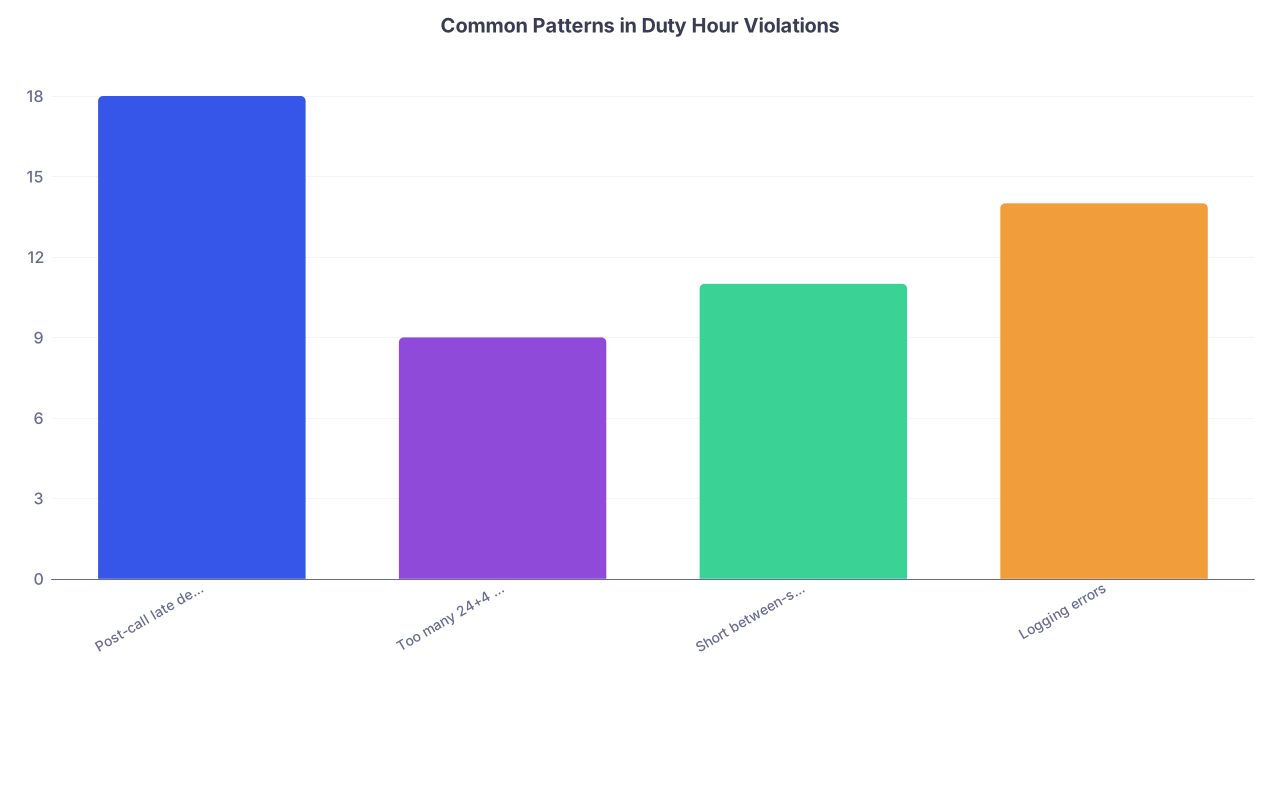
| Category | Value |
|---|---|
| Post-call late departure | 18 |
| Too many 24+4 shifts | 9 |
| Short between-shift rest | 11 |
| Logging errors | 14 |
1.2 Ask the right 10-minute questions
Pull each repeatedly-violating resident for a non-punitive 10–15 minute conversation. Script it if you need to.
Ask:
- “Walk me through your last call day from wake-up to sleep. Where did it go off the rails?”
- “What are the 2–3 recurring tasks that always keep you late?”
- “Who decides when you can leave? You, senior, attending, nobody?”
- “If you left on time, what would actually be unsafe or undone?”
- “What are you doing that someone else on the team could reasonably do?”
You are looking for bottlenecks:
- Discharge summaries done at 6 pm.
- Orders waiting for attendings who round at 4 pm.
- Notes started after rounds instead of during.
- Senior not redistributing work when admits spike.
- Nobody explicitly saying, “You are done. Go home. I’ll finish this.”
You will hear the same 4–5 themes on repeat.
2. Build A Simple Duty Hour Dashboard For Your Team
You cannot fix what your team does not see. Most residents get vague monthly emails like, “We had 13 violations this month.” Useless.
You need a rotation-level micro-dashboard. One page. Updated weekly.
| Metric | Value This Week |
|---|---|
| Total logged violations | 5 |
| Residents affected | 3 |
| Worst 24-hr total (hrs) | 29 |
| Shortest rest interval (hrs) | 7.5 |
| Most common trigger | Post-call tasks |
Post it in:
- Team room
- Resident lounge
- Email round-up (brief, not a novel)
Highlight:
- Where violations occurred (service, day)
- Type (over 80/wk avg, >24+4, <8/10 between shifts, >6 nights, etc.)
- Specific examples, de-identified but concrete (“Post-call resident stayed until 12:15 due to discharge paperwork + late consult note”)
You are not shaming. You are making reality visible.
Then tell the team: “We are tracking this weekly. We are going to experiment and make this number go down.”
Now they know this is a live problem, not an accreditation bullet point.
3. Fix Structural Problems First (If They Exist)
If structural overload is your main issue, you cannot solve it with “work smarter” hacks. You must change the architecture.
3.1 Test the “perfect robot” thought experiment
Assume:
- Every note started on time
- Every order placed promptly
- No socializing
- Zero wasted steps
Would your average team:
- Still hit 80+ hours per week?
- Still push post-call residents past 10 am or 11 am routinely?
- Still violate 24+4 with truly necessary clinical work?
If “yes,” you have a structural problem.
Common structural culprits:
- Admit caps that are fiction (e.g., “Cap 10,” but routinely at 15–18).
- Night float cross-covering absurd numbers of patients.
- One intern covering a gigantic post-op service with no APP support.
- Required conferences during peak clinical work without offset elsewhere.
You address structural issues like this:
- Define your red lines:
- Max patients per intern that still allows on-time departure.
- Max new admits per team per 24 hours.
- Max cross-cover census at night.
- Propose a concrete change trial (2–4 weeks, not theoretical):
- Lower cap from 10 to 8 for one high-risk service.
- Add “admit cut-off time” where ED redirects to next team post-X hour.
- Add temporary float/rescue resident for known crunch times (e.g., Friday evenings).
- Track before and after with your dashboard.
You will get resistance. “We can’t lower caps.” “We do not have more residents.” Fine. Then be explicit:
- “If structural volume is non-negotiable, we must change what residents are personally responsible for.”
Which leads directly to delegation and workflow.
4. Attack Workflow Inefficiencies Like A Process Engineer
This is where you can usually get 20–30% improvement without touching staffing.
You fix workflow by targeting:
- Notes
- Discharges
- Admissions
- Handoffs
- Conference and rounding timing
4.1 Notes: Stop writing a novel at 6 pm
Brutal truth: a massive number of late stays are “I still had notes.”
Basic rules that I have seen actually work:
- Every progress note has a skeleton by 11 am
At minimum: chief complaint, overnight events, objective data imported. - Hard 3 pm note deadline for non-ICU, non-unstable patients. Stuff after 3 pm goes into an addendum.
- Standardized smart phrases for routine situations (stable post-op day 2, improving pneumonia, etc.).
Enforce as team norms:
- If someone is consistently finishing notes after 5–6 pm:
- Pair them with an efficient co-resident for one week.
- Do a 1-hour “note audit” and strip out unnecessary paragraphs.
Residents are not lazy. They are usually reinventing the wheel 18 times a day.
4.2 Discharges: Move them to the front of the day
Late discharges are duty hour poison.
Fix this with a simple daily protocol:
- Pre-round huddle (5–10 minutes)
Each morning: “Who is 95% a discharge today or tomorrow?” - Discharge list at the top of the to-do board
Work those patients first on rounds. - 1–2 protected discharge “power hours”
- Example: 9–10 am, 1 intern focuses almost exclusively on discharge paperwork, calls, and med rec.
- The team limits new “side quests” for that intern during that hour.
Goal: most discharges leaving before 2 pm. That change alone reduces the 4–6 pm chaos and post-call bleed over.
4.3 Admissions: Control the chaos
You cannot control when patients show up. You can control how your team processes them.
Standards that help:
- Triage by complexity and teaching value
Senior assigns admits intentionally:- Easier admits to the most time-crunched intern/post-call person.
- Complex admits to the person with the most runway left in their shift.
- “First pass” admission template for the ED:
- Create a lean H&P template: focused HPI, PMH, meds, brief plan for main problems. Detailed social history and optimization can be next day.
- Senior time blocks:
- Senior dedicates short focused chunks (e.g., 30–45 minutes) just for helping with admissions at predictable busy times (3–5 pm, 8–10 pm), instead of getting drowned in their own list.

| Step | Description |
|---|---|
| Step 1 | Pre-round huddle |
| Step 2 | Identify likely discharges |
| Step 3 | Prioritize discharge patients on rounds |
| Step 4 | Protected discharge hour |
| Step 5 | Midday check - notes by 3 pm |
| Step 6 | Admit triage and assignment |
| Step 7 | Evening handoff and sign-out |
| Step 8 | On-time departure |
5. Reset The Culture: “Safe Care, Honest Logs, On-Time Departure”
If your culture is broken, you will either:
- Keep violating and lying, or
- Burn out the honest people and reward the ones who under-report.
You reset culture directly and repeatedly.
5.1 Say the quiet part out loud
At your next team or residency meeting, someone in authority (chief, PD, APD) needs to say:
- “I would rather see a true duty hour violation than see you falsify your logs.”
- “You will not be punished for honest reporting. We will use it to fix systems.”
- “Leaving on time is not weakness. It is part of your job. Someone telling you to stay late to ‘look good’ is wrong.”
Then back it up with cases:
- Share anonymized stories where changes were made because of honest logging.
- Explicitly state: “We are not using individual violation counts in your evaluation.”
If that is not true in your program, say what is true but stop the vague threat.
5.2 Give seniors explicit responsibility for duty hours
Interns do not control the culture. Seniors do.
On every admitting or ward team:
- One person (usually senior resident) is the Duty Hour Lead for that week.
- Their job:
- Know who is at risk for violation.
- Reassign work when someone is close to a limit.
- Tell people explicitly when they can go.
Give them a simple script:
- “You are done for the day. I will handle X and Y.”
- “You are at risk for violation if you stay past 5:30. Finish current note and sign out.”
Real-time permission matters. You remove the hidden expectation that “staying late = good soldier.”
5.3 Normalize early and on-time departures
You want moments like:
- Post-call intern walking out at 10:00 am, getting a “Good, see you tomorrow,” not a side-eye.
- A resident leaving at their scheduled time once their work is done and being used as a positive example: “That is what it should look like.”
If people who leave on time feel guilty or “less committed,” your culture is sick. Call that out.
6. Build A Clear Handoff and Escalation Protocol
Many violations happen in the gray zone: “I just needed 30 more minutes.” Those 30 minutes turn into 90.
You solve this with strict handoff rules.
6.1 Time-based hard stops
Set and enforce these:
- Post-call:
- Hard stop and out of hospital by 10 am (or 11 am max if your program uses that), barring active code / true emergency.
- Anything remaining at 9:30 am is handed off—no debate.
- End of scheduled shift:
- Handoff starts 30 minutes before scheduled end.
- No new non-urgent tasks started in that window.
- New admits in the last hour go to the next shift, not the person about to leave.
6.2 Clear “who owns what” after the handoff
The biggest excuse for staying late: “I didn’t want to dump this on the night team.”
You solve this by:
- Creating a short, concrete sign-out structure:
- Sick or watch-closely patients
- Outstanding critical tasks (calls that must be made, time-sensitive orders)
- Contingency plans (“If X, then Y”)
- Making it explicit:
- Once you have handed the patient off and documented a safe plan, the on-coming team owns it.
If night float is consistently overwhelmed, that is a structural and staffing problem, not a “just power through” problem. Loop back to Section 3.
7. Use A Tight Feedback Loop: 30-Day Intervention Cycle
Duty hour problems do not get fixed with one grand plan. They get fixed like this:
- Specific problem
- Specific change
- Measure the effect in 2–4 weeks
- Keep, tweak, or kill that change
Run 30-day cycles.
7.1 Example 30-day cycle
Problem:
- Repeated 24+4 and post-call violations on Red Medicine team.
Intervention:
- New rule: Discharges identified at 7 am huddle, discharge paperwork prioritized 9–11 am, post-call intern leaves by 10 am with hard handoff of remaining tasks.
- Senior is Duty Hour Lead and must sign off that post-call left on time unless a documented emergency occurred.
Measurement:
- Number of post-call departures after 11 am.
- Total duty hour violations on that team.
After 30 days:
- Did violations drop?
- Yes → Keep and spread to all med teams.
- No → Re-examine: Did seniors actually enforce it? Were there structural admit issues?
You repeat this process rotation by rotation.
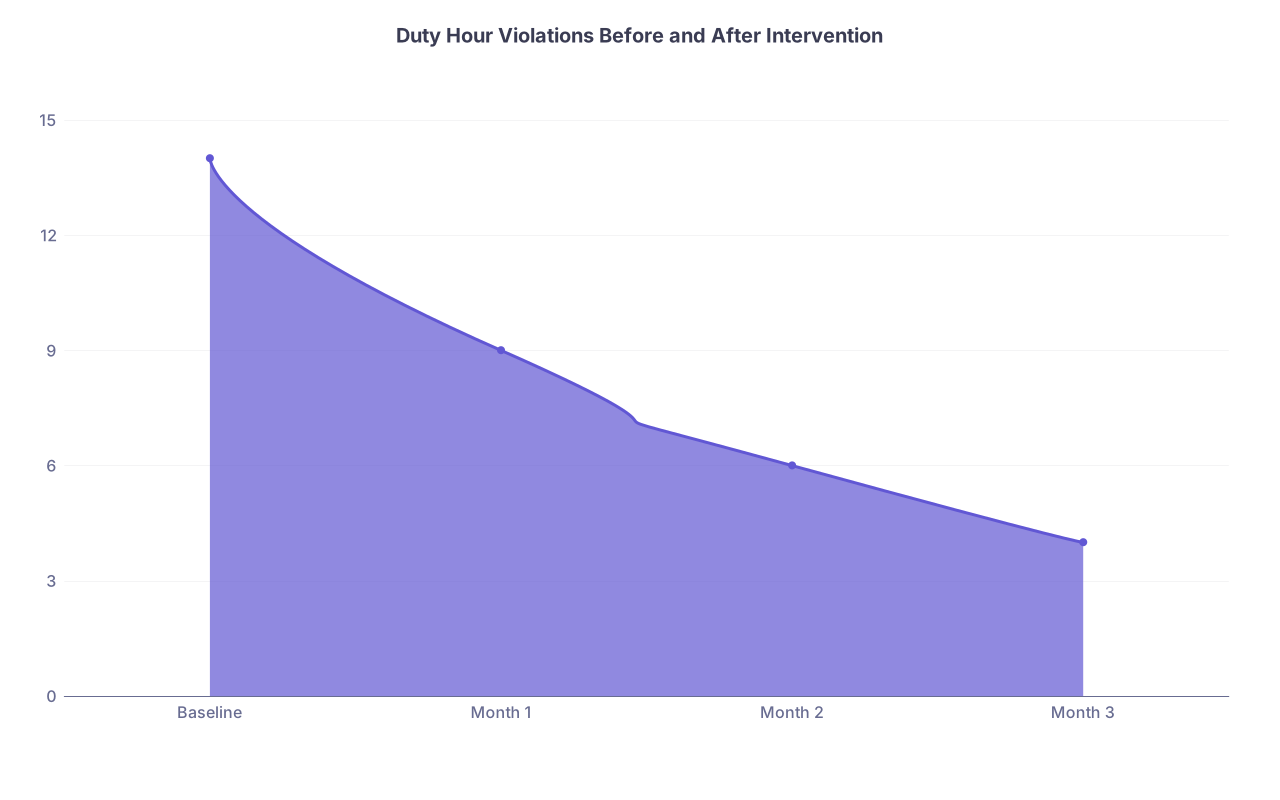
| Category | Value |
|---|---|
| Baseline | 14 |
| Month 1 | 9 |
| Month 2 | 6 |
| Month 3 | 4 |
8. How To Get Leadership On Board (Without Sounding Like You Are Complaining)
Sometimes you are not the chief or PD. You are a resident who is tired of getting burned.
Here is how you approach leadership strategically.
8.1 Show them data, not just feelings
Prepare:
- Last 4–6 weeks of violation counts for your team/rotation.
- 2–3 anonymized “day in the life” narratives showing exactly where the day extends past required limits.
- A very specific ask:
- “Trial a float resident for Red Medicine Fridays 2–8 pm for one month.”
- “Shift start time for clinic from 8 am to 8:30 am to respect required rest.”
- “Allow cap reduction from 10 to 8 on weeks with clinic half-day.”
Structure the conversation:
- “Here is the data.”
- “Here is where the day breaks the rules.”
- “Here is one concrete, limited change we can test for 30 days.”
- “I will help track the effect. If it does not work, we can kill it.”
Leaders respond to specificity and shared ownership. They tune out vague “We are overworked and tired” because they hear it all year.
8.2 Anticipate and neutralize the excuses
You will hear:
- “We don’t have more residents.”
Response: “Then we need to adjust caps, scope of tasks, or schedules. Otherwise we are in chronic violation and jeopardizing accreditation.” - “Other programs manage with similar volumes.”
Response: “Our actual logged hours and violation patterns say otherwise. Let’s look at our specific flow and see where we can apply known best practices.” - “This will upset attendings / ED / consultants.”
Response: “We can start small and communicate clearly. But JC / ACGME regulations are not optional, and current patterns are not sustainable.”
Say it calmly, with numbers.
9. Personal Survival Rules While The System Catches Up
You will not fix your entire institution in one block. Meanwhile, you still need to protect yourself.
Here are personal rules I push residents to adopt:
- Log honestly, every time
Back-date if you forget, but make it accurate. Your future self will thank you. - Set your own internal red lines
- If you are post-call and it is 10:15 am, you stop and sign out, period.
- If you are at 79 hours with 2 days left, you talk to your chief or senior immediately.
- Stop doing work no one else will ever see or use
- Multi-page daily novels in the notes that no one reads. Drop it.
- Spending 45 minutes reconciling a med list that pharmacy will redo. Collaborate instead.
- Ask seniors for explicit direction
“I can stay and finish this note, but I am at 78 hours. Should I go and you handle it, or do you want to reassign something?”
You are not abandoning patients. You are forcing the system to own its constraints instead of quietly donating your life.
FAQs
1. What if my program quietly punishes people who log violations honestly?
Then you document everything. Keep copies of your logs. Write down dates, times, who said what. Escalate to your chief residents or program leadership with specific examples of retaliation. If that fails, use your GME office or institutional ombudsperson. Accrediting bodies care far more about retaliation and falsification than about the original violations. You have more leverage than you think when you come with accurate records.
2. How do I handle an attending who pressures me to stay late despite hours?
Be direct but respectful. “I want to make sure we are within ACGME rules. I am at X hours this week and need to be out by Y to stay in compliance. I can either finish this now and something else has to be handed off, or I can hand this off and leave on time. Which do you prefer?” Put the choice on the system, not on your back. If the attending insists on you staying, log accurately and notify your chief or PD with the specific date and situation.
3. Is it ever acceptable to just under-report to avoid hassles if patient care feels safe?
No. That is exactly how you lock in a broken system for the next group of residents. Under-reporting teaches leadership that current volumes and workflows are “fine.” Honest logging is not whining; it is data. If you think the violation was clinically justified, document that context when you discuss it with leadership. But still log the hours accurately. Fixing anything long term depends on that honesty.
Key points to remember:
- Treat repeated duty hour violations like a process problem, not a moral failing. Diagnose structure, workflow, culture, and logging separately.
- Implement specific, testable changes—discharge-first mornings, duty hour leads, hard handoff times—then measure their effect in 30-day cycles.
- Protect yourself with honest logging, clear communication, and personal red lines while you push the system to improve.