
You are standing in front of the workroom whiteboard. It is 9:40 a.m. You were supposed to be out by 9:00. You are answering your fourth “one quick question” from the day team. Your cross-cover pager is still on you because “we just have to clarify a couple of things.” Your brain feels like oatmeal. You still have three more patients to sign out properly.
This is not sustainable. And it is not inevitable.
Let me be direct: most residents stay post-call way longer than necessary because their handover process is sloppy, ad‑hoc, and completely dependent on how fried their post‑call brain feels that day. You will not fix this with “trying to leave earlier.” You fix it by building and enforcing a simple, tight handover protocol that:
- Protects patients
- Shrinks your cognitive load
- Gives the day team exactly what they need and nothing extra
- Gets you out of the building on time most days
I am going to show you how.
1. The Core Problem: Your Handover Is Doing Too Much, Too Late
Most post‑call exits drag out for three reasons:
- You are thinking during handover instead of reporting
- You do not separate “must-discuss” from “can-look-up”
- You let other people’s disorganization become your overtime
If your handover sounds like, “Uh, let me think… yesterday he had… wait, I’ll open the chart,” you are dead. That is a 5–10 minute sign-out per patient. Multiply that by 10–14 patients. Now add random questions. There goes your morning.
The goal:
Post‑call, your handover should be mechanical. You are not processing; you are reading your prep. The thinking happened 1–2 hours earlier when you were less destroyed.
So the whole game is this:
Shift 80–90% of the handover work to pre‑call-night and pre‑sign-out time.
Make the actual sign‑out a short, scripted performance.
2. The Handover Framework: The 5‑Box Model
You need a structure that never changes, no matter the service or attending.
I use and teach a simple 5‑box model for each patient:
- ID & Situation – Who is this and why are they here?
- Overnight Course – What happened since the day team left?
- Today’s Plan – Concrete tasks and decisions for today
- Contingencies & Watch‑Fors – If X happens, do Y
- Loose Ends & Ownership – Clarify what is not done and who owns it
That is it. Every patient. Same order. Every time.
If you are on a busy inpatient service with 12 patients, your goal is 60–90 seconds per stable patient and 2–3 minutes for a disaster.
Let me show you how to make this real.
3. Build Your Handover Template (Once) and Reuse It Forever
Stop free‑styling your sign-out. Build a template and live in it.
3.1 Paper or Digital: Pick One and Standardize
Pick a primary tool:
- EMR sign-out note / handoff tool
- Shared spreadsheet (Google Sheets if allowed)
- OneNote / Notion / local sanctioned software
- Or old-school: printed census with your own structured notes
I do not care which, but your team has to use the same basic structure. If your program has an official handoff tool, hack it to match this structure as closely as possible.
Here is a simple structural template you can adapt:
| Box # | Section Name | Example Content |
|---|---|---|
| 1 | ID & Situation | 65M, COPD, CHF – here with pneumonia |
| 2 | Overnight Course | Febrile at 3am, blood cultures sent |
| 3 | Today’s Plan | Wean O2, repeat CXR, PT eval |
| 4 | Contingencies | If sat < 88% on 4L, call ICU |
| 5 | Loose Ends & Ownership | Cards consult pending – day team to follow |
You can literally keep 5 short labeled lines per patient:
- ID/S:
- ON:
- PLAN:
- CONT:
- LE:
That structure is your skeleton.
4. Pre‑Call Setup: Reduce Tomorrow’s Torture Before It Starts
Shorter post‑call exit starts before you go on call.
If you are starting a call day at 7 a.m., do this between 7–9 a.m. before the chaos hits:
For each patient, populate Box 1 & 3
- ID & Why they are here (ID/S)
- Anticipated plan for tomorrow (PLAN – even if rough)
Create a blank space for Boxes 2–5
- Literally have “ON: ___” “CONT: ___” “LE: ___” ready
Mark high‑risk patients
- Circle / highlight patients who could crash or change overnight
- These are the ones that blow up your exit time if not anticipated
You are seeding the ground so that post‑call you are only filling in blanks, not reinventing the wheel.
5. On-Call Night: Capture, Don’t Compose
Your night should not be spent “keeping it in your head” and dumping it in the morning. That is why you get stuck.
5.1 Micro‑Updates After Every Significant Event
Every time something non‑trivial happens:
- Rapid response
- New fever
- Major med change
- Big family discussion
- New consult or significant recs
You update one line in your handover field right away.
Example:
- 02:15 – “ON: RRT for desat; now stable on 6L, CXR ordered, trops pending”
- 02:17 – “CONT: If needing >10L or RR>30, consider ICU eval”
- 02:18 – “LE: Follow trops, CXR read; cards may need to see”
Two minutes then saves you 10 minutes later when your brain is mush.
5.2 Use a Standard Abbreviation Set
You do not need prose. You need signal. Create a shorthand that your team understands:
- “↑O2 need overnight, now stable 4L”
- “New AF RVR, started metop IV; cards paged – f/u recs”
- “CT abd pending (ordered 01:30 for new pain RLQ)”
The point: your morning self should not have to “remember what happened.”
6. Pre‑Handover Tightening: The 30–45 Minute Protocol
This is where most people lose time. They walk into sign‑out cold, open the EMR, and start thinking out loud.
Stop doing that. Use a pre‑handover tightening block.
Ideal timeline post-call (assuming 7 a.m. rounds, 9 a.m. sign-out cutoff):
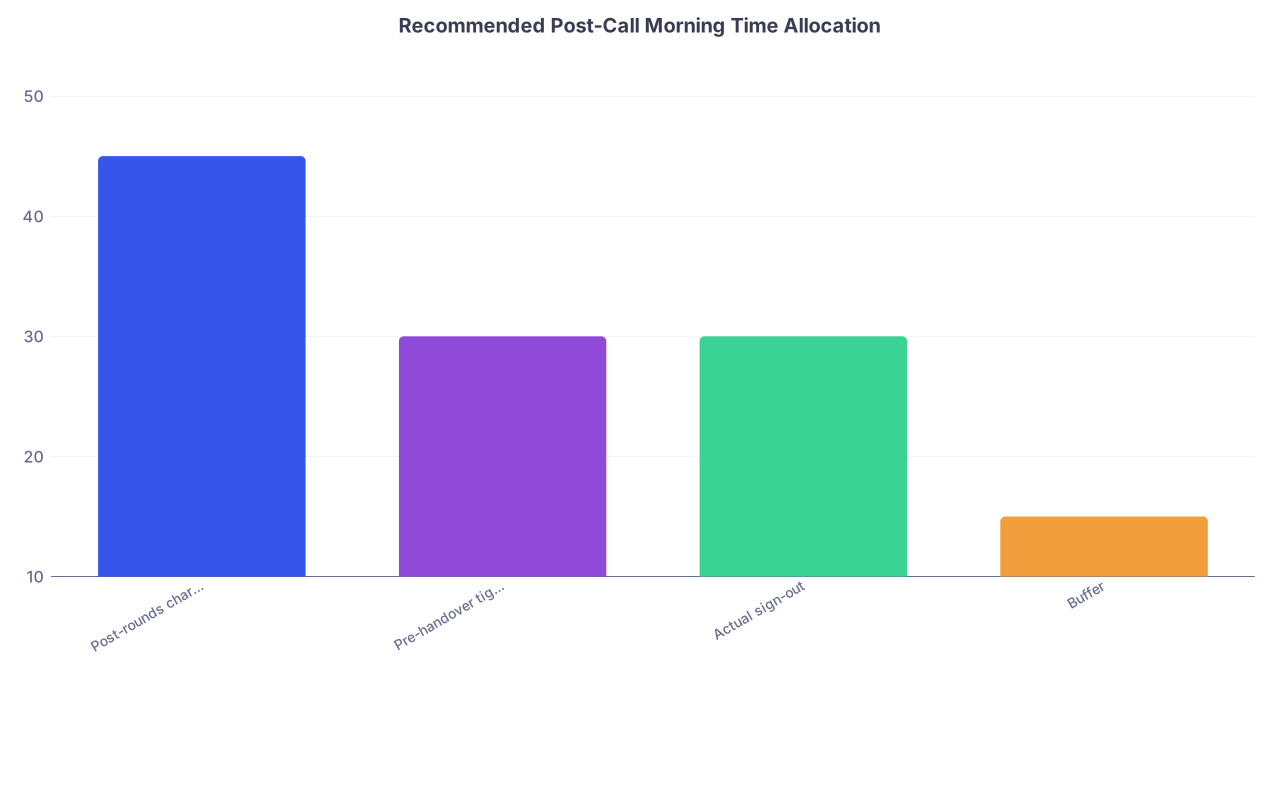
| Category | Value |
|---|---|
| Post-rounds charting | 45 |
| Pre-handover tightening | 30 |
| Actual sign-out | 30 |
| Buffer | 15 |
6.1 The Tightening Script (Per Patient, 1–2 Minutes)
Sit down alone or with your co‑resident. For each patient:
Scan vitals / events / new labs for the last 24 hrs
Ask: “What changed that the day team actually needs?”Update Box 2 – Overnight Course (ON)
- One to three bullets. Not a novel.
Refine Box 3 – Today’s Plan (PLAN)
- Make it crisp: “Today – dc Foley, downtitrate steroids, PT/OT, plan SNF”
Clarify Box 4 – Contingencies (CONT)
- At least one “If X then Y” for sick or unstable patients
- For stable patients, this might be: “If BP <90, recheck, if persistent page cards”
Box 5 – Loose Ends (LE)
- Outstanding consults, pending imaging, social issues, follow‑ups
- Assign explicit ownership: “Day team to….”
You should be able to “tighten” a 10–12 patient list in 20–30 minutes once you are used to it. Early on, it will take longer. That is fine. You are building a habit that will buy back hours every month.
7. The Actual Handover: Scripted, Bounded, and Hard‑Stopped
Now the fun part. You are going to run sign-out like a controlled meeting, not a random hallway chat.
7.1 Physical Setup
Tiny changes make a huge difference:
- Everyone seated, looking at the same list (whiteboard or shared screen)
- Pagers/phones on the table, face‑down, except for one designated “answerer”
- Timer visible (phone or clock) with a hard stop, e.g., out by 9:05
If your culture is “we stand in the hall and shout at each other,” you will always bleed time and miss information.
7.2 The Spoken Script Per Patient
For each patient, you hit the 5 boxes in order. Out loud. No digressions until the end.
Example:
“Bed 12, Mr. Jones.
65M, COPD, CHF, admitted for CAP, day 3.
Overnight – spiked 38.5 at 2am, repeat blood cultures sent, lactate normal, bolused 500 LR, responded, now stable on 3L nasal cannula, same as yesterday.
Today – Narrow cefepime to ceftriaxone if cultures negative at 48 hrs, wean O2 as able, PT/OT to see for dispo planning, repeat CXR if still febrile this afternoon.
Contingencies – If O2 need >5L or RR>28 sustained, would re‑eval for transfer to step‑down or ICU.
Loose ends – ID consult placed yesterday, please follow up their recs; needs SNF referral started today.”
Then you pause. One beat.
Then you ask: “Questions?”
If they have some, you answer briefly. If the question requires deep chart diving, say: “Let’s flag that and circle back at the end. Put a star by his name.”
You do not let one complex patient derail the whole list. You can always come back.
8. Managing the Day Team: Boundaries Without Being a Jerk
A lot of your post‑call slavery comes from one behavior:
You allow the day team to treat sign-out like a teaching conference + case conference + therapy session.
Your job post‑call is narrow:
- Hand over safe, actionable information
- Clarify ownership
- Get out before your brain makes a dangerous mistake
Here is how you control that without poisoning relationships.
8.1 Set Expectations Up Front
At the start of sign-out, say something like:
“I am pretty wiped and need to be out on time. I have structured sign-out for each patient with ID, overnight course, today’s plan, contingencies, and loose ends. Let me run the whole list first, then we can circle back for deeper dives or teaching questions if needed.”
You are not asking permission. You are declaring the structure.
8.2 Use a “Parking Lot” System
When someone starts a tangent:
- “Let’s put that in the parking lot. Star next to the name; we will come back after the list.”
- Keep a literal column on the board: “Questions to revisit”
Nine times out of ten, by the end, nobody actually needs those deep dives.
8.3 Standard Responses to Time‑Suck Questions
Some scripts you can use:
- “I do not want to guess; labs are in from 7 a.m., you will get a better read than me at this point.”
- “That is more of a dispo discussion; let us flag it for noon check‑in.”
- “I am not the best person to answer that now; the ICU attending saw him at 4 a.m., notes are in.”
You are not being lazy. You are acknowledging the limits of an exhausted brain and protecting patient safety.
9. Protecting Safety While Shortening Time
Let me be blunt: leaving late does not automatically mean you are being “more thorough.” Often it just means you are tired and inefficient.
A good handover does three things for safety:
- Reduces omissions by using a consistent structure
- Creates clear contingency plans for predictable problems
- Clarifies who owns outstanding tasks
9.1 The Contingency Box Is Your Safety Net
This piece is underrated. A solid contingency statement turns chaos into protocol.
Examples:
- “If BP <90 systolic and not responsive to 500–1000 mL fluids, call ICU fellow.”
- “If chest pain + dynamic ECG changes, activate cath protocol.”
- “If creatinine rises >0.3 from today, please hold ACE inhibitor and repeat BMP tomorrow.”
You are pre‑deciding the first moves for your colleagues. That avoids both overreaction and underreaction.
9.2 Clarify Ownership Explicitly
Never say: “We should probably follow up the echo.” That is code for “no one will.”
Say instead:
- “Day team – please check echo when done and call cardiology if EF <35%.”
- “Social work – I left a message; can you please confirm SNF acceptance today? It will impact tomorrow’s dispo.”
Ownership statements are what separate safe, fast handovers from chaotic ones.
10. Use Visuals to Keep Everyone Aligned
If your team can see the plan, your verbal handover can be shorter and cleaner.
10.1 Simple Whiteboard / Shared Screen Layout
Think of a basic board with these columns:
| Column | Example Entry |
|---|---|
| Patient / Bed | Jones / 12 |
| One-liner | 65M COPD/CHF, CAP day 3 |
| Today’s Top Task | Narrow abx, PT/OT, plan SNF |
| Red Flag / Risk | O2 needs, febrile overnight |
| Owner / Follow-up | Day team – check ID recs, start SNF process |
You do not need every box visible. Just the highlights that anchor your spoken handover.
11. Handling Different Services: Medicine vs Surgery vs ICU
The principles are the same, but the emphasis shifts slightly.
11.1 Medicine Ward
- More chronic complexity → emphasize Box 3 (Plan) and 5 (Loose Ends)
- High risk of “we’ll follow up later” tasks → ownership must be clear
11.2 Surgery
- Post‑op and acute changes → emphasize Box 2 (Overnight Course) and 4 (Contingencies)
- Use clear triggers: “If drain output >, if temp >, if HR >___, then do ___”
11.3 ICU
- Sick patients with lots of moving parts → do not over‑narrate pathophysiology in sign-out
- Focus on: “What changed, what is the current trajectory, and what events would make you change course”
To compare emphasis:
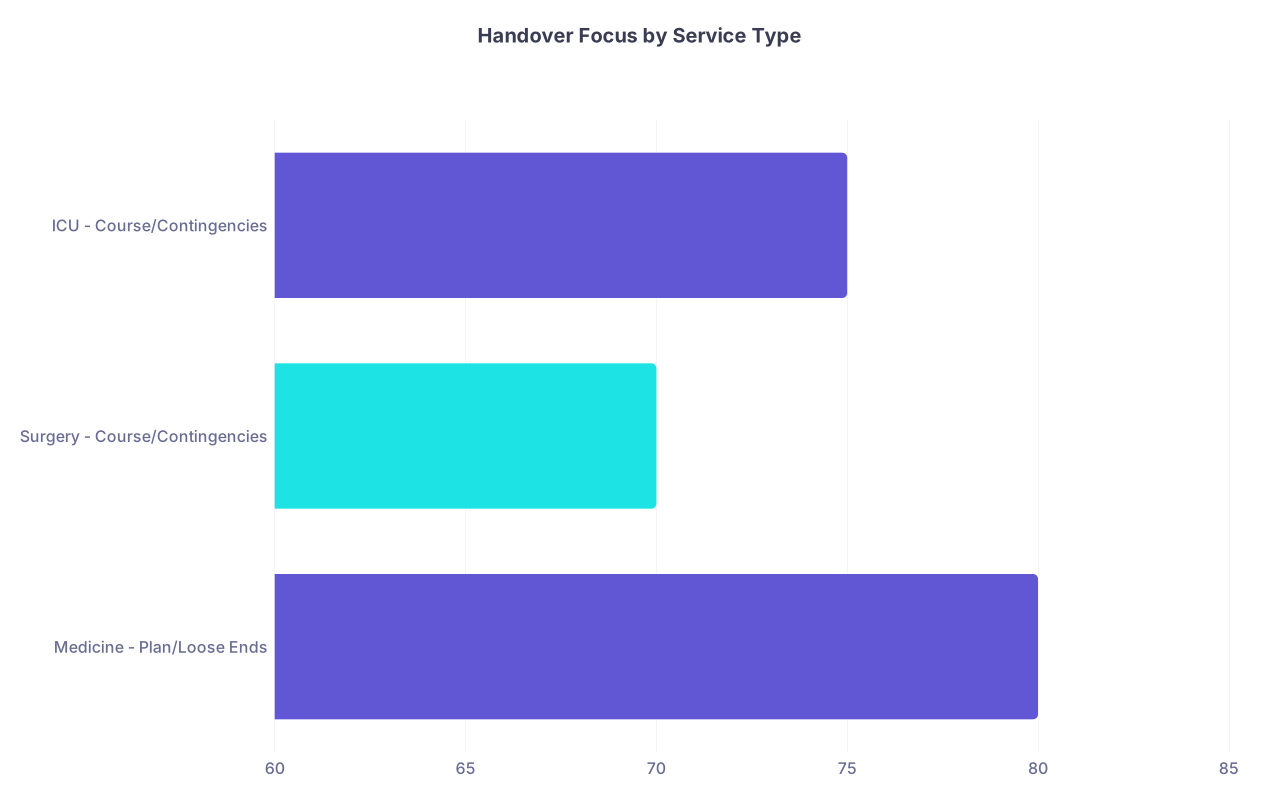
| Category | Value |
|---|---|
| Medicine - Plan/Loose Ends | 80 |
| Surgery - Course/Contingencies | 70 |
| ICU - Course/Contingencies | 75 |
(Think of this as relative emphasis, not strict numbers.)
12. Build a Team Culture Around Efficient Handover
If you are the only one using structure, you will still be better off. But if you want real time savings, the whole team has to buy in.
12.1 Do a 10-Minute Handover Huddle at the Start of Each Block
On day 1 of a rotation, say:
- “I would like us to try a standardized sign-out script to get everyone out on time post‑call. Here is the 5‑box structure I am using. Can we agree to try this for a week?”
Most people will go along, especially if you frame it as a safety + burnout issue, not as your personal preference.
12.2 Review One Handover Each Week
Once a week, pick a single patient after sign-out and ask:
- “Did we give the day team what they needed?”
- “Was anything extra or missing?”
- “What one tweak would make this cleaner next time?”
You are calibrating your system in real time. This takes 5 minutes and pays off massively.
13. Guardrails: What You Must Not Cut
Trying to shorten post‑call time can backfire if you cut the wrong corners. These are non‑negotiables:
Do not skip updating the overnight course
Outdated overnight info is dangerous and embarrassing.Do not leave high-risk patients without contingency plans
Especially fresh post‑ops, unstable cardiacs, or borderline respiratory patients.Do not hide or minimize near‑misses or complications
Document and communicate them. The day team must know where things almost went off the rails.Do not leave before a clear, explicit transfer of pager responsibility
Someone must explicitly say: “I have your pager / I am covering bed X–Y now.”

14. Personal Micro-Habits That Save You 15–30 Minutes
On top of the formal protocol, small habits compound.
- Pre-write your top plan items for each patient before morning rounds end
- Glance at vitals and labs with morning rounds instead of afterward
- Keep a running “follow up” column during the night and resolve items as soon as they are done
- During sign-out, sit facing the list and your notes; do not rely on memory
- After each call, ask yourself: “What 1 small change would have shaved 10 minutes today?”
That last question, asked honestly, will sharpen your system rapidly.
15. A Concrete Example: Before vs After
Let me show you the contrast.
Before Protocol
- 8:15–8:45: Morning rounds run late, you are still putting in orders at 9:00
- 9:00–9:30: You open each chart during sign-out, try to remember overnight events, ramble. Day team asks, “Wait, what were his labs again?” You click around.
- 9:30–9:50: Off-topic questions and teaching points.
- 9:50–10:10: Extra follow‑up questions because plans were vague.
- You leave at 10:30 feeling like you forgot something.
After Protocol
- Pre‑call: You set up the handover skeleton for each patient.
- Overnight: You add one‑line updates and quick contingencies after each significant event.
- 7:45–8:15: Morning rounds. As labs and vitals are reviewed, you refine today’s plan on your handover sheet in real time.
- 8:15–8:40: 25‑minute solo tightening session: 1–2 minutes per patient.
- 8:40–9:05: Structured sign-out. 45–60 seconds for stable patients, 2–3 minutes for complex ones. Parking lot for deep dives.
- 9:05–9:15: Only if needed, you answer 1–2 lingering questions from the parking lot.
- 9:15: You hand over pager, walk out. Brain fried, but safe.

| Step | Description |
|---|---|
| Step 1 | Finish Morning Rounds |
| Step 2 | Tighten Handover Notes 20-30 min |
| Step 3 | Structured Sign-out 20-30 min |
| Step 4 | Parking Lot Questions 5-10 min |
| Step 5 | Explicit Pager Transfer |
| Step 6 | Leave Hospital |
16. Implementation Plan: 7-Day Rollout
Do not try to redesign everything tonight. Use a one‑week sprint.
Day 1–2: Build and Test the Template
- Create your 5‑box structure in your preferred tool
- Use it for half your patients, then all of them
- Do micro‑updates overnight for major events
Day 3–4: Add Tightening Block
- Before sign-out, protect a 20–30 minute window just for tightening
- Time yourself: seconds per patient
- Start using the spoken script
Day 5–7: Team Alignment
- Share the structure with your co‑residents / interns
- Ask to run a single fully structured sign-out as a trial
- Afterward, ask: “Did that help you? What would you tweak?”
You will feel clunky at first. That is normal. Within 2–3 calls, it will feel faster than your old way. Within a month, you will be one of the few people consistently walking out on time post‑call without sacrificing care.

17. One Last Thing: Your Brain Is a Safety‑Critical System
A fatigued resident trying to improvise handover is a safety hazard. Not because you are careless. Because you are human.
Protocols are not about being rigid or robotic. They are about protecting you and your patients from the reality that at 9:00 a.m. post‑call, your working memory is trash.
So take this seriously: designing a tight, repeatable handover is part of your job as a physician. It is not optional, and it absolutely justifies you pushing back on chaos.
Your Next Step Today
Do this in the next 10 minutes:
- Open whatever you use for your patient list (EMR sign-out tool, spreadsheet, notebook).
- Add five short labels under each patient:
- ID/S, ON, PLAN, CONT, LE
- For your current patients, fill in ID/S and PLAN only. Leave the rest blank for now.
That is your new skeleton.
Next call, you will not be starting from zero.