
What if the thing you’ve been told your whole life about surgery—that you have to destroy your health, your relationships, and maybe your sanity to become a good surgeon—is simply wrong?
Not “a little exaggerated.” Wrong.
Let me be direct: the belief that high‑quality surgical training requires abusive, unsafe work hours is a relic from the Halsted era that refuses to die. It’s cultural inertia dressed up as “tradition” and “grit.” And when you actually look at the data, the story is very different from what the loudest voices in the surgeon’s lounge like to tell.
You can absolutely train excellent surgeons without 110‑hour weeks, chronic sleep deprivation, and unsafe post‑call operating. In fact, the evidence says you’re probably more likely to train safer surgeons if you stop pretending people are robots.
Let’s pull this apart.
Where The Myth Comes From (And Why It’s So Sticky)
The myth sounds like this. I’ve heard versions of it verbatim from senior attendings:
“We trained with every‑other‑night call and 120 hours a week, and we turned out fine. You cannot learn surgery in 80 hours. Period.”
Except:
- Many of them did not “turn out fine” (burnout, divorces, substance issues, early retirement due to health).
- That’s not how learning or patient safety actually work.
The Halsted model was built on three assumptions:
- total immersion produces mastery
- the hospital owns your life during residency
- more hours = more experience = better surgeon
The first has some truth. The second is ethically bankrupt. The third? That’s the one the data really rips apart.
The modern version of the myth says: “Sure, the 80‑hour rule exists, but if you really want to be good, you’ll push past it. And if you cap hours further, patient care will suffer.”
So, is any of that backed by actual outcomes? Complication rates? Board pass rates? Resident error data?
Not really.
What The Evidence Actually Shows About Work Hours And Outcomes
You don’t have to guess. We’ve had multiple natural experiments: before vs. after duty‑hour restrictions, and even randomized trials.
The 80‑Hour Work Week: Did Surgical Care Get Worse?
After the ACGME 80‑hour rule came in (2003), there were endless predictions of doom: “Patients will die, residents won’t see enough, surgery will be destroyed.”
Researchers actually looked. Large national datasets. Many specialties. Years of outcomes.
The pattern is boringly consistent:
- No clinically meaningful worsening of mortality or major complication rates after the 80‑hour rule.
- In several analyses, outcomes in teaching hospitals stayed the same or slightly improved as systems adapted.
- Board pass rates for surgery did not collapse.
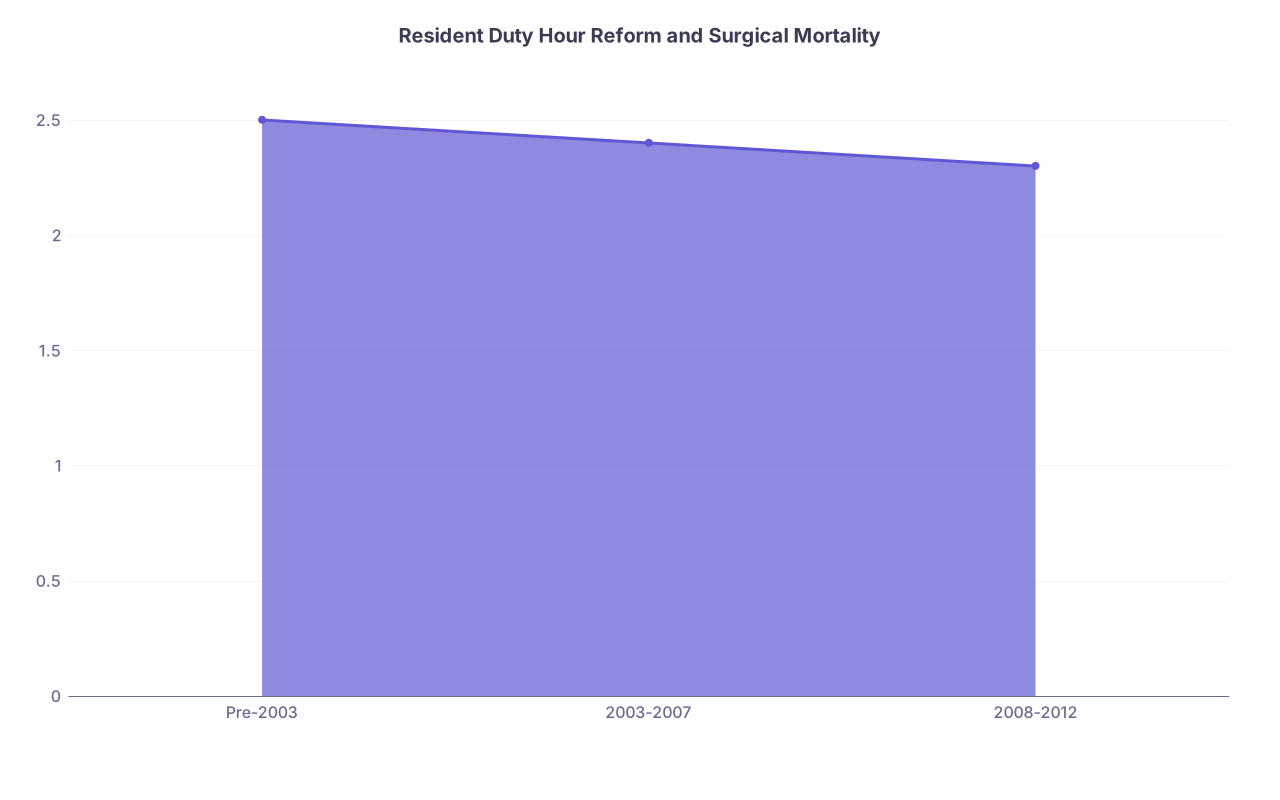
One example you’ll see a lot in discussions: national surgical databases following general surgery residency programs before and after duty‑hour reform. Mortality does not spike. Complications do not explode. If anything changes, it’s tiny and usually driven by other system improvements like checklists and team‑based care.
| Category | Value |
|---|---|
| Pre-2003 | 2.5 |
| 2003-2007 | 2.4 |
| 2008-2012 | 2.3 |
That chart is typical of what you see: mortality drifting down over time, in the setting of better systems, better ICU care, and yes, capped hours. Not the apocalypse.
What About Intern Capping To 16 Hours?
This is where a lot of emotional arguments kick in. The 2011 rule limiting interns to 16‑hour shifts was viciously attacked in surgery. It was partially rolled back in 2017. Advocates said continuity was destroyed, handoffs increased, and errors would skyrocket.
So again, people did the work.
The FIRST Trial (Flexibility in Duty Hour Requirements for Surgical Trainees) took 117 general surgery residency programs and randomized them:
- standard ACGME rules vs.
- more flexible hours (longer shifts, less strict clock‑watching)
Then they looked at hard endpoints: patient death/serious complications, resident satisfaction, sleep, education.
Results:
- No difference in death or serious complications between strict and flexible programs.
- No advantage of longer hours in measured patient outcomes.
- Residents in flexible programs felt they had better continuity, but they were also more likely to report duty hour violations and fatigue.
Translation: giving programs permission to stretch hours did not suddenly make patients safer. It just made residents more tired while outcomes stayed the same.
The iCOMPARE trial in internal medicine found essentially the same thing: no mortality advantage to letting interns work longer continuous shifts.
So the romantic idea that “staying with the patient all night” intrinsically delivers better outcomes? The data does not support it in a way that outweighs sleep‑deprivation risk.
Sleep Deprivation: Surgeons Are Not Exempt From Biology
Here is the part surgeons hate, because it fights the self‑image of being superhuman.
Sleep‑deprived humans perform worse. On basically everything that matters in clinical care:
attention, working memory, reaction time, judgment, and fine motor skills.
Surgery has tried very hard to pretend it’s exempt. It isn’t.
You can find plenty of quotes like, “I can operate fine on no sleep, I’ve done it my whole career.” That’s subjective perception, not objective performance. People are notoriously bad at judging how impaired they are when sleep‑deprived.
We have simulation data showing this. Residents doing laparoscopic tasks post‑call perform similarly to someone with a blood alcohol level high enough that you’d never let them drive. But for some reason, we’re okay letting them clip a cystic duct.
Patient‑level data is messier, but there are concerning signals:
- Higher complication rates with surgeons performing elective surgeries after overnight emergencies in some studies.
- Increased error rates with overnight work in multiple medical domains, not just surgery.
Is every post‑call surgery unsafe? No. But the idea that sleep deprivation is neutral for surgical performance is nonsense. It’s just ego plus tradition.
The kicker: even if you argue “we still need long hours for experience,” you can’t seriously argue that 28‑ or 32‑hour shifts are safer than 16‑ or 20‑hour shifts for a human body. There is no biological mechanism where that becomes true.
“But You Can’t Learn Surgery In 80 Hours A Week”
This is the line that gets weaponized against applicants: if you want lifestyle, choose derm. If you choose surgery, don’t complain.
Here’s the ugly secret: a lot of time in those 100‑hour weeks is not high‑yield operative learning. It’s scut, inefficient rounding, bad workflow, and you waiting around for things that could be organized better.
When you measure operative case numbers and board pass rates before and after duty‑hour reform, the sky does not fall.
Let’s lay out some numbers.
| Metric | Pre-80-Hour Era | Post-80-Hour Era |
|---|---|---|
| Avg weekly hours | 95–110 | 70–80 |
| Total cases at graduation | ~900–1050 | ~850–1000 |
| ABS first-time pass rate | 75–80% | 80–90% |
| Accredited program length | 5 years | 5 years |
Do those numbers vary by program? Of course. But the trend is clear: you can cut hours meaningfully without gutting case numbers or board performance.
So why do some residents still feel undertrained?
Because skill is more about deliberate practice, feedback, and autonomy than raw clock time. If your program lets you retract for 14 hours and close the skin at the end, those 14 hours aren’t magically turning you into a better surgeon. They’re making you tired and resentful.
High‑quality, efficient training beats “more hours” every single time:
- earlier graduated responsibility
- focused time in the OR, not just presence in the building
- simulation and deliberate practice for complex skills
- structured feedback instead of passive osmosis
You don’t need 120 hours. You need better use of 70–80.
The Real Risk: Bad Systems, Not Fewer Hours
Here’s where people get twisted: they see negative consequences after duty‑hour changes and blame the hours alone. Reality is more boring.
Poorly managed handoffs, fragmented teams, and leadership that refuses to redesign workflow can absolutely harm patient care. But that’s not inherent to limiting hours. That’s a system refusing to adapt.
Good programs do something different. They:
- Create stable team structures so patients are not being passed between strangers every 12 hours.
- Use standardized handoff tools (I-PASS, etc.) to reduce information loss.
- Design schedules that preserve continuity for the sickest patients rather than rigid clock‑punching.
- Offload low‑yield nonclinical tasks to coordinators, APPs, or technology.
Bad programs?
They keep the same broken processes and then complain that “these new hours are unsafe.” No. Your system is unsafe. The cap just exposed it.

| Step | Description |
|---|---|
| Step 1 | Duty hour limit |
| Step 2 | Protected education |
| Step 3 | Safer handoffs |
| Step 4 | Fragmented care |
| Step 5 | Blame hours not system |
| Step 6 | Stable or improved outcomes |
| Step 7 | System redesign |
The myth conflates these two: “Our outcomes suffered after duty‑hour reform” becomes “We must go back to 110‑hour weeks,” instead of “We need to stop pretending 1990 scheduling works in 2026.”
Burnout, Mental Health, And The Fantasy Of The Indestructible Surgeon
Let’s talk about the cost of the “unsafe hours are necessary” superstition.
Surgical residents have some of the highest burnout rates in medicine. Depression, anxiety, suicidality—none of this is theoretical. I’ve watched residents go from enthusiastic interns to hollowed‑out PGY‑3s who honestly do not care if they live or die.
High work hours aren’t the only cause. But they pour gasoline on everything:
- Less sleep means less emotional regulation, more conflict, more errors.
- No time outside the hospital means no support system when things go wrong.
- Chronic exhaustion makes studying harder, not easier.
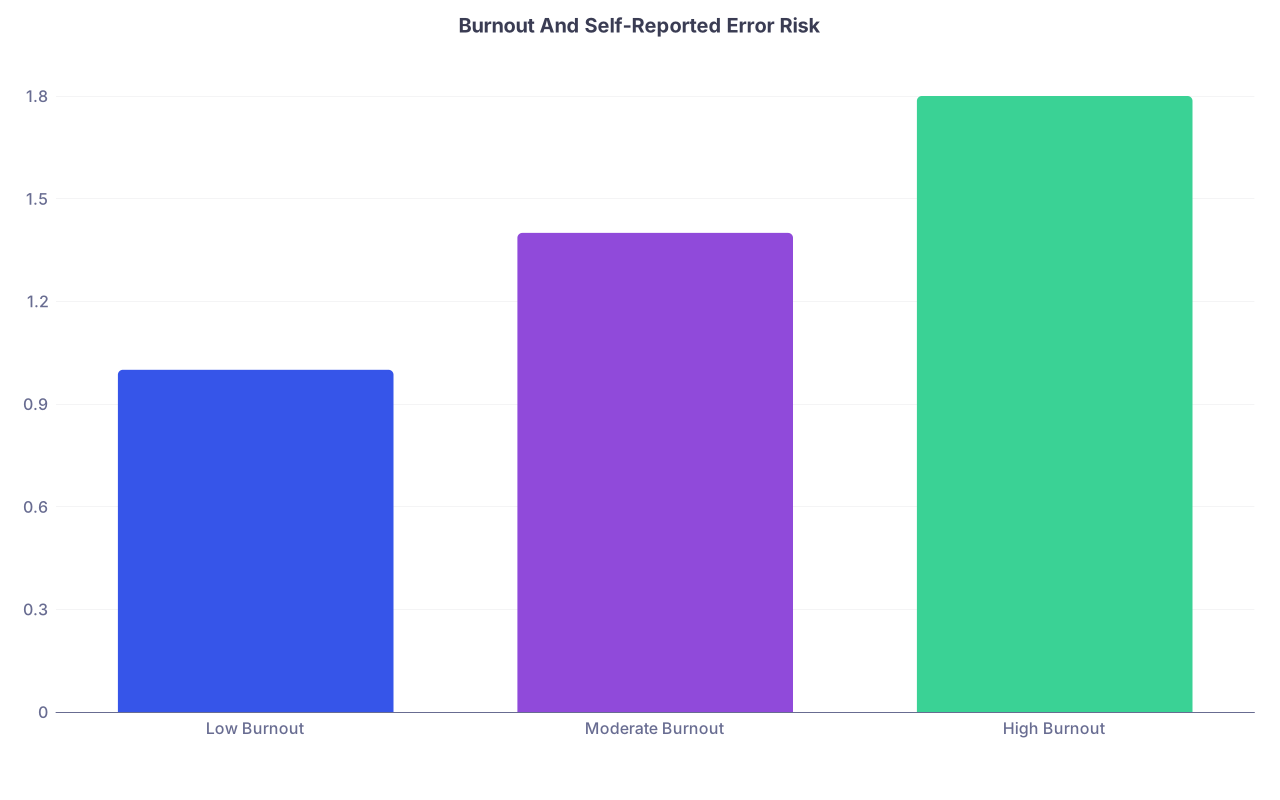
We also know something else ugly: burnout and depression are associated with self‑reported medical errors. You can argue about causality all day, but pretending there’s no connection is intellectually dishonest.
| Category | Value |
|---|---|
| Low Burnout | 1 |
| Moderate Burnout | 1.4 |
| High Burnout | 1.8 |
High burnout = higher odds of self‑reported significant error. That’s not the profile of a safer, “more dedicated” surgeon. It’s someone running on fumes.
And no, the answer isn’t “people today are soft.” That’s a lazy narrative older generations use to avoid questioning the system that shaped them. Toughness is not the same as masochism. You can select for resilience and refuse to institutionalize abuse.
What Actually Produces Good Surgeons (Spoiler: Not Abuse)
There’s a very clear pattern in programs that reliably produce strong surgical graduates without glorifying unsafe hours.
They don’t chase hero narratives. They build training around:
- Volume and variety of cases, not 36‑hour shifts for their own sake.
- Direct, graduated autonomy: letting you actually make decisions and do critical parts of the case.
- Smart coverage models: day, night float, and weekend structures that respect the 80‑hour rule and still cover sick patients.
- A culture where saying, “I’m dangerously tired” gets you backup, not ridicule.
That does not mean cushy. Surgical training will never be 40 hours with free weekends and daily yoga. You will work hard. You will be tired. You will sacrifice.
But there’s a big gap between “this is intense” and “this is unsafe and counterproductive.”
Programs that pretend they have to violate hours “for your education” are telling on themselves. What they’re really saying is:
“We don’t know how to train you efficiently, so we’ll just keep you here until you learn by osmosis.”
How To Think About This As A Current Or Future Resident
If you’re a med student or junior resident, you’re stuck in the middle of this culture war. You’ll hear one camp saying, “Hours don’t matter, suck it up,” and another saying, “Residency should feel like a 9‑to‑5.” Both are wrong.
Here’s the evidence‑based middle ground:
Surgical training:
- Does not require 100+ hour weeks to produce excellent surgeons.
- Does not become magically safer by ignoring sleep science.
- Does not improve patient outcomes just because residents stay in the building longer.
What does matter is:
- Case exposure
- Quality of supervision and feedback
- Thoughtful scheduling and handoffs
- A culture that treats residents as developing professionals, not disposable labor
When you evaluate programs, listen carefully when you ask about hours. If the answer is, “We’re old school, we don’t really track that,” what they’re saying is, “We’re not honest about it.” If they brag about “we push past 80, but you’ll thank us later,” recognize that as ideology, not data.
Conversely, if a program is rigidly obsessed with never letting you stay 10 extra minutes to finish a case, that’s not great either. Continuity and professionalism matter. The best environments use the 80‑hour rule as a ceiling, not an excuse to kill every bit of flexibility or continuity.

The Bottom Line: What The Data Actually Says
Let’s strip it down.
Unsafe, extreme work hours are not required to train excellent surgeons. Case logs, board pass rates, and large outcome studies after duty‑hour reform all say you can cap hours and still produce competent, safe surgeons.
Longer continuous shifts do not magically produce better outcomes. Randomized trials in surgery and medicine show no mortality benefit to “flexible” longer duty hours. Sleep deprivation impairs performance; surgeons are not immune.
The real problem is system design, not hour limits. When programs cling to old workflows and then blame duty‑hour rules for problems, they’re protecting their culture, not their patients.
If someone tells you you must accept unsafe, abusive hours to be “worthy” of surgery, they’re defending a myth, not practicing evidence‑based training.