
The belief that reporting duty hour violations will wreck your career is mostly fear, not fact. And it’s a fear that programs quietly benefit from.
Let’s kill this myth properly.
Residency runs on two parallel systems: the official ACGME-compliant world on paper, and the “don’t rock the boat, just fix your hours” shadow culture. You live in the second one. The ACGME, NRMP, and even your own hospital’s legal department live in the first. When those two collide, your career is not the one most at risk. Theirs is.
You have been implicitly conditioned to believe the opposite.
The Core Myth: “If I report, they’ll blacklist me”
Here’s the common narrative you hear from upper levels or the burned-out senior who corners you by the microwave at 2 a.m.:
- “Don’t log that. It’ll trigger a citation.”
- “If the PD finds out you reported, kiss that letter of rec goodbye.”
- “Programs talk. You’ll be labeled a troublemaker.”
It sounds plausible. You’re vulnerable. They’re powerful. On the face of it, retaliation seems like a real risk.
Now here’s what the data and rules actually say:
- The ACGME requires a mechanism for confidential reporting of duty hour and program violations. If they retaliate, they can be cited. Hard.
- Programs are far more afraid of repeat citations and loss of accreditation than they are of one resident with an accurate timecard.
- The NRMP and ACGME both have formal policies against retaliation and coercion. Not “suggestions.” Policies with teeth.
Does retaliation still happen? Yes. Quietly. Subtly. I’ve seen it. No one writes an email that says, “We are retaliating because you reported hours.” They just suddenly “realize” someone else is a “better fit” for that fellowship, or your schedule mysteriously shifts to worse rotations.
But here’s the uncomfortable reality: most residents are punished more by not reporting than by reporting. You just do not notice it because the punishment looks like “this is just residency.”
Chronic 80+ hour weeks. Unsafe cross-cover. Falling asleep driving home. Those are consequences too. You’re already paying a price; you’re just not calling it that.
How duty hour enforcement actually works
You need to understand the system to see where the fear is exaggerated and where it’s legitimate.

| Step | Description |
|---|---|
| Step 1 | Resident logs hours |
| Step 2 | No issue |
| Step 3 | Program flags or edits |
| Step 4 | Local conversation with chief or PD |
| Step 5 | Program level review |
| Step 6 | Formal complaint and potential site visit |
| Step 7 | Compliant on paper |
| Step 8 | Pattern or serious issue |
| Step 9 | Resident escalates to GME or ACGME |
There are three main enforcement layers:
Internal program reporting (MedHub, New Innovations, etc.)
This is the dashboard your PD stares at before every Clinical Competency Committee meeting. It exists for:- Accreditation compliance
- Legal protection (if anything goes wrong, they can say: “Look, 100% compliance on duty hours”)
This is also where the “fix your hours” culture lives.
Institutional GME / DIO (Designated Institutional Official)
Above your program director sits the GME office and DIO. They care about:- Institution-wide ACGME accreditation
- Preventing any one program from blowing things up for the whole house staff
They are more likely to take systemic duty hour problems seriously because a bad ACGME citation at the institutional level is a five-alarm fire.
ACGME itself
Your nuclear option. Residents can submit confidential complaints directly to ACGME. These can trigger:- Focused or full site visits
- Citations
- Conditional or withdrawn accreditation in extreme cases
Here’s the punchline: your individual name barely matters at layers 2 and 3. What matters is pattern, volume, and severity.
Programs aren’t sitting around plotting the downfall of one resident for logging 84 hours. They’re trying not to be the program on the next ACGME slide deck under “adverse actions taken.”
What actually happens when you log honestly
Let’s be plain. In most programs, these are the real consequences of honest logging:
- Chiefs will ping you: “Hey, looks like you went over—just remember to log when you left, not when you finished notes.” Translation: help us keep this green.
- Someone will say: “ACGME doesn’t want us under-reporting, but if you’re always over, it looks like you can’t manage your time.” Now your competence is magically linked to your ability to lie.
- A PD might have “a discussion” with you about efficiency.
But the scary, career-destroying stuff? Rare. Because to actively retaliate in a documented way over duty hour compliance is brain-dead from an institutional risk standpoint.
Let’s stack what you fear against what actually happens:
| Perceived Risk | What Commonly Actually Happens |
|---|---|
| Blacklisted from fellowship | No direct impact; fellowship cares more about letters, scores, research |
| PD tanks your evaluations | Occasional subtle bias, but usually just “efficiency” feedback |
| Fired from residency | Extremely rare solely for reporting hours |
| Program loses accreditation immediately | Usually results in citation, action plan, monitoring |
| No one else is reporting | In many programs, multiple residents are quietly under‑reporting and a few are logging honestly |
Notice: the catastrophic stuff is mostly imagined, the “annoying but manageable” stuff is real.
The evidence: what surveys and outcomes actually show
No, there is not a randomized trial of “resident logs truthfully” vs “resident lies through their teeth.” But there are decent data points:
- National surveys of residents (like the ACGME resident/fellow survey) show consistent under-reporting of violations at a program level while anonymous institutional or specialty-specific surveys show much higher actual hours. That gap doesn’t exist by magic. It reflects intimidation and culture, not actual written policy.
- ACGME publishes annual data on citations and adverse actions. The majority of programs with duty hour issues receive:
- Citations
- Required corrective action plans
- Follow-up monitoring
Loss of accreditation is much rarer and generally linked to repeated noncompliance, not a few logged violations.
- There are published studies showing worse patient safety outcomes and higher burnout with excessive hours and noncompliant schedules. When programs fix these, performance improves. This is exactly what the ACGME is supposed to enforce.
In other words, when systemic duty hour problems surface, the long-term “career risk” tends to fall on the program leadership, not on you.
You might feel some friction. You’re not going to be the one explaining to an ACGME site visitor why 60% of residents report weekly violations on the anonymous survey while the official logs are pristine.
They are.
Let’s talk about the real risks
Here’s what actually does put your career at risk:
- Chronic sleep deprivation leading to errors that get you written up or sued
- Burnout severe enough that you start failing exams, missing deadlines, or quitting a specialty altogether
- A reputation among faculty for being unsafe because you’re constantly overextended, not because you “complain”
Duty hour violations do not exist in a vacuum. They bleed into performance, patient safety, and your own mental health. Programs pretend this is about “toughing it out;” it’s about whether you are still functional after month 18 of 90-hour “80 hours reported” weeks.
Here’s the uncomfortable calculation:
You’re weighing a hypothetical risk—being labeled high-maintenance—against a very concrete risk—destroying your cognitive function and making career-limiting mistakes.
Anonymous vs traceable: how to choose your battles
Not all reporting is equal. You do not need to walk into your PD’s office and slam down a printout of your 92-hour week. You have options.
1. Routine logging (non-anonymous, internal)
This is your standard MedHub/New Innovations stuff. It’s tied to your name. You should:
- Log honestly enough that patterns of violation are visible.
- Avoid obvious “I live in the hospital” theatrics that you never mention to anyone verbally.
- Pair your logging with appropriately phrased feedback: “On X rotation, the pager coverage plus admissions makes it impossible to leave on time even when I’m efficient.”
In many programs, if multiple residents are logging similar overages on the same service, leadership will adjust staffing or call schedules. Not because they suddenly found morality. Because it looks bad in aggregate.
2. Internal anonymous reporting (GME, ombuds, surveys)
This is underused and frankly more powerful than most residents realize.
- Annual (or more frequent) anonymous GME surveys feed directly into how worried the institution is about a program. GME offices pay attention when 70% of residents say duty hours are violated “very often.”
- Many hospitals have anonymous reporting tools or ombuds services. These can raise patterns without naming you directly.
The fear that “they’ll know it was me” is usually overblown. Programs are often guessing. Unless you have a very small class or a very unique schedule, it is hard to pin anonymous complaints to a specific person without serious confirmation bias.
3. ACGME resident/fellow survey and formal complaints
This is where your input has the most leverage.
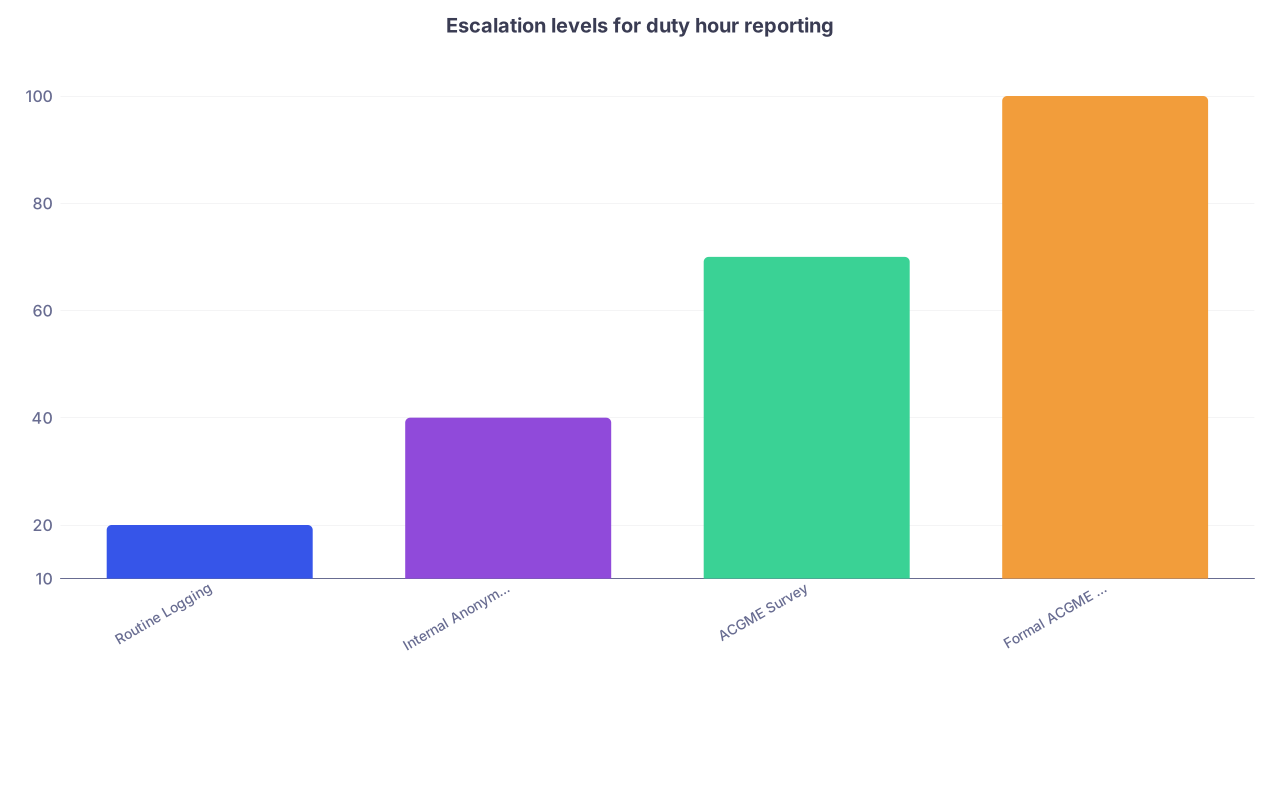
| Category | Value |
|---|---|
| Routine Logging | 20 |
| Internal Anonymous | 40 |
| ACGME Survey | 70 |
| Formal ACGME Complaint | 100 |
Think of it like this:
- Routine logging = minor pressure
- Internal anonymous = moderate institutional pressure
- ACGME survey = serious accreditation pressure
- Formal ACGME complaint = red alert
Programs know this. That’s why some will subtly push you: “Remember, the ACGME survey looks at the overall culture, not just one tough month.” Translation: please dilute your truth.
Your answers on that survey are powerful. Say what is actually happening. Patterns of “Frequently” and “Very Often” on duty violations and fear of retaliation are what trigger focused attention.
Will a “reputation” follow you?
Here’s the part most people get flat-out wrong.
Fellowship programs are not getting some backchannel blacklist that says, “This applicant logs hours and answered honestly on surveys.” What they see are:
- Your letters
- Your performance
- Whether your program says you’re ready for independent practice
Could a deeply petty PD tank your letter because you were the loudest voice about duty hours? Absolutely. I’ve seen versions of that. But that’s not “because you reported hours.” That’s because they were looking for a reason, any reason, to frame you as “disruptive” or “not a team player.”
And that kind of PD will invent something else if you do nothing. The underlying hostility is the problem, not the logging itself.
If you’re worried about this, here’s the tactical way to operate:
- Document patterns, not just feelings. Save schedules, emails, call changes. If they ever try to label you “unprofessional,” you have receipts that the real issue was structural.
- Be boringly professional in how you raise concerns. “I’m worried this pattern of hours is unsafe and noncompliant,” not “this program is abusive garbage.”
- Cultivate multiple strong mentors/letter writers, not just the PD. The more people willing to vouch for your work ethic and character, the less power any one person has to define your narrative.
When you should absolutely report, even if it’s uncomfortable
There are some situations where the risk balance flips hard and fast:
- You’re consistently over 90 hours a week or going days without real sleep.
- You’re routinely driving home dangerously exhausted or having near-crashes.
- You’re being explicitly told to falsify hours or “adjust” logs after the fact.
- Residents are routinely alone covering volumes that are objectively unsafe (e.g., single intern covering an entire hospital overnight with minimal backup).
Those aren’t “some programs are tough” variations. They are serious violations that can injure you and patients.
That’s when you use every layer:
- Log accurately.
- Talk with chiefs and document the conversation.
- Use GME/ombuds/anonymous tools if nothing changes.
- Be honest on the ACGME survey.
- If the system stonewalls and you’re truly unsafe, consider a formal ACGME complaint or even exploring transfer.
Yes, transfer is ugly and disruptive. But staying in a chronically unsafe, noncompliant program that won’t fix itself is a bigger long-term risk to your career and sanity.
The bottom line: myth vs reality
Let me strip it down.
- The myth: Reporting duty violations will ruin your career.
- The reality:
- Mild friction? Possible.
- Being side-eyed as “that resident”? Sometimes.
- Actual, traceable career destruction solely from honest reporting? Very rare, and programs know they’re exposed if they try.
Meanwhile, chronic unreported violations absolutely wreck careers. Through burnout, errors, failed exams, and people leaving medicine sooner than they ever planned.
If there’s one thing you take away, let it be this:
- Your honest logging and survey responses are far safer—and more powerful—than the scare stories make them sound.
- The bigger, quieter threat to your career is unchecked overwork, not being “the one who told the truth.”