
The 80-Hour Cap Myth: Why Most Residents Still Feel Exhausted
If residency is capped at 80 hours a week, why do you still feel like you’re being slowly ground into dust?
You’re told the “bad old days” are over. No more 120-hour weeks, no more every-other-night call. There are ACGME duty hour regulations now. Fatigue committees. Wellness initiatives. Mandatory naps.
Yet PGY-1s are still crying in their cars after night float. Seniors are still falling asleep in sign-out rooms. People still quietly admit they’ve nodded off driving home.
So what gives?
Let’s pull this apart without the PR gloss.
What the 80-Hour Rule Actually Says (Not What People Assume)
The mythology says: “Residents can’t work more than 80 hours per week. Problem solved.”
Reality is more complicated and much more generous to hospitals than residents.
| Rule / Concept | What It Actually Means in Practice |
|---|---|
| 80-hour average | Averaged over 4 weeks, not a hard weekly limit |
| 1 day off in 7 | Also averaged over 4 weeks |
| 24 + 4 hour shifts | 28 hours from sign-in to sign-out allowed |
| In-house call frequency | No more often than q3, averaged |
| “Home call” | Doesn’t fully count like in-house hours |
The key word that programs and hospitals quietly love: averaged.
You can absolutely work:
- 95 hours one week
- 70 the next
- 78 the next
- 77 the next
And your “average” is still 80. You’re “compliant.”
Same for days off. You can technically go 13 days straight, get one day off, then 13 days straight, and still have “1 day off in 7 averaged over 4 weeks.”
I’ve seen schedules that did exactly that. Nobody calls it “13 days straight.” They call it “a tough block.”
Now add the other loopholes:
- Pre-rounding before your “shift” technically starts
- Notes and calls done from home after your “shift” ends
- “Home call” that turns into multiple in-house hours but isn’t tracked honestly
- Conferences, M&M prep, QI projects, research, committee work… magically invisible to official hour reports
So before you blame your own stamina, understand this: the 80-hour limit is a reporting construct. Not a physiologic safety limit. And certainly not a guarantee of feeling rested.
The Biology Reality: 80 Hours Is Still Physically Punishing
You don’t need a randomized trial to know that 80 clinical hours plus all the uncounted work is brutal. But we have data anyway.
Residents routinely report sleep for:
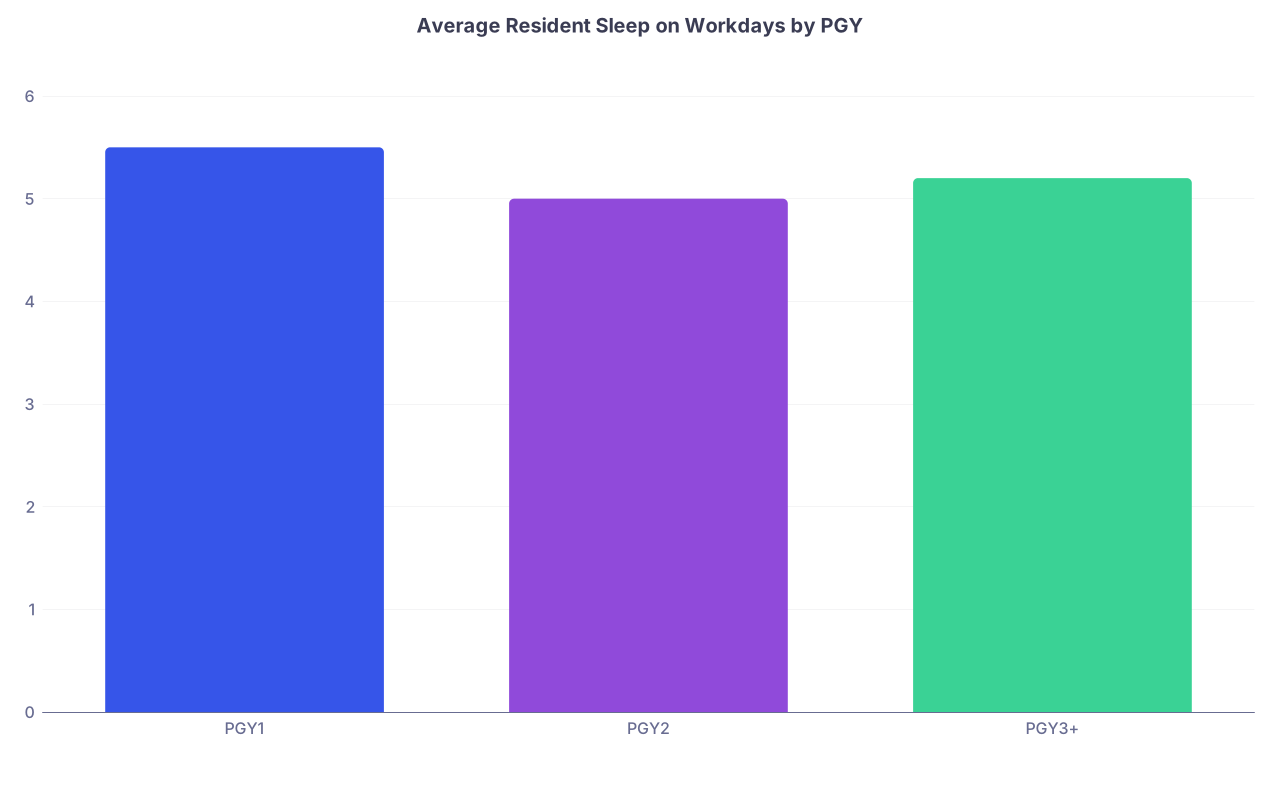
| Category | Value |
|---|---|
| PGY1 | 5.5 |
| PGY2 | 5 |
| PGY3+ | 5.2 |
That’s not a wellness-retreat number. That’s “your reaction time is impaired” territory.
Studies have repeatedly shown:
- After about 17–19 hours awake, your psychomotor performance looks like someone with a blood alcohol of 0.05–0.1.
- Chronic sleep restriction to 5–6 hours per night produces cumulative cognitive impairment over days, even if you “feel fine.” Your brain adapts by lowering your standards for what “normal” feels like.
Residency compresses:
- Very long days (16–28 hours at times)
- Chronic partial sleep deprivation
- Irregular sleep: nights, early mornings, flipping back and forth
- Zero real recovery time between heavy blocks
So yes, compared to the 36-hour marathons your attendings brag about, it’s “better.” But “better than unsafe” is not the same thing as “safe” or “not exhausting.”
Think of it like this: if a factory used to make you work 120 hours a week with no breaks, and now it caps you at 80 with optional coffee, that’s technically progress. Doesn’t mean the workers are thriving.
Why You Still Feel Wiped Out Even at 60–70 Hours
Let’s say your program is genuinely conservative. They target 60–70 hours. No obvious violations. Residents still feel like hell. Why?
Because the structure of the workday matters more than just the total.
Here’s what modern “80-hour compliant” residency really looks like from the inside:
Intensity is higher. Fewer residents per service, more documentation, more metrics, more patient throughput. The work per hour is higher than it was 20 years ago. A 12-hour shift now is not the same as a 12-hour shift in 1995.
The clock doesn’t count the mental load.
You leave the hospital, but you don’t leave the hospital. You’re replaying near misses in your head. Remembering the one patient whose sodium you didn’t recheck. Anticipating morning “why didn’t you…” questions. That’s not rest.Shifts destroy circadian rhythm.
One week of nights, one week of days. Or 3 nights, 2 days, 1 day off, back to days. You never stabilize. The physiology literature on shift work is brutal: higher rates of metabolic issues, depression, accidents.Work compression.
You’re told, “You can’t stay past 28 hours, so be more efficient.” Translation: all the same tasks, just squeezed. Less time to think, more time sprinting.No real off switch.
Your “day off” is used for laundry, life admin, grocery shopping, catching up on studying, and occasionally collapsing. Not exactly a spa day.
So when an older attending says, “We worked 120 hours and survived,” what they’re ignoring is that the entire clinical ecosystem changed. More EMR, more click work, more defensive documentation, more throughput, more complexity, more oversight, more metrics.
In short: modern residency is less about physical presence and more about sustained cognitive load. That fries you just as effectively.
The Numbers: Residents Are Still Exhausted and Burned Out
You don’t have to guess what residents feel; there’s survey data on it.
National studies of residents across specialties have found:
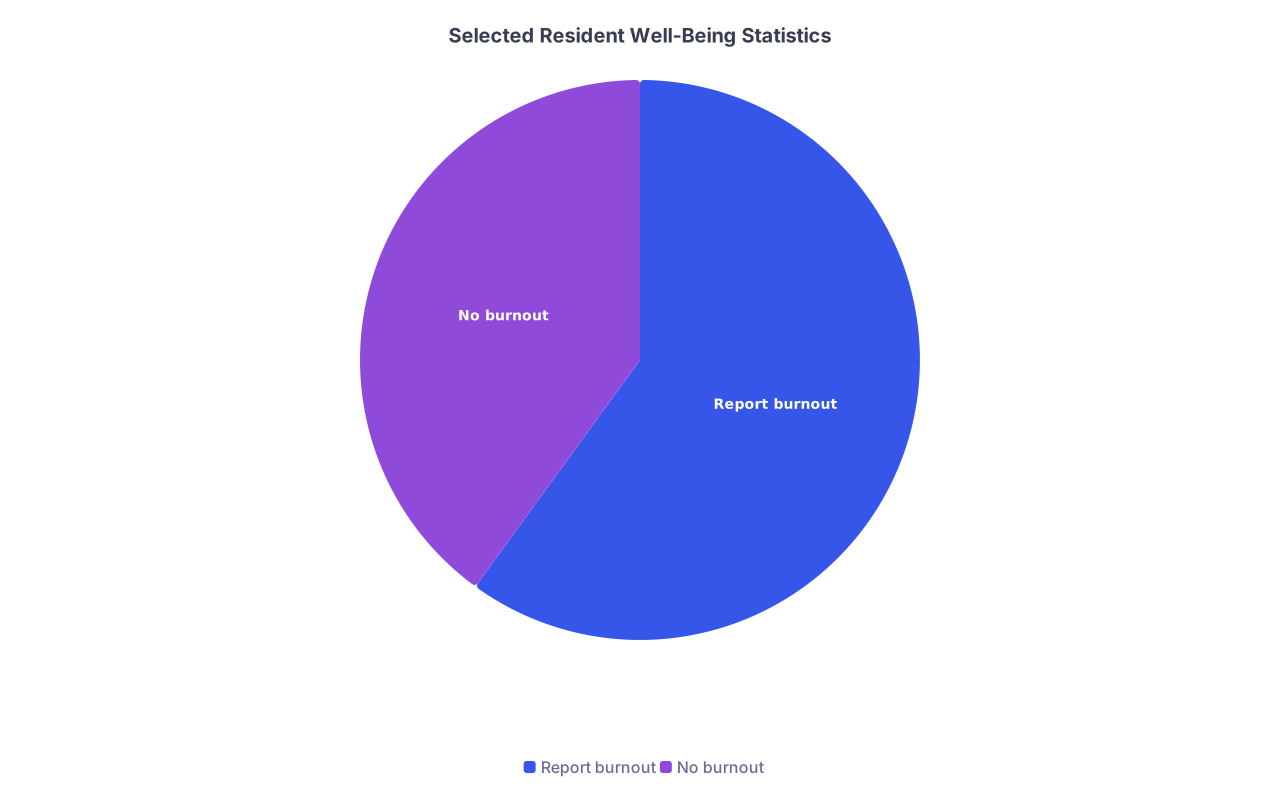
| Category | Value |
|---|---|
| Report burnout | 60 |
| No burnout | 40 |
And that’s conservative. Some specialties (EM, surgery) report rates even higher than 60%.
You also see:
- High rates of depressive symptoms
- Significant sleep disturbances
- Self-reports of fatigue-related errors and near misses
- Residents admitting to driving while dangerously sleepy
None of this disappeared with the 80-hour rule. At best, it shifted what the suffering looks like.
Residents used to tell stories of sleeping in stairwells mid-call. Now they talk about waking up at 2 a.m. in a panic, dreaming they missed a critical lab. Different symptom, same underlying problem: chronic, unresolved fatigue.
The Gaming of Duty Hours: “Just Fix It in New Innovations”
Let’s talk about the silent open secret: duty hour reporting is often fiction.
Officially, programs tell you:
- “Report all your hours honestly. We want accurate data.”
- “We’ll never punish you for a true 80+ hour week.”
Then, culturally, what you hear in the workroom:
- “You probably don’t need to log pre-rounding.”
- “Don’t include the time you were just finishing notes from home.”
- “Don’t mark that as a violation, or it’ll trigger a review.”
Residents aren’t dumb. They understand that “violations” create administrative headaches, not systemic change. So they under-report. A little at first. Then more. Then the entire system re-normalizes “compliance” that isn’t real.
Some typical patterns I’ve seen or heard repeatedly:
- Arrive at 5:30 a.m. to pre-round, but officially your day starts at 7:00 a.m.
- Stay till 7:30 p.m. finishing notes and family calls, but log out at 6:00 p.m.
- Do an extra 3 hours of “quick” follow-up from home and count it as zero.
On paper: 70 hours.
On your body: 85.
Older attendings then wave the duty hour printouts as proof: “See, nobody is over 80. Residents these days just have no resilience.”
Right.
Why Cutting Hours Alone Hasn’t Fixed the Fatigue Problem
The naïve assumption in policy land was: “Long hours → fatigue → errors. So, fewer hours → less fatigue → fewer errors.”
But that line is too clean. Reality is messier.
Here’s what happened after duty hour reforms in many places:
More handoffs
Fewer prolonged shifts mean more transitions, more signouts, and more people touching each patient’s care. Each handoff is a chance for information loss. You trade sleep for continuity.Front-loading work
If you can’t stay late, you cram earlier. Seniors push teams harder to get discharges done by lunch. You’re constantly behind. That sensation—never caught up—burns people out.Shifting work to others
When interns can’t stay past 16 or 24 hours (depending on the era), more work moves to seniors, NPs/PAs, or the next shift. Nobody actually removed the work. They just redistributed it.Education gets squeezed
It’s easier to cut didactics than throughput. Conferences get shorter or more superficial. You get less “big picture” understanding and more “just get it done.” Working hard and feeling clueless is a toxic combination.
So no, duty hour reform didn’t magically make residency humane. It put guardrails around the worst extremes and then left everything else mostly intact.
The Culture Problem: “Toughing It Out” Is Still the Currency
The 80-hour rule tried to regulate time. It did not fix the culture that equates suffering with dedication.
You still hear:
- “I did it, you’ll be fine.”
- “This is what you signed up for.”
- “Patients are sicker now, the work just has to get done.”
- “We can’t teach professionalism if you’re clocking out at 5.”
The hidden curriculum teaches you:
- Saying you’re tired = weak
- Saying you’re overwhelmed = poor fit for the specialty
- Admitting to near misses from fatigue = liability risk, not a systems problem
So residents internalize the message: If I’m exhausted, it’s my fault. I’m not efficient enough. Not resilient enough. Not ‘meant’ for this.
That story is garbage.
You’re running a physiologic experiment that would never pass an IRB: chronically insufficient, irregular sleep plus high-stakes cognitive work plus emotional trauma plus minimal control. Of course you’re exhausted.
So What Actually Helps? (Beyond Fantasy Fixes)
I’m not going to peddle nonsense like “practice better self care.” You can’t yoga your way out of 28-hour calls.
But there are differences between places that leave their residents totally wrecked and those where people are tired but functional.
Patterns I’ve seen that actually matter:
Realistic staffing.
Not pretending that you can cover a 24-patient census with an intern and a resident without both drowning. Programs that fight their hospital for more warm bodies (or adjust caps) are rare but invaluable.Genuinely protected days off.
Not fake “days off” where you’re still expected to do a pile of admin from home. A true, no-pager, no-EMR day here and there helps more than some vague “wellness lecture.”Rational scheduling.
Grouping nights, minimizing flip-flop between days and nights, not stacking the heaviest rotations back-to-back. This is basic circadian science, but many programs still ignore it.Honest hour tracking.
Programs that say, “If we’re over 80, we need to change the system,” instead of, “log differently,” have a very different vibe. You can feel it.Faculty who shut down macho culture.
When an attending openly says, “I’m glad duty hours exist; our old system was unsafe,” it gives residents cover to stop pretending they’re fine.
These are structural and cultural changes, not individual hacks.
On your level, you have limited power. You can’t redesign rotations. But you can stop gaslighting yourself. Feeling exhausted does not mean you’re weak. It means you’re human in a system that still runs too hot.
The Real Myth
The myth isn’t just “80 hours = safe.” It’s deeper:
- That an averaged, loosely enforced time cap can override basic biology
- That modern residency is fundamentally humane now, and you’re the problem if you’re drowning
- That fatigue is a personal failing instead of a predictable output of a badly tuned system
Here’s what the data and lived experience actually say:
80-hour compliant does not equal non-exhausting. The rules closed the door on the most egregious abuses; they did not create a sane training environment.
Structure, intensity, and culture matter just as much as the raw number of hours. You can be destroyed at 65 and functional at 75 depending on how those hours are arranged.
Your exhaustion is not imaginary and not a moral weakness. It’s a legitimate response to chronic sleep disruption, high clinical load, and emotional strain under constant scrutiny.
If you remember nothing else, keep this: the system is better than it was, and still not good enough. You are not broken because you’re tired. The story that “80 hours fixed residency” is the thing that’s broken.