
Work-life balance in residency is not a millennial problem. It’s a patient safety problem dressed up as a generational stereotype.
The moment you frame work-hours reform or wellness as “Gen Z softness,” you’ve already told me you haven’t read a single outcomes paper on resident fatigue, medical errors, or depression. Or you’ve read them and decided to ignore them because the mythology of “I suffered, so you should too” feels more comfortable than data.
Let’s tear into the myths, because a lot of what passes for “old-school wisdom” about residency hours is flat-out wrong.
Myth #1: “Long Hours Make Better Doctors”
I have heard some version of this in every hospital I’ve walked into:
“If you’re not miserable, you’re not learning.”
“Residency is supposed to break you down.”
“You think 80 hours is bad? We did 120.”
This isn’t a teaching philosophy. It’s hazing with stethoscopes.
The claim is simple: more hours = more exposure = better training. The reality is uglier and quantifiable: beyond a point, more hours = more fatigue = more mistakes and worse learning.
Let’s rewind.
When New York State passed the Libby Zion law after a fatigued, poorly supervised resident disaster, it wasn’t because someone got touchy-feely about wellness. It was because a patient died and the public realized residents were working 100+ hour weeks on no sleep. That law—and later ACGME limits—were not designed for resident happiness. They were designed for patient safety.
Multiple controlled studies since then have shown the same pattern: extreme sleep deprivation wrecks performance.
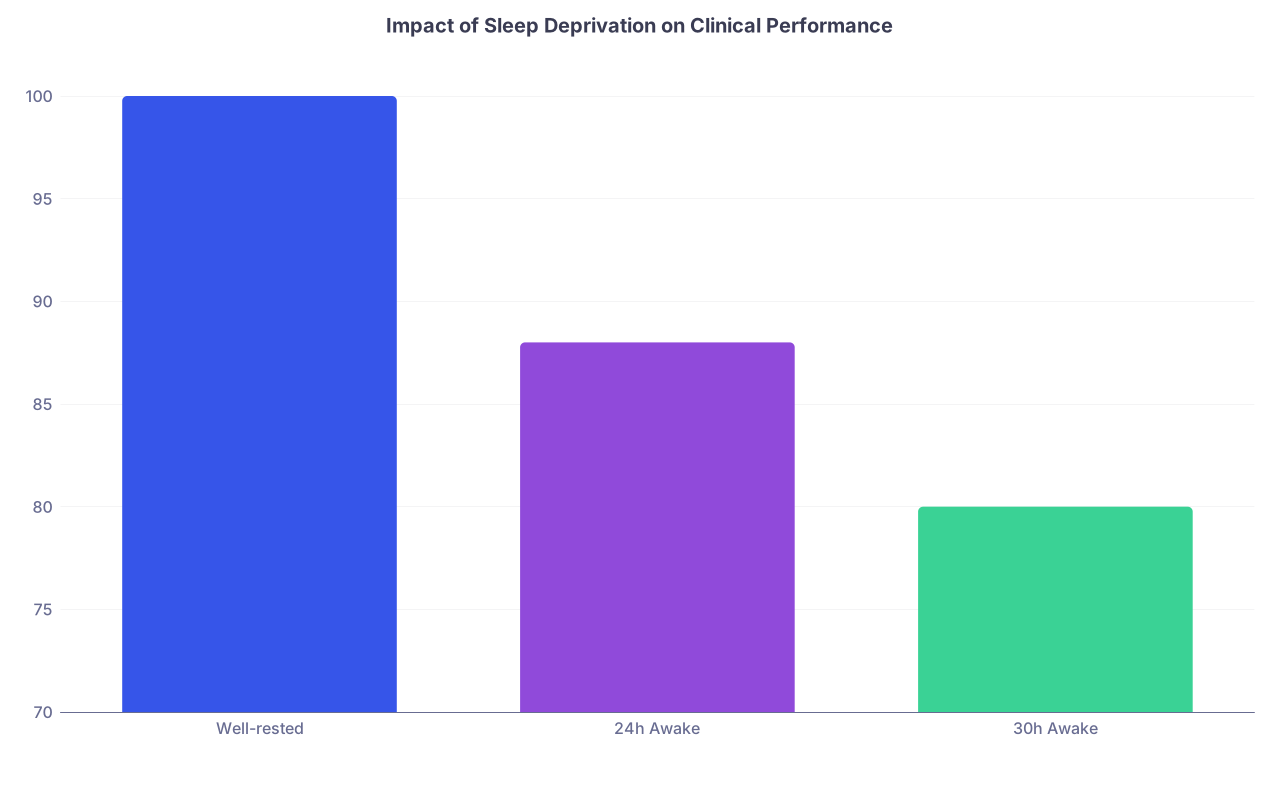
| Category | Value |
|---|---|
| Well-rested | 100 |
| 24h Awake | 88 |
| 30h Awake | 80 |
This is a simplification, but it reflects what the literature keeps finding: by 24–30 hours awake, cognitive performance, psychomotor skills, and decision making drop significantly. Not metaphorically. Measurably. Accuracy down. Reaction time worse. Error rates up.
Classic studies have compared residents under heavy call vs more reasonable hours and found:
- Substantially more serious medical errors on extended shifts
- More attentional failures at night
- Worse performance on psychomotor vigilance and cognitive tests
And before someone trots out the stock line—“But how else will you learn to manage sick patients at 3 AM?”—note something important: none of these studies say residents should never be tired, never stay late, never take night call. They say chronic near-total sleep deprivation as a system design is dangerous.
There is a difference between learning to function when tired vs being permanently impaired and calling it “training.”
And the kicker? Learning itself tanks when you’re exhausted. Memory consolidation, executive function, judgment—these aren’t optional for becoming a good physician. So the argument that horrifying schedules make you a better doctor isn’t just unsupported. It’s backwards.
Myth #2: “Complaining About Balance = Weakness / Lack of Commitment”
This one is pure culture, almost no data. The idea that caring about your life outside the hospital means you’re less dedicated to medicine.
Reality: the residents most obsessed with “balance” are often the same ones reading UpToDate at 11 p.m., hunting for feedback, asking for extra procedures, and showing up early for teaching rounds. They’re not trying to work less. They’re trying not to completely disintegrate.
If you actually look at the mental health data, the bravado about “toughing it out” looks a lot less heroic and a lot more like denial.
Prevalence of depression or depressive symptoms in residents hovers around 28–30% in meta-analyses. That’s not a few fragile souls. That’s nearly a third of your workforce. Burnout rates? Commonly 50% or higher in some fields.
And no, that’s not just because “medicine is hard.” When you compare:
- Programs with reasonable scheduling, some predictability, and non-toxic leadership
vs - Programs with chronic schedule abuse, humiliation, and zero support
you do not see the same rates of burnout and depression. The environment matters.
Here’s where the “weakness” narrative collapses: depression, anxiety, burnout, and fatigue don’t just hurt the resident—they bleed into patient care. Depressed and burned-out residents have higher self-reported error rates, more absenteeism, lower empathy, worse professionalism scores. Again, not a theory. There are multiple large studies on this.
So when a resident pushes for safer hours, protected time, or some form of balance, they’re not undermining the profession. They’re trying not to turn into the doctor everyone complains about in M&M: distracted, irritable, making sloppy errors.
Calling that “weakness” is lazy. It’s what people say when they don’t want to fix the system.
Myth #3: “The 80-Hour Rule Fixed Everything”
The 80-hour rule is treated like some radical wellness concession. The truth? It was a compromise that still allows for residents to work the equivalent of two full-time jobs with night shifts built in.
And even then, let’s be honest: violations are rampant.
| Measure | ACGME Limit | Common Real-World Experience |
|---|---|---|
| Max hours per week (averaged) | 80 | 80–100 in many programs |
| Max shift length (most fields) | 24 + 4 | 28–30 “because finishing” |
| Days off in 7 (averaged) | 1 | “Golden weekends” rare |
| Night float rotations | No hard cap | Weeks of flipped schedules |
I’ve lost count of how many residents I’ve heard say: “On paper, we’re 80. In life, it’s closer to 90–100 some weeks, and people just don’t log it.”
Duty hours become a creative writing exercise. People under-report to avoid getting their program in trouble or being labeled “the complainer.” Chiefs quietly “fix” logs. Faculty say things like, “If you stay late to help, just don’t put it in the system.”
So no, the rule itself didn’t magically solve work-life imbalance. It drew a rough boundary that many programs dance around.
And even if every program perfectly complied, 80 hours is still not balanced. It’s survivable for many. Sometimes workable. But it leaves almost no margin when life hits—kids, illness, a partner with a job, a crisis.
The point is not that 80 must become 40. The point is: pretending “the rule exists, so the problem is solved” is delusional.
Myth #4: “Residents Today Work Less, So They’re Less Prepared”
Here’s the nostalgic fantasy:
Back in the day, residents did 120 hours, saw a million cases, and came out as ironclad clinicians. Today’s residents, with their “restrictions,” are supposedly weaker, less autonomous, less prepared.
If that were universally true, you’d expect clear evidence of:
- Worse board pass rates over time
- More catastrophic errors by recent graduates
- Objective declines in performance on standardized assessments
You don’t see that pattern.
Board pass rates (Step 3, specialty boards) have not crashed in the post-duty-hour era. In many fields they’re still quite high. The competencies programs track—procedural logs, milestone evaluations—don’t show residents suddenly becoming incompetent.
What has changed?
Medicine itself. Complexity, documentation burden, EMR overhead, patient volume, and the expectation of multidisciplinary care have all exploded. Residents are spending huge chunks of time doing non-educational work: clicking boxes, fixing order sets, chasing consult notes, working around hospital inefficiencies.
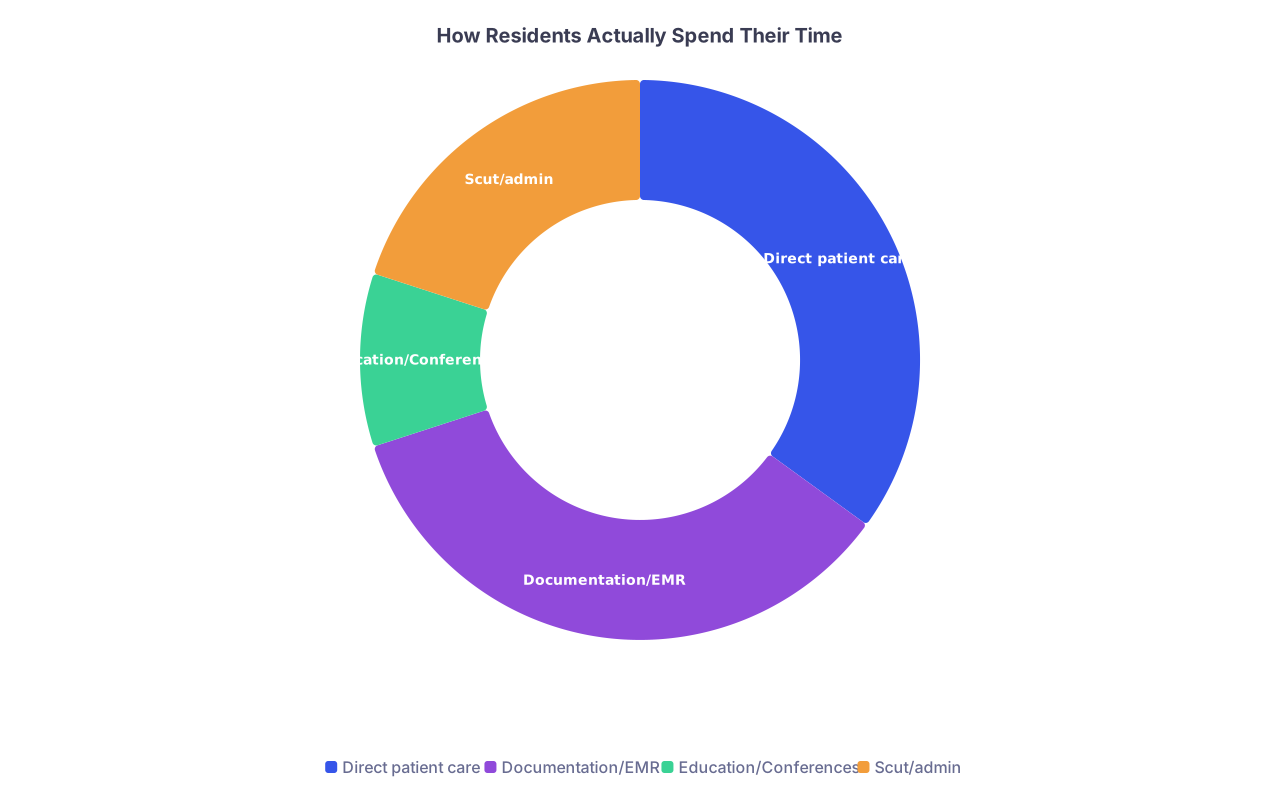
| Category | Value |
|---|---|
| Direct patient care | 35 |
| Documentation/EMR | 35 |
| Education/Conferences | 10 |
| Scut/admin | 20 |
So yes, in face time hours, many older attendings truly did grind more. But a huge percentage of that time was in a pre-EMR, lower-complexity world, with different expectations and fewer systemic inefficiencies.
If you want residents better prepared, the honest move isn’t “just make them stay more.” It’s:
- Strip out meaningless work that has zero educational value
- Protect real teaching and autonomy inside the hours that exist
- Stop equating physical presence in the hospital with high-quality training
You can absolutely destroy a resident with 80 hours of low-yield misery. You can also train a beast of a clinician with less time but higher-quality, targeted experience.
Hours are a proxy. A crude one. They’re not training quality.
Myth #5: “Work-Life Balance Means Working Less and Caring Less”
This is the straw man that refuses to die.
When residents talk about balance, they’re rarely saying, “I want to clock out at 4 p.m. no matter what.” What they actually want:
- To not be emotionally and physically annihilated for three years straight
- To have some agency over their schedule and life planning
- To be able to show up to work as a functioning human, not a resentful zombie
I’ve watched residents drag themselves through back-to-back brutal rotations, accumulate sleep debt like compound interest, and then go home and stare at the wall instead of seeing their kids. That isn’t noble. It’s brain damage, slow-motion.
Residency will never be a 9–5. Emergencies happen, sick patients don’t schedule themselves, codes don’t care about your yoga class. Fine. That’s the job.
But if you can’t hold both truths in your head—medicine is demanding and humans have limits—you’re not defending the profession. You’re defending dysfunction.
Work-life balance in residency, done right, is about sustainability:
- Enough recovery to avoid chronic cognitive and emotional impairment
- Enough predictability to maintain relationships and basic adult responsibilities
- Enough respect for residents as humans that they don’t leave the field in disgust
The data on career satisfaction is clear enough: chronic burnout in training predicts early exit, scope reduction, or severe cynicism later. If you want a generation of doctors who stay in full-scope practice, you can’t treat their 20s and early 30s as expendable.
What Actually Works: Evidence-Based Balance
You want to know what correlates with less burnout, better patient care, and less “I hate my life” among residents? It’s not beanbags and pizza in the call room.
The better programs I’ve seen do things like:
- Real effort scheduling: Not perfect, but intentional. Cap on insane strings of nights. Thoughtful rotation design so you’re not jumping from brutal week to brutal week with no recovery.
- Protected teaching time that’s actually protected: Not constantly cannibalized by “but we’re short today.” You can’t call it protected if you page the resident out every 5 minutes.
- Fair distribution of garbage work: Some scut is unavoidable, but it’s shared, not dumped on the same few people while others hide.
- Psychological safety: Residents can say “I’m unsafe to drive” or “I’m too tired to safely do this procedure alone” without being humiliated.
And here’s the uncomfortable truth for program leadership: every time you fix these things, you often find that the problem was not resident softness. It was bad staffing, poor process design, and neglect that had been normalized.
Residency is supposed to be hard. It doesn’t have to be stupid.
Why This Isn’t Just a “Millennial / Gen Z” Story
The generational framing is a distraction.
Yes, younger physicians talk more openly about mental health, therapy, parenting, and wanting a life outside work. That’s not fragility; that’s dropping the mask older generations were forced to wear.
When I talk to attendings in their 40s, 50s, 60s—many will quietly admit:
- Their marriages almost broke in residency
- They drank too much
- They did dangerous things while severely sleep-deprived
- They still carry guilt about errors they made while wrecked
That’s not some golden era we should nostalgically recreate.
What’s changed is not human biology. It’s tolerance for pretending this is fine.
If anything, the residents pushing for work-life balance are trying to protect both themselves and their future patients from a model that burned out and damaged a generation of doctors before them.
The Bottom Line
Strip away the noise and you’re left with this:
- Extreme resident work hours and chronic sleep deprivation worsen learning and patient safety. The data is not on the side of the “just grind harder” crowd.
- Work-life balance in residency isn’t about coddling; it’s about sustainability and competence. Destroyed residents don’t become better doctors—they become dangerous and they leave.
- The real fix isn’t romanticizing the past; it’s designing training that is intense, yes, but not idiotic—high-yield hours, humane schedules, and the basic recognition that residents are humans first, physicians second.
You want better doctors? Stop confusing suffering with training.