
The fastest way to destroy a residency year is not “bad rotations.” It is bad weekend coverage.
You can survive long days. You will not survive a calendar that quietly steals every third Friday, every other Sunday, and turns your “days off” into logistical junk.
Let me walk you through the worst weekend coverage mistakes I see residents make—and that programs make to them—and how to protect yourself before your entire month is booby-trapped.
The Core Problem: Weekends Are a System, Not Just Shifts
Most residents make the same error: they look at weekends one at a time.
“OK, I am on call this Saturday. That sucks, but fine.”
Wrong frame. Weekends are a pattern problem, not a single-day problem. The pattern is where the traps live:
- Illegal or near-illegal stretches (11–13 days “in a row” once you count partial days)
- Fragmented “days off” that are technically compliant but practically useless
- Invisible recovery debt that destroys your subsequent rotations
- Weekends that poison weekdays: constant post-call zombies landing on Monday clinics or Tuesday OR days
You must train your eye to see sequences, not dots.
Trap #1: The “11 Days Straight” Mirage
The biggest and most common weekend trap: sequences that look legal under ACGME rules but absolutely crush you.
The rule everyone half-remembers:
1 day off in 7, averaged over 4 weeks.
Max 6 consecutive days in practice if your program is being conservative.
Yet I repeatedly see:Start a painful inpatient block on a Monday.
Work straight through the first week.
Weekend “off” is actually one day off and one “short call.”
End up with 11–12 calendar days where you never actually disengage from work.
Example I saw on a real schedule:
- Mon: Work
- Tue: Work
- Wed: Work
- Thu: Work
- Fri: Work late
- Sat: 24-hour call
- Sun: Post-call “off” (you leave at noon wrecked)
- Mon: Back on days
- Tue: Work
- Wed: Work
- Thu: Work
- Fri: Work
On paper, that looks “fine”: you had Sunday “off.” In reality, you never had a real day where you woke up not responsible for the hospital.
Do not accept this structure without pushing back.
You must scan your schedule like this:
- Count calendar days where you physically have to show up or recover.
- Mark which ones are truly off (no call, not post-call, no required educational events).
- Flag any stretch where you go more than 7–8 calendar days without a full, real day of no obligation.
What to do:
- When schedules get posted, immediately scan for runs > 7 days without a real, full day off.
- Email your chief with specific sequences, not vague complaints:
“From 7/8 to 7/18 I never have a full day where I am not either in-house, post-call, or on backup. Can we trade X call or move Y to keep within a 6-day run?” - Use the actual ACGME language if you must. Chiefs usually respond to “averaged over 4 weeks” and “meaningful rest” more than “this feels bad.”
If you do not do this in week 1 of the block, you will be stuck. By week 3, trades are almost impossible.
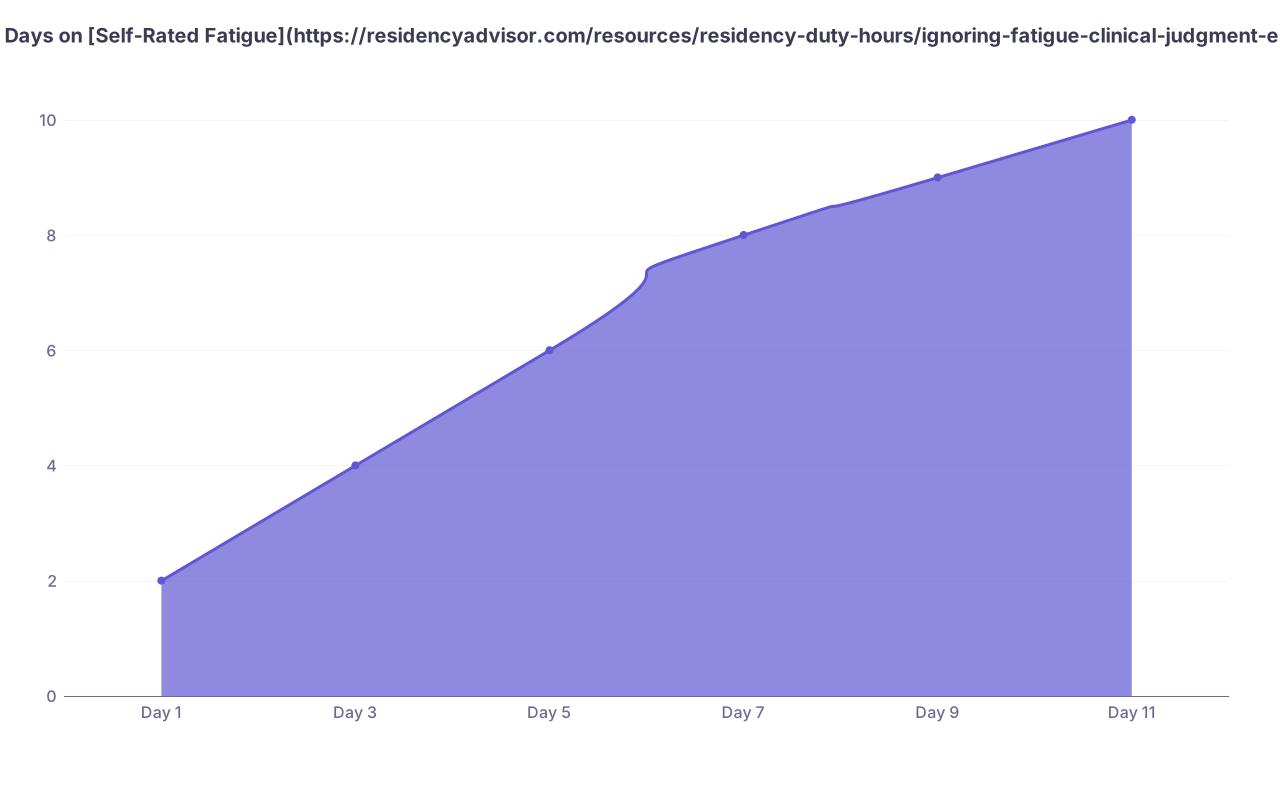
| Category | Value |
|---|---|
| Day 1 | 2 |
| Day 3 | 4 |
| Day 5 | 6 |
| Day 7 | 8 |
| Day 9 | 9 |
| Day 11 | 10 |
Trap #2: The “Fake Day Off” Weekend
The next big scam: the “day off” that is not actually off.
Common versions:
- Saturday AM rounding with “the rest of the day off”
- Sunday cross-cover from 4–10 pm with “most of the day off”
- Required Saturday conference or exam disguised as “educational activity, not work”
- “Backup call” that basically glues you to your phone and blocks leaving town or properly resting
Here is the key concept: a day off is defined by control of your time, not hours on a clock.
If half your “off day” is:
- Commuting
- Pre-rounding
- Signing out
- Sitting in a lecture you could not skip
That is not rest. That is a short shift.
I have seen residents burned by this repeatedly when they:
- Agree to “swap” a full Saturday off for “just come round on Sunday morning instead”
- Accept weekend backup call every other week “because it is usually quiet”
- Count post-call days as their “weekend” and then let chiefs assign more “educational” time on those days
Start labeling your days honestly:
- Full working day
- Partial but committed day
- True off day (no clinical, no required academic, no backup, no formal call)
If your 4-week block has fewer than 4–5 true off days, your weekends were stolen.
How to avoid this trap:
- When someone suggests a trade, ask: “Is that day truly off—no rounding, no conference, no backup?”
- Document your obligations. When GME or program leadership ask about burnout, vague answers are useless. Be able to say:
- “In this 4-week block, I had only 2 days with zero required activities.”
- For required weekend conferences:
- Clarify whether they count as duty hours.
- If they do, they must be part of the 80-hour calculation and your day-off calculations.
You are not being difficult. You are defending the one thing that keeps you from making dangerous mistakes: rest.
Trap #3: Alternating Weekends That Poison Both Weeks
Alternating weekends sounds fair. Half the weekends you work, half you do not. Reasonable.
Except the implementation is often garbage.
Common pattern:
- Week 1: Long days, work Saturday
- Week 2: Work full week again, “off” Sunday only
- Week 3: Long days, work Sunday
- Week 4: Post-call zombies scheduled for Monday clinics or OR
Or the version where your “weekend off” is wrapped by late Friday and early Monday, so there is no real rest in between.
The real damage is where your weekends land relative to your hardest weekdays.
You want at least some of these:
- A real day off before a known heavy Monday (big clinic, OR day, ICU census explosion pattern)
- A post-call day that actually lets you decompress, not just collapse then wake up to another early start
- Occasional weekends that are truly empty: no call, no post-call, no backup, no random required event
The mistake residents make is consenting to coverage patterns that:
- Put 24-hour Saturday call right before an important Monday rotation (like a new sub-specialty or a key attending)
- Stack weekend nights with early-morning weekday responsibilities
- Create a “yo-yo” pattern: recover all Sunday, slam Monday, crawl through Tuesday
When you are negotiating weekend coverage, stop thinking in isolation: “Is this Saturday okay?” Start thinking:
- “What does the 5-day arc before and after this weekend look like?”
- “Will I be safe to function on Monday if I take this call?”
- “Am I walking into an exam week, interview, or high-stakes clinic after this weekend?”
You cannot avoid all bad combos, but you can avoid catastrophic ones.
Trap #4: The Sneaky Post-Call Monday (and Friday Night Death Spiral)
There are two particular weekend setups that reliably ruin entire weeks.
1. Post-Call Monday Clinics
Residents love to underestimate this one. The schedule reads:
- Sunday: 24-hour call
- Monday: “Post-call day” with “just a half-day clinic”
Sounds survivable. Until you are living it.
You stumble into clinic:
- Cognitive speed: half-normal
- Patience: near zero
- Documentation: a train wreck
- You fall behind on notes, orders, follow-ups, and that backlog will haunt your entire week
You made one trade months ago. You “just” agreed to keep that Monday clinic rather than reschedule. Now your entire week is built on exhaustion.
2. Friday Night → Saturday Call → Monday full day
This is rage-inducing but extremely common:
- Friday: Long OR day / call / admissions till 9–10 pm
- Saturday: In-house 24-hour call
- Sunday: Post-call “off” (you sleep)
- Monday: Full academic day with conference plus clinical
Technically legal. Functionally miserable. And you will spend the whole week making small errors and bad decisions because you are running on fumes.
How to protect yourself:
- If you see a Sunday 24h call, fight to clear Monday AM whenever possible.
- If you cannot clear it, at least consolidate: see fewer patients, ask to move new consults to later in the week.
- For Friday → Saturday combos:
- See if you can shorten that Friday or move elective things away from that day.
- Ask seniors: “Historically, is the Friday before this call usually brutal?” If yes, try to trade.
You do not want to be the resident who mis-doses a medication or misses a subtle decompensation because you protected “fairness” instead of your nervous system.
Trap #5: Swap Yourself into a Hole
Residents are usually their own worst enemies with weekend trades.
You try to be a good colleague:
- You pick up someone’s random Sunday because they have a wedding
- You agree to be “flexible” on backup
- You trade a weekend now because you are desperate for a single event (exam, partner’s visit, family emergency) and forget to examine the larger pattern
I have watched smart people do all of these:
- Trade a light weekend now and accidentally create a 19-day block with one real off day later
- Stack two weekend nights to “get them over with,” then walk into a monstrous ICU stretch
- Take one extra weekend to help a friend and then find yourself out of compliance, forcing leadership to “fix” it by destroying one of your only future clean weekends
Process for any weekend trade:
- Pull up the entire 4-week block (not just the current 7 days).
- Ask: “How many true off days do I lose and gain across these 4 weeks?”
- Check for new dangerous sequences:
6 work days in a row
- 2+ weekend calls in the same 3-week span
- Post-call landing on a heavy academic / OR / clinic day
- Put it on paper (or in your notes app). “If I trade, I will have calls on X, Y, Z and off days on A, B, C.”
If the trade creates a worse cluster later, think very hard before you agree.
| Question | Red Flag Answer |
|---|---|
| Any 7+ day work stretch created? | Yes |
| Losing more true off days than gain? | Yes |
| Post-call now before key clinic/OR? | Yes |
| Two heavy weekends in 3-week span? | Yes |
| Backup that limits real rest? | Yes |
If you hit 2+ red flags, you are trading yourself into a hole.
Trap #6: Backup Call That Quietly Steals Your Life
Backup sounds harmless. “You rarely get called in. Just keep your phone on.”
Do not underestimate the psychological tax:
- You cannot really leave town.
- You cannot really disconnect.
- You check your phone constantly.
- You sleep poorly because you are partially “on alert.”
Backup is not equal to a free day. Especially when:
- Census is climbing and they are short-staffed regularly.
- Your program culture is “if you are backup, we expect you to be ready to come in.”
- Chiefs use backup as a pressure valve for bad primary coverage patterns.
You need to track backup like real call:
- Log it as duty hours if you are called in (obviously).
- Treat repeated backup weekends as partial weekend loss.
- Avoid agreeing to every “can you just be backup?” request just to be nice. That is how you lose your real weekends stealthily.
Reasonable compromise:
- Rotate backup evenly.
- Cap number of backup weekends per block or per 3-month period.
- For heavy services, have a clear rule: if backup is “activated” more than X times per month, re-evaluate staffing.
You should not be the permanent safety net for a chronically understaffed schedule.
Trap #7: Not Using Data (You Are Flying Blind)
Most residents complain about weekend coverage based on vibes. “This feels bad.”
Program leadership responds much better to:
- “In the last 8 weeks, I had only 3 full, unencumbered weekend days.”
- “The average stretch between real days off on our ICU rotation is 9 days.”
- “We had four residents working 2+ weekend 24s in a single 28-day block.”
Track basic metrics for yourself, then for your class when you can.
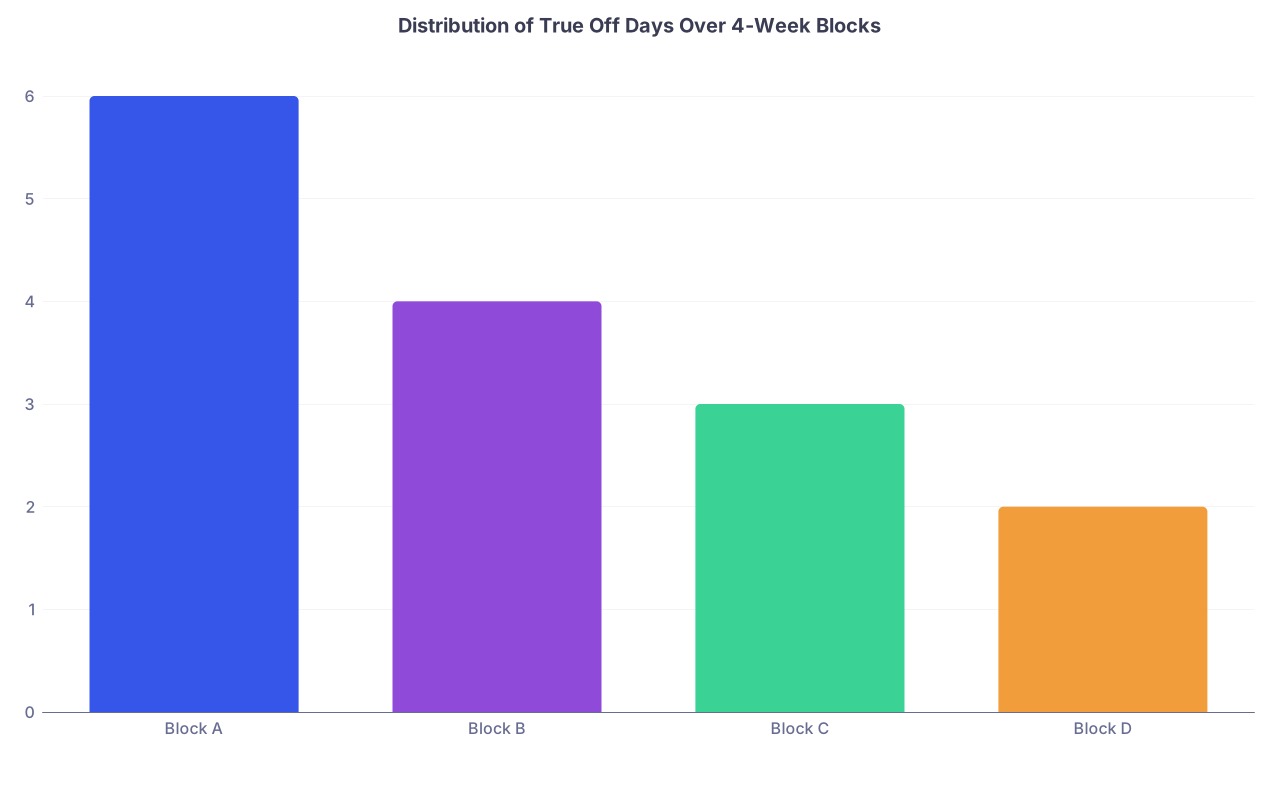
| Category | Value |
|---|---|
| Block A | 6 |
| Block B | 4 |
| Block C | 3 |
| Block D | 2 |
If your program is actually violating duty hour rules, you need a paper trail. But even before that, you need self-awareness. Most people underestimate how few real breaks they get.
Simple system:
- Use a calendar (digital or paper).
- Color-code:
- Full work day
- Call
- Post-call
- Backup
- True off
- At the end of the month, count.
You might discover the problem is not “I hate this rotation,” but “I have had 2 actual weekend days off in six weeks.”
Once you have numbers, you can:
- Make smarter trade decisions.
- Show chiefs specific patterns to fix.
- Protect the few good weekends you have from being cannibalized.
Practical Defense Moves: How To Not Get Crushed
Let’s make this concretely useful. Key moves to stay out of weekend coverage hell.
- At the start of every block, print or open the full 4-week grid.
- Mark:
- All weekend call / nights
- All post-call days
- All backup
- All required weekend conferences / exams
- Circle your true off days. Count them.
- Look for:
- Any 7+ day stretches without a true off day
- Any 2+ weekend calls in 3 weeks
- Post-call landing on high-stakes Mondays
- Negotiate:
- Use very specific language: “If I swap that Sunday call, my only off day in this 9-day run disappears. Can we re-balance another way?”
- Offer solutions, not just complaints: trade weekends with similar intensity, volunteer to shift a weekday instead of stacking weekends, etc.
- Protect:
- One occasionally sacred weekend per quarter where you refuse to add backup or extra duties unless there is a true emergency.
- At least one weekend per month where you have two consecutive true off days if possible.
And document. Quietly. For yourself at first. For the program later if needed.

| Step | Description |
|---|---|
| Step 1 | Receive Monthly Schedule |
| Step 2 | Mark Weekend Duties |
| Step 3 | Identify True Off Days |
| Step 4 | Request Adjustments |
| Step 5 | Accept and Track Hours |
| Step 6 | Any 7+ day stretches? |
| Step 7 | Post call on key days? |

Frequently Asked Questions
1. My program’s culture is “don’t complain.” How do I push back on weekend coverage without getting labeled difficult?
You avoid generic complaining and bring concrete, measurable problems. Instead of “these weekends are killing me,” say:
- “In this 4-week block, I have only 2 true off days. ACGME expects 1 day in 7 on average.”
- “This Sunday 24h call followed by Monday full clinic is concerning for patient safety. Can we move either the call or clinic?”
You frame it around duty hours, fairness across residents, and patient safety, not personal preference. You propose alternatives. You offer to help solve the puzzle instead of just pushing the problem back on chiefs.
The residents who get labeled “difficult” are usually the ones who whine vaguely or always say no, not the ones who bring very specific, reasonable concerns with options.
2. Is it ever worth stacking bad weekends to get a cleaner month later?
Sometimes. But you need to see the entire quarter, not just one month.
Worth it when:
- You gain a truly clean stretch later (for a life event, exam, critical rotation).
- You are not creating a 10+ day work run without a real day off.
- You are not stacking bad weekends right before a big exam or critical evaluation period.
Not worth it when:
- You are already close to burnt out.
- You keep saying, “I will rest next month,” but next month is another heavy block.
- You endanger your performance on rotations that actually determine your fellowship or job prospects.
Your nervous system does not care that “next month should be lighter” if you never actually get there intact.
3. What if everyone else seems to tolerate the weekend schedule and I am the only one struggling?
First, do not assume that. Residents are experts at pretending they are fine.
Second, even if you are the only one saying it out loud, that does not mean you are wrong. People have different baselines, support systems, commute lengths, chronic illnesses, family responsibilities.
Your job is not to match the highest possible tolerance for punishment. Your job is to be safe and sustainable.
You do not need to demand a custom schedule built around your preferences. You do need to:
- Avoid clearly dangerous sequences (11–12 days of work without a real off day).
- Avoid combinations that reliably wreck you (like post-call Mondays with full clinics).
- Ask for help early, before you spin out with errors, tears, or near-misses.
If you ignore your limits to prove you are “tough enough,” that is not resilience. That is negligence—toward yourself and your patients.
Key points to remember:
- Do not judge weekends one at a time; analyze patterns across 4-week blocks and count true off days.
- Avoid “fake days off,” dangerous sequences (7+ days without real rest), and trades that solve today’s problem by creating a bigger one next month.
- Use data and specific sequences—not vibes—to negotiate safer, more sustainable weekend coverage.