Night cross-cover is where residents either learn to think like real clinicians… or drown in chaos and guilt.
You are not paid to be a hero who answers every page instantly and personally. You are paid to manage risk, triage ruthlessly, and protect patients from the worst things that can happen at 3 AM. That requires a system. Not vibes.
Let me break this down specifically.
The Core Problem: Unlimited Demand, Very Limited You
On nights, cross-cover turns you into three things at once:
- The “primary” for 40–80 patients you barely know.
- The rapid response / code responder.
- The human answering service for every nurse, tech, and consultant on the floor.
If you approach pages in the order they arrive, you lose.
You need a reproducible, hierarchical approach that works when:
- You have 7 unread pages.
- Someone is calling you overhead for a rapid response.
- You have an unstable patient in front of you.
- And the ED is trying to sign out two new admits.
This article will give you that hierarchy and the actual phrases, mental shortcuts, and micro-algorithms I have seen work in real hospitals at 2 AM.
Step 1: Build Your Night Mental Model Before the Pages Hit
The worst night shifts I see are the ones where the resident walks in, grabs the sign-out, and immediately just starts reacting.
Smart residents front-load the work. They create a “map” of their cross-cover that lets them prioritize pages in context.
You need three things before the first page:
- A clean, structured sign-out
- A rapid mental model of each high-risk patient
- A simple coding system for your list
What a Real Sign-Out Should Contain
If your sign-outs look like dumped H&Ps, you are making your life harder. A useful night sign-out is a one-liner + specific “if X, then Y” guidance.
I like a structure like this (and I push teams to use it):
- One-liner: “Mr. Smith, 68, COPD, CHF, on 2L baseline, here with pneumonia, day 2 ceftriaxone/azithro.”
- Active problems: “Hypoxic pneumonia; CHF stable; AKI improving.”
- Night concerns / anticipations: “May need more O2 if he desats walking.”
- Explicit contingency plans: “If O2 need >4L or RR >28 → get VBG, CXR; consider ICU consult.”
- Code status + baseline function: FULL, independent at home.
This gives you permission to act quickly when the page comes: you already know the plan.
If your seniors or attendings do not model this, you push for it anyway. Because at 3 AM, you will not be digging through 12 notes to figure out if the patient is full code.
Coding Your List
I do not care if it’s starred, color-coded, or scribbled in the margins, but you need a visual shorthand.
Example scheme:
- “U” = Unstable or potentially unstable
- “N” = New admit (less known, less predictable)
- “B” = Borderline (on pressors earlier, on BiPAP, etc.)
- “L” = Low concern (post-op POD3, stable labs, no active issues)
You glance at your list and your brain already knows: pages about “U” patients rank higher than “L” patients, even if the text of the page sounds similar.
You are not just triaging pages. You are triaging patients.
Step 2: The Triage Framework – What Do You Answer First?
Here is the core hierarchy I want in your head every minute of the night.

The Priority Ladder
This is the order. Period. You deviate only with very good reason.
- Active codes / unresponsive patient / no pulse
- Respiratory distress / airway threat
- New hypotension / chest pain / acute neuro change
- Rapid responses / severe sepsis / new high O2 requirement
- New significant abnormal labs (K 6.2, Hb 6.5, Na 118, etc.)
- Pain / agitation / nausea in unstable or high-risk patients
- Pain / nausea / sleep in low-risk patients
- Non-urgent tasks (med rec clarifications, diet orders, home meds)
Now layer on one more rule:
Pages about patients you have never seen + concerning vitals > routine requests about patients you know are stable.
This is why a quick pre-night skim of your “U” and “N” patients matters. It changes your interpretation of every page.
Converting Chaos Into a Queue
You will often have to choose between multiple urgent-sounding things. Here is how you convert noise into an internal queue in 10 seconds.
Let’s say you receive these three pages within two minutes:
- “403 A: Pt complaining of 8/10 chest pain, BP 90/60, HR 110.”
- “512 B: Pt requesting Ativan to sleep, very anxious.”
- “602 C: Lab calling critical K 6.0, patient on tele, no symptoms.”
Your order should be:
- 403 A chest pain + hypotension (could be MI, PE, bleed, sepsis)
- 602 C K 6.0 (dangerous but usually has a 30–60 minute window if asymptomatic and on tele)
- 512 B Ativan request (comfort issue, not life threat)
Now, when four more pages drop while you are heading to 403 A, you do not stop walking every time your pager beeps. You acknowledge, jot mental notes, and preserve your priority.
You can literally say on the phone:
“Got it, I’m responding to a more urgent situation right now. I will call you back within 10–15 minutes. Re-page STAT if vitals change or you are worried.”
You are allowed to protect the patient in front of you.
Step 3: A Structured Workflow for Every Page
Every page should trigger the same internal script:
- Triage category (where on the ladder?)
- Vital signs and mental status
- Key focused questions
- Decide: phone order vs go see vs delegate/deflect
- Time-stamp mentally: “I will get to this by X minutes”
1. Triage Category
Ask yourself in 1–2 seconds:
“Is this potentially life-threatening in the next 5–10 minutes?”
If yes → jumps to top.
If no → filtered down.
Examples:
- “Pt desat to 84% on 4L, working to breathe” → high.
- “Pt pulled IV, needs new line” → low.
- “Pt with new confusion, slurring words” → very high (stroke until proven otherwise).
2. Get Vitals and Mental Status First
Your first response to the nurse is usually some variation of:
- “What are the most recent vitals?”
- “What is the patient’s mental status compared to baseline?”
If they do not have vitals, you ask them to get a full set (BP, HR, RR, O2, temp) while you are heading there or finishing another urgent task.
This alone separates minor from major at least 60–70% of the time.
3. Minimum Questions for Common Page Types
You do not have time for full H&Ps. You need 3–4 targeted questions.
Chest pain page:
- Location, character, radiation.
- Vitals and telemetry changes.
- Relation to exertion or breathing.
- Known CAD / ACS history.
If they say: “Substernal, pressure, radiates to left arm, HR 120, new ST changes on tele” → this becomes top priority.
If: “Sharp, localized, worse with inspiration, HR 80, normal vitals, reproducible on palpation” → still high concern, but next-in-line if you are coding someone.
Shortness of breath:
- O2 sats now and 30 minutes ago.
- On what O2 support? Change from baseline?
- Work of breathing: speaking full sentences? Retractions?
- Any new wheezing/crackles noticed?
Hypotension:
- Accurate BP reading? Cuff size? Repeat reading?
- HR trend. Urine output.
- Mental status: alert vs drowsy.
- Recent meds: opiates, antihypertensives, new diuretic dose, etc.
You are looking for: shock vs artifact vs medication effect vs benign.
Agitation / delirium:
- New vs chronic behavior.
- Vitals, glucose, and recent pain meds.
- Does the patient have lines/tubes at risk?
- Is anyone in physical danger right now?
If a patient is trying to yank out a fresh femoral line, this rises in priority. If they are just sundowning but redirectable, it can wait 15–20 minutes.
4. Decide: Phone Order vs Bedside Assessment
You will not physically see every patient for every page. You cannot. It is not a failure; it is being realistic.
Rough rule:
You should go see the patient when:
- There is any acute change in mental status, respiratory status, or hemodynamics that is not obviously benign.
- The nurse sounds truly worried. (Learn their tone. When an experienced ICU nurse says “He does not look right,” you go. Now.)
- The situation might require escalation (rapid response, ICU transfer, code).
- This is a high-risk patient where minor instability could decompensate quickly (severe CHF, massive PE, recent GI bleed, etc.).
You can usually manage by phone when:
- It is pure comfort/symptom management in a stable patient (pain, insomnia, constipation).
- It is a lab abnormality that is chronic / mild / already known.
- It is an order clarification with no clinical instability.
- It is a predictable, low-risk issue (e.g., missing home statin, needed DVT prophylaxis order).
When in doubt your first few months, over-see. Over time, you develop judgment. But do not kid yourself: no one is impressed if you saw every patient but missed the one who was actually dying.
Step 4: Handling Multiple Simultaneous Crises
The real stress test of night cross-cover is not one crashing patient. It is two. Or three. Plus a code in another building.
You need a mental algorithm for “multi-hit” nights.

| Step | Description |
|---|---|
| Step 1 | Receive multiple pages |
| Step 2 | Go to code immediately |
| Step 3 | See sickest pt first |
| Step 4 | Evaluate high risk pt |
| Step 5 | Phone manage lower priority |
| Step 6 | Stabilize or call RRT/ICU |
| Step 7 | Reassess queue and continue |
| Step 8 | Any code or unresponsive pt? |
| Step 9 | Resp distress or severe hypotension? |
| Step 10 | Neuro change or chest pain? |
Rule 1: Ask for Help Early, Not Perfectly
PGY-1s often try to manage two crashing patients alone because they are afraid to “bother” the senior or attending at 2 AM.
That is how bad outcomes happen.
You call your senior when:
- You have more than one patient with life-threatening issues.
- You are in a code and another patient is rapidly deteriorating.
- You are unsure whether to escalate to ICU/rapid response.
- You have a bad gut feeling and cannot articulate it yet.
You do not present a polished case. You say:
“Hey, I need backup. I am in 7A with a hypotensive septic patient on 4 pressors. I just got paged about 9C with new O2 sat 82% on non-rebreather. Can you see 9C while I stay here?”
That is what seniors are for.
Rule 2: Use the System – Rapid Response, Code, Security
You are not alone at night. Every hospital has some version of:
- Rapid response team
- Code team
- Respiratory therapy
- ICU consults
- Security / sitters for dangerous agitation
If you are trying to personally manage a patient in impending respiratory failure, place a central line, calm an agitated psych patient, and adjust 4 pressors all while holding the pager… you are misusing the system.
Escalate formally. Call rapid response when:
- You see a patient who is “sick enough that you are uncomfortable managing them solo on the floor.”
- There is persistent hypotension, hypoxia, or altered mental status not rapidly improving.
Yes, there are hospitals where people roll their eyes at “too many” rapids. Those people also quietly attend morbidity and mortality when things go wrong.
Rule 3: Declare Your Priorities Out Loud
Nurses are not mind readers. If you disappear into one room for 90 minutes, they assume you are ignoring everyone else unless you communicate.
Say things like:
- “I am heading to 412 for new chest pain with hypotension. After that, I will handle 430’s K of 6, then 405’s nausea. Re-page me STAT if anyone’s vitals worsen.”
- “I called rapid response for 520. I will be tied up there for 20–30 minutes. If there’s a new respiratory or neuro change on any other patient, call the RRT directly and they will get me.”
This does two things:
- It clarifies why you are not immediately present for every request.
- It gives nurses a mental model of your hierarchy, which actually reduces low-priority pages.
Step 5: Common Night Pages and How to Prioritize Them
Let us get concrete. These are the patterns you will see over and over, and how I rank them.
| Page Type | Typical Priority |
|---|---|
| Code / unresponsive patient | Highest |
| Respiratory distress / sat <90% | Very High |
| New chest pain / neuro change | Very High |
| New hypotension (MAP <65) | Very High |
| Critical lab (K>6, Hb<7, Na<120) | High |
| Uncontrolled pain in sick pt | Moderate-High |
| Routine pain / insomnia | Low-Mid |
| Diet / home med / DVT orders | Low |
1. “Patient is Desatting”
Details matter. “Desat” can mean a quick dip to 88% that resolved, or a crashing patient.
You ask:
- What is the O2 sat now, and what O2 are they on?
- What were they on earlier tonight?
- Are they in distress? Tripoding, tachypneic, cannot speak full sentences?
- Known COPD with chronic hypoxia vs new?
Priority:
- Sat <90% and worsening / increasing O2 needs / visible distress → Very high. Go now.
- Sat 89–92%, mild increase from baseline, no distress, COPD baseline 88–90% → Still important, but you can finish a critical lab call first.
2. “Patient is Hypotensive”
The wrong response: knee-jerk fluid bolus orders without seeing the patient.
You ask:
- Repeat BP with correct cuff, manual if needed.
- HR trends. Is patient tachycardic?
- Mentation: alert vs drowsy.
- Urine output last few hours.
- Meds: Did they just get IV dilaudid, extra beta-blocker, or 80 mg IV lasix?
Priority:
- MAP <65 or SBP <90 + tachycardia + cold/clammy or altered → top priority, almost certainly go see now, consider rapid response.
- Single low BP in sleepy post-op patient after opiates, HR 70s, warm, normal mentation → can often recheck, reduce meds, and see within 30–45 minutes if stable.
3. “Patient is Confused / More Agitated”
Night delirium is rampant. But not all confusion is equal.
Ask:
- What is baseline? Oriented x3 previously vs already confused?
- New focal neuro deficit? Slurred speech? Weakness?
- Vitals, glucose, O2, infection signs.
- Lines or tubes they might pull?
Priority:
- New focal deficit or speech change / acute inability to follow commands → stroke alert territory, very high.
- Mild worsening of baseline sundowning, redirectable, vitals stable → can wait a bit while you handle life threats.
4. “Patient is in Pain”
This is where new interns lose time. Yes, pain management matters. But not every 2 AM oxycodone request beats a K of 6.5.
Ask:
- Vitals, especially HR and BP.
- Location and type of pain.
- What they already received and when.
- Any red flags (chest, abdomen, neuro).
Priority:
- New severe chest or abdominal pain in a high-risk patient → high. Might uncover PE, perforation, MI.
- Chronic hip pain in a stable, afebrile patient asking for an extra dose early → can be handled by protocol, sometimes deferred a bit.
5. “Critical Labs”
Labs can sound terrifying but be banal. Or vice versa.
You need context:
- Potassium 6.1 in CKD patient who runs high and just got kayexalate this morning, no EKG changes vs
- Potassium 6.1 in previously normal kidney function with new AKI and peaked T waves.
Both need treatment. Second one likely higher risk.
Other high-priority labs:
- Hb <7 (or lower depending on threshold) in a bleeding risk patient.
- Na <120 or >160, especially with neuro symptoms.
- Glucose <50, especially if symptomatic.
- Lactate very elevated in septic or unstable patient.
You usually:
- Call back quickly (within 5–10 minutes).
- Decide if you must go see the patient or can manage via orders.
- Place the initial orders (e.g., insulin/dextrose, calcium, EKG, type and screen) even if you are heading there.
Step 6: Managing Low-Yield, Low-Urgency Pages Without Losing Goodwill
Not every page is clinically important. Some are nonsense. Some come from systemic laziness (“Can you order melatonin?” four times a night).
You still have to maintain relationships with nurses and staff. Because those same people will save you when a patient crumps.
The trick is to be predictable, respectful, and firm.
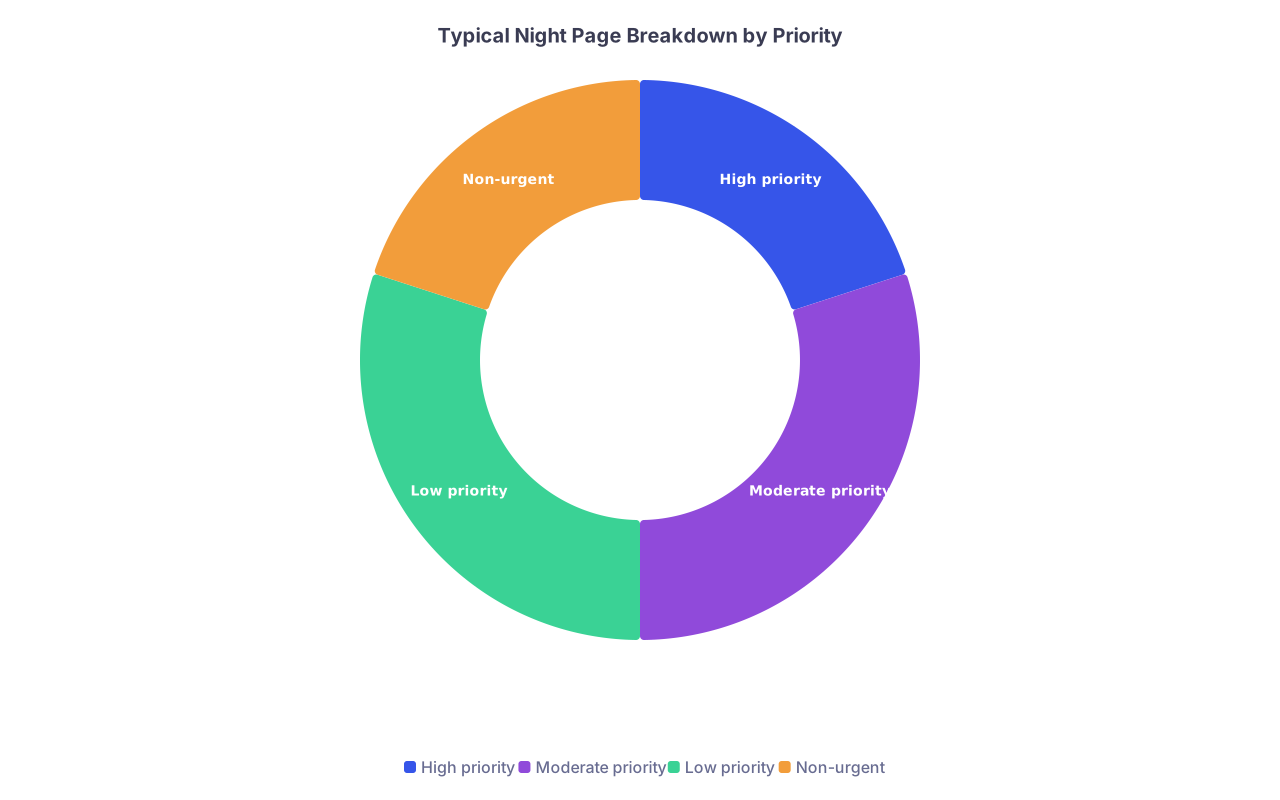
| Category | Value |
|---|---|
| High priority | 20 |
| Moderate priority | 30 |
| Low priority | 30 |
| Non-urgent | 20 |
What I Do with Truly Non-Urgent Requests at Peak Chaos
If I am managing something truly heavy (code, intubation, RRT), I often say:
“I am in a rapid response right now. I want to address that, but it is not safe for me to do it this second. Can it wait 45–60 minutes? If something changes or it becomes urgent, please re-page me STAT.”
Nine out of ten times, the nurse understands. You have acknowledged them and given a time frame.
Pre-emptive Orders to Reduce Useless Pages
If you constantly get “Tylenol for headache” pages at 1 AM, it means your day teams are not doing their jobs, or you are not giving PRNs.
On cross-cover, if you know the patient’s active issues, you can prophylactically order:
- PRN bowel regimen for opioids.
- PRN Tylenol for mild pain/fever.
- PRN nausea medication.
- A reasonable PRN for sleep if not contraindicated (e.g., melatonin).
You will cut your non-urgent pages down significantly.
Step 7: Protecting Your Brain – Personal Workflow, Not Heroics
Residents love to brag about being constantly paged and never sitting down. That is not a flex. That is bad systems thinking.
You have to protect cognitive bandwidth. Otherwise you will make a serious mistake at 4 AM.
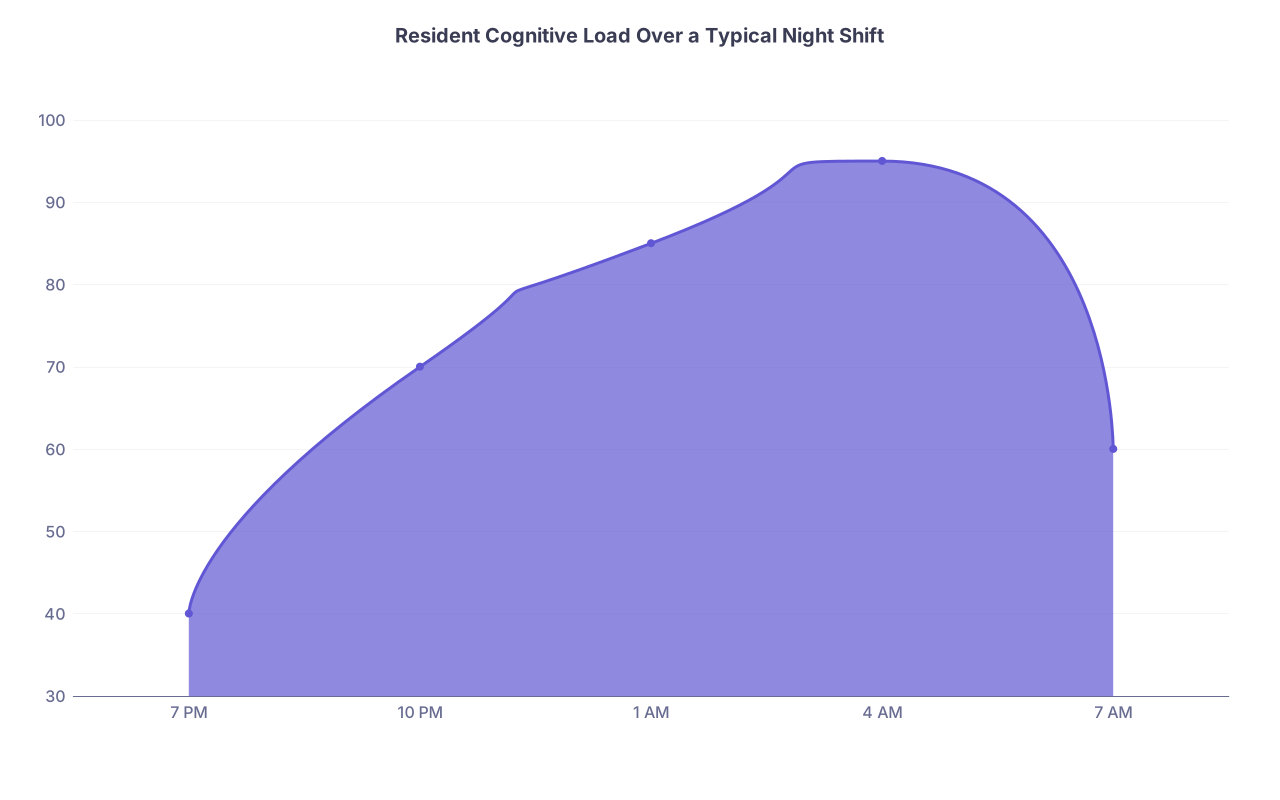
| Category | Value |
|---|---|
| 7 PM | 40 |
| 10 PM | 70 |
| 1 AM | 85 |
| 4 AM | 95 |
| 7 AM | 60 |
Simple Habits That Make Nights Safer
- Always carry: patient list, working pen, and something to track tasks (paper or digital).
- Create a running “to-do later” section for non-urgent issues so they do not occupy brain space.
- When you finish an acute situation, pause for 30 seconds to re-prioritize your remaining pages, not just jump to the last one you got.
- Drink water. Actual water. Not just coffee. Your brain needs it at 3 AM.
Debrief With Yourself Post-Shift
After a rough night, ask three questions:
- Where did I get overwhelmed? Was it volume, complexity, or poor triage?
- Which page did I respond to too late, and why?
- What information did I wish I had in sign-out that would have helped?
Then adjust. Ask teams for better anticipatory guidance. Change your list format. Add common PRNs. Nights get easier when you keep iterating.
Step 8: Documentation Without Drowning
You are right to worry about documentation. But documentation is not the priority at 2:13 AM when someone is hypoxic.
Use a tiered approach:
For minor, low-risk issues (sleep aid, constipation, home med refills):
- Brief note or addendum in the morning or at a lull.
- Single line: “Paged overnight for insomnia, vitals stable, ordered melatonin 3 mg PRN.”
For moderate issues (up-titrating diuretics, starting antibiotics, critical labs that required treatment):
- Short problem-focused note that night:
“Overnight cross-cover: paged for K 6.1. Pt asymptomatic, tele showing peaked T waves. Gave IV calcium gluconate, insulin/dextrose, ordered repeat BMP in 2 hours, EKG improved. Primary team to follow.”
- Short problem-focused note that night:
For major events (rapid responses, transfers to ICU, near-codes):
- Proper event note. That night. You will not remember clearly later.
- Include what you found, what you did, who you called, patient response, and any pending tests.
You are documenting your reasoning as much as your actions. That protects patients and you.
Final Thoughts: What Actually Matters on Cross-Cover Nights
Let me strip this down.
First: Your job is not to clear pages. Your job is to catch and treat the dangerous stuff early. Everything else is negotiable.
Second: Systems beat willpower. A fixed priority ladder, consistent questions, and clear habits will carry you when you are exhausted and flooded with pages.
Third: Communication buys you time. When you tell nurses where you are, what you are doing, and when you will get to them, they work with you instead of against you.
If you remember nothing else:
- Always know who your sickest and riskiest patients are before the first page.
- Triage by threat to life and organ function, not by who paged you last.
- Ask for help early when you are facing more than one serious problem at a time.
That is how you survive cross-coverage on nights—and more importantly, how your patients do.