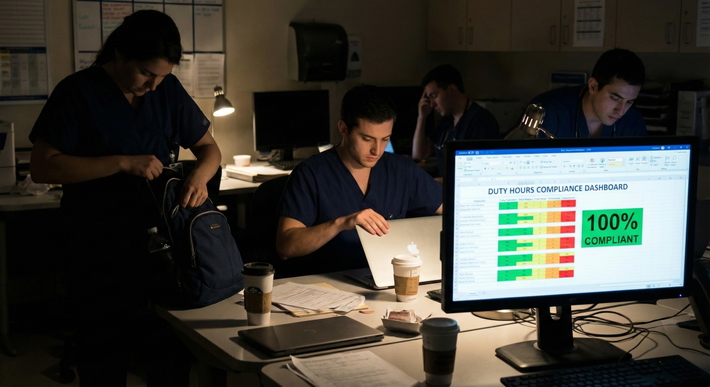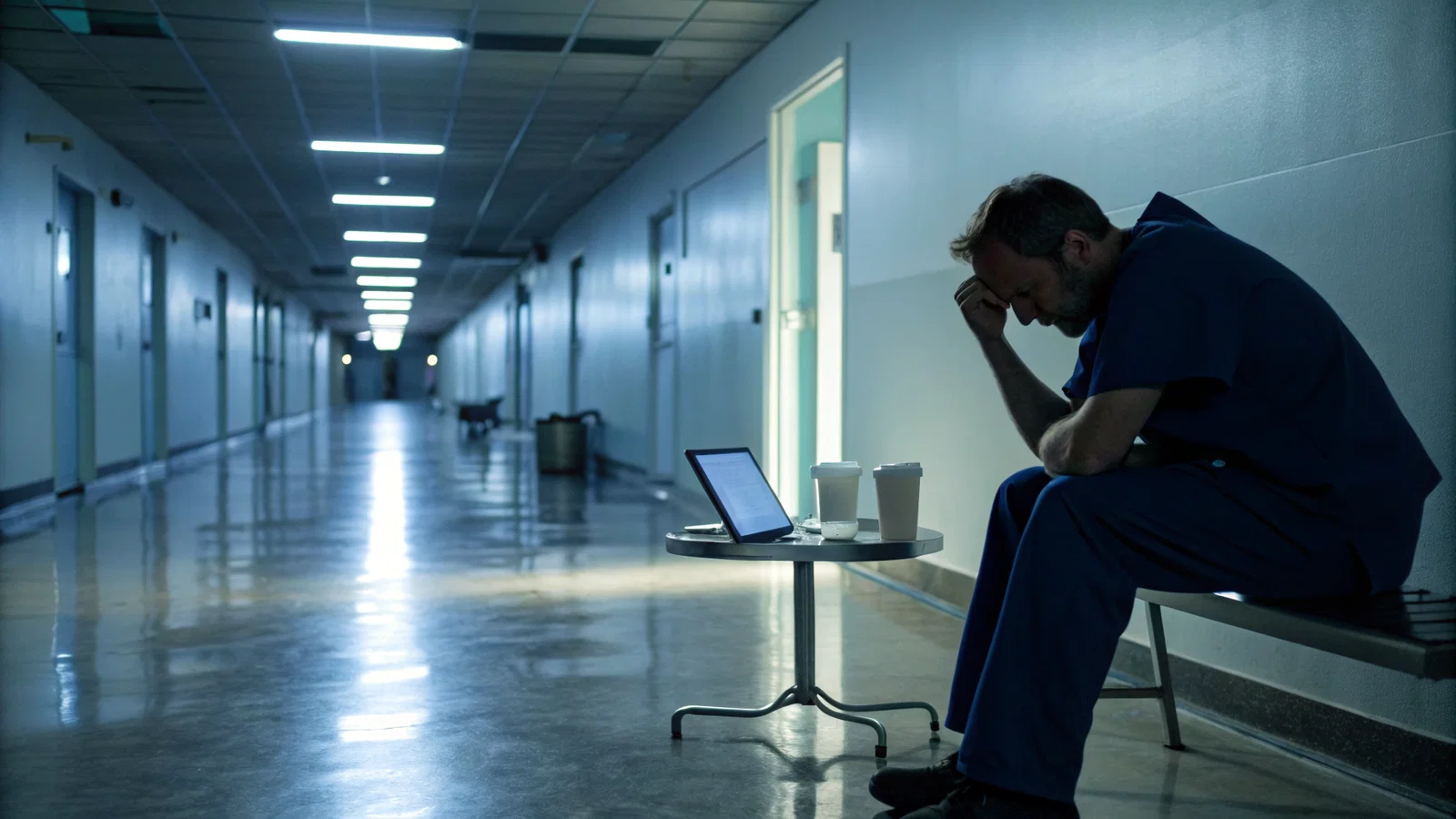
At 6:12 a.m., the night float resident signs out twelve patients, smiles like a hostage on camera, and says, "We're good." Then she walks to the parking garage, sits in her car, and finishes two discharge summaries on her laptop before driving home. None of that counts in the duty hour log. The dashboard says the program is compliant. The resident says she's fine. The Program Director says wellness is a priority. And everybody, at least on paper, has done exactly what they were supposed to do.
Let me tell you what really happens.
Duty hour compliance has become one of the most misunderstood metrics in residency education. Applicants treat it like a safety signal. Faculty use it like a shield. Administrators wave it around as proof that the system works. It doesn't. Not by itself. A clean duty hour report can exist in a deeply unhealthy program. I've seen it happen in surgery, medicine, OB/GYN, even supposedly "lifestyle" fields. The paperwork looked pristine. The residents looked forty years older by February.
This article is for educational purposes only. It is not financial advice, not legal advice, and not tax advice. Regulatory figures vary, and if you need guidance about a specific institutional or employment issue, consult a qualified professional.
The Illusion of the 80-Hour Cap: What PDs Aren't Saying
The 80-hour cap was never a magic boundary between safe and unsafe. It's a legal and accreditation checkbox. That's it. Programs don't get points because residents feel restored, focused, or respected. They get points because the spreadsheet doesn't trigger an accreditation problem.
That distinction matters more than applicants realize.
A resident can log 78 hours and still be dangerously cooked. Why? Because fatigue doesn't come from a single number. It comes from fragmentation, unpredictability, emotional load, commute time, documentation creep, and the constant low-grade panic of unfinished work. Fourteen hours in the hospital followed by an hour of "just tying up charts" at home is still work, even if the software never sees it. A post-call "quick call to the family" on the drive home is still work. Reading overnight imaging because you don't trust the prelim and want to protect yourself before rounds? Work. None of that magically becomes restorative because it happened off the clock.
This is the dirty little secret behind a lot of perfect compliance reports: residents do work that the system doesn't capture, and everyone quietly benefits from pretending it's negligible.
Some of it is structural. Electronic logging systems are blunt tools. They record what a resident enters, not what a resident lives. Some of it is cultural. Residents learn quickly which violations are "acceptable" to report and which ones make them look inefficient, weak, or politically annoying. If you're the intern who keeps logging overages, people start asking questions. Not always compassionate questions. Sometimes the subtext is, "Why can't you handle what everyone else handles?"
And then there's the pressure on Program Directors. I don't say this to excuse them. I say it because you need to understand the incentives. PDs are squeezed from both ends. The ACGME wants compliance. Hospital systems want service coverage. Budgets get cut, hiring lags, APP support is patchy, and resident staffing ratios stretch thinner every year. When there are fewer bodies covering the same amount of clinical work, the labor doesn't disappear. It just becomes invisible. Hidden in early arrivals, late departures, skipped meals, and "brief" after-hours tasks that no one logs because they've absorbed the message: don't make this a problem.
So when a program boasts perfect duty hour compliance, don't applaud yet. Ask the adult question. Are they truly supporting residents, or are they just managing paperwork well enough to stay out of trouble?
Those are not the same thing. Not even close.
Red Flag #1: The Phantom Hours in Call Schedules
Call schedules are where the deception gets obvious, if you know how to read them.
A program can technically honor the 24+4 rule and still grind residents into dust. I call this call overload: a schedule that stays inside official limits while blowing past anything remotely sustainable for a human nervous system. It's the difference between legal and livable. Programs love the first word. Residents need the second.
General Surgery and OB/GYN are the classic offenders, though they are hardly alone. In these fields, call doesn't end when the block on the calendar ends. It mutates. You finish your primary duty period, but then you're still answering pages because no one else knows the patient. You're still fielding consult questions because the cross-cover resident is drowning. You're still being pulled into a case because "you know the anatomy" or "you were there from the start." Congratulations. You are now on secondary call whether or not anyone uses that term.
That extra work often comes with no meaningful recovery time. No protected afternoon off. No clean handoff. No acknowledgment that the body and brain don't reset because the official shift technically expired. This is how programs create phantom hours: labor that is operationally expected but administratively deniable.
(See also: How to Track Post-Shift Home Chart Work Without Breaking Duty Hour Rules for more.)
Here's another behind-the-scenes truth. Attendings know residents underreport. Not every attending, but enough. They know the culture. They know that if they ask a resident to stay for an add-on case, a difficult family meeting, or a "quick" bedside procedure after sign-out, most trainees will comply and never log it. Why? Because residents are constantly judged for attitude. You can be brilliant, hardworking, and kind, but if faculty decide you're "difficult," that label follows you. Fellowship letters. Case opportunities. Evaluations. Everything.
I've watched residents get the message in real time. The attending says, "I know you're technically off, but this will be a great learning case." Translation: stay. The chief says, "We all do this." Translation: don't be the one who complains. The intern looks at the board, looks at the team, and understands the social math immediately. If they leave, they're selfish. If they stay, the system wins.
(See also: The Hidden Red Flags in How a Program Talks About Work-Life Balance for more.)
So what do you do as an applicant or rotator? Don't ask the useless question: "What are duty hours like here?" You'll get polished nonsense. Ask instead, "How does secondary call work?" Then shut up and watch faces. Ask, "If the primary call resident gets tied up in the OR or on labor and delivery, who covers the other patients?" Ask, "After a heavy call night, how often do residents actually leave on time?" Ask, "What happens when multiple urgent consults hit at once?"
If the answer is vague, defensive, or loaded with phrases like "we all pitch in," pay attention. "Pitching in" is often code for chronic understaffing dressed up as camaraderie.
The best programs can explain coverage clearly. They have backup systems. They can tell you who steps in, how residents recover, and when attendings absorb work instead of exporting all pain downward. Bad programs speak in folklore. Good programs speak in operations.
Red Flag #2: The Culture of Invisible Labor
The loudest work in residency gets counted. The quiet work empties people out.
Invisible labor is the stuff that bloats a day after the "real medicine" is supposedly done. Insurance prior authorizations. Care coordination. Tracking down outside records. Calling families who can only talk after 6 p.m. Arranging placement for the patient who's medically ready but socially impossible to discharge. Rewriting discharge summaries because the template is garbage. Messaging case management. Waiting for consultants to call back. Chasing transportation. Cleaning up everyone else's loose ends because if you don't, the patient suffers and tomorrow gets worse.
None of this is glamorous. All of it is exhausting.
This is where productivity culture poisons education. In a healthy training program, the goal is competency: can you assess, prioritize, communicate, and make sound decisions with growing independence? In a sick program, the goal quietly becomes endurance. The resident who stays longest gets praised as committed. The resident who leaves on time after working efficiently gets side-eye. That is not education. That's martyrdom theater.
And once that culture takes hold, it reproduces itself. Burned-out attendings stop modeling healthy boundaries because they don't have any left. Chiefs who were exploited as juniors normalize the same behavior one year later. Faculty stop noticing what should offend them. A resident finishing notes from home at 9 p.m. becomes so routine that nobody even calls it extra work. They call it being responsible.
I'll give you the kind of example you never see in glossy recruitment materials. A senior resident signs out at 7 p.m. She technically leaves on time. Great. Except she gets home, opens the laptop, and spends another two hours completing discharge summaries because there was no swing coverage, the ED kept boarding patients, and the team had three admissions in the final hour. She is "compliant" in the log because she already badged out. She is not well. She is not recovering. She is extending the workday into private space because the institution failed to staff the service appropriately.
That's invisible labor. And it is one of the clearest signs of hidden burnout.
What makes this dangerous is that invisible labor doesn't just steal time. It steals narrative control. Residents start blaming themselves for system failures. They think, "I'm slow," when the real issue is impossible workload. They think, "I need to be more resilient," when what they need is actual support. They think exhaustion is proof they care. That's the most toxic lie in graduate medical education. Caring about patients should not require the ritual destruction of your own life.
Watch how a program talks about this work. Do they acknowledge it? Do they redesign workflows to reduce it? Do attendings step in on high-burden days? Or do they romanticize it as part of becoming a doctor? If it's the last one, you are looking at a machine that converts idealism into depletion.
How to Decode the Real Signals During Your Rotations
You do not need access to internal spreadsheets to know whether a program is burning people out. You need eyes, ears, and a little nerve.
Start with the staff lounge during peak hours. Not the curated noon conference. The actual lived-in spaces. Look at how people eat. Are residents sitting for ten minutes and talking like humans, or are they inhaling food while typing with one hand? Are they isolated? Are they jumpy when their phone buzzes? Burnout leaves a body language trail long before anyone admits it out loud.
Then do the parking lot test. It sounds trivial. It isn't. If you're rotating somewhere for a few weeks, notice which cars are still there when you leave. Notice whether the same residents seem to linger long past the official end of day. The badge data may be hidden from you. The Honda with the sun-faded med school sticker is not.
Ask sharper questions. Not "What are duty hours like?" That question is dead on arrival. Ask, "When was the last time a resident took a mental health day, and how was it handled?" Ask, "How do you handle call-related fatigue when someone has a brutal stretch?" Ask, "Who helps when documentation piles up?" Ask, "What happens if a resident says they're overwhelmed?" The content matters, but so does the speed and confidence of the answer. Healthy programs don't freeze when you ask about strain. Unhealthy ones do.
Also, trust your own physiology. Seriously. If you walk into a service and immediately feel your chest tighten, your shoulders rise, and your mind starts bracing for impact, that's data. Medical students are trained to override instinct in hierarchical spaces. Bad habit. Sometimes your nervous system recognizes a toxic environment before your intellect assembles the argument. Listen to it.
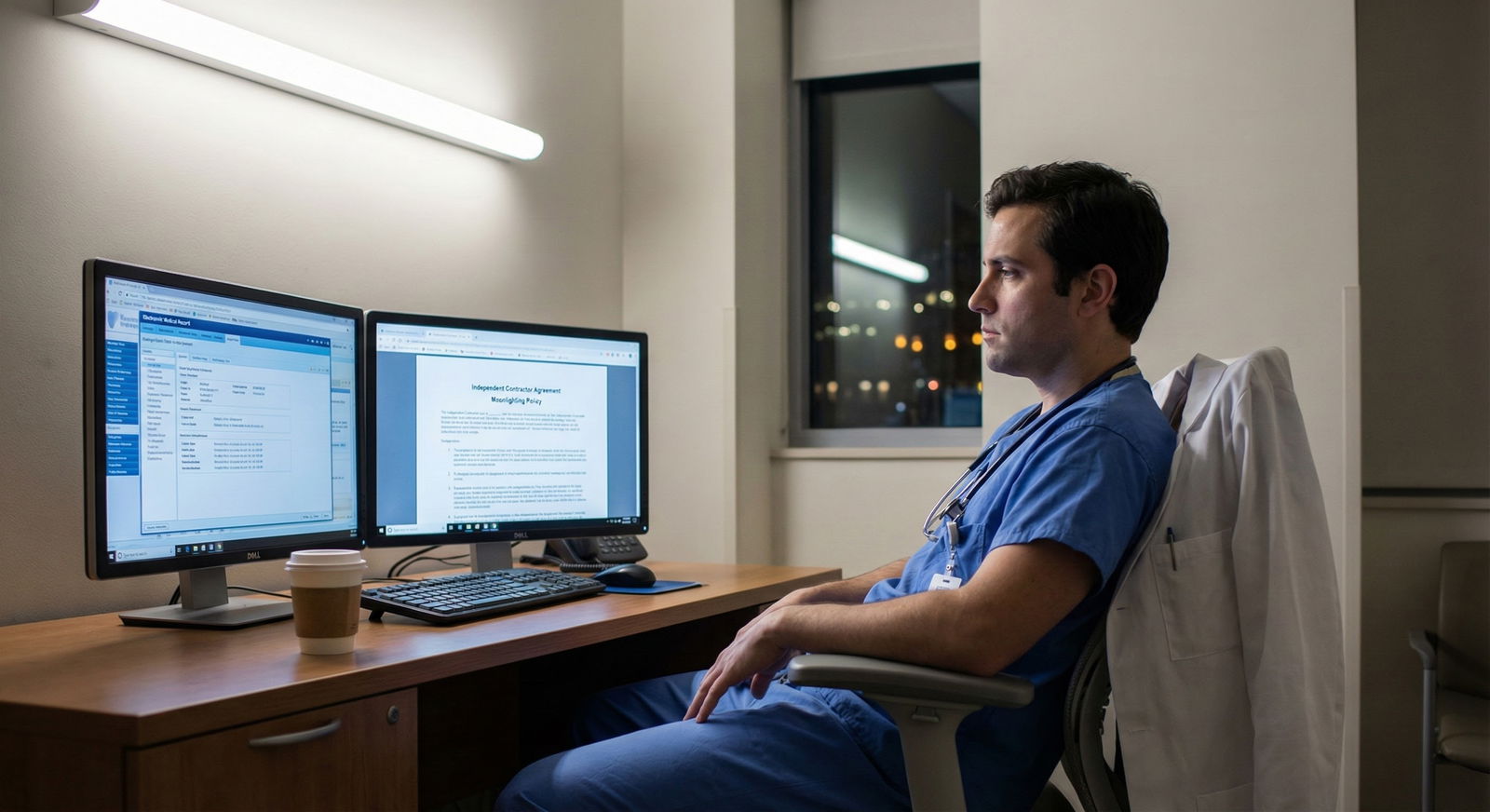
One more thing. Watch how residents talk when faculty leave the room. That tone shift tells you more than any brochure ever will. If the conversation gets flat, cynical, or weirdly careful, there's usually a reason. If the residents can laugh without fear, complain specifically without panic, and still sound fundamentally supported, that's a good sign. Not perfect. But real.
The hidden curriculum of residency is always visible if you stop looking at slogans and start looking at behavior.
Burnout rarely announces itself with a formal memo. It leaks through scheduling, silence, late notes, defensive answers, and tired eyes in fluorescent hallways. Your job is not to be impressed by compliance theater. Your job is to see the human cost behind the numbers.
And here's the encouraging part: once you know how to read these signals, you become much harder to fool. That matters. There are programs that protect residents, tell the truth about workload, and treat support as an operational duty rather than a branding exercise. Find those places. Ask the uncomfortable questions. Trust what you observe. Your training will shape not just your career, but your baseline idea of what medicine is allowed to demand from you.
Choose carefully. Sanity is not weakness. It's strategy.