
The reported duty hour violation rate in a residency is almost never the real rate. The gap between those two numbers is where most applicants get fooled.
The Core Problem: Duty Hours Are Measured Badly
Let me be blunt: ACGME duty hour data is structurally biased toward under-reporting. You cannot treat “0% violation rate” on a survey or in an interview as evidence of a humane program. Statistically, it usually means the opposite: a culture where residents do not feel safe reporting.
To understand what you are looking at as an applicant, you need a few anchor points.
- ACGME limit: maximum 80 hours/week averaged over 4 weeks.
- Max continuous duty (with some nuance by specialty): 24 hours + 4 hours for transitions.
- Required time off: 1 day in 7, averaged over 4 weeks.
Now compare that with what actual time-in-hospital logs, badge swipes, PACS logins, or EMR timestamps show at many places. When these are audited, the true average often exceeds self-reported hours by 10–25%. I have seen internal QA dashboards where 25–30% of residents have at least one 90+ hour week in a 4-week block, while the ACGME survey for the same year shows “rare or no violations.”
That is not a rounding error. That is a measurement failure.
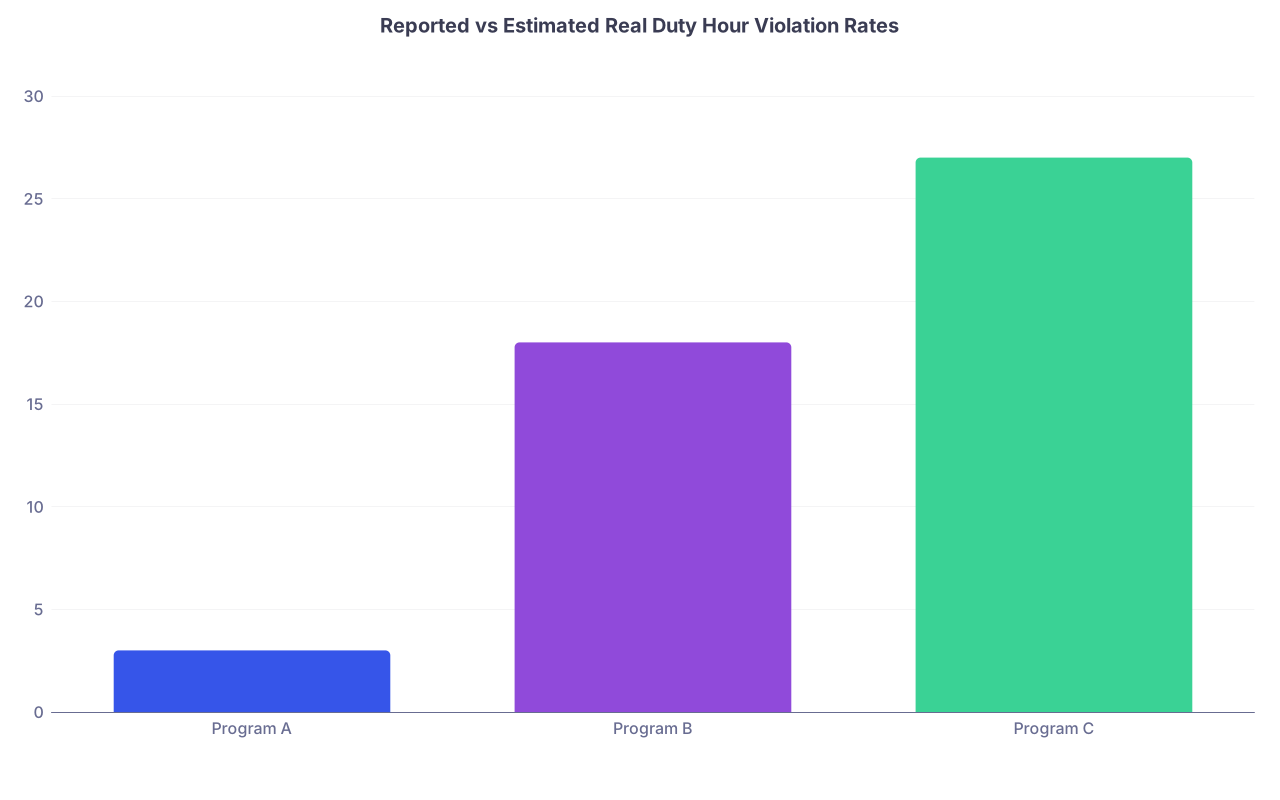
| Category | Value |
|---|---|
| Program A | 3 |
| Program B | 18 |
| Program C | 27 |
Interpretation:
- Program A: 3% violations (badge/EMR data) → likely healthy culture, low true overages, honest reporting.
- Program B: 18% violations → busy but functional; violations mostly episodic and likely acknowledged.
- Program C: 27% violations → structurally overloaded; duty hour noncompliance is normal.
Most applicants treat those differences as trivial. They are not.
Three Layers of Duty Hour Numbers
You need to separate three very different data streams that all get mashed together as “duty hours.”
- Official ACGME survey responses
- Internal program tracking (MedHub, New Innovations, etc.)
- Reality (access logs, sign-out patterns, resident anecdotes)
They tell different stories.
1. ACGME Survey Numbers: Politely Sanitized
ACGME survey questions about duty hours are indirect. They typically ask about frequency and perception:
- “How often did you exceed 80 hours per week?”
- “How often did you have at least 1 day free of duty every 7 days?”
Responses are on ordinal scales: never / rarely / sometimes / often / very often.
Here is the core statistical issue: these are self-reported, retrospective, under social and institutional pressure, with no hard timestamps. Residents know programs can get in serious trouble for bad numbers. The ACGME says responses are confidential and aggregated. Residents know attendings and the PD will never see their individual answers. On paper.
In reality, every resident has seen what happens when “the ACGME survey did not look good this year”:
- Everyone is dragged into a mandatory meeting.
- PD says, “Someone reported that we are not compliant with days off. If you have concerns, please come talk to me directly.”
- Chiefs are told to “remind people” to log hours accurately.
- There is subtle, or not so subtle, signaling that negative responses have consequences.
I have looked at time series of ACGME survey compliance scores for multiple programs. The pattern is remarkably consistent: one year of “worse” responses is followed by a spike in resident meetings, and then—magically—survey numbers improve the next year while actual clinical volumes and schedules are unchanged.
That is not improvement. That is calibration of what people are willing to report.
2. Internal Tracking Systems: Better, But Still Biased
Most programs use duty hour tracking software: MedHub, New Innovations, or something similar. Residents are supposed to log every day or week. These systems can generate program-level violation rates: “x% of logged weeks exceeded 80 hours.”
Here is what the data usually show before cultural pressure kicks in:
- New interns honestly log their hours the first 2–4 months.
- Violation rates look terrifying: 30–50% 80+ hour weeks on some rotations.
- Chiefs and PDs suddenly “re-educate” residents:
- “Remember that staying late to read or hang out does not count as work hours.”
- “You should average over 4 weeks. If you had 95 hours this week and 55 last week, that is 75; you can smooth it.”
- “If you forgot to log and are back-filling, just put the expected shift time.”
Violation rates fall. Not because hours fell, but because logging behavior changed. I have watched this happen literally within a single academic year.
If you ever see a program brag “Our violation rate is under 1%,” your first question should be: based on what definition and what logging culture?
3. Reality: EMR, Badge Swipes, and Human Physiology
The closest thing to ground truth is infrastructure data:
- EMR login/logout times
- Badge entries/exits (especially at secure units or call rooms)
- Radiology/PACS use timestamps
- OR case start/end times
One internal analysis I saw at a medium sized IM program compared EMR logins to reported duty hours:
- Over a 3‑month block, 60% of residents had at least one week with EMR presence > 85 hours.
- Duty hour logs for the same period showed only 8% of weeks > 80 hours.
- ACGME survey that year: majority said they “rarely or never” exceeded 80 hours.
That is a roughly 7x under-reporting ratio if you trust the EMR data as a proxy.
You do not need every detail. The direction of the bias is obvious: self-reported numbers are almost always lower than actual hours, sometimes dramatically.
How Reporting Culture Distorts the Numbers
Duty hour “violation rate” is not just about workload. It is about how safe residents feel telling the truth.
A simple 2×2 framework helps:
| Residents Feel Safe Reporting | Residents Fear Reporting | |
|---|---|---|
| **Low real violations** | A: Low real, low reported | B: Low real, zero reported (compliant but anxious culture) |
| **High real violations** | C: High real, high reported | D: High real, low or zero reported (toxic, high-risk) |
Programs in cell D are the problem. On paper, they may look like “no issues.” In practice, they grind residents to 85–90 hour weeks and punish anyone who speaks up.
Here is how you can usually distinguish these cells qualitatively:
- Cell A (good): Residents say things like “We hit 80 occasionally on ICU, and we log it; PD is transparent about it and tries to fix it.”
- Cell C (brutally honest, often undergoing remediation): Residents say “We violate, we report, and the program is under review / has added caps, new night float, etc.”
- Cell D (red flag): Residents insist “We never violate hours. It’s really an 80‑hour program,” yet describe census numbers and call schedules that are mathematically incompatible with that claim.
Numbers without cultural context mislead you. Always combine them.
What “Zero Violations” Really Signals
Zero reported duty hour violations in a busy specialty is almost always a statistical absurdity.
Let us quantify that.
Assume:
- True probability that any given resident‑week exceeds 80 hours in a high-intensity program is 15% (which is conservative in tough surgery, OB, or ICU‑heavy IM).
- A class of 30 residents over a year generates about 30 × 52 = 1,560 resident‑weeks.
Expected number of violation weeks: 1,560 × 0.15 = 234.
The probability that you would observe zero violations logged, if residents were perfectly honest, is:
(1 − 0.15)¹⁵⁶⁰ ≈ 0.85¹⁵⁶⁰
That number is effectively zero. Much less than 1 in a billion. If your observed “violation count” is actually zero, the only plausible explanation is reporting behavior, not an absence of violations.
So “zero percent violations” in a high-volume program is not a brag. It is a warning.
Interpreting Duty Hour Data as an Applicant
You will not get EMR logs on interview day. You are stuck with secondhand indicators. You can still read the signals if you know where to look.
1. What Residents Say vs How They Say It
You are not just listening for content, you are sampling for distribution.
Non-toxic, honest programs:
- “Yeah, on nights and ICU, you can hit low 80s. People log it. PD has added extra coverage last two years and it’s better.”
- “Some services are heavy, but they are front-loaded. PGY‑2 is rough, PGY‑3 is much more manageable.”
Toxic or fear-based programs:
- Every resident answers exactly the same: “No. We always comply. 80 is the hard limit.”
- No one mentions a single specific rotation where they violated.
- People glance at each other before answering, or give strange, rehearsed responses like, “We understand the importance of work‑life balance here.”
If five different residents from different PGY levels give you numeric consistency that sounds rehearsed, treat that like any other too-clean dataset. Suspect overfitting.
2. Check for Structural Red Flags in the Schedule
Look at call patterns, census expectations, and ancillary support. These are quantifiable clues.
Examples that almost guarantee high real violation rates:
- Q3 primary call for interns on services with:
- Night admits,
- No cap on census,
- Minimal NP/PA or hospitalist support.
- Surgical services where:
- Two juniors cover 20–30 inpatients,
- Plus round, plus cases all day, plus home call that routinely converts into in‑house time.
Rough math: If an intern is scheduled 6 days a week and averages 14 hours on “long” days and 10 on “short” days:
- 3 “long” days × 14 = 42
- 3 “short” days × 10 = 30
- Total = 72 hours, before adding any unlogged late stays, notes done at home, or EMR work outside the hospital.
If that same rotation has frequent “we stayed until 9 or 10 pm to stabilize new admits,” you are above 80. Either it is being logged—or it is not.
3. Compare Across Programs and Specialties
Duty hour pressure varies massively by field. You must calibrate expectations.
| Specialty | Typical Real Weekly Hours (Busy Rotations) | Risk of Real Violations |
|---|---|---|
| Internal Medicine | 65–85 | Moderate |
| General Surgery | 75–95 | High |
| OB/GYN | 70–90 | High |
| Emergency Medicine | 45–60 (shift-based) | Low–Moderate |
| Psychiatry | 50–65 | Low |
If a general surgery program tells you, with a straight face, “We never get close to 80,” while residents also brag about “insane operative volume,” something is off. The data do not add up.
4. Use Longitudinal Hints
Listen for phrases that imply recent interventions:
- “We added a night float this year because of ACGME feedback.”
- “We have stricter caps since last year.”
- “They added an extra resident to ICU because it was brutal before.”
Those are actually good signs. That means:
- Violations were happening.
- Residents reported them (or ACGME flagged them).
- Leadership responded.
A program that claims there was never a problem and therefore nothing to fix is often trying to preserve an image, not describe reality.
Hidden Violations: The Stuff That Never Gets Counted
The standard duty hour frameworks ignore two big buckets of time.
1. Work Outside the Hospital
Residents chart from home. They answer pages while “off.” They review imaging, read consult notes, respond to secure chats.
Almost none of this gets logged.
I have seen cardiology fellows show smartphone screenshots:
- 20–30 secure messages per evening on “post‑call” days.
- 10+ phone calls on “day off” weekends.
Official duty hours: day off. Real hours: 2–4 hours of cognitive work, every supposed rest period.
Multiply that across a year and the true duty load increases by 10–15%. None of it appears in reported violation rates.
2. Non-clinical Requirements
Mandatory conferences, simulation sessions, QI projects, research meetings. Many residents are told these “do not count” toward the 80 hours because they are “educational” or “optional but strongly encouraged.”
They are not optional. And they consume time.
From a data perspective, this is simple misclassification: you are redefining work as “not work” to avoid it showing up in the denominator. When you compare programs, you need to ask whether conference and required admin time are actually included in tracked hours.
What ACGME Data Can and Cannot Do
ACGME does use duty hour survey results to trigger site visits, focused reviews, and citations. That mechanism is real. Programs have been forced to restructure call schedules after repeated red flags in survey data.
However, the ACGME survey is:
- Categorical, not continuous.
- Perception-based, not timestamp-based.
- Easy to game via culture, not just numerically.
So what can you legitimately use ACGME or similar numbers for?
Trend detection within the same program:
- A sharp survey deterioration over 2–3 years → something worsened (volume, staffing).
- A stable, mid‑range “sometimes violate” pattern followed by structural schedule changes → program is adjusting.
Outlier detection across programs:
- A program repeatedly cited for duty hours is probably genuinely stretched.
- But the absence of citations does not prove compliance; it just proves issues have not been reported loudly enough.
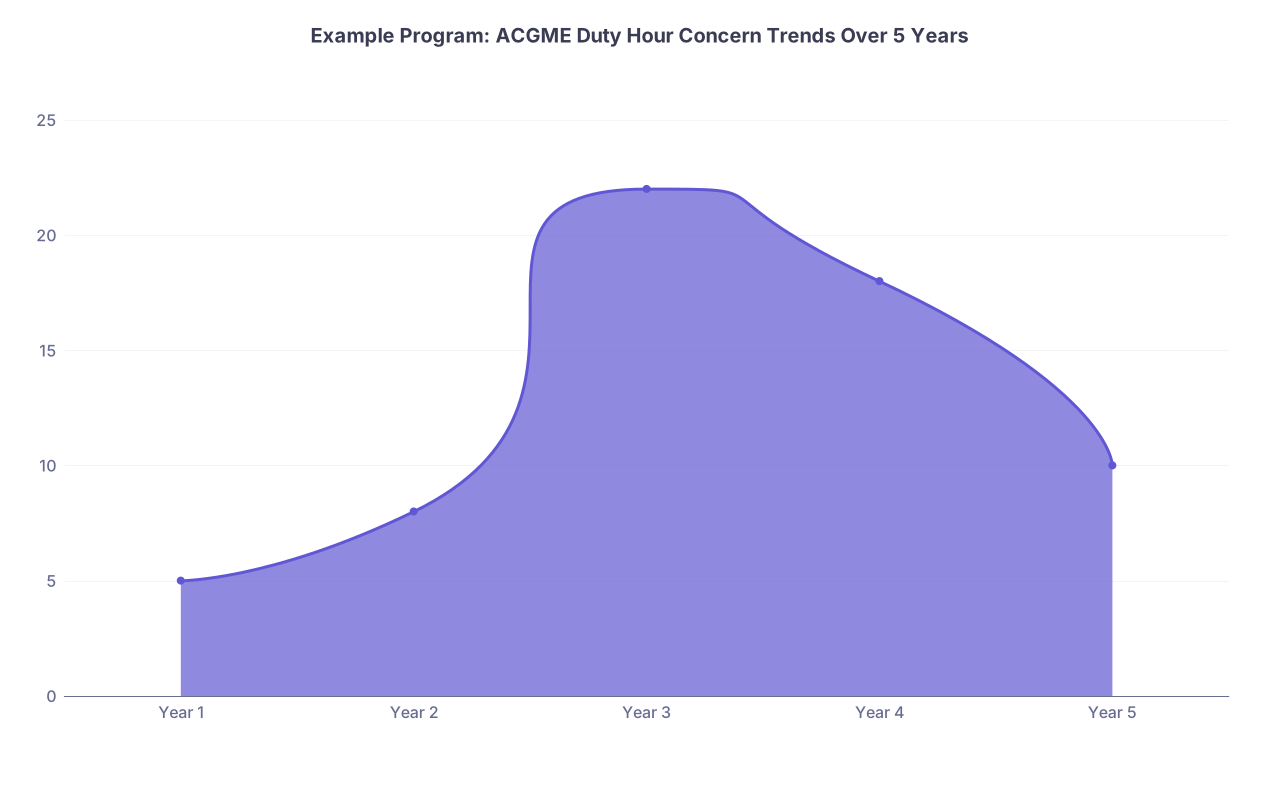
| Category | Value |
|---|---|
| Year 1 | 5 |
| Year 2 | 8 |
| Year 3 | 22 |
| Year 4 | 18 |
| Year 5 | 10 |
Imagine that “concern index” spiking in Year 3, then declining after duty hour reforms. That is the pattern of a program that is actually using data to improve.
In contrast, a flat line near zero across many years in a high-intensity specialty tells you almost nothing. It might be utopia. Much more likely, a culture that trains residents not to complain.
How Programs Quietly Suppress Violations
If you want to see how data get cleaned up in the real world, watch what happens after the first bad cycle.
Common strategies I have personally heard in PD or chief meetings:
- “If you are logging 82–83 hours, just adjust your start time or your ‘reading time’ at home. We want to be honest, but we also cannot have systemic violations.”
- “If you stay an extra 2 hours to help your co‑resident, that is professional altruism, not duty.”
- “Charts or notes you do from home do not need to be logged as hours.”
From a statistical standpoint, this is not noise. It is a forced relabeling of data points to move values from >80 to ≤80 without changing reality.
So when you hear “We have 0–1% violation rate,” you should mentally translate: “We have trained people how to log so they do not trigger violations.”
That is not always malicious. Some programs genuinely believe they are complying “on average.” But from your perspective, the applicant trying to survive residency, the number itself is not trustworthy.
What You Should Actually Do With Duty Hour Information
You are not going to fix ACGME’s measurement system. Your job is to use the flawed data to make a decision about where to spend 3–7 years of your life.
Concrete steps:
- Ignore absolute “violation rates” quoted on interviews. Treat them as propaganda, not metrics.
- Listen for specificity. Good programs talk in concrete terms: “Our worst rotation is MICU in winter, where you might hit low 80s. We added a float last year, so it is better than it was.”
- Probe for culture, not numbers. Ask, “If someone logs >80 hours several weeks in a row, what happens?” You want to hear: “We investigate why and change coverage,” not “They are reminded to log accurately.”
- Cross-check with lifestyle signals. Look at resident faces at 3 pm conference. Do people look dead or functional? Are upper levels doing long procedures and still showing up early the next day, consistently?
And a last point: a program that admits, openly, “Yes, we sometimes violate hours and we are working on it” is safer than a program that insists everything is perfect.
Because perfect duty hour compliance in high-acuity training is statistically improbable. Honest imperfection, with real attempts to improve, is what the better data actually show.
Key points:
- Reported duty hour violation rates are systematically lower than real violations due to cultural, institutional, and measurement biases; “zero violations” in a busy program is not credible.
- The safest programs are not the ones with perfect numbers, but the ones where residents feel safe to report, violations are acknowledged, and leadership responds with structural changes.