
You are staring at your rank list. Again.
It is 11:47 p.m., interview season is basically over, and you have three programs fighting for your #1 spot:
- One has clear red flags but is in your dream city.
- One is solid, safe, but in a dull location.
- One is big-name prestige with a weird vibe and brutal hours.
You keep dragging them up and down your list, reordering, second-guessing, wondering which trade‑off will hurt less five years from now.
Let me be direct: there is a structure to this problem. You can systematize how you weigh red flags vs location vs prestige. Not perfectly. But enough to prevent catastrophic errors and late‑night panic.
Here is how to fix your rank list decision-making.
1. First Principle: The Match Algorithm Favors Your True Preferences
Before we even touch red flags or prestige, you need this burned into your brain:
The NRMP algorithm is applicant-optimal.
That means your safest move is to rank programs in the true order you would want to attend them, assuming you had offers from all.
Do not:
- Try to “game” the algorithm based on how much a program “likes” you
- Drop a competitive program you love because “they probably will not rank me highly”
- Reorder for imagined strategy
If you would rather be miserable in Program A than happy in Program B, sure, rank A higher. That is your life. But do not reorder purely out of anxiety about “odds” or “signals.” You are already operating from a position of uncertainty; do not add fake math into the mix.
So the question becomes: How do you decide what you actually prefer once you factor in red flags, location, and prestige?
We build a framework.
2. Know What Actually Moves the Needle Long-Term
You are choosing where you will spend 3–7 of the most intense years of your life. Certain factors matter much more than others for how your career and sanity turn out.
Here is the hierarchy I use when I work through rank lists with residents:
| Priority Level | Factor |
|---|---|
| 1 (Critical) | Program safety/red flags |
| 2 (High) | Training quality |
| 3 (High) | Institutional culture |
| 4 (Medium) | Location and support |
| 5 (Medium) | Prestige and name |
You will notice prestige is not #1. Or #2. Because I have seen too many burned‑out PGY‑3s in big‑name programs who would trade 10% fellowship odds for 50% more sleep and basic respect.
Let us break down the three variables in your title and put them in order of how you should treat them.
3. Red Flags: The Only Thing Allowed to Outweigh Everything Else
If you remember one rule from this article, make it this:
No location or prestige is worth a toxic or unsafe residency.
Red flags are not “nice to consider” details. They are hard stops or at least major speed bumps.
A. Tier 1 Red Flags (Automatic Demotion or Drop)
These are serious enough that I would tell you to move a program significantly down your list, if not off entirely, unless you truly have no other viable options.
Systemic mistreatment
- Multiple residents (not just one) quietly saying:
- “People get yelled at here a lot.”
- “There is a culture of shaming in front of patients.”
- “You will be fine if you never push back.”
- Faculty openly belittling residents on interview day or Q&A.
- Multiple residents (not just one) quietly saying:
Chronic, unaddressed duty hour violations
- Not just “we sometimes stay late,” but:
- Regular 28–30+ hour calls
- Charting at home every night until midnight
- Residents saying “we just stopped logging accurately”
- Leadership minimizing it: “We are a hard-working program, not for everyone.”
- Not just “we sometimes stay late,” but:
Scary ACGME or board issues
- Recent or ongoing ACGME probation for resident education, supervision, or duty hours.
- Board pass rates consistently below national averages with no clear plan to fix it.
Disaster handling of major concerns
- Residents speak about harassment, discrimination, or safety concerns that went nowhere.
- PD turnover every 1–2 years, culture described as “unstable” or “chaotic.”
Malignant competitiveness
- Residents undermining each other, hoarding procedures, refusing to help.
- Zero tolerance for vulnerability: “Do not show weakness if you want a good fellowship letter.”
If you see multiple of these, I do not care how glamorous the city or shiny the hospital. That program should drop. Hard.
B. Tier 2 Red Flags (Strong Caution, Context-Dependent)
These do not automatically kill a program, but they absolutely should make you question putting it high:
No real resident voice
- “We have a chief meeting with leadership,” but nothing ever changes.
- Suggestions met with “that is just how training is.”
Excessive service over education
- Very high patient caps with minimal teaching.
- Chief or seniors shrugging and saying, “You are basically an inexpensive workforce here.”
Weak mentorship or advising
- No clear process for fellowship mentorship.
- Residents saying, “If you want a competitive fellowship, you have to figure it out yourself.”
Bad fit for your identity or needs
- You detect hostility or dismissiveness around your gender, race, sexual orientation, or disability.
- You are told versions of, “We are not political here,” when asking about DEI support or accommodations.
Tier 2 red flags do not always mean “do not rank.” They mean: you better be getting something major in return (elite training, perfect location, unique opportunities) and you still proceed carefully.
4. Location: Overrated in Theory, Underrated in Specifics
Most applicants overvalue generic “city vs suburb” talk and undervalue the real-life details of location.
A. When Location Truly Should Matter A Lot
These are situations where location legitimately moves a program several spots up or down your list:
You have a serious support dependency
- Young kids and a partner who needs child care help from nearby family.
- Chronic medical issues that require being near a particular health system or support person.
- You or your partner are in recovery or managing a serious mental health condition and have a known stable support environment in one place.
Partner career reality
- Your partner’s career only works in certain cities (e.g., film in LA/NYC, certain biotech hubs, industry-specific constraints).
- Visa issues or licensure issues that make some regions much easier to live in than others.
You know you tank in certain climates or geographies
- Seasonal depression that absolutely crushes you in gray climates.
- You grew up in a major city and know from rotations that you felt truly isolated in small towns (or vice versa).
Location is not “nice to have” in these cases. It is a protective factor against burnout and breakdown.
B. When Location Is Mostly Lifestyle Dressing
This is where people get trapped:
- “But this city has better restaurants.”
- “Everyone wants to live by the coast.”
- “I always pictured myself in a big city.”
Fine. Preferences are allowed. But here is the truth: after a few months, your daily radius is:
- Hospital
- Place you sleep
- Grocery store
- Maybe one gym or park
You are not living a travel blog. You are mostly living between wards and your couch.
Given two programs of similar culture and training, use location to break the tie. But do not let a nice zip code outweigh glaring program problems.
5. Prestige: Powerful, But Often Misunderstood
People swing wildly here. Either they worship prestige or try to pretend it does not matter. Both are wrong.
Prestige absolutely can matter. But you need to be clear on how and for whom.
A. When Prestige Is Actually High-Yield
Prestige tends to help most in these scenarios:
You are targeting ultra-competitive fellowships or academic careers
- Dermatology fellowship from a top IM program.
- CT surgery, IR, GI, Heme/Onc from heavily academic pipelines.
- You want a research-heavy career, K-award type trajectory, or to end up at a big-name academic center.
The name truly signals strong training and networks
- Programs with national reputations for producing well-trained, autonomous graduates.
- Faculty with deep fellowship connections who actually advocate for you.
You are coming from a weaker med school background
- IMG/DO or lower tier MD where a prestigious residency can open doors that might otherwise be harder to reach.
In these situations, a “better name” can legitimately move a program above a similar-but-not-famous one, assuming the red flags are not severe.
B. When Prestige Is Mostly Ego Fuel
Beware these traps:
- “I want to tell my family I matched at [Insert Famous Hospital].”
- “This program is in the top 10 on USNWR, so it must be the best for me.”
- “My classmates will be impressed if I go there.”
Your co-residents will not care after about one week. Fellowship PDs care far more about:
- Letters of recommendation quality
- Your reputation as a resident
- Actual performance and growth
- Research productivity in your interest area
Prestige helps. It is not magic.
C. Prestige vs Lifestyle vs Culture
Here is the honest tradeoff:
A high-prestige but malignant program will often limit your long-term career more than a mid-tier but supportive and well-run one.
Burned-out, bitter residents do not usually become energetic researchers and outstanding fellows. They survive. Barely.
Given:
- Program A: Highly prestigious, culture shaky, red flag-lite (workload, toxicity hints)
- Program B: Mid-prestige, strong teaching, residents genuinely happy
I usually advise putting B above A unless you are laser-focused on a top 5 fellowship and fully willing to eat the pain.
6. A Structured Method: Scoring System You Can Actually Use
You did not come here for vague philosophy. You came for something you can sit down and do tonight.
Here is a simple, practical scoring framework.
Step 1: Make Your Categories
Use these five:
- Red Flags / Safety
- Training Quality
- Culture / Resident Support
- Location / Personal Life
- Prestige / Career Leverage
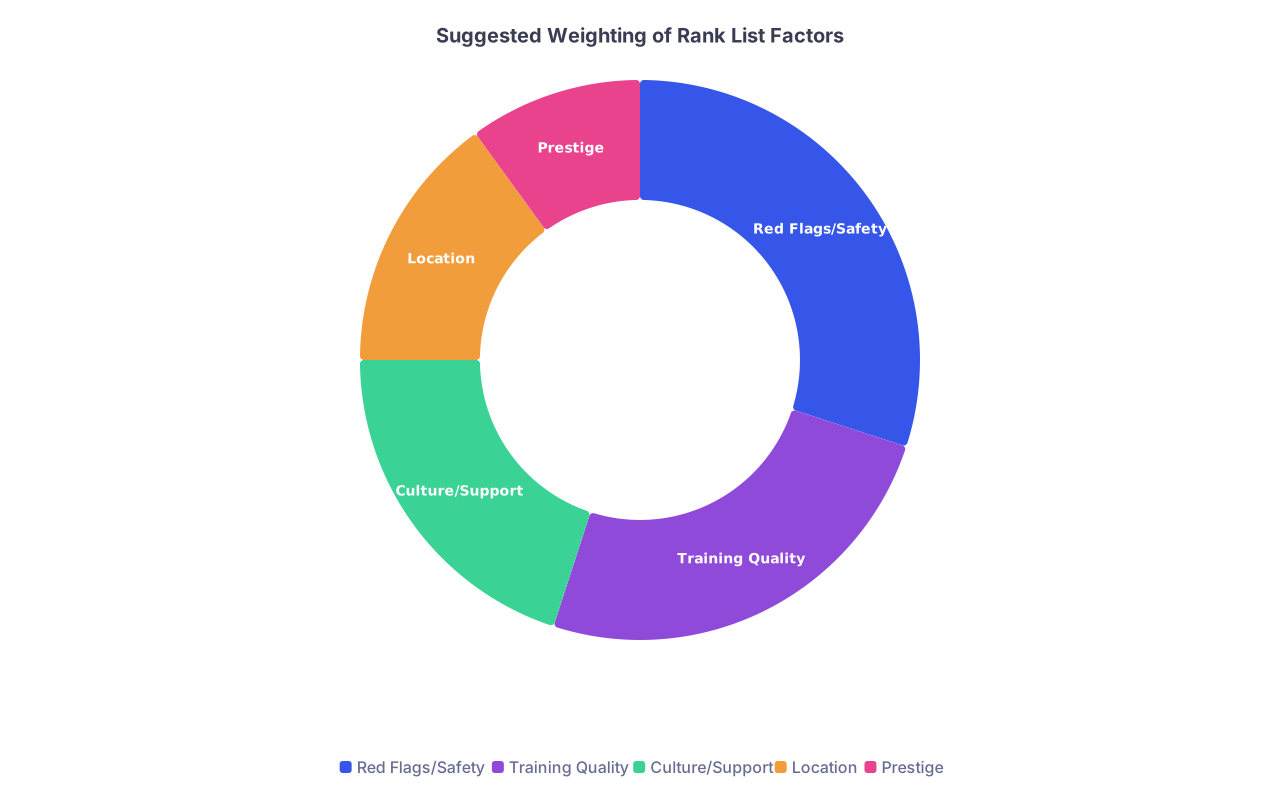
Step 2: Set Weightings (How Much Each Should Count)
As a baseline, I recommend:
- Red Flags / Safety: Pass/Fail filter first, then weight 30%
- Training Quality: 25%
- Culture / Resident Support: 20%
- Location / Personal Life: 15%
- Prestige / Career Leverage: 10%
| Category | Value |
|---|---|
| Red Flags/Safety | 30 |
| Training Quality | 25 |
| Culture/Support | 20 |
| Location | 15 |
| Prestige | 10 |
Adjust slightly if needed:
- Gunning for a hyper-competitive fellowship? Maybe bump prestige to 15–20% and take a little from location.
- You have kids or medical needs? Increase location/personal life weight.
Step 3: Apply the Hard Filter: Red Flags
Before scoring anything:
- Mark any program with Tier 1 red flags as:
- “Drop from list” or
- “Rank only if I have very few total programs”
Do not try to rescue a malignant program with a nice city or huge name. That is how you end up as the horror story intern others warn about.
For the programs that pass your basic safety filter, then you score them.
Step 4: Score Each Category 1–5
For each program:
- 1 = Terrible
- 3 = Fine / acceptable
- 5 = Excellent
Example for “Training Quality”:
- 5: Strong board pass rates, clear teaching structure, fellows who match well, residents feel prepared.
- 3: Solid but not stellar; some holes but overall fine.
- 1: Frequent complaints of poor supervision, bad board performance, ACGME issues.
Step 5: Calculate a Weighted Score
You do not need complex software. Simple spreadsheet or even paper.
For each program:
- Multiply each category’s score (1–5) by its weight (e.g., 0.3 for 30%)
- Add them up
- Compare totals
Now you have something more rational than “vibes” to go on. You still use your gut. But your gut now has scaffolding.
7. Example: Red Flag vs Location vs Prestige in Real Life
Let us walk through a simplified example with three imaginary internal medicine programs.
- Program X: Big coastal city, famous name, some red flag rumors
- Program Y: Mid-size city, mid-prestige, rock solid culture
- Program Z: Smaller city, less known, but close to your family
Assume you have already filtered out any truly malignant programs.
You score them (example numbers):
| Factor | Weight | Program X | Program Y | Program Z |
|---|---|---|---|---|
| Red Flags/Safety | 0.30 | 3 | 5 | 4 |
| Training Quality | 0.25 | 5 | 4 | 3 |
| Culture/Support | 0.20 | 2 | 5 | 4 |
| Location/Personal | 0.15 | 5 | 3 | 4 |
| Prestige/Career | 0.10 | 5 | 3 | 2 |
Now weight them:
Program X
- (3×0.30) + (5×0.25) + (2×0.20) + (5×0.15) + (5×0.10)
- 0.9 + 1.25 + 0.4 + 0.75 + 0.5 = 3.8
Program Y
- (5×0.30) + (4×0.25) + (5×0.20) + (3×0.15) + (3×0.10)
- 1.5 + 1.0 + 1.0 + 0.45 + 0.3 = 4.25
Program Z
- (4×0.30) + (3×0.25) + (4×0.20) + (4×0.15) + (2×0.10)
- 1.2 + 0.75 + 0.8 + 0.6 + 0.2 = 3.55
Result: The mid-prestige, strong-culture Program Y wins clearly on total value, even though X has the big name and Z has the family location.
Would you have to rank it first? No. But if you choose differently, at least you are consciously trading off against a structured assessment, not just vibes.
8. How to Reality-Check Your Impressions
Numbers are only as good as the input. So you need decent data.
A. Talk to Current Residents the Right Way
Do not ask, “Is your program good?” Everyone will say yes.
Ask questions that force concrete detail:
- “If your best friend were applying, what would you warn them about?”
- “Have residents ever left the program voluntarily? Why?”
- “On your worst days, what is usually going wrong?”
- “If leadership promised to fix one thing and really meant it, what would you pick?”
- “How many hours do you actually work on a typical ward month – door to door?”
- “Do you feel safe bringing up concerns? Has anything actually changed from resident feedback?”
Listen for tone as much as content. A slightly tired but proud resident is very different from a cynical, resigned one.
B. Cross-Check With Hard Data
- ACGME letters or status changes (public).
- Board pass rates (ask directly if needed).
- Match lists (for fellowships) over the past few years.
- Faculty stability: PD and APDs for more than 3–5 years is a good sign.
C. Watch for Inconsistencies
If residents say “everything is great” but also:
- Jokingly mention working 100-hour weeks
- Describe frequent crying in stairwells as “just part of training”
- Can only praise superficial things (“good cafeteria,” “nice new building”)
…bump the red flag score up a notch.
9. The Future-of-Medicine Angle: How Much Should You Bet on Trends?
You are not training for today’s system. You are training for the healthcare mess 5–10 years from now.
So ask: how does this program position you for the future?
A. Programs That Age Well
Strong bets:
- Those with genuine QI, informatics, or value-based care projects
- Programs with protected time for scholarly work, not just lip service
- Hospitals actively adopting tech and new care models (telemedicine, advanced EMR use, team-based care)
These features add to your “prestige/career leverage” score even if the program is not famous. Because in 10 years, the ability to lead QI, navigate systems, and think beyond the bedside will matter more.
B. Programs That Age Poorly
Red flags for the future:
- Totally rigid, zero-innovation mindsets: “We have always done it this way.”
- Complete indifference to burnout, wellness, or sustainable schedules.
- No exposure to outpatient systems, population health, or multidisciplinary teams.
That kind of program might still get you decent board scores now but leave you unprepared for evolving practice models.
10. Step-by-Step Protocol for Finalizing Your Rank List
Here is the tight, practical sequence you can follow this week:

| Step | Description |
|---|---|
| Step 1 | List all programs |
| Step 2 | Screen for Tier 1 red flags |
| Step 3 | Remove from list |
| Step 4 | Score remaining programs |
| Step 5 | Apply weightings |
| Step 6 | Sort by total score |
| Step 7 | Gut check top 3-5 |
| Step 8 | Lock final order in NRMP |
- List every program you interviewed at.
- Mark clear Tier 1 red flags.
- Decide: drop entirely vs keep at bottom as true backup.
- Set your category weights (safety, training, culture, location, prestige).
- Score each remaining program 1–5 in each category.
- Calculate weighted totals (simple spreadsheet).
- Order programs by score as a first pass.
- Look at your top 3–5. Ask yourself:
- “If I match at #1, would I secretly wish I were at #2?”
- “Would I rather be at #3 than #4 if all else were equal?”
- Adjust slightly for your gut, but do not demolish your whole framework over one interview-day goodie bag.
- Enter your list, walk away, and stop reordering every night.
At some point you have to decide that your future self deserves a rested brain, not endless rehashing.
FAQ (exactly 3 questions)
1. Should I ever rank a program with serious red flags high if it is my only option in a desirable city?
You can, but you need to be honest about the cost. If it has Tier 1 red flags (malignancy, duty hour abuse, ACGME issues, systemic harassment), I strongly recommend pushing it down. Living in your dream city while being destroyed at work is a bad bargain. If you genuinely have no other realistic options, you can keep it on your list, but prioritize any safer program above it, even in a less exciting location.
2. How much does prestige actually matter for fellowship if I am at a mid-tier but strong program?
If your program has solid training, supportive mentors, and graduates who reliably match into reasonable fellowships, you are fine. Your personal performance, letters, research output, and relationships will carry more weight than a small prestige gap. Name brand really pushes the needle mainly for ultra-elite fellowships or when everything else (scores, publications, letters) is equal. For most residents, being great at a “good” program beats being average at a “famous” one.
3. What if my weighted scoring system and my gut feeling disagree completely?
Then you investigate the gap. Ask yourself what your gut is reacting to: one charismatic resident? A fancy hospital? A fear of leaving a favorite city? Or did your scoring miss something structural (like your partner’s job or a serious mental health concern)? Adjust your weights or scores if they were wrong, not just because you feel weird. If, after revisiting the data, your gut still clearly prefers one program and there are no Tier 1 red flags, it is reasonable to rank according to that preference. The system is there to expose blind spots, not to override your considered judgment.