
The blunt answer: rapid residency program expansion is usually a risk until proven otherwise, not a built‑in “growth opportunity.” You treat it like a possible red flag and make it prove to you that it isn’t.
Let’s break down how to tell the difference between smart growth and a dumpster fire in progress.
1. Why Programs Expand Fast (And What That Really Signals)
Start with motive. Programs don’t suddenly decide to double residents out of pure educational generosity.
Here are the usual reasons a residency expands quickly:
Cheap labor to cover exploding clinical volume
Hospital bought new clinics, opened a new tower, or lost a bunch of attendings → residents become the patch. This is the most common and the most dangerous.Hospital leadership wants more billing, more coverage, more status
“We want to be a major academic center.” Translation: more residents = more bodies at lower cost than hiring fully trained clinicians.Genuine educational vision with resources to match
This is rare but real. New funded sites, more faculty, better case mix, strong GME leadership that forces planning before numbers.Desperation after prior trouble
Program went on probation, lost faculty, or had mass resident attrition. Now they’re “restructuring” and “growing.” Often lipstick on a pig.
You can’t just read their website and guess which it is. You need evidence.
2. Core Question: Are They Expanding Capacity, Or Just Adding Bodies?
That’s the central filter. Every other detail feeds into it.
Here’s how to think about it:
Healthy expansion = increased resident count plus proportional:
- faculty,
- clinical sites,
- workrooms/parking/housing,
- didactics and simulation,
- admin support (coordinators, PD/APDs, wellness, etc.).
Red-flag expansion = more residents without comparable investment in:
- supervision,
- teaching time,
- infrastructure,
- call/workload balance.
If they’re just multiplying the number of people available to hold pagers and write notes, that’s not “growth.” That’s exploitation.
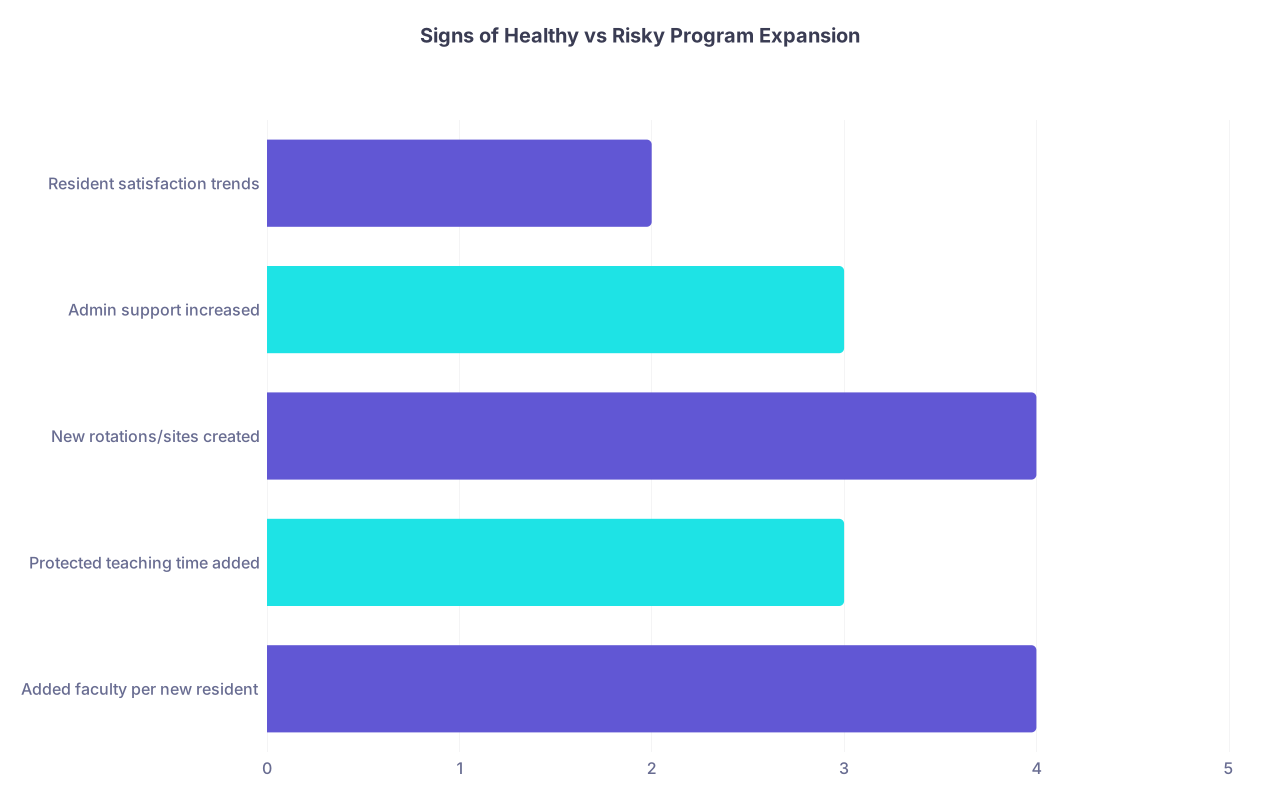
| Category | Value |
|---|---|
| Added faculty per new resident | 4 |
| Protected teaching time added | 3 |
| New rotations/sites created | 4 |
| Admin support increased | 3 |
| Resident satisfaction trends | 2 |
Think of that chart as this: the higher the “score,” the more you should demand real, specific examples. Programs love buzzwords; you’re looking for receipts.
3. Concrete Warning Signs: When Rapid Expansion Is a Major Red Flag
Here’s where you stop believing the brochure and start interrogating reality.
A. Timeline That Makes No Sense
If they’ve gone from, say, 6→10→16 residents per year over 2–3 cycles, ask:
- Did they add a new hospital or major clinical site?
- Did they increase the number of full-time faculty in your specialty by at least a few people?
- Is there an actual, written plan shared with residents?
If they can’t clearly describe what changed besides the headcount, that’s a problem.
B. Faculty Numbers and Burnout
Ask specific questions like:
- “How many core teaching faculty are there for this program?”
- “How many new faculty have joined in the last 2–3 years to support expansion?”
- “Do faculty have protected time for teaching and mentoring, or is this mostly service?”
Red flags:
- Faculty seem tired and cynical in interviews.
- Residents say, “We love Dr. X and Dr. Y, but they’re pulled in a million directions.”
- You hear “we’re hiring” but can’t get names, signed start dates, or roles.
If faculty:resident ratio is collapsing, expect:
- poor supervision,
- rushed feedback,
- unsafe workload.
C. Service vs Education Balance
This is where the truth usually leaks out.
Ask residents (away from faculty if possible):
- “What changed when the program expanded?”
- “Did your workload get better, worse, or the same?”
- “Did you get new rotations, or just more people on the same teams?”
Watch for answers like:
- “Call is technically better because there are more of us, but the hospital volume just keeps going up.”
- “They added a night float this year... mostly because no one could survive the old system.”
If you hear “We needed more residents to meet service needs,” that’s your answer. They expanded primarily for service.
D. Didactics, Simulation, and Teaching Quality
Educational growth should look like:
- More structured didactics, not fewer.
- Added simulation sessions with dedicated staff.
- Protected time that isn’t constantly getting cancelled for “clinical needs.”
Ask:
- “How often are conferences cancelled because of service coverage?”
- “Has the curriculum changed to match the expanded class size?”
- “Is there enough procedural volume per resident after expansion?”
If residents shrug and say, “We’re supposed to have protected time, but…” — that “but” matters.
E. Program Reputation Trend
Rapid expansion right now plus:
- recent ACGME citations,
- probation history,
- major leadership changes,
- multiple residents leaving or transferring,
…is a bad combo.
Search:
- ACGME public list (for serious stuff).
- Reddit, SDN, specialty forums (taking drama with a grain of salt, but patterns matter).
- Alumni outcomes: Are they matching into good fellowships/jobs or just scrambling?
If you hear “we’ve had some challenges but we’re growing out of them” — push for specifics:
- What were the issues?
- What changed structurally?
- Has the ACGME closed the loop?
Vague “we’re improving” talk without concrete fixes is smoke.
4. When Rapid Expansion Is a Real Opportunity
Now the other side. There are programs where growth is legitimately good for you.
You’re looking for this pattern:
New or expanded clinical sites that make sense
Example: A community IM program that:- added a VA hospital rotation,
- built a new ICU with intensivist coverage,
- partnered with a cancer center or children’s hospital.
Explicit investment in education
Things like:- multiple new fellowship-trained faculty,
- a simulation center that actually runs scheduled sessions,
- new tracks (research, global health, ultrasound, QI).
Transparent long-term plan
On interview day, leadership can:- show you a timeline,
- describe where they see the program in 5 years,
- explain how expansion improves your experience, not just their coverage.
Current residents aren’t miserable
They may be busy, sure. But:- They feel heard.
- They see improvements year-to-year.
- They say things like, “When I started PGY-1, X was rough; now it’s better because they did Y.”
That last part is huge. You’re joining mid-experiment. You want signs the experiment is trending positive.

| Step | Description |
|---|---|
| Step 1 | Program expanding fast |
| Step 2 | Possible opportunity |
| Step 3 | Likely red flag |
| Step 4 | Rank confidently |
| Step 5 | Rank with caution |
| Step 6 | Clarify details |
| Step 7 | Consider not ranking |
| Step 8 | More capacity or more bodies |
| Step 9 | Residents satisfied? |
5. How to Vet Rapid Expansion on Interview Day
You’re not powerless here. You can interrogate this like a consultant.
Ask Program Leadership (PD/APD) Directly
Use direct, non-fluffy questions:
- “What drove the decision to expand the program from X to Y residents per year?”
- “What changes have you made in faculty, clinics, and didactic structure to support the expansion?”
- “How do you monitor for over-reliance on residents for service as the program grows?”
You’re listening for:
- specific actions,
- real numbers,
- acknowledgment of risk.
If the answers are all “We’re very excited about growth,” with no concrete details: file that under marketing, not substance.
Ask Residents Specifically About Before vs After
Targeted questions:
- “You’ve seen the program before and after expansion. What’s better? What’s worse?”
- “Did the number of attendings/NPs/PA’s increase as residents increased?”
- “Any services where you feel stretched thin or like the resident is the primary workhorse?”
If senior residents say, “We’re still waiting for the promised help,” be careful. Empty promises are a trend.
Look at Schedules and Call
Ask to see sample schedules. Look for:
- Number of ICU, nights, and ED weeks.
- Cross-cover volume.
- Any rotations obviously built for cheap coverage (e.g., “hospitalist service” that’s basically resident-run with minimal attending presence).
If expanding has allowed:
- more electives,
- more subspecialty exposure,
- more flexibility in senior years,
that’s good. If it just filled every empty slot with “ward” or “cross cover,” not good.
6. Comparing Types of Expansion: Which Is Riskier?
Different patterns carry different levels of risk.
| Expansion Pattern | Risk Level | Why It Matters |
|---|---|---|
| Added new hospital + more residents | Medium | Depends on faculty/support |
| Same sites, more residents | High | Usually pure service expansion |
| New subspecialty services + residents | Medium | Good if faculty-heavy |
| Expansion after ACGME concerns | High | Possible cosmetic fix, not structural |
| Slow steady growth over 5+ years | Low | Often better planned and resourced |
If you had to oversimplify it:
- Fast jumps without new sites/faculty = most concerning.
- Slow, transparent growth with new resources = usually safer.
7. Future of Medicine Angle: Why You’ll See More of This
You’re not imagining it. Rapid program expansion is getting more common.
Why?
- Workforce gaps in primary care, psychiatry, and certain hospital-based specialties.
- Hospitals want resident labor rather than hiring more expensive staff.
- New medical schools pumping out more grads while residency spots play catch-up.
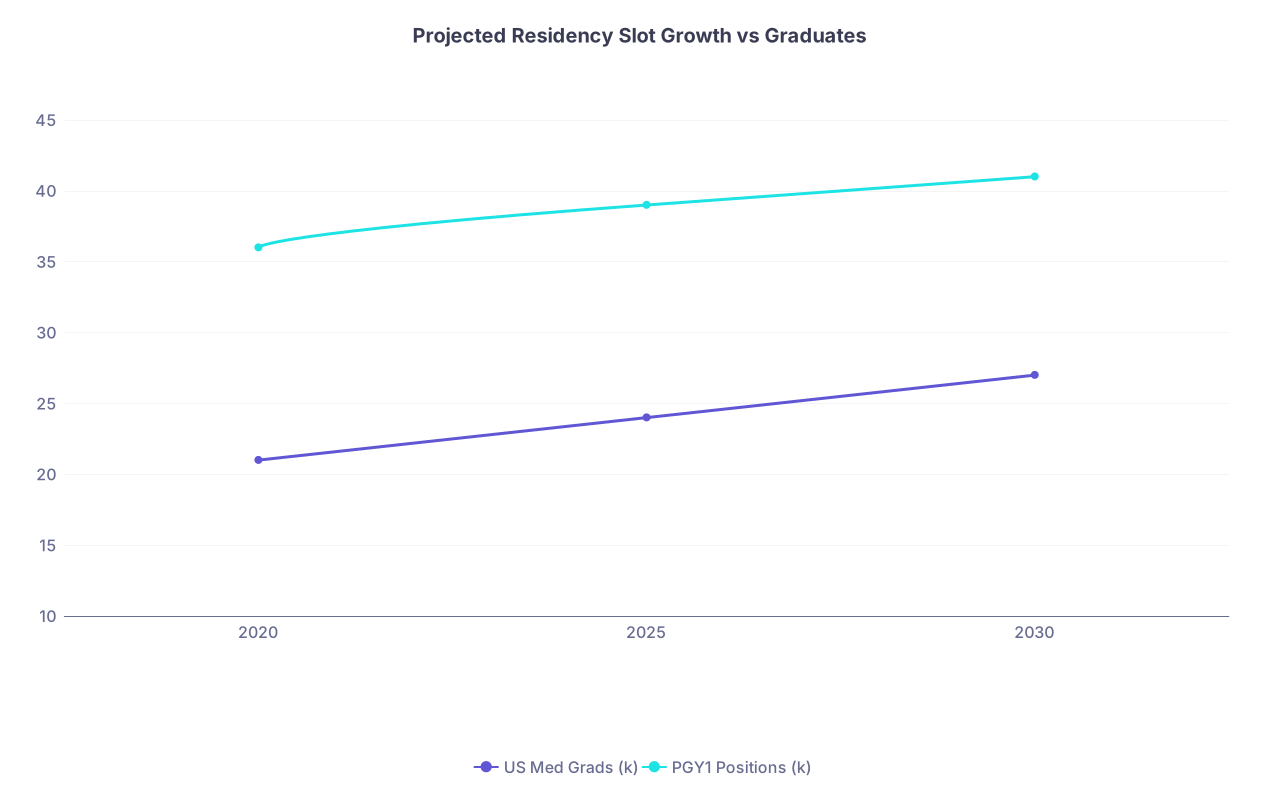
| Category | US Med Grads (k) | PGY1 Positions (k) |
|---|---|---|
| 2020 | 21 | 36 |
| 2025 | 24 | 39 |
| 2030 | 27 | 41 |
That chart is rough, but the point stands: programs are under pressure to grow. Some will do it thoughtfully; some will grow like a tumor.
As a future resident, your job isn’t to “save” a struggling expanding program. Your job is to pick a place where you can safely learn, graduate, and move on with your life and career.
Sometimes that means:
- choosing a stable, “boring” mid-sized program over a flashy “rapidly growing” one.
- accepting that being the “pioneer class” of a big expansion is not worth the extra chaos.
FAQ: Rapid Program Expansion & Red Flags
1. Is a brand-new program or new track automatically a red flag?
No, but it’s risky. New programs and new tracks (like a new rural track or preliminary year) are still ironing out kinks. If they’re also expanding numbers fast on top of being new, the risk stacks. You’d better see strong institutional backing, experienced leadership, and very clear structure.
2. How many years of data should a rapidly expanding program have before I trust it?
I’d want at least 3–5 years of steady function with graduating classes whose outcomes you can see (board pass rates, fellowships, jobs). If they’re only in year 1–2 of a major expansion, you’re the test subject. Some people are fine with that; you don’t have to be.
3. What’s the single best question to ask residents about expansion?
“Compared to before expansion, do you feel like the program got better for you, stayed about the same, or got worse — and why?” Then shut up and let them talk. The “why” part will tell you everything.
4. Is rapid expansion ever an advantage for fellowship or career prospects?
It can be if growth comes with:
- new subspecialty exposure,
- more research opportunities,
- more faculty with strong networks.
For example, an IM program that adds a transplant service and recruits big-name attendings could boost your fellowship chances. But more residents alone doesn’t help your CV.
5. How much should I weigh rapid expansion in my rank list?
Heavily. If you see clear red-flag expansion (more bodies, not more capacity), that program should drop significantly or come off your list. You can survive a mediocre location or weak research. You can’t thrive in a chronically understaffed, overexpanded mess.
6. Can I directly ask if residents feel used as cheap labor?
Yes — just phrase it slightly softer. Something like: “Do you feel like the clinical workload is primarily designed for your education, or mainly to meet hospital service needs?” If more than one resident laughs before answering, you have your answer.
Key takeaways:
- Treat rapid expansion as a risk that must be justified, not as automatic “growth.”
- Look for proof of added capacity — faculty, sites, support — not just more residents.
- Listen carefully to residents who’ve lived through the change; if their lives got worse, yours probably will too.