
Understanding Resident Turnover in ENT Residency as an IMG
Resident turnover is one of the most important—yet often under‑discussed—warning signs when evaluating otolaryngology (ENT) residency programs, especially for an international medical graduate (IMG). In a competitive field like ENT, where positions are limited and expectations are high, residents leaving a program early or frequently can indicate serious underlying problems.
This IMG residency guide will help you:
- Understand what “resident turnover” really means in the context of ENT
- Recognize specific resident turnover red flags
- Distinguish between normal changes and true program problems
- Learn how to discreetly investigate turnover during interviews and rotations
- Apply these principles specifically as an IMG, including visa and support issues
The goal is not to scare you away from programs, but to help you recognize where you can thrive, not just survive.
What Does Resident Turnover Mean in ENT Residency?
Resident turnover simply refers to changes in resident staffing that are not part of the planned, yearly graduation and new intern intake. In otolaryngology, which usually has small program sizes (often 2–4 residents per year), even a single resident leaving can be a big deal.
Types of Resident Turnover
Voluntary Transfers or Resignations
- A resident chooses to leave the program—either to switch specialties, change programs, or step away from training.
- Examples:
- PGY-2 leaves ENT for radiology.
- PGY-3 transfers to another ENT program “closer to family.”
Involuntary Dismissal or Non‑Renewal
- The program does not renew a resident’s contract or dismisses them.
- Common reasons: professionalism concerns, academic failure, serious policy violations.
Extended Leaves or Gaps
- Residents go on prolonged leave (medical, family, personal) and may not return.
- Sometimes positions remain unfilled for years afterward.
Chronic Under‑Staffing
- Positions are “approved” but not filled, or residents are repeatedly recruited off-cycle to “plug holes.”
In ENT, these shifts matter because every resident carries substantial call, operative, and clinic responsibilities. When one person leaves, everyone else feels it.
Why Resident Turnover Matters So Much in Otolaryngology (ENT)
1. Small Program Size Magnifies Problems
ENT programs are typically smaller than internal medicine or pediatrics. If a program has 12 total residents and 3 leave over two years, that is 25% of the resident body—a major signal.
For an IMG, this matters because:
- Fewer residents mean less protection from toxic dynamics—you cannot “hide” in a large cohort.
- If a co‑resident leaves, your call burden and workload can skyrocket overnight.
- Academic and OR opportunities might be redistributed unfairly.
2. It Often Reflects Deeper Structural or Cultural Issues
High or recurrent turnover frequently signals:
- Poor leadership or unstable program direction
- Chronic under‑resourcing (staffing, clinic support, OR time)
- Burnout from excessive workload or unfair expectations
- Poor support for residents in difficulty
- Lack of psychological safety—residents don’t feel safe speaking up
For an IMG, you may be even more vulnerable to these problems, especially if:
- You are on a visa, limiting your ability to transfer programs
- You have less informal support or advocacy inside the institution
- You feel pressure to tolerate poor conditions to stay in the United States
3. It Can Directly Affect Your Training Quality
Resident turnover can harm your ENT education by:
- Reducing continuity with faculty mentors
- Interrupting service coverage, limiting your OR time or clinic exposure
- Forcing you into extra service work instead of educational cases
- Creating a culture of fear: residents worry more about survival than learning
An IMG-friendly program should show stability, clear expectations, and a track record of supporting residents through challenges, not simply losing them.
Resident Turnover Red Flags: What IMGs Should Watch For
This section focuses on concrete warning signs related to resident turnover and what they may mean. No single sign automatically proves the program is bad, but clusters of issues should make you cautious.
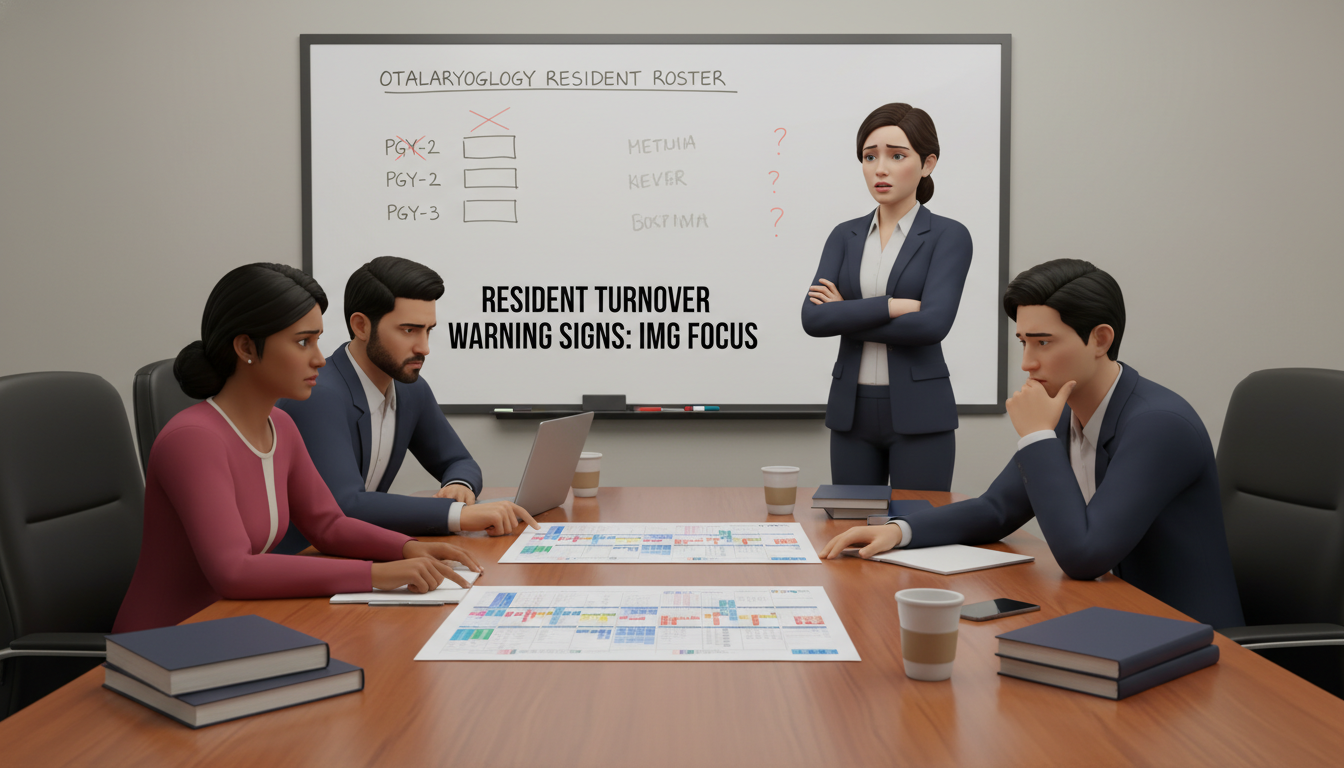
1. Multiple Residents Leaving in the Last 3–5 Years
What you might hear:
- “We’ve had some residents switch to other specialties.”
- “A couple of people realized ENT wasn’t for them.”
- “We had unexpected openings in the last few years.”
Why it matters in ENT:
- Because ENT is highly competitive, few people casually walk away.
- Multiple departures in a short period can indicate systemic program problems, not just individual mismatches.
Follow-up questions to ask residents:
- “How many residents have left in the last 3–5 years, and why?”
- “Were those residents supported if they wanted to stay?”
- “How did their departure affect your workload or call?”
Red flag level:
- 1 departure in 5 years: probably benign, especially with clear explanation.
- ≥2–3 departures in a small program: strong caution—dig deeper.
2. Unclear or Vague Explanations for Turnover
If residents or faculty talk about residents leaving the program but give you vague or scripted answers, pay attention.
Concerning phrases:
- “They decided it wasn’t a good fit” (without any further detail)
- “Personal reasons” (repeatedly, for several different people)
- “They went to another opportunity” (but no one can say where or what)
In a healthy culture, people can openly, calmly, and consistently explain what happened without fear. For example:
- “She struggled with the workload and realized she preferred a clinic‑based specialty. She switched to dermatology and is very happy now.”
- “He had family issues out of state and transferred to a program closer to home. We helped support that transition.”
Warning signs:
- Different residents give different or contradictory stories.
- People visibly become uncomfortable, change the subject, or look to faculty before answering.
- Off‑record hints that “there’s more to the story” but no one feels safe to share.
3. Chronic Under‑Staffing and Over‑Call
ENT is procedure-heavy with frequent emergencies (airway, epistaxis, post‑op complications). A chronically under‑staffed program is a major warning.
Signs of chronic under‑staffing:
- Several open positions not filled for years.
- Frequent mentions of “stretching to cover call” or “always short.”
- Senior residents covering junior call or vice versa for long periods.
- Regular “emergency coverage” by off‑service residents or hospitalists.
Questions to ask:
- “Has the program been fully staffed in recent years?”
- “Have you had to cover for missing residents often?”
- “Have there been any mid‑year or off‑cycle additions due to unexpected vacancies?”
For IMGs specifically:
If you are on a visa, being in an under‑staffed program can trap you in:
- Excessive workload with little recourse.
- Fear of leaving because of immigration status.
- Pressure to accept unsafe conditions because you feel indebted for the opportunity.
4. High PGY-Level Disruption (Mid‑Level Residents Leaving)
In ENT, PGY-2 to PGY-4 years are particularly intense with more call and OR responsibilities.
Red flags:
- Multiple PGY-2 or PGY-3 residents have left or been dismissed in recent years.
- Program histories that sound like: “We lost a PGY-2 last year and a PGY-3 the year before.”
This can indicate:
- Poor support during the transition from junior to intermediate responsibility.
- Unrealistic expectations in the OR or on call.
- Harsh, punitive responses to errors rather than a learning culture.
5. Quiet, Anxious, or Guarded Residents
Resident behavior itself can be a powerful signal of hidden otolaryngology match issues relating to turnover.
Warning behaviors:
- Residents speak very cautiously when faculty are around.
- They deflect questions about program problems or turnover.
- There is visible tension or discomfort when leadership is mentioned.
- One or two residents do all the talking, while others remain silent.
What this may suggest:
- Culture of fear or retaliation.
- Residents feeling they could be the next to be “pushed out.”
- Poor psychological safety and lack of trust in leadership.
For an IMG, a low‑trust environment can be particularly risky; you may rely heavily on honest feedback and clear guidance.
6. Frequent Leadership Changes with Little Transparency
ENT programs do evolve over time, and leadership transitions happen. However, rapid turnover of program directors (PDs) or chairs is a clear warning.
Red flag patterns:
- More than two PD changes in 5 years.
- Nobody can clearly explain why the previous PD stepped down.
- Residents say things like, “We’re still figuring out what the new leadership wants” or “Everything is in flux.”
Leadership instability can lead to:
- Shifting expectations and inconsistent evaluation.
- Residents being caught between “old rules” and “new rules.”
- Poor handling of struggling residents—with more dismissals or pressured resignations.
Questions you might ask:
- “How long has the PD been in the role?”
- “What changes have been made in the program recently?”
- “How are resident concerns handled at the PD and departmental level?”
7. Reputational Concerns and Off‑the‑Record Comments
ENT is a small community. Many program issues circulate informally. While you must be cautious about rumors, consistent patterns of concern are important.
Signals to note:
- Residents from other programs give you polite but clear warnings: “I’ve heard they’ve had some people leave recently.”
- Faculty at your home or away rotations advise you to be “careful” about certain programs with high turnover.
- On interview day, residents at that program allude to “a lot of changes lately” or “a rough couple of years.”
Use this as data, not absolute truth. Combine it with your observations:
- Does what you see align with these concerns?
- Do people speak openly about past problems and current improvements?
- Is there a credible plan and evidence of progress?
8. IMG-Specific Red Flags Related to Turnover
As an international medical graduate pursuing ENT, there are additional dimensions to resident turnover:
a. Prior IMG Residents Leaving or Transferring
If multiple past IMG residents left the program, ask why:
- Did they feel isolated or unsupported?
- Were there visa or contract issues?
- Did they struggle with expectations or communication and receive little help?
Key questions:
- “Have there been IMG residents in recent years? How did they do?”
- “Have any IMGs left the program? What happened?”
b. Visa and Contract Insecurity
High‑turnover, unstable programs may:
- Delay visa processing or changes.
- Use the threat of non‑renewal or visa issues as leverage.
- Provide minimal time for you to respond if there are concerns.
Ask current or former IMGs:
- “Have you felt secure in your visa and contract renewals?”
- “How transparent was the program about visa processes and timelines?”
c. Unequal Treatment in Times of Crisis
In programs under stress from residents leaving, IMGs can be seen as “less likely to leave” due to visa constraints and might receive:
- Heavier call burdens
- Less flexibility in scheduling
- Less support when struggling
Look for any pattern where IMGs carry more clinical burden or have fewer opportunities compared to US graduates.
How to Investigate Turnover During Interviews and Rotations
Knowing what to look for is only half the battle. You also need a practical strategy to investigate resident turnover without appearing confrontational.

1. Ask Specific, Neutral Questions
Frame your questions to sound analytical, not accusatory.
Examples:
- “How stable has your residency class size been over the last few years?”
- “Have there been any residents who have transferred or left? How did the program handle that?”
- “What happens here when a resident is struggling academically or personally?”
- “How has call coverage been over the past year—has it changed because of staffing?”
2. Compare Resident and Faculty Answers
Ask similar questions to:
- Program leadership (PD, APD)
- Senior residents
- Junior residents
Compare for consistency:
- If leadership says, “We’ve had no issues with turnover,” but residents describe multiple departures, that mismatch is concerning.
- If everyone gives the same, overly polished line, it may signal a controlled narrative.
3. Use Away Rotations or Observerships Wisely
For an IMG, away rotations or observerships can reveal much more than a single interview day.
During a rotation, quietly observe:
- How often residents mention being “short‑staffed.”
- Whether people express burnout or hopelessness.
- Whether residents seem to respect leadership—or fear them.
You can ask in a low‑pressure way:
- “How has your class changed over the years?”
- “What kind of residents tend to do well in this program?”
4. Talk to Recent Graduates
Recent graduates may be more open than current residents.
Ways to reach them:
- Program website alumni list (email).
- LinkedIn or professional networking.
- Ask the PD if you can speak to a recent graduate (their reaction itself is informative).
Good questions:
- “Were there any residents who left during your time? What were the circumstances?”
- “How did the program respond when residents were dissatisfied or burnt out?”
- “If you were applying again today, would you rank this program highly?”
5. Research Public Records and Match Data
Although limited, publicly available information can sometimes reveal patterns:
- NRMP and program fill rates: Chronic unfilled ENT positions can hint at deeper issues.
- Program websites: Look for discrepancies in resident numbers or gaps in graduation years.
- Conference attendance and research output: A sudden drop sometimes correlates with leadership or culture problems.
Balancing Risk and Opportunity as an IMG Applicant in ENT
Not all turnover is bad; not all stability is good. Your goal is to interpret the pattern, particularly as an IMG applying to a competitive field like otolaryngology.
When Resident Turnover May Be Less Concerning
Turnover may be acceptable—or even neutral—if:
- It is rare (one resident in many years).
- The explanation is clear, reasonable, and consistently described.
- The program shows learning and improvement after the incident:
- Better support systems.
- Revised evaluation processes.
- Wellness or mentorship initiatives introduced.
Example:
A PGY-2 discovered a strong passion for another specialty after a major life event, and the program supported a transfer. No other residents left in the previous 7 years. Residents and faculty discuss it openly and without defensiveness.
This does not necessarily indicate a resident turnover red flag.
When You Should Be Strongly Cautious
Consider ranking a program lower—or not at all—if you observe:
- Multiple residents leaving over a few years, particularly at mid-levels.
- Vague or inconsistent explanations for departures.
- Ongoing under‑staffing, heavy call, and significant burnout.
- IMG residents who appear isolated, overworked, or unsupported.
- Leadership turnover combined with unclear program direction.
For an IMG, the risks include:
- Limited ability to transfer if things go wrong (visa, sponsorship issues).
- Professional harm if you are dismissed or forced to resign.
- Psychological and physical health consequences from chronic stress.
Strategic Advice for IMGs
Prioritize Programs with Clear IMG Support Histories
- Evidence of multiple successful IMG graduates.
- Honest, transparent communication about expectations and support.
Treat Recurrent Resident Turnover as a Serious Data Point
- Even if the program seems prestigious or is in a desirable location.
- Prestige does not protect you from burnout or unsafe cultures.
Have a Backup Plan
- Rank a mix of programs with strong reputations and stable resident histories.
- Do not over‑concentrate your rank list on programs with concerning turnover, even if they seem IMG‑friendly.
Trust Both Data and Your Instincts
- If things feel “off” on interview day—anxious residents, evasive answers—take that seriously.
- ENT training is long and demanding; you need a program that is both rigorous and humane.
FAQs: Resident Turnover Warning Signs in ENT for IMGs
1. Is any resident turnover automatically a red flag?
No. A single, well‑explained case of a resident leaving over many years is common and not necessarily a sign of program problems. Pay attention to:
- Frequency and pattern of departures.
- How openly and consistently the story is told.
- Whether the program appears to have learned and improved afterward.
It becomes a red flag when turnover is recurrent, poorly explained, and associated with under‑staffing or low morale.
2. As an IMG, should I avoid any program that’s had a resident leave?
Not automatically. Instead of a blanket rule, apply a risk‑benefit analysis:
- If only one resident left and everyone explains it the same way, and the program clearly supports IMGs, it may still be a good choice.
- If multiple residents—especially IMGs—have left, and explanations are vague or defensive, that is a major concern.
Your visa and career security make your margin for error smaller; avoid programs with unclear or repeated turnover histories.
3. How directly can I ask about residents leaving the program during interviews?
You can ask directly but keep the tone professional and neutral. For example:
- “I’m trying to understand program stability when building my rank list. Have there been residents who have left the program in recent years, and how did the program support them through that process?”
This shows maturity and insight rather than aggression. Watch not only what they say, but how they say it.
4. What if a program seems very strong academically but has worrying turnover patterns?
High academic strength cannot compensate for a harmful training environment. For an IMG in ENT, a “strong on paper” program with frequent residents leaving the program may be more dangerous than a mid‑tier but stable, supportive program.
If you see:
- Outstanding research and surgical volume plus
- Multiple departures, guarded residents, or unstable leadership
treat it as a high‑risk option. You might still rank it, but not above programs with stable, transparent cultures where residents clearly thrive and graduate.
By carefully evaluating resident turnover warning signs, you protect not only your match outcome, but your long‑term wellbeing, professional development, and satisfaction as an otolaryngologist. Use these tools as part of your broader IMG residency guide strategy to choose a program where you can grow, learn, and ultimately succeed.