Last cycle, I watched a program director walk an applicant straight into a trap with a single “innocent” question. The student thought it was small talk; the PD was actually testing whether she’d tolerate a brutal call schedule and zero support. She smiled, answered politely, and basically told them, “Yes, you can exploit me.”
You think the red flags are in what PDs tell you. The real red flags are in what they ask you. And which questions show up over and over, because they map exactly onto the program’s hidden problems.
Let’s go through the greatest hits. The questions that, the minute you hear them, should make a little alarm go off in your head: “Why are they asking that?”
1. “How do you handle conflict with seniors or attendings?”
When a PD leans into “conflict” questions, they’re not doing a psychology experiment. They’re crowdsourcing solutions to their own culture problems.
Here’s the pattern I’ve seen in rank meetings: a PD says, “We’ve had a few… interpersonal issues on night float,” then you look at their interview question list and it’s loaded with conflict and professionalism scenarios.
Questions that should make you suspicious:
- “Tell me about a time you disagreed with a senior resident. How did you handle it?”
- “How do you respond when you feel you’re being treated unfairly?”
- “What would you do if an attending raises their voice at you in front of others?”
What this usually means behind the scenes:
They have a bully problem.
There’s a notoriously toxic attending or chief. Everybody knows it. GME has had complaints, maybe even formal investigations. Instead of removing the problem, they screen for residents who will endure it quietly.I’ve literally heard an associate PD say in a debrief, “I like that she didn’t talk about going to GME or filing a complaint. She just said she’d reflect and try to improve.” Translation: “She’ll absorb abuse and not rock the boat.”
They’re terrified of residents escalating.
If your answer involves HR, GME, ombuds, or “formal complaint,” watch how some PDs subtly recoil. Programs that have been in trouble with ACGME for culture issues become hypersensitive to anything that looks like “another resident who might document things.”They expect you to manage up… a lot.
At healthier programs, the question is more like, “Tell me about feedback you received and how you used it.” At sketchier ones, it’s “What do you do when treated unfairly?” over and over. That’s not about growth. That’s about survival.
How to respond and gather intel:
You answer professionally—of course. But then you make a mental note and later ask residents, one-on-one, very directly:
“Do you feel comfortable speaking up when a senior or attending is inappropriate?”
Watch the micro-reactions. The half-second pause tells you more than any polished answer.
And if different interviewers keep returning to conflict, that’s not random. That’s a culture signal.
2. “We work hard here. How do you manage long hours and stress?”
On the surface, this sounds normal. Residency is hard. But some programs push this question like a warning label they hope you won’t actually read.
Variations:
- “Tell me about a time you were working 80 hours a week or more. How did you keep going?”
- “How do you recharge when you’re post-call and have to come back the next day?”
- “What’s the most exhausted you’ve ever been in clinical training?”
What they’re really checking:
Are you going to complain about duty hours?
Programs that regularly hit or exceed ACGME limits become obsessed with “resilience,” “grit,” “stamina.” It’s not inspirational—it’s defensive.I’ve heard PDs say after an interview: “He mentioned that his clerkship director got involved when hours got too heavy. I worry he’ll be someone who runs to duty-hour reporting.” That is code for “We break the rules and want people who will tolerate it.”
They already had a duty-hour citation.
Once a site visit report mentions duty hours, everything becomes about optics. They still run residents into the ground, but they’re very careful which personalities they recruit.You’ll see this pattern: they brag about being “busy,” “high-volume,” “like a real-world safety net hospital,” and then pepper you with “how do you tolerate it?” questions.
There is no real wellness infrastructure.
Programs that actually care about wellness ask different questions: “What structures helped you take care of yourself?” “What would you like to see in a wellness curriculum?” Programs that don’t? They ask whether you can just grind harder.
Here’s the quiet trick: after this question, they want to hear words like “push through,” “show up no matter what,” “I don’t mind long hours if I’m learning.” That’s the exact language I’ve heard PDs praise behind closed doors.
You can answer in a way that doesn’t mark you as “fragile,” but you should absolutely flag this as a potential hours problem. Then later, with residents, you ask:
“How often do you actually log 80? Does the program push back if you report violations?”
If they laugh or dodge, you know.
3. “How do you feel about independent learning / autonomy?”
Autonomy is one of the most abused words in residency recruiting. It’s used to sell you under-supervision as “freedom.”
Listen for questions like:
- “Do you prefer close supervision or more independence?”
- “Tell me about a time you had to make a tough clinical decision on your own.”
- “How comfortable are you managing sick patients with limited backup?”
There’s a difference between a program that builds graded autonomy… and a program that just leaves you alone at 3 a.m. because no attending wants to come in.
What this often hides:
Sparse attending coverage—especially nights.
Community programs and smaller hospitals love talking about “autonomy” when what they really have is one hospitalist on call from home covering multiple sites.I’ve seen night float setups where the PGY-2 or 3 is effectively the ICU attending from midnight to 6 a.m. The “autonomy question” is them screening whether you’ll tolerate that.
Weak fellow presence in critical areas.
EM, IM, surgery—if there are no fellows, they may pitch it as “you get to do everything.” Sometimes that’s great. Sometimes it means you’re intubating and placing lines unsupervised because there’s no one else.Liability they want you to carry.
Be very careful when wording in the question (or follow-up) hints at you “owning your decisions,” “standing by your judgment,” or “being comfortable without immediate oversight.” That’s a program that will hang residents out to dry when something goes wrong.
How you test it:
You answer by valuing both supervision and autonomy: “I like support early, and increasing independence as I show I’m ready.” Then later, you ask residents:
“When you’re on nights, how often is the attending physically present? How easy is it to get help at 3 a.m.?”
If you hear, “They’re always available… by phone,” you’ve got your answer.
4. “Where do you see yourself in five to ten years?”
This is a common question, but the way they react to your answer tells you what the program cannot support.
Variations:
- “Are you interested in academics or community practice?”
- “Do you see yourself in fellowship, or going straight into practice?”
- “What are your research interests?”
Programs don’t ask this from curiosity. They ask it to sort you into “fit” or “problem.”
Here’s what’s hiding underneath:
They don’t match into your desired fellowship.
If you say “cards” and their eyes flick to your CV, they’re looking for evidence they can make you competitive. At strong programs, that’s an opportunity. At weak ones, it’s a liability.I’ve watched PDs drop applicants down the rank list because, “They’re going to be disappointed; we don’t have the research infrastructure for that.” They will not tell you that on interview day.
They actively don’t want academics-focused residents.
Lots of community-heavy or service-heavy academic programs are built to produce hospitalists and primary care. They tolerate a small number of fellowship-bound residents, but the culture is: “We work; we don’t publish.”If they follow up with, “Would you be happy as a generalist if fellowship didn’t work out?” that’s a red flag. They’re preemptively lowering your expectations to match their outcomes.
Minimal mentorship structure.
If you mention specific interests and they can’t name a single faculty member who matches them—or they vaguely say, “Oh yes, we have lots of research”—they’re bluffing. Programs with real pipelines connect the dots immediately: “You’d work well with Dr. X and Dr. Y.”
You can flip this to your advantage:
When they ask where you see yourself, answer honestly. Then later, during your questions, you pin them down: “How many residents in the last 5 years matched into [my specialty]?” and “Who would likely be my main mentor for that path?”
If they can’t give specifics, your “dream” is not their strength.
5. “What do you do outside of medicine?” (and how they twist it)
This one sounds friendly. Human. But in some places, it’s actually a screening question for: “Will your life get in the way of our demands?”
The question itself:
- “What are your hobbies?”
- “How do you spend your free time?”
- “What do you like to do outside the hospital?”
Pay attention to follow-up tone.
What it can reveal:
They expect total lifestyle sacrifice.
At brutal programs, they’re not asking because they care about your balance. They’re checking if you have any life that might conflict with a 6-day-per-week schedule, 14-hour days, and random shift changes.I’ve heard an attending say after interviews: “He’s in a band? We’ve had issues with people having too many outside commitments. I’d rather take the person who just said they like to read.” That’s how they think.
They’re wary of family commitments.
Watch what happens if you mention kids, a partner in another city, or caring for a parent. Good programs lean into support structures: “We have multiple residents with families; here’s how they make it work.”
Bad ones tense up. They start asking about flexibility, childcare, commuting. That’s them wondering if you’ll be “unreliable” for short-notice schedule changes or coverage.They have zero wellness culture.
If they ask the hobbies question and then immediately pivot to “Well, you won’t have much time for that here,” that’s not humor. That’s truth leaking out.I’ve seen residents nervously laugh when a faculty member says this on interview day. Then six months into intern year, they repeat it word-for-word: “They told us who they were. We just didn’t listen.”
How you protect yourself:
You don’t need to hide that you’re a human being, but be aware: at some programs, rich outside lives get interpreted as “potential problems.” That alone is a red flag about their culture.
6. “How do you handle feedback and being corrected?”
Every program will ask some version of this. The nuance is what they’re actually worried about: your growth… or your willingness to eat criticism without fighting back.
Look for versions like:
- “Tell me about harsh feedback you received.”
- “Have you ever been told you were difficult to work with?”
- “What would your worst evaluator say about you?”
Sometimes this is healthy—every resident needs to learn from feedback. But there are patterns that suggest deeper issues.
What it often signals:
A culture of shaming, not coaching.
Programs where attendings routinely humiliate residents in front of teams will obsess over whether you’re “coachable.” Translation: Will you accept being torn apart on rounds without escalating?I’ve sat in meetings where attendings defended their style with, “We’re not mean; we just hold people to a high standard. The snowflakes can’t handle it.” Those same people are the ones pushing these “harsh feedback” questions.
They recently had a resident push back.
If a resident involved GME, union reps, or legal over abusive feedback, the program often overcorrects by screening harder for “easy-going,” “non-defensive” personalities. Instead of fixing their feedback culture.Evaluation systems are opaque and punitive.
Overly vague talk about “some residents not fitting our culture” or “people not responding to feedback” usually means there is no transparent remediation system. You do not want to be at a place where your career hinges on one attending’s “vibe.”
Again, the trick is to answer with maturity—yes, you can grow from feedback—while mentally marking this as a point to investigate.
Later you ask residents: “When someone is struggling, what does support look like?” If the answer is, “Uh… try not to struggle,” that’s your sign.
7. “Do you see yourself staying in this area / with our system long-term?”
This question is almost never about your dreams. It’s about their retention statistics.
Variations:
- “Do you have ties to this region?”
- “Would you consider staying on as faculty or as a hospitalist here?”
- “Is your family local?”
What’s behind it:
High attrition or early-exit rates.
Programs that have had residents transfer out—or leave medicine, or switch specialties—get nervous. ACGME looks at attrition. Hospital administration hates turnover. So PDs start pushing for “roots” and “ties” and “stability.”They’re plugging service holes, not training.
If the hospital is short on hospitalists or nocturnists, they’re using residency as a recruitment pipeline. They’re not training you for the world; they’re training you for their staffing needs.I’ve watched PDs argue against ranking strong but mobile candidates: “She’s great, but she’s from the coasts; she won’t stay. We need people who’ll staff our rural clinics.” That’s not inherently evil, but it’s a misalignment if you don’t share that plan.
They know the city is hard to live in.
Could be extremely expensive (Bay Area, NYC, Boston) or extremely isolated. Either way, if they over-focus on whether you like this place, they’re trying to reduce the risk you’ll be miserable and leave.
You answer honestly, but don’t feel obligated to promise lifelong loyalty. Just be aware: the more they push this, the more you should ask residents, off-script, “How many grads stayed? How many people have transferred out in the last 5 years?”
8. “What questions do you have for us?” — and what happens next
This is where applicants completely miss gold.
The red flag isn’t in the question; it’s in how they handle your answers.
Programs with issues often:
- Get defensive when you ask about past ACGME citations, duty hours, or prior probation.
- Hand-wave away fellowship match data: “Our residents do well!”—with no numbers.
- Glaze over if you ask about mentorship specifics, faculty accessibility, or protected didactics.
You watch the room. The micro-expressions. The shift in tone.
This is the moment you turn their questions back on them.

| Step | Description |
|---|---|
| Step 1 | PD asks pointed question |
| Step 2 | Culture or bullying issue |
| Step 3 | Duty hour or workload problem |
| Step 4 | Under supervision risk |
| Step 5 | Weak fellowship or mentorship |
| Step 6 | Exploitative expectations |
| Step 7 | You note pattern |
| Step 8 | Ask residents specific follow up |
| Step 9 | Which theme? |
If you notice that certain “themes” keep coming up—conflict, resilience, autonomy, “fit”—assume there’s a reason. Healthy programs talk more about what they offer. Struggling programs spend interviews probing what you will tolerate.
9. How to read patterns, not just individual questions
Any single question could be innocent. PDs borrow from each other; some just read from a script they inherited 10 years ago. The red flag is in the clustering.
Common problematic clusters:
| Question Theme | Likely Underlying Issue |
|---|---|
| Conflict / unfair treatment | Toxic culture or bullying |
| Long hours / stress | Duty hour violations, heavy load |
| Autonomy / independence | Weak supervision, unsafe coverage |
| Future plans / fellowship | Poor match or mentorship |
| Outside life / hobbies | Exploitative expectations |
You hear three different interviewers ask about conflict in slightly different ways? That’s not random. That’s a program trying to fix culture through selection rather than leadership.
You get multiple versions of the “how do you handle heavy workload” question plus jokes about “we basically live here”? They’re warning you. Softly.
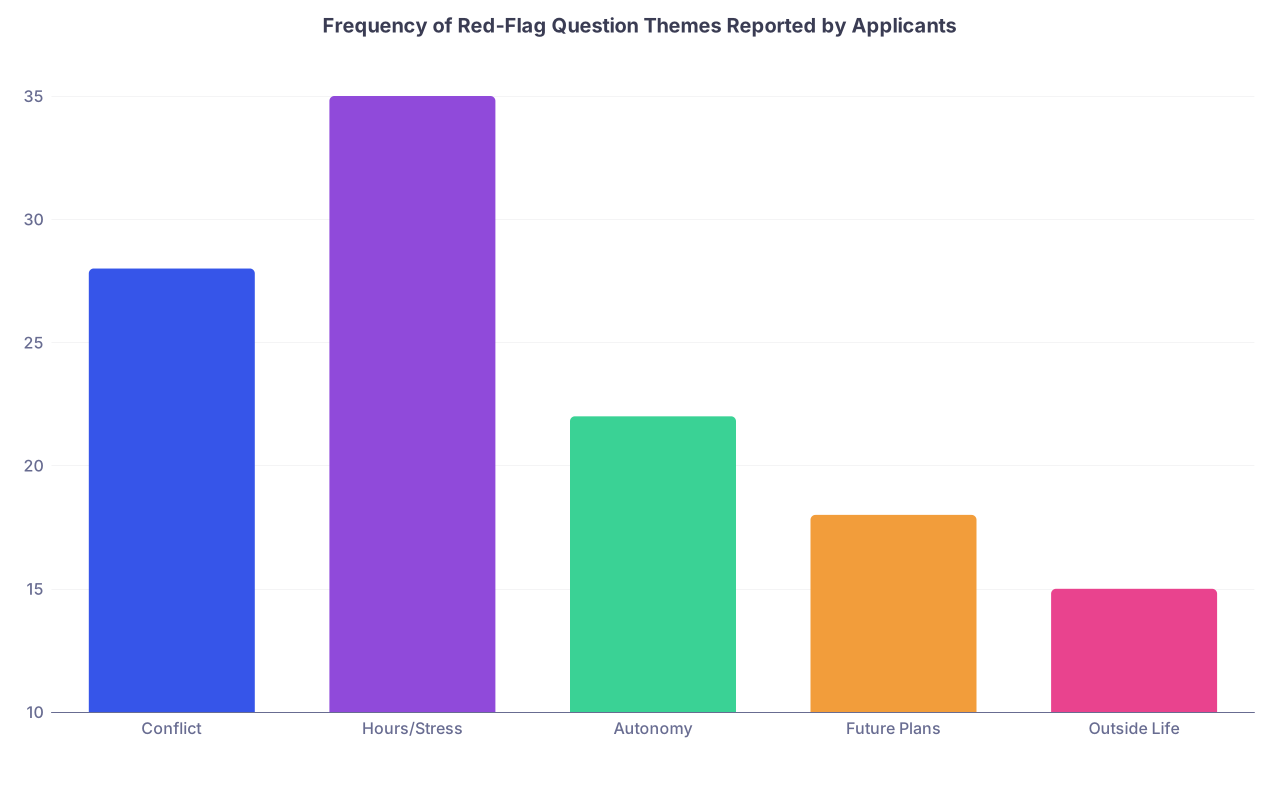
| Category | Value |
|---|---|
| Conflict | 28 |
| Hours/Stress | 35 |
| Autonomy | 22 |
| Future Plans | 18 |
| Outside Life | 15 |
You’re not just there to be interviewed. You’re there to collect data. Every question is a tiny piece of their self-portrait.
10. The resident-only truth filter
Here’s what people outside do not realize: PDs can spin. Websites can spin. Residents, when you get them alone and make it clear you’re not judging, are your only real truth serum.
Once you’ve heard the PD’s questions, you go to the resident lunch or pre-interview social and you say things like:
- “I got a couple of questions about conflict. Is that something residents struggle with here?”
- “They talked a lot about autonomy at night. Do you feel supported when things get hairy at 3 a.m.?”
- “How often are you actually hitting 80 hours? Do you feel pressure not to log honestly?”
- “They seemed interested in people staying here. Have many people transferred out?”
The resident reaction is everything. If they look at each other before answering, if someone changes the subject, if one person later pulls you aside and says, “Off the record…”—listen.

Sometimes you’ll get this exact line: “It’s a great place to train… but it’s not for everyone.” That phrase, in PD-speak and resident-speak, is code for “There are serious tradeoffs.” Your job is to figure out whether you’re willing to pay them.
11. How to protect yourself without tanking your chances
You can spot these red flags without setting yourself on fire in the process.
A few principles:
You answer professionally. You show you can handle feedback, work hard, function on a team. You don’t announce, “I will escalate everything to GME.” You don’t lie, but you also don’t foolishly volunteer that you’ll be their internal whistleblower.
At the same time, you are running your own interview:
- You track patterns in their questions.
- You verify with residents in unsupervised spaces.
- You reach out to recent grads on LinkedIn or by email and ask, “Would you choose this program again?”
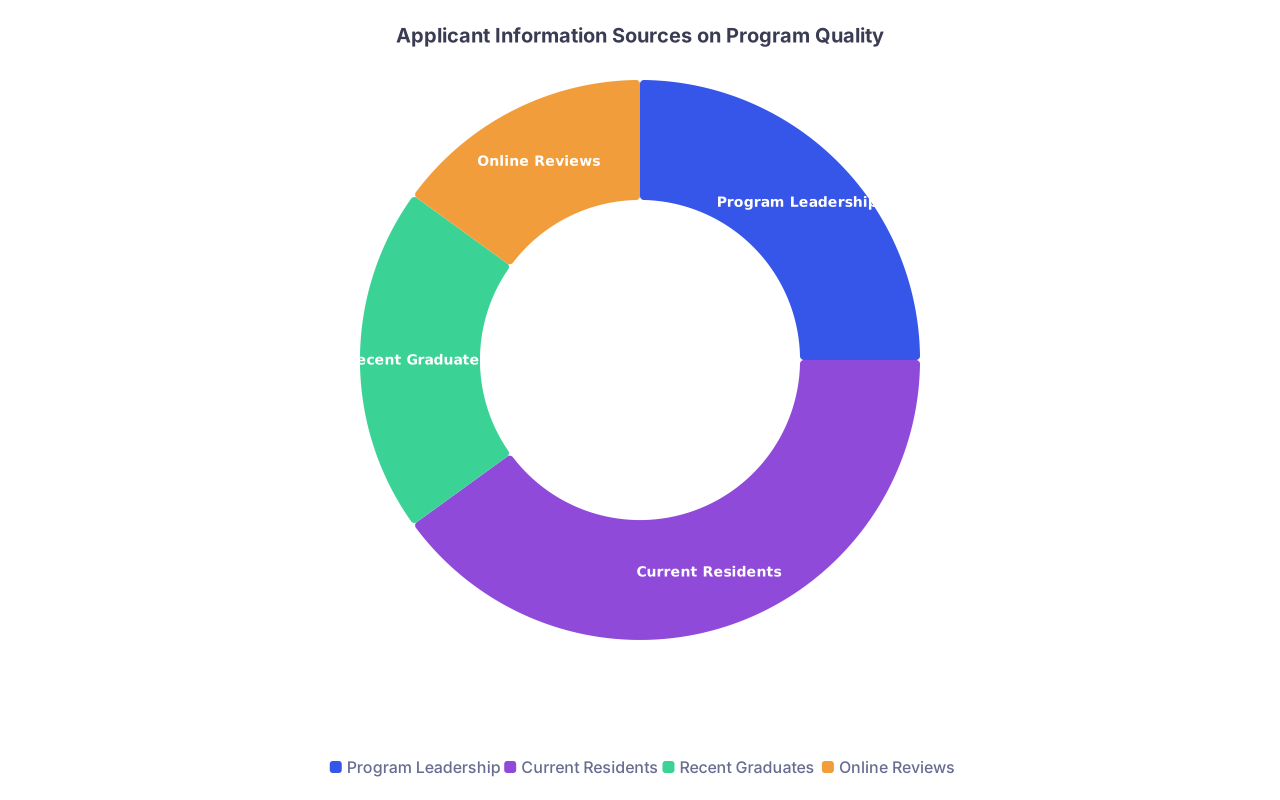
| Category | Value |
|---|---|
| Program Leadership | 25 |
| Current Residents | 40 |
| Recent Graduates | 20 |
| Online Reviews | 15 |
And you remember this: programs that are actually excellent do not need to push you so hard on whether you will tolerate suffering. They’re too busy showing you their teaching, their graduates’ success, their supportive culture.
When a PD spends more time asking, “Will you survive us?” than, “Here’s how we’ll grow you,” believe what they’re really telling you.

The bottom line
Three things to carry into every interview:
- The questions they keep asking you are a mirror of their biggest problems—conflict, hours, supervision, mentorship, culture. Track the patterns.
- Any time a question feels more like, “Will you put up with this?” than, “How can we help you grow?” you’re staring at a program weakness.
- Residents and recent grads are your reality check; use the PD’s questions as a roadmap for what to press them on when no one from leadership is listening.