The biggest red flags in residency applications don’t appear on ERAS. They walk in the door with you during pre‑interview visits. And they get remembered.
Most applicants think pre‑interview “meet and greets,” open houses, and second‑look type visits are low‑stakes. They’re not. They are unrecorded auditions. People on the selection committee take mental notes, then bring them to the ranking meeting. I’ve watched an otherwise strong applicant get quietly dropped 20+ spots on the rank list based entirely on what happened at an “informal” pre‑interview event.
Let me walk you through what program directors, chiefs, and faculty actually see as major red flags during those visits—stuff nobody writes on the website, but that absolutely shifts your fate.
The Myth of “Informal” – Why These Visits Really Matter
Here’s the truth: there is no such thing as “informal” once you’re in front of people who can vote on your rank.
At many programs, the pre‑interview dinner or virtual open house is where they answer one key question:
“Would I want this person on my team at 2 a.m. when things are falling apart?”
Scores, publications, class rank—they fade into the background. On these visits, your behavior becomes the data.
At a large IM program I know, the PD starts the ranking meeting by asking the chiefs: “Who did you hate at the dinner?” They don’t sugarcoat it. They name names. Those names get an asterisk before anyone talks about Step scores.
Another surgical program I’ve worked with literally has a separate list: “No‑Fly List = Do Not Rank.” That list rarely comes from the interview alone. It’s built from what residents and faculty notice during these pre‑interview and “get to know us” touches.
So what actually gets you on that list?
Social and Professional Red Flags You Don’t Realize They’re Tracking
1. Treating Residents Like Background Noise
This one is fatal.
If you are warmer, more attentive, and more respectful to the program director than to the residents, they see it. And they talk about it.
Common patterns that set off alarms:
- You spend the entire dinner hovering near faculty and ignore the PGY‑1s and 2s.
- You ask residents only superficial questions (“What’s the call schedule like?”) and then immediately pivot back to attendings.
- You visibly “check out” when the only people at your table are interns.
What PDs infer:
You’re a climber. You respect hierarchy more than teamwork. You’ll be the resident who kisses up and kicks down.
I’ve watched this play out. A strong applicant at a top‑tier anesthesia program charmed the PD, laughed with the APD, and barely acknowledged the CA‑1 sitting next to him. Next morning, during debrief, the PD said, “I really liked him.” The chief just stared at him and said, “We didn’t.” Guess whose opinion carried the day.
2. Being a Different Person With Different Audiences
Residents are extremely good at spotting code‑switchers. Not in the healthy, adaptive sense— in the “I act nice to people above me and dismissive to people below me” sense.
Red-flag behaviors:
- You’re warm, engaged, and smiling with faculty. With staff in the clinic (nurses, MAs, unit secretaries), you’re curt or aloof.
- You’re highly professional in the formal Q&A, then crude or cynical at the “more casual” social after.
- You drop the “future colleague” act the minute you think nobody who “matters” is watching.
Here’s the part you don’t see: the PD will go out of their way to ask nurses and staff, “What did you think of the applicants?” The unit clerk who says, “That tall guy in the gray suit didn’t even say hello,” can sink you.
If your personality changes when you think the room doesn’t count, you’re playing with fire. People notice the discrepancy more than they notice either version of you.
Behavioral Toxicity: The Stuff That Gets You Blacklisted
3. Subtle Entitlement and “I Deserve” Energy
You don’t have to say, “I deserve this spot” out loud. They can feel it.
Pre‑interview visits are rife with these micro‑moments:
- Commenting that you’re “also holding an invite” from a bigger‑name program in a way that feels like a flex.
- Asking questions that sound less like curiosity and more like evaluation: “How does your fellowship match compare to [prestige program]?” while making a face.
- Suggesting you’re “concerned” about the volume, acuity, or name recognition in a patronizing tone.
The red flag isn’t that you ask comparative questions. It’s the vibe that you’re doing the program a favor by being there.
One PD I know keeps a handwritten note from a resident social: “Applicant C – eye roll when told we don’t have ECMO yet.” They did rank him. Very low. And they still joke about the ECMO eye‑roll guy years later.
4. Inappropriate Humor and “Testing the Line”
There’s always one person at every pre‑interview gathering who decides they need to show they’re “chill” or “one of the team” by being edgy.
Examples I’ve personally seen:
- Applicant making a “dark humor” joke about an ICU death in front of a fellow who had just lost a patient that week.
- Applicant using slang about patients (“frequent flyer,” “drug seeker”) to impress residents who they think talk like that behind closed doors.
- Applicant making a sexual innuendo about call room situations trying to be funny.
What you think: I’m showing I can hang.
What they think: This person has terrible judgment and I can’t put them in front of my patients or my students.
Residents will forgive you for being quiet. They won’t forgive you for being gross.
5. Alcohol Missteps
Let me spell this out very clearly: you are never off the record around program staff or residents during recruitment season. Ever.
Major red flags with alcohol at dinners or social events:
- Ordering multiple drinks when everyone else is nursing one.
- Getting noticeably louder, looser, or more handsy.
- Sharing “war stories” that involve alcohol or partying as the punch line.
One EM program director told me straight: “If a candidate loses track of their filter after one drink, they’re off the list. I don’t need to see them after three.”
You don’t need to be a teetotaler. You do need to be boringly controlled. If you’re not sure? Order club soda with lime and let people assume it’s something else.
Communication Red Flags: How You Talk Gives You Away
6. Constantly Centering Yourself in Every Conversation
There’s a particular applicant archetype: high‑achieving, very polished, and incapable of asking a question that isn’t really about themselves.
You know the type:
Resident: “Our ICU months are pretty heavy, but we get a lot of responsibility.”
Applicant: “Yeah, on my sub‑I I basically ran the unit by myself at times…”Faculty: “We’re building up our quality improvement work.”
Applicant: “That’s perfect actually because my QI project was selected for a big conference and I…”
Everything is a segue back to their CV. It’s exhausting.
Faculty phrase it politely: “A bit self‑focused.”
Residents phrase it honestly: “I don’t want to be on nights with that person.”
Programs are looking for people who can listen, be curious, and respond like a human, not a walking personal statement.
7. Complaining About Your Current Program or Colleagues
This is one of the fastest ways to get labeled toxic.
Red-flag phrases we hear way too often:
- “My school just doesn’t care about students.”
- “Honestly, the residents where I rotated were pretty lazy.”
- “Our attendings are kind of malignant.”
You think you’re building rapport by venting about a shared enemy—”training is tough, we can bond over how bad my med school is.”
What the PD hears: “You will say the same about us in two years. Probably publicly.”
Every program has flaws. Mature applicants can talk about them without trashing individuals. The line is actually pretty clear if you stop and listen to yourself.
Professionalism & Judgment: The Quiet Deal‑Breakers
8. Oversharing or Getting Too Personal Too Fast
There’s a boundary problem that shows up a lot in pre‑interview visits. Not malicious. But concerning.
Examples:
- You share deep personal trauma with a resident you met 10 minutes ago in a loud bar because they asked, “What got you into medicine?”
- You monologue about how burnt out and depressed you are right now in a way that makes people question your stability and support.
- You go into excruciating detail about a contentious professionalism incident, blaming everyone else.
Let me be blunt: vulnerability is fine; lack of containment is not. If you’re still in the middle of the fire, people worry about how you’ll handle intern year.
A PD once said during ranking: “I don’t doubt their story. I just don’t think we’re the right environment for someone that fragile right now.” That’s code for: too big a risk.
9. Being Weirdly Transactional About Letters, Research, or Connections
Here’s something most applicants don’t realize: pre‑interview touches are partly about seeing whether they want to invest in you long‑term.
Red flags:
- Asking a faculty member on a pre‑interview visit whether they’d be willing to write you a letter before you’ve worked with them.
- Pushing hard for research opportunities right there (“Could I maybe join that project? I have experience and need more pubs.”).
- Name‑dropping connections and asking if they “help your chances here” in a way that sounds manipulative.
Everyone knows this is a game. But when you say the quiet part out loud too explicitly, it rubs people the wrong way. There’s a difference between being ambitious and being transactional. Programs prefer the former.
Fit Red Flags: When Your Story and Your Behavior Don’t Match
10. Saying One Thing on Paper, Showing Another in Person
Program directors spend time reading your application before they see you. They’re looking for consistency.
Red flag patterns:
- Your personal statement screams “I am deeply committed to underserved, urban populations,” but at the visit you complain repeatedly about safety, rough neighborhoods, or “difficult” patients.
- You write about loving teamwork, then visibly isolate yourself at the social and don’t engage with your potential class.
- You emphasize your interest in academic medicine, then show zero curiosity about teaching, conferences, or scholarly activity when you’re actually there.
Residents are ruthless about this mismatch. At one midwestern program, an applicant sold themselves as obsessed with primary care for immigrants, then rolled their eyes when someone asked about their continuity clinic population. That person got absolutely shredded in the resident debrief.
11. Acting Like the Program Is Your “Backup” in Front of Them
You may have a dream specialty, city, or program. They know that. What they won’t tolerate is having it shoved in their face.
Red flags:
- Telling people outright, “I really want to be on the West Coast eventually, but I figured I’d check things out here too.”
- Admitting you’re “keeping options open” between an entirely different specialty and theirs in a way that makes it clear they’re second choice.
- Mentioning six times that your partner is at “X prestigious institution on the other side of the country” and you’re hoping to be there next year.
Programs don’t expect you to swear undying loyalty. But they don’t want to feel like a consolation prize. At ranking time, those “maybe they’ll bail on us” concerns hurt you, especially at smaller programs.
How Programs Actually Use This Information
Let me show you how this plays out in the real mechanics of selection.
At many places, there’s some version of this:

| Step | Description |
|---|---|
| Step 1 | Pre interview visit |
| Step 2 | Resident impressions |
| Step 3 | Faculty impressions |
| Step 4 | Do not rank or drop down |
| Step 5 | Normal interview day |
| Step 6 | Ranking meeting |
| Step 7 | Any major red flag |
I’ve sat in those ranking meetings. Stories from pre‑interview visits alter the trajectory.
- Applicant A: Stellar scores, strong letters, okay interview. Residents: “They were kind, asked good questions at the social, helped a nervous applicant feel included.” → Rank moves up.
- Applicant B: Strong on paper, slick in formal setting. Residents: “Disrespected staff, weird comments about our city, braggy about other offers.” → Rank plummets or gets a quiet “DNQ” (do not qualify).
Sometimes programs even formally track this stuff.
| Program Type | How Feedback Is Used | Impact on Rank |
|---|---|---|
| Large university IM | Structured resident survey after socials | Can drop 10–20 spots |
| Mid‑size community | Informal group discussion with PD | “No” from residents often fatal |
| Competitive surgical | Chiefs submit written notes | Single serious red flag → Do Not Rank |
| Smaller regional | PD directly asks staff and nurses | Negative staff feedback heavily weighted |
And yes, they remember specifics.
I’ve heard PDs two years later refer to someone as “the guy who interrupted the nurse three times while asking me about fellowships.” That’s how sticky these impressions are.
What You Should Actually Do During Pre‑Interview Visits
You wanted red flags; I’ve given you the ugly list. Now, briefly, how to avoid being that story.
Focus on three things:
Be the colleague people want on call.
Calm. Respectful. Slightly self‑deprecating. Curious. You don’t need to be the loudest, smartest, or funniest. You do need to be decent.Remember everyone can talk to the PD.
Residents. Nurses. Fellows. The coordinator who checked you in. The person replenishing coffee in the conference room. Assume they all have a vote, because their opinions will reach someone who does.Stay consistent with your written story.
If you sold yourself as mission‑driven, act like someone who actually cares. If you say you love teaching, show interest when someone mentions med students. Don’t rebrand yourself on the fly because the vibe is different than you expected.
To blunt the anxiety: most applicants are fine. They’re awkward, a little tired, sometimes quiet—but fine. That’s not a problem. Programs don’t need perfect. They need “not a risk.”
If you stay out of the red‑flag zones we’ve walked through, you’re already ahead of more people than you think.
, Complaining about others, Alcohol issues](https://cdn.residencyadvisor.com/images/articles_svg/chart-common-pre-interview-red-flags-reported-by-residen-7423.svg "Common Pre Interview Red Flags Reported by Residents")
| Category | Value |
|---|---|
| Disrespect to staff | 28 |
| Arrogant vibe | 24 |
| [Inappropriate jokes](https://residencyadvisor.com/resources/residency-program-red-flags/common-red-flags-applicants-ignore-on-interview-day-and-regret-later) | 18 |
| Complaining about others | 16 |
| Alcohol issues | 14 |

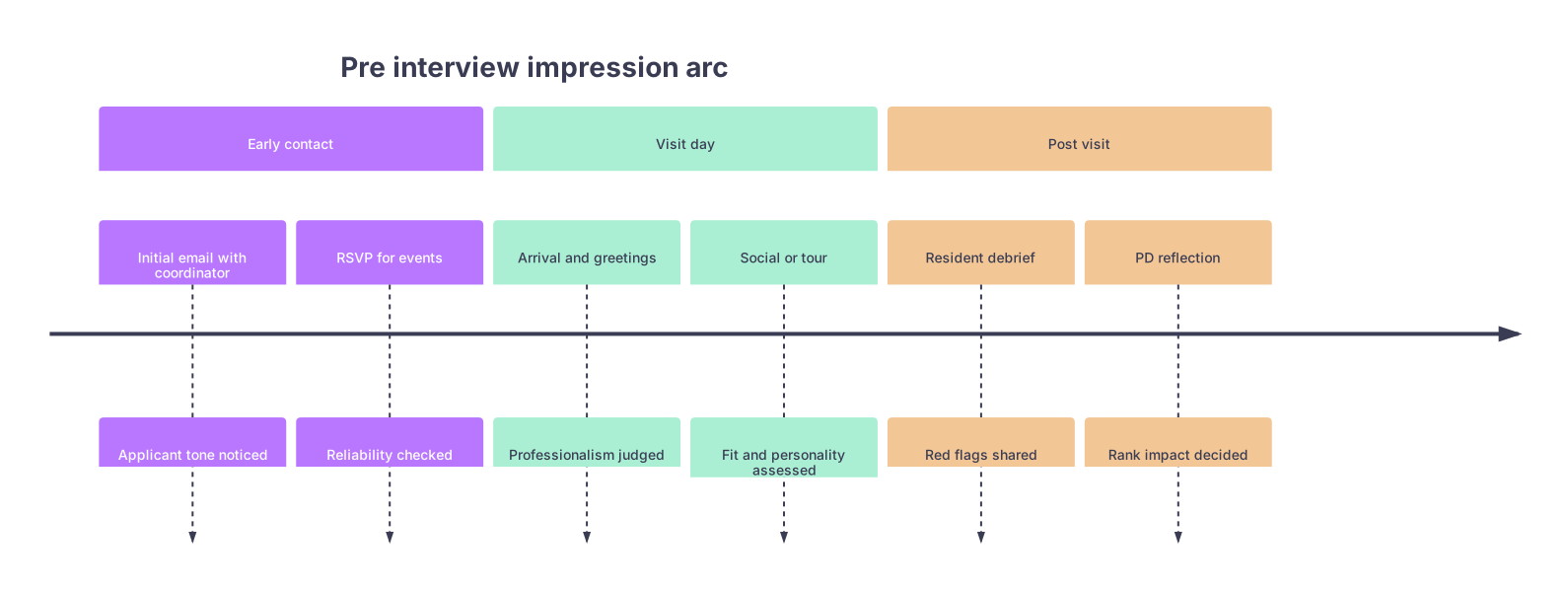
| Period | Event |
|---|---|
| Early contact - Initial email with coordinator | Applicant tone noticed |
| Early contact - RSVP for events | Reliability checked |
| Visit day - Arrival and greetings | Professionalism judged |
| Visit day - Social or tour | Fit and personality assessed |
| Post visit - Resident debrief | Red flags shared |
| Post visit - PD reflection | Rank impact decided |