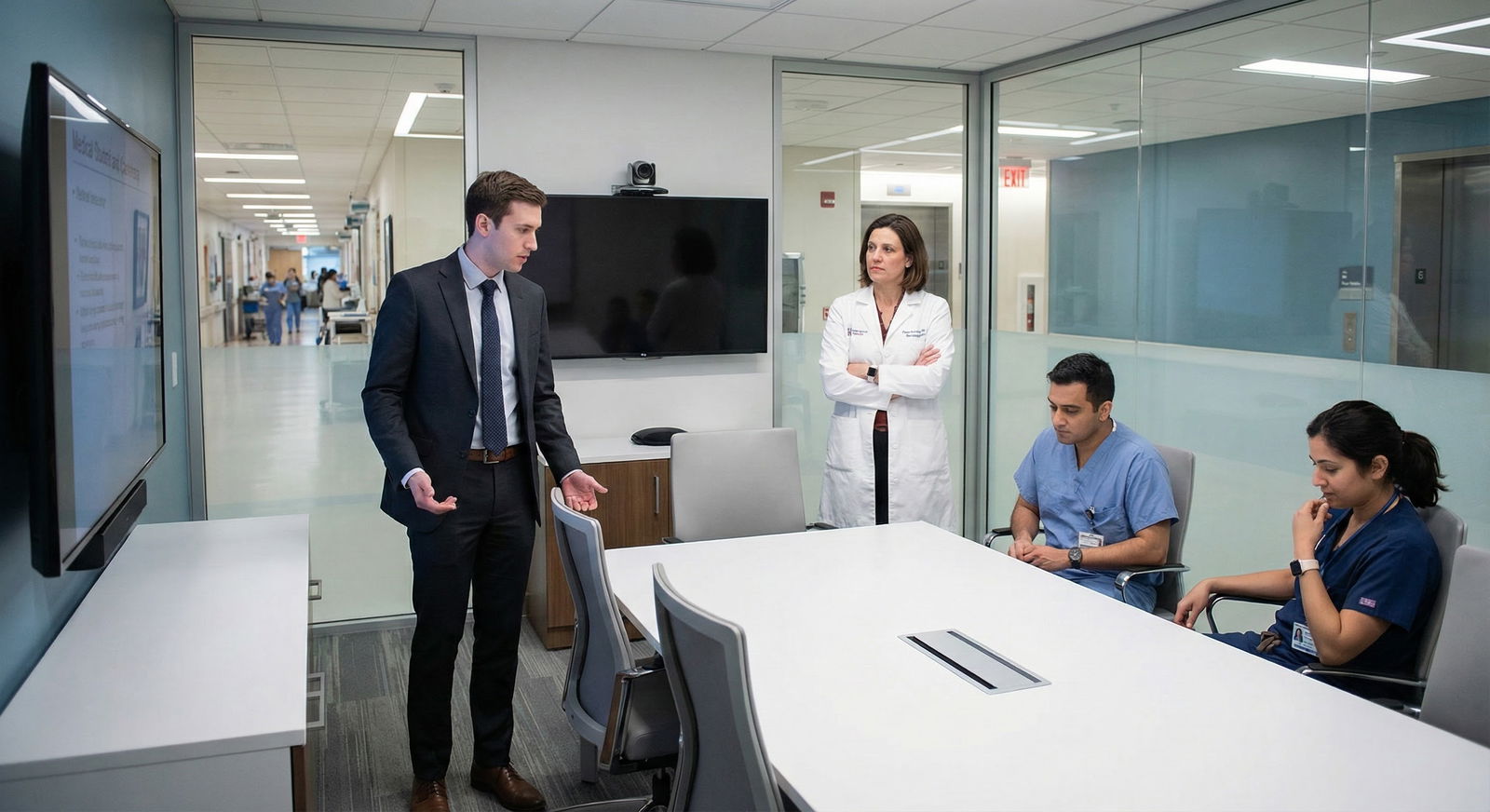
It’s a Wednesday afternoon. You’ve just finished a virtual “open house” with a residency program. The PD was polished, the slides were slick, the residents all said the same line about “we’re like a family.” On paper, it looks perfect.
But your gut is nagging you. Something felt…off.
Let me decode that feeling for you, because what you sensed is real. There are culture red flags that no program director will ever admit in public, no matter how much they “value transparency.” I’ve heard how they talk when you’re not in the Zoom room. I’ve sat in meetings where they strategize which problems they can safely hide for one more recruitment cycle.
You’re about to see what actually goes on behind that brochure.
The Scripted Resident
You log onto the interview social. Six residents show up. They all say nearly identical lines:
“We work hard but we’re supported.” “Everyone is so nice.” “Administration really listens to us.”
You ask a slightly uncomfortable question: “What’s something that could be better about the program?” Suddenly the energy shifts.
One resident cuts in: “Oh, just the parking situation haha.” Another: “Yeah, I honestly can’t think of anything big.”
Let me translate that. They’ve been coached.
Most programs do some version of resident prep before interview season. There’s normal, reasonable prep: “Please don’t violate HIPAA, don’t talk about specific co-residents, be professional.” Fine.
Then there’s what I’ve actually heard in closed-door meetings:
- “Do not bring up the call schedule change; it’s still in flux.”
- “If someone asks about X attending, just say ‘we get a wide range of teaching styles.’”
- “Avoid discussing last year’s ACGME citation unless pressed.”
At a toxic program, residents know very clearly which topics are radioactive. They’ve seen what happens to the one resident who spoke too freely the previous year and “somehow” got the worst rotations the next schedule cycle.
What you should look for
You want divergence. Imperfect, unscripted answers. One resident saying, “Our night float is rough, I’m not going to lie, but they’ve actually changed X and Y after our complaints.” Another saying, “Our EMR is awful. We all hate it, but we work around it.”
If every answer feels like it came from the same Google Doc, the culture is not safe. People in a healthy program don’t sound like PR agents.
The “We’re a Family” Lie
“Here, we’re like a family.”
Programs love that line. It sounds warm. Supportive. Human.
Inside a lot of places, “we’re a family” really means: blurred boundaries, guilt-based coverage, and an expectation that you’ll silently absorb dysfunction for the good of the group.
I’ve heard chiefs say to a resident who pushed back on staying late for an uncovered shift: “Everyone’s tired. We’re all sacrificing. Be a team player.” That’s the “family” talking. And that resident never spoke up again.
Healthy vs. unhealthy “family” culture
Let me put this in a simple comparison, because this trips up applicants all the time.
| Aspect | Healthy Program | Toxic Program |
|---|---|---|
| Coverage | Clear policies, backup jeopardy | Guilt, last-minute pressure |
| Boundaries | Time off respected | Days off routinely encroached |
| Feedback | Safe to disagree | Disagreement = disloyalty |
| Conflict | Addressed directly | Buried, then punished quietly |
| Burnout | Acknowledged and acted on | Labeled as weakness |
In a healthy place, people say “we’re a family” but also happily talk about their lives outside the hospital. They have hobbies. They have boundaries.
In a bad place, attendings say “we’re a family” right before they dump extra clinic sessions on you.
Trust behavior, not branding.
How PDs Talk When You’re Not in the Room
Let me tell you what actually gets said in those debrief meetings after interview days.
I’ve heard:
- “That applicant asked too many questions about wellness. Probably not a good fit.”
- “She seems very… boundary-conscious. Might not tolerate our call schedule.”
- “He kept bringing up work-life balance. This is not a 9-to-5 specialty.”
Now, they won’t put this in any email. You’ll never hear it on a recorded session. But this is exactly how some programs protect their culture: they filter out anyone who might resist it.
Watch for the subtle tells during your interaction with leadership:
- When you ask about wellness or duty hour enforcement, does the PD get slightly defensive or sarcastic?
- Do they reframe your question like you’re fragile? “Well, you know this is residency, not a spa.”
- Do they pivot quickly to “our residents are tough” or “we work hard here” without answering the actual question?
That’s them telling you: the culture is not changing. You will.
The “We Listen to Residents” Myth
Almost every program flashes some slide about “resident-driven change.” Town halls. Anonymous surveys. Open-door policy. The usual.
I’ve watched this play out from the inside. There are three real models.
Model 1: Performative Listening
They run surveys because the ACGME expects it. They skim the comments. They fix trivial things (snacks, new chairs) and ignore systemic problems (abusive attendings, unsafe workloads).
When a recurrent problem shows up for the third year in a row, someone in leadership says, “Residents always complain about that. It’s just a generational thing.”
That phrase—“generational thing”—is a culture red flag. Translation: “We have no intention of changing.”
Model 2: Controlled Listening
They let you speak. They even let a few cosmetic changes through.
But the real decisions—call schedules, service structure, how many patients per resident—they happen in meetings you will never be invited to.
If a chief resident tries to push too hard, they get labeled “difficult” and mysteriously lose institutional support. I’ve watched chiefs graduate with attendings quietly warning each other, “Don’t hire them—always causing trouble.”
Model 3: Actual Listening
This is rare, but it exists.
You’ll recognize it by specifics:
“We used to have 28-hour calls, but residents were drowning. We changed to night float in 2021 after multiple resident proposals. It took a year and a half, but it happened.”
Or: “Our continuity clinic was brutal. So residents designed a new template and leadership implemented it last year. Still not perfect, but way better.”
Programs that truly listen can give concrete examples: year, problem, change. If all they have is generic “open-door policy” language, assume it’s performative.
The Hidden Metric: How They Talk About Graduates
Listen very carefully when faculty talk about previous residents. This is where the mask slips.
I’ve heard attendings refer to graduates as:
- “She was… emotional.” (Translation: She refused to be gaslit.)
- “He was not a team player.” (Translation: He said no when being exploited.)
- “They struggled with professionalism.” (Translation: They tried to set boundaries.)
If every story about a resident who pushed back is told as a cautionary tale, that’s your warning. Program culture is enforced socially, not on paper.
A strong, healthy program will tell stories like:
- “We had a resident who challenged our workflow, and to be honest, they were right—we were creating unnecessary busy work.”
- “One of our seniors burned out hard. It forced us to look at our ICU rotations and change things.”
That’s how you know they’re at least capable of growth, not just punishment.
Pay Attention to the Rotations They Gloss Over
There is always a rotation or site they don’t want to talk about.
The county hospital with chronic understaffing.
The private hospital where residents function as free labor for a hostile attending group.
The “rural site” that’s essentially three months of being overworked, under-supervised, and far from support.
On virtual Q&A, if you ask, “What’s your toughest rotation and how is it supported?” and the answers get vague, you’ve just hit a nerve.
Programs that own their flaws will say, very directly:
- “Our trauma nights are brutal. We offset that with post-call protected days and lighter clinics the following week.”
- “Our county wards can be overwhelming. We capped teams at X patients and added extra APP support after residents flagged safety concerns.”
Programs that are hiding something will say:
- “Yeah, that site is… busy. But you’ll learn a lot!”
- “It’s definitely a growth experience. Our residents come out very strong.”
Busy. Growth experience. Strong. Those are euphemisms for miserable.
Data They Will Never Put on the Website
No program is putting the following on their homepage, but you should absolutely be thinking about it:
- How many residents quietly go part-time, extend training, or take “research” years because they’re burning out.
- How many residents try to transfer out after PGY-1.
- How many residents have been on formal remediation or probation in the last five years.
- How many anonymous ACGME complaints have been filed.
I’ve watched PDs spin these numbers like pros.
“I wouldn’t say we have high attrition; occasionally we have residents who realize they want to be closer to family and transfer.”
Right. After they have panic attacks on call for six months.
You’re not going to get hard numbers on most of this. But you can triangulate.
Ask residents privately: “Has anyone transferred out in the last few years?”
If they pause just a little too long. If they say, “Yeah, but it was complicated,” and then clearly do not want to talk about it—something happened.
What Resident Burnout Really Looks Like from the Inside
Everyone claims to care about burnout now. Most of it is lip service.
I’ve seen real burnout up close. It does not look like someone saying “I’m a little tired” with a smile. It looks like:
- Residents showing up sick because they’re terrified of the fallout if they call out.
- People crying in stairwells and then wiping their face and going back to pre-rounds.
- PGY-3s telling PGY-1s, “Don’t report that, it’ll just make your life harder.”
PDs and chairs will confidently tell you, “Our residents are happy.” What they mean is, “Our graduation rate is acceptable and no one has gone fully nuclear to the ACGME this year.”
If you’re on-site and you get a hallway moment with a resident, watch their face when you ask, “How are you really doing?” Some will toe the line. Occasionally, someone will look down, exhale, and say, “It’s… a lot.”
That “a lot” is your most honest data point.
Future of Medicine: Why This Culture Stuff Is Going to Get Worse Before It Gets Better
You’re entering residency at a time when medicine is in full-on identity crisis. Reimbursement is dropping. Volume targets are going up. Documentation demands keep multiplying.
Program leadership is getting squeezed from above, and they turn around and squeeze you. Quietly.
Here’s the uncomfortable truth many PDs acknowledge off the record: for a lot of hospital systems, residents are cheap labor holding together unsafe systems. Fixing culture requires sacrificing some of that “value.” Administration does not love that.
There are three directions programs are drifting:
Extraction Programs
Squeeze maximum work out of residents, sell it as “rigorous training,” keep recruitment shiny enough to maintain the pipeline. These will lean on “we work hard, we’re intense, we produce strong graduates.”Survival Programs
They know things are bad. Leadership is not malicious, just overwhelmed and politically weak. They patch what they can, spin what they can’t.Reform Programs
Still minority. Usually driven by a very strong PD or chair who’s willing to irritate the C-suite. They push for caps, real mental health support, honest feedback cycles, even if it costs RVUs.
You want to train in category 3, or at least the top end of category 2. Category 1 will chew you up and brag about how “resilient” you are.
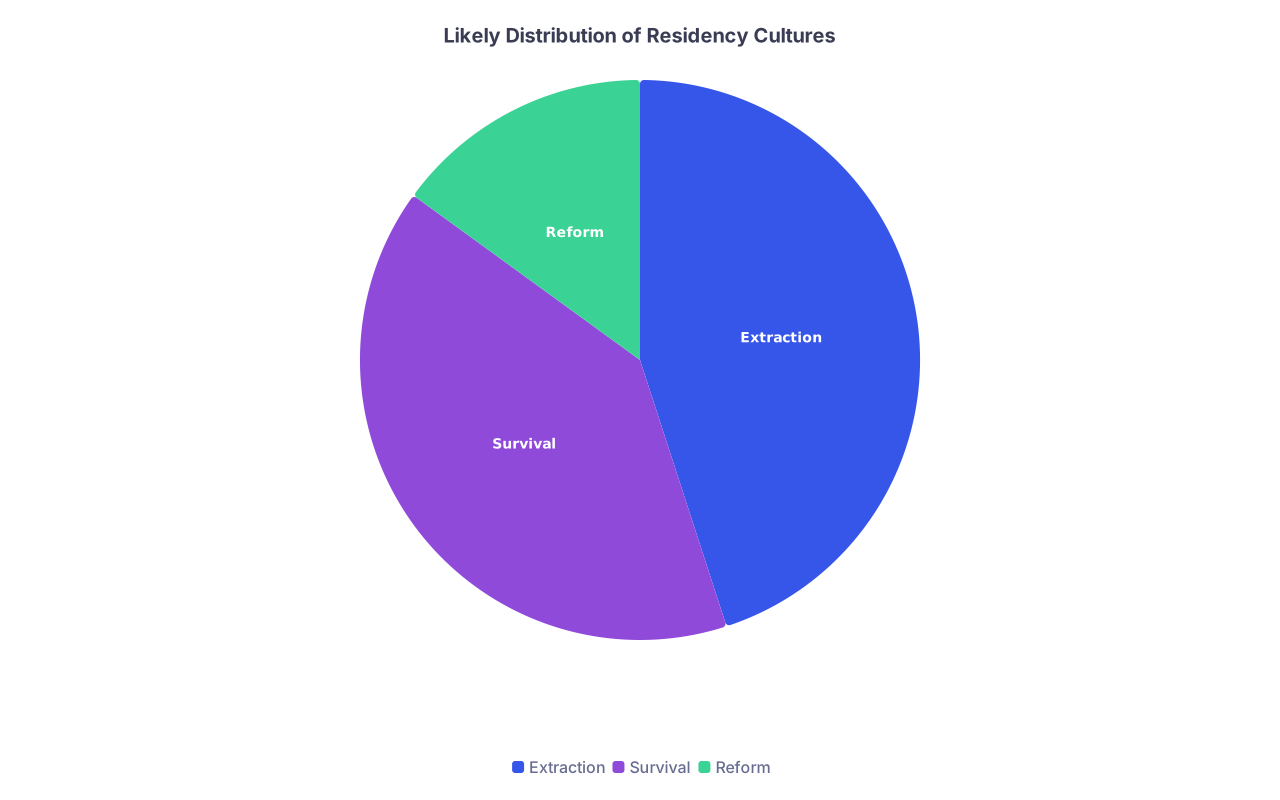
| Category | Value |
|---|---|
| Extraction | 45 |
| Survival | 40 |
| Reform | 15 |
No one will admit which category they’re in. But you can infer it from how they respond to hard questions, how often they say “RVUs,” and whether they brag more about their case numbers or their graduates’ well-being.
Concrete Questions That Force the Mask to Slip
You can’t ask, “Are you toxic?” and expect an answer. But you can ask questions that are very hard to fake without revealing something.
Use a few of these, and watch answers carefully:
- “Tell me about a time resident feedback led to a major change in the program. What changed, and over what timeframe?”
- “What’s the hardest part of being a resident here that applicants might not appreciate from the outside?”
- “What’s something your residents are unhappy about right now?”
- “When a resident is struggling—clinically or emotionally—what actually happens step by step?”
- “Have any residents transferred out or switched specialties from your program in the last 5 years? What did you learn from that?”
Good programs will have real, specific stories. Bad programs will either dodge or sanitize everything beyond belief.
The Off-the-Record Channel: How to Actually Get the Truth
Here’s the part no official guide will say out loud: you almost never get the real story on interview day. You get it in the backchannel.
You need at least one conversation with a current or recent resident who is:
- Not hand-selected by the PD for recruitment.
- Not on a zoom where faculty can “drop in.”
- Not obviously terrified of being overheard.
Ways people actually do this:
- Ask your med school alumni office for grads at that program and email them directly: “Can I ask you a couple candid questions, completely off the record?”
- Message residents on LinkedIn or social media with a short, respectful note. Some won’t answer. Some will tell you everything.
- During second looks or away rotations, find a safe moment: cafeteria, call room, walk between sites.
I have watched residents be brutally honest once they trust you’re not going to quote them to the PD. They’ll say things like, “Officially, yes, you can call in sick. Unofficially, you will pay for it later.”
That’s the intel you need.

| Step | Description |
|---|---|
| Step 1 | Official Brochure |
| Step 2 | Interview Day Messaging |
| Step 3 | Resident Social |
| Step 4 | 1-on-1 Off Record Chat |
| Step 5 | Real Culture Picture |
You’re not gaming the system. You’re just refusing to be the next naive PGY-1 walking into a buzzsaw.
FAQ (Exactly 5 Questions)
1. If residents look exhausted on interview day, is that an automatic red flag?
Not automatically. Residency is hard everywhere. What matters is how they talk about the exhaustion. If they say, “Yeah, it’s been a brutal week but they adjusted the schedule after we flagged it,” that’s very different from, “It’s just how it is here, you get used to it.” Persistent, normalized exhaustion with no path to improvement is the red flag.
2. Is it a bad sign if the PD doesn’t show up to the resident social or Q&A?
Not by itself. Some PDs intentionally give residents space to be candid. The problem is when faculty never step out of the room, cameras are always on, and residents clearly self-censor. Presence isn’t the issue—control is. If residents can’t speak freely even once, assume there’s something to hide.
3. How much should I worry about a program that recently had an ACGME citation?
Depends what it was and what they did about it. A program that says, “We had a citation for duty hours; here’s exactly what we changed and here’s the follow-up result,” may actually be safer than a program that quietly skates at the edge but never gets caught. The real danger is a program that denies, minimizes, or won’t discuss specifics.
4. What if I really like the program clinically but feel uneasy about the culture?
Then you’re seeing the trap clearly. You can get strong clinical training in more than one place. You get one body and one brain. If your gut is screaming now, it will be hoarse by the end of PGY-1. Lean toward programs where you feel both challenged and fundamentally respected. Skills are useless if you’re too burned out to use them.
5. Can a single bad attending ruin a good program?
They can make your life miserable on certain rotations, but they don’t define the entire culture. The real question is: how does leadership respond to them? If “everyone knows” Dr. X is abusive and nothing ever changes, that’s not a bad apple problem; that’s a rotten tree problem. A strong program isolates or removes toxic faculty instead of asking residents to absorb the damage.
Key points and then I’ll stop.
First, culture is not what’s printed on the brochure; it’s what residents say when no one from leadership is listening.
Second, any program can train you clinically. Not every program can let you graduate intact. Choose accordingly.